Summary
The gummy category is growing up fast—and it’s not just about nostalgia anymore. Today’s consumers want candy that delivers indulgence without compromise: lower sugar, cleaner labels, and even functional benefits. But reformulating gummies isn’t as simple as cutting sugar—it’s one of the most technically demanding challenges in confectionery. Whether you’re working with starch, gelatin, or pectin, each system comes with its own rules around structure, water activity, and texture. In this white paper, we break down how the market is shifting toward better-for-you formulations and what it really takes to succeed—replacing not just sweetness, but everything sugar does. From rare sugars and polyols to functional fibers and complete sweetness systems, Icon Foods helps formulators build gummies that perform as good as they taste.
Thom King, CFS, Food Scientist
Chief Innovations Officer, Icon Foods
The global gummy market is not static candy nostalgia; it’s a high-growth segment fueled by broadening use cases, from confections to functional supplements. Multiple market research forecasts put the compound annual growth rate (CAGR) for the gummy category solidly in the double digits over the next decade, with estimates ranging from roughly 10% to over 13% globally depending on the specific segment and time frame. For example, one authoritative projection shows the overall gummy market expanding at about a 13.2% CAGR through 2030, driven by demand for functional, fortified, and natural ingredient formats.
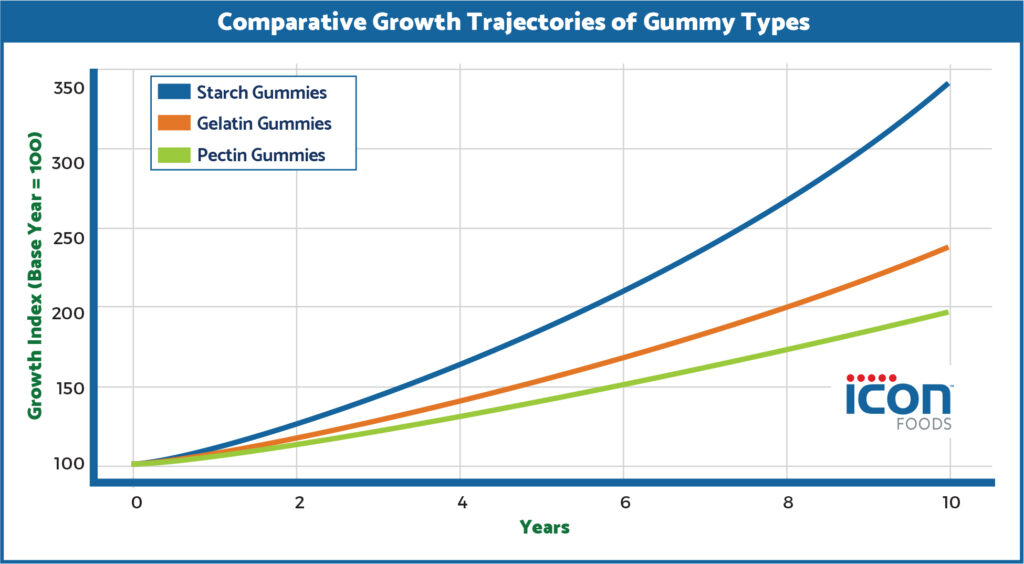
The above graph illustrates comparative compounded growth trajectories for starch, gelatin, and pectin gummies using a simple indexed model (base year = 100 over 10 years).
How to read it, no fluff:
- Starch gummies grow steadily but modestly. Mature, entrenched, operationally efficient, but not where innovation dollars are chasing growth.
- Gelatin gummies outpace starch due to texture preference and mainstream candy dominance, but growth is capped by animal-based constraints and clean-label friction.
- Pectin gummies bend the curve hard. That steeper rise reflects where the market is actually moving: vegan, functional, supplement-forward, clean-label gummies.
This is an illustrative CAGR model, not a claim that every SKU grows at these exact rates. The directional truth is what matters: pectin is the growth engine, gelatin is strong but constrained, starch is stable but legacy.
Gummies used to be a sugar delivery system dressed up as a bear. Corn syrup, gelatin, artificial colors, and a wink that said “don’t ask questions.” That era is over. Consumers want gummies that still feel indulgent but behave better in the body, the label, and the formulation spreadsheet. Lower sugar. Fewer calories. Cleaner labels. Functional benefits. And yes, still chewy, elastic, and craveable.
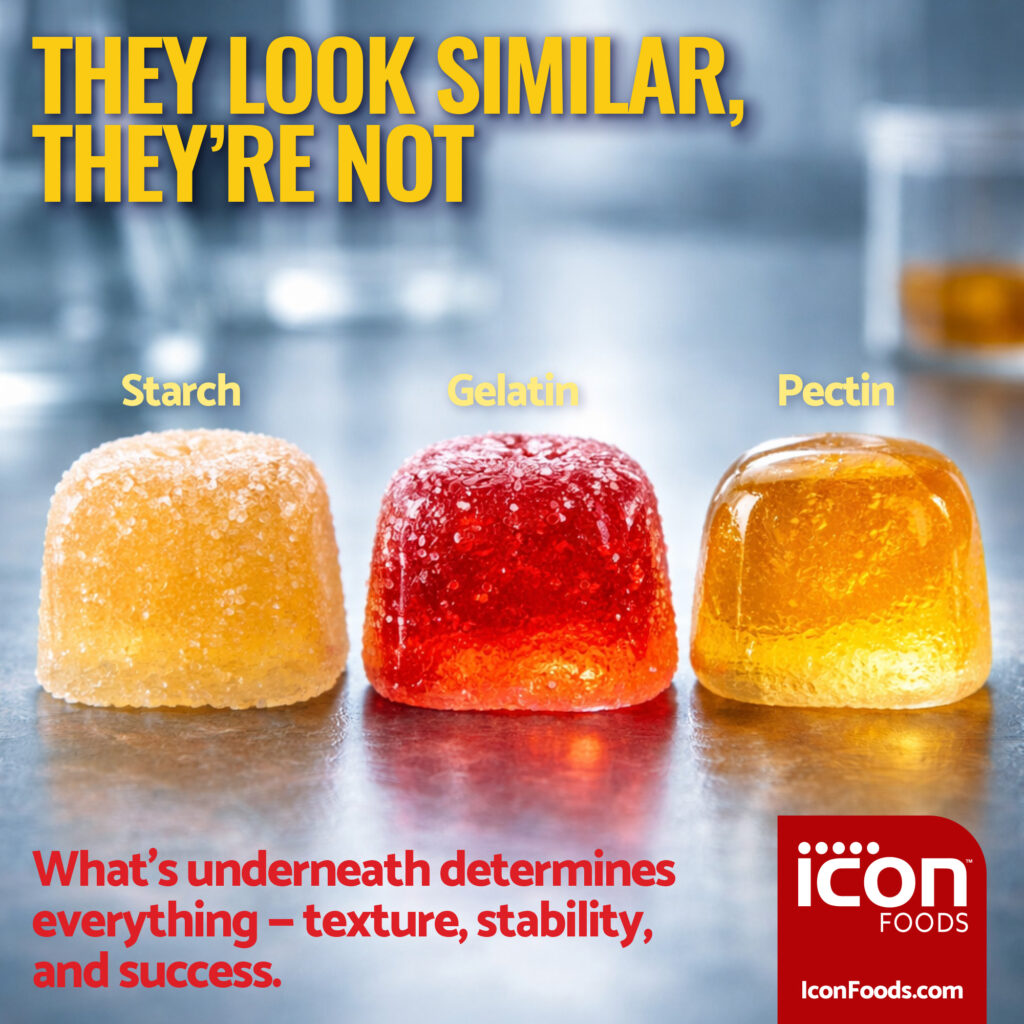
That’s a tall order. Gummies are one of the most technically demanding confectionery formats, and “better-for-you” turns the difficulty knob to eleven. The gelling system you choose sets the rules of the game. Everything else follows.
Let’s break down the big three: starch, gelatin, and pectin.
Starch Gummies: Old School, Still Relevant
Starch-molded gummies are the original industrial workhorse. You deposit a hot syrup into starch trays, let it set, dry it down, and de-mold. This system is forgiving, scalable, and well understood.
Pros
- Familiar process and equipment
- Broad flavor compatibility
- Good shelf stability when done right
Cons
- Traditionally very sugar-heavy
- Drying time is long and energy-intensive
- Texture depends heavily on solids and water activity
Better-for-you reality check
You can reduce sugar in starch gummies, but you can’t pretend sugar isn’t doing real work. It drives solids, structure, and set. Pull too much sucrose or corn syrup without replacing functionality and you get weeping, collapse, or sticky sadness.
This is where high intensity sweeteners, rare sugars, and fibers earn their keep. Allulose, maltitol, and soluble fibers can replace bulk, depress water activity, and maintain chew. But they have to be balanced carefully to avoid crystallization, laxation limits, or off-textures.
Gelatin Gummies: The Chew King
Gelatin gummies are what most consumers think of when they think “gummy.” Elastic. Bouncy. Melt-in-the-mouth. That signature chew is hard to beat.
Pros
- Superior elasticity and snap
- Fast set
- Excellent flavor release
Cons
- Animal-derived (not vegan, not always kosher/halal)
- Sensitive to heat and moisture
- Sugar reduction can wreck texture fast
Better-for-you reality check
Gelatin is incredibly efficient. You don’t need much to get structure, but it depends on sugar for body and water control. Drop sugar aggressively and gelatin gummies can turn rubbery, weak, or synerese like a bad science experiment.
Smart sugar reduction here leans on rare sugars like allulose, low-GI polyols, and soluble fibers that increase solids without killing elasticity. You’re formulating a matrix, not swapping ingredients one-for-one.
Pectin Gummies: The Clean-Label Darling
Pectin gummies are the fastest-growing segment in better-for-you confectionery. Plant-based, label-friendly, and compatible with vegan positioning.
Pros
- Vegan and consumer-approved
- Clean, fruit-forward bite
- Excellent for functional and nutraceutical gummies
Cons
- Acid and Brix sensitive
- Narrow processing window
- Sugar reduction is technically unforgiving
Better-for-you reality check
Pectin likes high solids and low pH. Traditional formulas rely heavily on sucrose and glucose syrup to hit the Brix needed for proper gelation. Pull sugar without replacing solids and the gel simply won’t form.
This is where allulose, soluble fibers, and carefully chosen polyols shine. Allulose contributes solids and freezing point depression without the glycemic hit. Fibers add bulk and structure. But formulation discipline is non-negotiable. Pectin does not forgive sloppy math.
So Where Does Icon Foods Fit?
This is the part where we stop talking theory and start talking solutions.
Icon Foods lives at the intersection of sweetness chemistry, bulk replacement, and process-ready systems. Better-for-you gummies are exactly where our toolbox matters.
Sugar Reduction Without Structural Collapse
- Allulose for sugar-like functionality with minimal glycemic impact
- Erythritol and maltitol to manage bulk, water activity, and sweetness
- Rare sugar and polyol blends tuned for gummy matrices
Fiber That Actually Works in Gummies
Not all fibers belong in candy. We focus on low-grit, highly soluble fibers that:
- Increase solids
- Improve chew and mouthfeel
- Support sugar reduction without clouding or graininess
Sweetness Systems, Not Single Ingredients
High-intensity sweeteners alone don’t solve gummies. They spike sweetness but contribute nothing to structure. Icon Foods builds layered sweetness systems that mimic sucrose’s curve, onset, and decay so gummies taste familiar, not engineered.
Formulator-First Thinking
We don’t sell fairy dust. We sell ingredients that behave in:
- High-Brix environments
- Acidic pectin systems
- Heat-sensitive gelatin processes
- Starch-molded production lines
That matters when you’re scaling from benchtop to commercial runs.
Better-for-you gummies are not about removing sugar. They’re about replacing what sugar actually does. Structure. Water control. Mouthfeel. Flavor delivery. Shelf stability. Starch, gelatin, and pectin each bring different constraints and opportunities. Th1ere is no universal solution, only smarter systems. Brands that win in gummies understand this and formulate accordingly.
This is why gummies are no longer a novelty category. They’re a proving ground. And if you can make a gummy that’s lower sugar, clean label, functional, and still craveable, you can formulate just about anything. Icon Foods is here for that fight.
When sugar comes out, everything else tends to fall apart—texture, stability, and consumer acceptance. Icon Foods replaces what sugar does, not just what it tastes like. The result is a better-for-you gummy that performs, scales, and sells.
Reach out to your Icon Foods representative for sweeteners, fibers and modulator, samples, documentation formulation and usage guidance.
Since 1999 Icon Foods has been your reliable supply chain partner for sweeteners, fibers, sweetening systems, inclusions and sweetness modulators.
Taste the Icon difference.
Order Samples of Our Sweeteners!