

Summary
RTD coffee has moved beyond convenience and into its second act: function-first formulation. Today’s bottled brews are expected to deliver protein for satiety, fiber for balance, adaptogens for focus, and low sugar without sacrificing drinkability. But coffee is a demanding matrix, acidic, polyphenol-rich, and unforgiving when sweetness or mouthfeel systems fall apart
Adding protein can destabilize texture. Fiber can expose viscosity flaws. Adaptogens amplify bitterness. Removing sugar strips body and balance. Success in modern RTD coffee is no longer about stacking trendy ingredients; it’s about systems thinking. Layered high-intensity sweeteners, precision sweetness modulation, fiber-supported mouthfeel, and processing-aware formulation must work in concert. When built intentionally, these systems preserve a coffee-first flavor while delivering the functional benefits consumers now expect. The next growth curve in RTD coffee will not be won by louder claims, but by better drinking.
Thom King, CFS, Food Scientist
Chief Innovations Officer, Icon Foods
Protein. Fiber. Adaptogens. And Where Smart Sweetening Finally Shows Its Hand
RTD coffee isn’t a novelty anymore, it’s infrastructure. A daily ritual wrapped in a bottle, now expected to fuel, stabilize, and support the body without wrecking blood sugar or blowing up the ingredient deck.
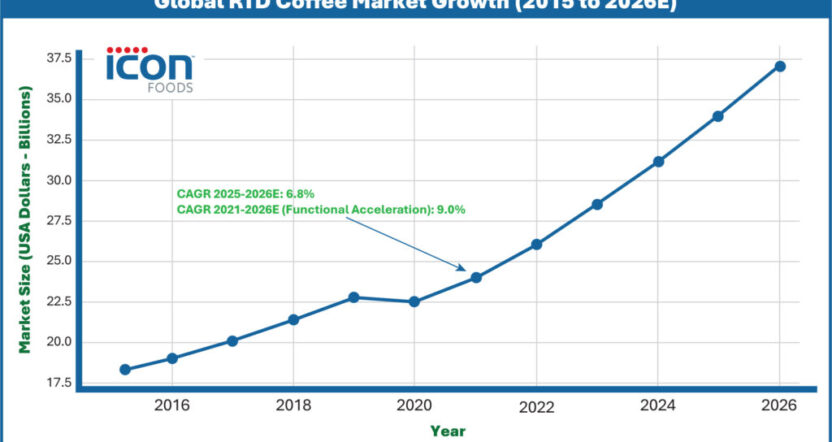
Assumptions used (clearly reflected in the chart above):
- Global RTD coffee market
- 2015: $18.0B
- 2020: $22.5B (COVID softness)
- 2026E: $37.0B
- CAGR 2015–2026E: ~6.8%
- Acceleration phase (functional coffee era)
- CAGR 2021–2026E: ~9.1%
This framing visually supports the narrative that functional RTD coffee (protein, fiber, adaptogens, low sugar) is driving the second growth curve, not just convenience.
But here’s the truth formulators know all too well:
Coffee is not a blank canvas. It’s a hostile environment with opinions.
- Add protein? It pushes back.
- Add fiber? It exposes texture flaws.
- Add adaptogens? It magnifies bitterness.
- Take sugar out? It reveals everything.
This is where formulation stops being ingredient stacking and becomes systems thinking.
Protein in Coffee: The Marriage Everyone Wants (and Few Execute Well)
Why it’s hot
- Satiety
- Muscle support
- Blood sugar moderation
- Broad demographic appeal (not just gym bros anymore)
The core challenges
Coffee is:
- Acidic (pH ~4.8–5.2)
- Polyphenol-rich (protein-binding nightmares)
- Heat-processed (UHT/HPP stress)
Translation: proteins want to denature, aggregate, precipitate, or taste like regret.
Best practices
- Protein choice matters
- Whey isolates: clean flavor, but heat + acid sensitive
- Milk protein concentrates: better stability, heavier mouthfeel
- Plant proteins: workable, but masking is mandatory
- Target 18–22g protein for coffee-first SKUs (Higher loads often destroy drinkability)
- Use protein as structure, not filler
- Pair with fat or fiber to soften perception
- Manage viscosity intentionally
Rule of thumb: If it drinks like sludge, no amount of branding will save it.
Adaptogens: Where Marketing Dreams Meet Sensory Reality
Adaptogens sell—but they are the most abused category in functional beverages.
What consumers think they’re getting
- Calm energy
- Stress resilience
- Focus without jitters
What formulators actually deal with
- Earthy, bitter, astringent actives
- Color instability
- Regulatory ambiguity
- Dose vs. taste trade-offs
Best practices
- Choose coffee-compatible adaptogens
- Lion’s mane
- Cordyceps
- Low-dose ashwagandha extracts
- Micro-dose strategically
- Coffee already delivers perceived “function”
- You don’t need hero doses to justify inclusion
- Mask with intent
- Cocoa notes
- Vanilla, caramel, cinnamon
- Sweetness modulators > brute-force sweeteners
Hard truth: If the adaptogen ruins the coffee, the consumer will not power through it.
The Sweetness Problem No One Escapes
Let’s call it what it is:
RTD coffee is bitterness-forward, acidic, and polyphenol-rich. When you reduce sugar, you don’t just lose sweetness, you lose:
- Body, viscosity, and mouthfeel
- Temporal balance
- Bitterness masking
- Flavor carry
Most failures in functional coffee aren’t about protein or adaptogens.
They’re about poor sweetness architecture. This is where precision matters.
Where High-Intensity Sweeteners Actually Work in Coffee
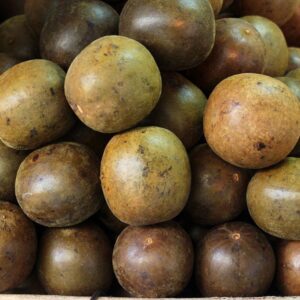
Monk Fruit (MV50)
Monk fruit shines in coffee when used correctly, not as a sugar replacement hammer, but as a top-note lifter.
- Rounds edges
- Adds perceived sweetness without bulk
- Plays well with cocoa, vanilla, caramel, and dairy notes
Best use:
Layered, not dominant. Monk fruit alone won’t fix bitterness, but it can absolutely polish a well-built system.
Stevia Reb M
Reb M is the workhorse of modern RTD coffee.
- Clean sweetness
- Minimal bitterness contribution
- Excellent synergy with both dairy and plant systems
Reb M works best when:
- You’ve already addressed mouthfeel with fiber or fat
- You’re targeting ≤5g added sugar or zero-added-sugar
- You want sweetness that doesn’t announce itself
Think of Reb M as structural sweetness, not flavor.
Stevia RM95D
RM95D earns its keep in coffee because of its temporal behavior.
- Fast sweetness onset
- Strong upfront impact
- Useful in masking early bitterness from coffee solids and adaptogens
Best used:
- In combination with Reb M
- At lower inclusion levels to avoid sharpness
- As a bridge between bulk sweeteners and long-tail sweetness
Sweetness Modulators: The Real Power Move
Here’s where formulators level up.
Sweetness modulators don’t add sweetness, they reshape perception.
In coffee systems, they:
- Suppress bitterness
- Extend sweetness decay
- Reduce the need for higher HIS loads
- Improve flavor clarity post-UHT or HPP
Used correctly, modulators allow you to:
- Lower total sweetener usage
- Maintain clean labels
- Preserve “coffee-first” flavor identity
This is especially critical in:
- Protein coffees (where bitterness creeps late)
- Adaptogen systems (where earthiness lingers)
- Ultra-low sugar SKUs (<2g added sugar)
Where Fiber and Sweetness Intersect
Fiber isn’t just a functional add-on; it’s a sweetness partner.
Low-viscosity soluble fibers:
- Restore lost solids when sugar is removed
- Improve sweetness carry
- Smooth out acid perception
- Reduce sharpness from HIS systems
In well-designed RTD coffee, fiber does as much sensory work as sweeteners, sometimes more.
Processing Still Decides the Winner
None of these matter if it collapses after processing.
- UHT can expose weak protein–sweetener systems
- HPP can amplify bitterness if modulators aren’t dialed in
- Shelf life will punish overconfident bench-top formulations
Sweetener systems must be evaluated post-process, not pre.
Where Icon Foods Fits In
This category doesn’t need more ingredients; it needs better integration. Icon Foods operates at the intersection of:
- High-intensity sweeteners (Monk Fruit MV50, Reb M, RM95D)
- Sweetness modulation
- Soluble fibers for mouthfeel and sugar replacement
- Systems-level formulation support
The real value isn’t any single ingredient. It’s how they work together inside coffee, one of the most unforgiving matrices in beverage.
RTD coffee success comes from:
- Layered sweetness, not brute force
- Bitterness management before sweetness addition
- Fiber-driven mouthfeel restoration
- Modulators that clean up the finish
- Processing-aware formulation from day one
The next generation of RTD coffee won’t win by shouting louder. It will win by drinking better.
Protein-forward.
Fiber-supported.
Adaptogen-aware.
Low sugar.
Coffee first.
When sweetness systems are built with intention, and not desperation, functional coffee stops tasting like compromise and starts tasting like choice. And that’s where the category is headed.
Reach out to your Icon Foods representative for sweeteners, fibers and modulator, samples, documentation formulation and usage guidance.
Since 1999 Icon Foods has been your reliable supply chain partner for sweeteners, fibers, sweetening systems, inclusions and sweetness modulators.