

Summary
Most formulation strategies still focus on sweetness curves, macros, and label claims. But the real metabolic story begins after digestion, in the colon, where microbial fermentation determines whether your product drives short-chain fatty acids or neurotoxic byproducts. In this white paper, Thom King reframes fiber not as a trend, but as metabolic traffic control. He explains how strategic fiber stacking shapes SCFA production, protects gut barrier integrity, enhances GLP-1 signaling, and prevents the slow chemical drag of proteolytic fermentation. Fibermaxxing is not marketing theater. It is formulation responsibility.
Thom King, CFS, Food Scientist
Chief Innovations Officer, Icon Foods
Why SCFAs Are the Signal, Neurotoxins Are the Warning, and Formulation Is the Lever
Most formulation conversations still start in the wrong place. Sweetness curves. Calorie counts. Net carbs. Mouthfeel tweaks. Meanwhile, the most important metabolic chemistry in the human body is happening downstream, out of sight, after your product is swallowed and forgotten.
The colon doesn’t care about claims panels. It cares about what ferments.
Every food and beverage you formulate either pushes the microbiome toward order or entropy. Toward SCFAs or toward neurotoxic byproducts. Toward metabolic stability or quiet dysfunction. Fibermaxxing isn’t a consumer trend. It’s a formulation responsibility.
The Colon Is a Bioreactor, Not a Trash Can
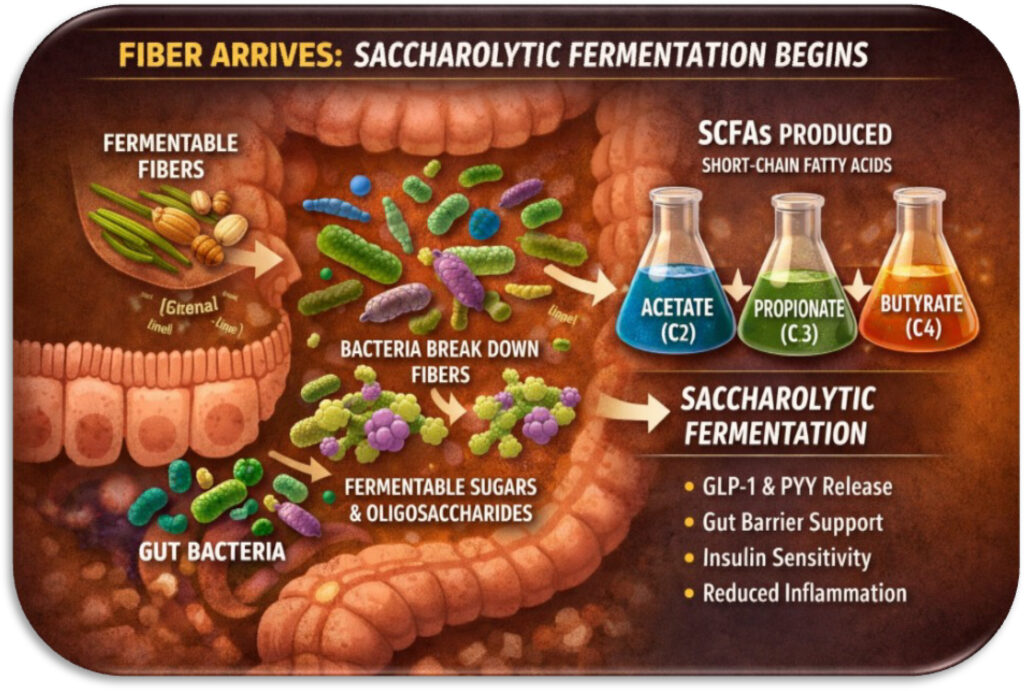
Fermentable fiber that survives digestion reaches the colon intact. Humans can’t break it down. Microbes can. That’s the deal.
When fermentable fibers arrive, bacteria preferentially run saccharolytic fermentation, producing short-chain fatty acids (SCFAs). When fiber is absent and protein dominates, microbes switch to proteolytic fermentation, producing ammonia, phenols, indoles, sulfur compounds, and other metabolites that leak upstream into systemic circulation.
Same microbes. Different chemistry. Entirely different outcomes. Formulation determines which pathway dominates.
SCFAs: the metabolic payoff of doing this right
SCFAs are not trace byproducts. They are host-signaling molecules.
Acetate
Systemic, abundant, and regulatory. Influences energy balance, lipid metabolism, and appetite signaling. It sets baseline tone.
Propionate
Primarily hepatic. Suppresses excess gluconeogenesis, modulates cholesterol synthesis, and strongly stimulates GLP-1 and PYY release. This is glycemic control without coercion.
Butyrate
The linchpin. Primary fuel for colonocytes. Enhances tight junctions, thickens the mucus layer, suppresses inflammation, and functions as a histone deacetylase inhibitor. That last part matters. Butyrate changes gene expression.
SCFAs bind to GPCRs like FFAR2 and FFAR3 on enteroendocrine, immune, and neural cells. Translation: they act like hormones.
This is how fiber:
- Improves insulin sensitivity
- Stabilizes appetite
- Supports gut barrier integrity
- Reduces systemic inflammation
- Enhances endogenous GLP-1 signaling
No fiber, no signal. It’s that simple.
The Other Side of the Coin: Neurotoxic Metabolites
When fermentable fiber is missing, microbes don’t stop working. They just work on different substrates.High-protein, low-fiber systems favor metabolites that are neuroactive and neurotoxic.
- Ammonia from amino acid fermentation crosses the blood–brain barrier and disrupts astrocyte function
- p-Cresol from tyrosine metabolism interferes with dopamine signaling and increases oxidative stress
- Excess indoles overwhelm regulatory pathways and contribute to inflammation
- Hydrogen sulfide impairs mitochondrial respiration and damages colonocytes when not counterbalanced by butyrate
These compounds don’t cause dramatic failure. They cause drag. Brain fog. Irritability. Low stress tolerance. The slow erosion people mislabel as burnout or aging.
Fiber doesn’t just create good metabolites. It prevents bad ones from being made.
Fiber Is Metabolic Traffic Control
Fermentable fiber reshapes colonic chemistry in three ways that matter to formulators:
- Substrate prioritization
Carbohydrate fermentation is energetically cheaper than proteolysis. Provide fiber, and microbes abandon amino acids. - pH modulation
SCFA production lowers luminal pH, suppressing toxin-producing species. - Transit time control
Faster transit reduces the opportunity for putrefactive chemistry.
This is not ideology. It’s microbial economics.
Why “High Protein” Products Fail Without Fiber
Protein without fiber is incomplete formulation.
You can hit macros, satiety claims, and texture targets and still generate products that:
- Increase ammonia burden
- Elevate neuroactive phenols
- Disrupt gut–brain signaling
- Undermine long-term metabolic health
Fiber is not a nice-to-have add-on. It is a protein’s metabolic chaperone. Fibermaxxing enables high-protein systems to work with physiology rather than against it.
Formulation Reality: Not All Fiber Works
Fiber inclusion is not about slapping a number on a label. It’s about fermentability, tolerance, and sensory integration.
Effective fibermaxxing requires:
- Soluble, fermentable fibers that actually reach the colon
- Mixed fermentation rates to avoid GI distress
- Neutral sensory impact
- Stability across pH, heat, and shelf life
- Compatibility with alternative sweeteners
Poorly chosen fiber creates gas, grit, off-notes, and consumer rejection. Well-formulated fiber disappears into the system and quietly does its job.
That’s the difference between compliance and adoption.
Why This Matters for Food and Beverage Brands Right Now
Consumers are chasing:
- Blood sugar stability
- GLP-1 support
- Gut health
- Mental clarity
- Satiety without punishment
They don’t need another sweetener debate. They need products that restore fermentation where it belongs.
Fibermaxxing is the fastest, cleanest way to deliver real metabolic value without drugs, restriction, or theatrics.
Mapping Fermentable Fibers to SCFA Profiles
Not all fermentable fibers behave the same once they reach the colon, and treating them as interchangeable is where most formulations quietly fail. Each fiber carries a distinct fermentation rate, microbial preference, and SCFA bias that determines whether it drives rapid satiety signaling, sustained gut barrier support, or balanced metabolic control. When mapped correctly to application, fibers stop being passive ingredients and become active design tools. The following breakdown links individual fibers to their dominant SCFA profiles and shows where they actually perform best across beverages, gummies, bars, and solid foods.
“Fiber is not a claim. It’s metabolic architecture.”
What Ferments, What It Makes, and Where It Actually Works
No fiber makes only one SCFA. Fibers bias the system, they don’t dictate it. What we’re mapping here is dominant production tendencies when fibers are used at meaningful doses in mixed diets.
- Inulin and FOS
(Chicory root, agave, Jerusalem artichoke)
Fermentation rate: Fast
Primary SCFAs:
- ↑↑ Acetate
- ↑ Propionate
- Moderate butyrate (via cross-feeding)
Microbial bias:
- Bifidobacteria (strong)
- Lactobacillus (secondary)
Metabolic impact:
- Strong GLP-1 and PYY stimulation
- Appetite suppression
- Improved mineral absorption
- Can overshoot gas if abused
Best applications:
- Gummies (low dose, blended)
- Powdered drink mixes
- Nutrition bars
- Yogurt-style systems
Avoid solo use in:
- Clear RTD beverages
- High-dose single-serve products
Formulation note:
Inulin is a starter fuel. It lights the fermentation match but burns fast. Always pair it. See my paper on fiber stacking.
- Soluble Tapioca Fiber (Resistant Dextrins)
Fermentation rate: Moderate
Primary SCFAs:
- ↑↑ Acetate
- ↑ Butyrate
- Balanced propionate
Microbial bias:
- Broad consortium
- Strong secondary fermenter support
Metabolic impact:
- Gut barrier support
- Improved insulin sensitivity
- Excellent tolerance profile
Best applications:
- RTD beverages
- Functional sodas
- Syrups
- Bars and baked goods
Formulation note:
This is a workhorse fiber. Neutral taste, stable, forgiving. One of the safest ways to drive butyrate indirectly.
- PHGG (Partially Hydrolyzed Guar Gum)
Fermentation rate: Slow and sustained
Primary SCFAs:
- ↑↑ Butyrate
- Moderate acetate
- Low propionate
Microbial bias:
- Butyrate producers (Faecalibacterium, Roseburia)
Metabolic impact:
- Gut lining integrity
- Reduced intestinal permeability
- Anti-inflammatory signaling
- Excellent GI tolerance
Best applications:
- Clinical nutrition beverages
- Protein shakes
- Coffee and tea systems
- Daily fiber beverages
Formulation note:
PHGG is colon fuel, not marketing fiber. Low sweetness impact, low gas, high structural payoff.
- Resistant Starch (RS2, RS4)
Fermentation rate: Slow
Primary SCFAs:
- ↑↑ Butyrate
- Moderate propionate
- Lower acetate
Microbial bias:
- Ruminococcus
- Eubacterium species
Metabolic impact:
- Improved insulin sensitivity
- Reduced postprandial glucose
- Strong colonic health signal
Best applications:
- Bars
- Baked goods
- Nutrition powders
- Spoonable foods
Limitations:
- Poor clarity in beverages
- Texture sensitivity under heat
Formulation note:
Resistant starch shines in solid matrices where slow fermentation is an asset, not a liability.
- Polydextrose
Fermentation rate: Moderate to slow
Primary SCFAs:
- ↑ Acetate
- ↑ Propionate
- Modest butyrate
Microbial bias:
- Mixed saccharolytic populations
Metabolic impact:
- Glycemic blunting
- Satiety support
- Mild GLP-1 effect
Best applications:
- Carbonated beverages
- Baked goods
- Reduced-sugar confections
Formulation note:
Excellent structural fiber, modest biological punch. Works best as part of a blend.
- Arabinoxylans / Oat Fibers
Fermentation rate: Moderate
Primary SCFAs:
- ↑ Propionate
- Moderate acetate
- Low butyrate unless blended
Microbial bias:
- Bacteroides species
Metabolic impact:
- Cholesterol modulation
- Hepatic glucose control
Best applications:
- Cereals
- Bars
- Baked systems
Formulation note:
Propionate-leaning fibers are great for liver-focused metabolic claims, but they need butyrate partners.
How Formulators Should Actually Use This
The rule: No single fiber. Ever. Always stack.
High-performing systems use:
- One fast fermenter (kick-start)
- One mid-range fermenter (balance)
- One slow fermenter (sustain + butyrate)
Example blends by application
- RTD Beverage: Soluble tapioca fiber + PHGG → Balanced acetate + butyrate, high tolerance
- Gummy: Low-dose inulin + polydextrose → GLP-1 signal without GI blowback
- Protein Shake: PHGG + resistant dextrin → Protein supervision, ammonia suppression
- Bars: Resistant starch + tapioca fiber → Slow burn, glucose control, gut integrity
Where Icon Foods Plays a Role
This is where formulation stops being theoretical.
Icon Foods sits at the intersection of clean-label sweetening and functional fiber systems, giving formulators the tools to build products that ferment correctly and taste right.
That includes:
- Neutral, soluble fibers that support SCFA production without wrecking sensory profiles
- Fiber systems compatible with allulose, stevia, monk fruit, and polyols
- Solutions designed for beverages, gummies, bars, baked goods, and confections
- Practical guidance on inclusion rates, tolerance thresholds, and matrix effects
Fibermaxxing doesn’t work if it can’t be formulated at scale, survive processing, and pass consumer reality checks. Icon Foods exists to make that possible.
Not with trends. With chemistry.
Every product you formulate sends a metabolic message. Fiber is not filler. It’s postbiotic engineering.
Fiber-poor systems whisper chaos. Fiber-rich systems restore order.
SCFAs are the reward. Neurotoxic metabolites are the warning sign. And formulation is the lever that decides which one shows up.
Fibermaxxing isn’t a fad. It’s how modern food stops fighting human biology and starts cooperating again.
Reach out to your Icon Foods representative for fibers and fiber blend, samples, documentation formulation and usage guidance.
Since 1999 Icon Foods has been your reliable supply chain partner for sweeteners, fibers, sweetening systems, inclusions and sweetness modulators.
Taste the Icon difference.