

Summary
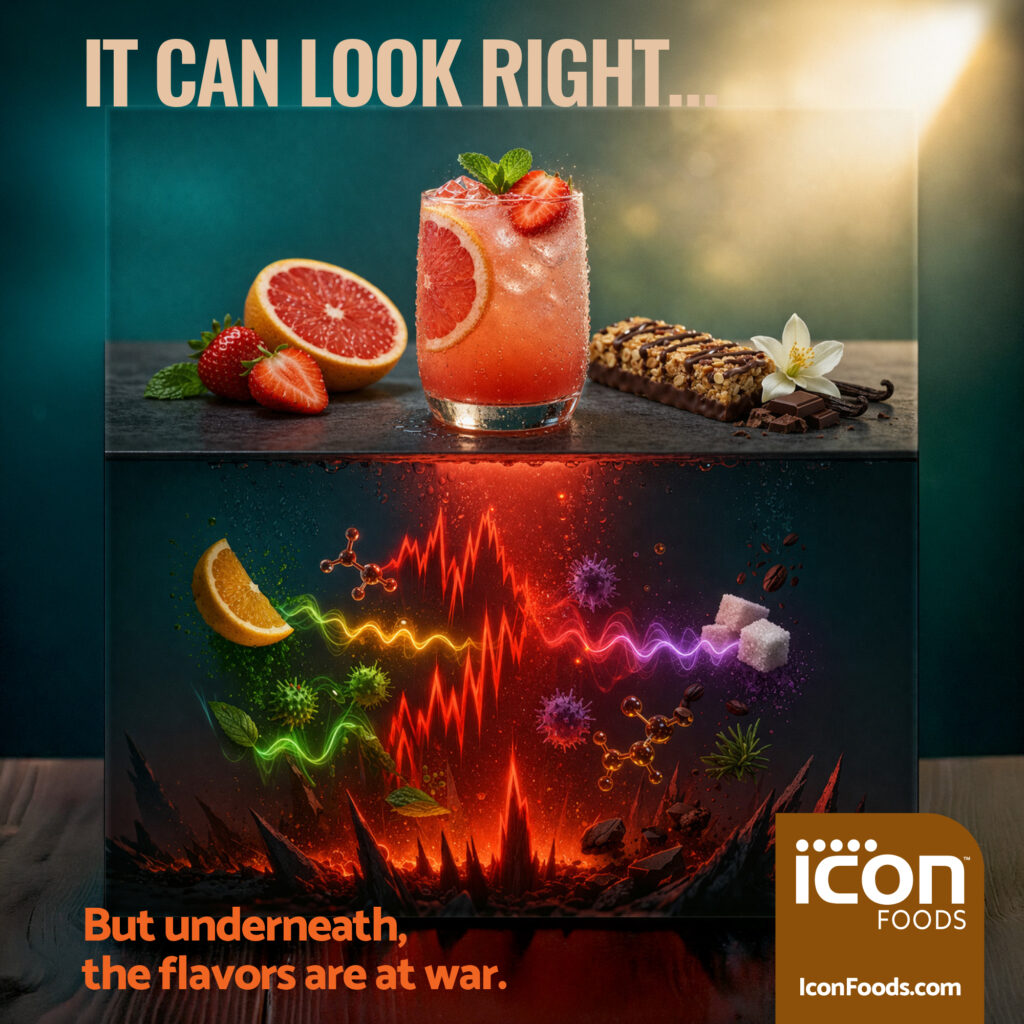
In modern formulation, great taste isn’t accidental—it’s engineered. Behind every clean-label success story is a careful balance of tools designed to manage bitterness, enhance sweetness, and shape the overall flavor experience. Blockers, maskers, and modulators each play a distinct role, but their real power emerges when used together as part of a cohesive system. Understanding how these ingredients interact at the sensory level allows formulators to overcome off-notes, optimize sweetness profiles, and deliver products that meet both consumer expectations and technical demands.
Thom King, CFS, Food Scientist
Chief Innovations Officer, Icon Foods
In the game of food and beverage formulations it’s key to know your players. The terms “flavor masker,” “bitter blocker,” “sweetness modulator,” and “flavor modulator” refer to different types of compounds or agents that interact with our taste perception in unique ways. Here’s a breakdown of their scientific differences:
Flavor Maskers and Bitter Blockers:
1. Flavor Maskers:
- Mechanism: Flavor maskers are substances that can blunt or obscure certain tastes, making them less perceivable. They work by either altering the interaction of taste molecules with taste receptors or by providing a competing flavor that distracts the palate.
- Examples: Ingredients like salt, certain fats, or even specific flavor compounds can mask undesirable flavors in food and beverages. For instance, salt is known to enhance sweetness while masking bitterness.
2. Bitter Blockers:
- Mechanism: Bitter blockers specifically target and inhibit the taste receptors responsible for detecting bitterness (primarily T2R receptors). These blockers can either bind to the receptor sites or interfere with signal transduction pathways, reducing the perception of bitter flavors.
- Examples: Compounds such as certain peptides or synthetic molecules designed to block bitter receptors can be used in products like beverages or medications to make them more palatable.
Sweetness Modulators and Flavor Modulators:
1. Sweetness Modulators:
- Mechanism: Sweetness modulators enhance or reduce the perception of sweetness without necessarily adding calories or sugar. They can act on sweetness receptors (T1R2 and T1R3) to amplify sweet signals or modify the sweetness profile of a product.
- Examples: High-intensity sweeteners, such as aspartame or sucralose, can act as sweetness modulators, providing sweetness without the bulk of sugar. Some modulating agents can also enhance the sweetness of natural sugars when used in combination.
2. Flavor Modulators:
- Mechanism: Flavor modulators influence the overall flavor profile of a product. They may enhance certain flavors while suppressing others, creating a more balanced taste experience. This can involve altering aroma compounds or modifying how flavors are perceived by the palate.
- Examples: Certain acids (like citric acid) can enhance fruitiness, while compounds such as umami enhancers (like MSG) can round out flavors in savory dishes. Flavor modulators can also be used to create a more complex flavor profile in food and beverages.
Summary of Differences:
- Target Effects: Flavor maskers and bitter blockers focus on reducing or masking undesirable flavors, particularly bitterness, while sweetness and flavor modulators enhance or adjust sweetness and overall flavor profiles.
- Mechanism of Action: Flavor maskers and bitter blockers primarily work at the receptor level to inhibit taste perception, whereas sweetness and flavor modulators may enhance receptor signaling or modify flavor attributes without necessarily blocking them.
- Applications: These agents are utilized in food, beverage, and pharmaceutical industries to improve taste profiles, making products more appealing to consumers.
In practice, these tools are rarely used in isolation. The real art of formulation lies in how they are layered together to build a complete sensory experience. A well-designed system might use a bitter blocker to eliminate harsh notes, a masker to smooth residual edges, and a sweetness modulator to bring forward a clean, rounded sweetness profile. When done correctly, the consumer doesn’t perceive any of these individual interventions—they simply experience a product that tastes “right.” That’s the goal: not to manipulate flavor, but to remove barriers to enjoyment.
For formulators navigating sugar reduction, functional ingredients, or cost pressures, understanding how and when to deploy blockers, maskers, and modulators is no longer optional—it’s foundational. As ingredient systems become more complex, success will increasingly depend on building resilient, multi-dimensional flavor strategies rather than relying on a single solution. The companies that win will be those that treat taste not as a constraint, but as a system to be engineered with precision.
If your formulation tastes right on paper but falls short on the palate, Icon Foods can help you fine-tune it with targeted blockers, maskers, and modulators, so consumers experience nothing but clean, balanced flavor.