Applying Fiber Systems in Beverages, Bars, and Baked Goods
Where reduced-sugar formulations either hold, or fall apart
Summary
Most reduced-sugar formulations don’t fail in the lab, they fail in the real world. What looks stable on day one begins to break down under the combined pressure of pH, water activity, heat, time, and packaging. Beverages thin out, bars harden, and baked goods stale because the underlying system was never built to hold. This paper moves beyond theory to show how fiber systems actually perform across RTDs, bars, and baked goods, and why stability over shelf life depends on managing water, structure, and ingredient interactions as a coordinated system. The takeaway is clear: sugar reduction isn’t about replacing sweetness, it’s about rebuilding functionality so products perform consistently from first production through final consumption.
Thom King, CFS, Food Scientist
Chief Innovations Officer, Icon Foods
This is where most formulations fail. Not in theory. Not in the benchtop prototype. They fail in the real world, where pH, water activity, time, and packaging start pulling the system apart. Everything looked fine on day one:
- sweetness was dialed
- texture was acceptable
- the label looked clean
Then the product sat. And that’s when reality showed up:
- viscosity drift
- texture breakdown
- moisture migration
- tolerance complaints
That’s not bad luck. That’s a system that was never designed to survive.
RTD Systems: pH, Time, and Stability Under Stress
RTDs are the most unforgiving environment you’ll work in. You are dealing with:
- acid
- heat
- shear
- oxygen
- time
All acting on a system that no longer has sugar to stabilize it.
pH Zones: Where Fiber Lives or Dies
Acidic Systems (pH 3.2–4.2)
Think hydration, energy, juice-adjacent beverages.
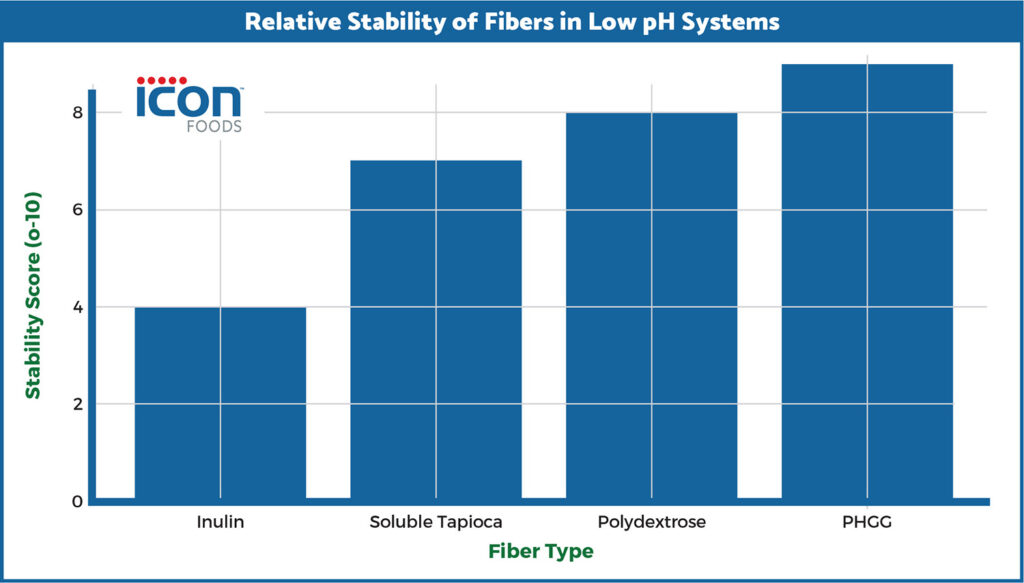
- Best performers: PHGG, soluble tapioca fiber
- Risk ingredient: inulin
Why: Inulin can hydrolyze under acid + heat + time. It doesn’t fail immediately. It fails gradually, showing up as viscosity loss and thinning over shelf life.
Neutral Systems (pH 6.4–7.0)
Think protein shakes, meal replacements.
- Best performers: inulin, PHGG, soluble tapioca
- Support: polydextrose
Why: Inulin finally gets to do its job here. It builds body and creaminess without being chemically dismantled.
Viscosity Targets (and why they drift)
- Water-like beverages: 3–10 cP
- Lightly structured drinks: 10–20 cP
- Shakes / meal replacements: 20–80 cP
The trap is designing viscosity for day one.
What Actually Happens over Time
- Inulin systems → can thin out in acidic environments
- Poor water control → phase instability
- Low solids → thin mouthfeel
If your viscosity changes over time, your system wasn’t stable. It was temporary.
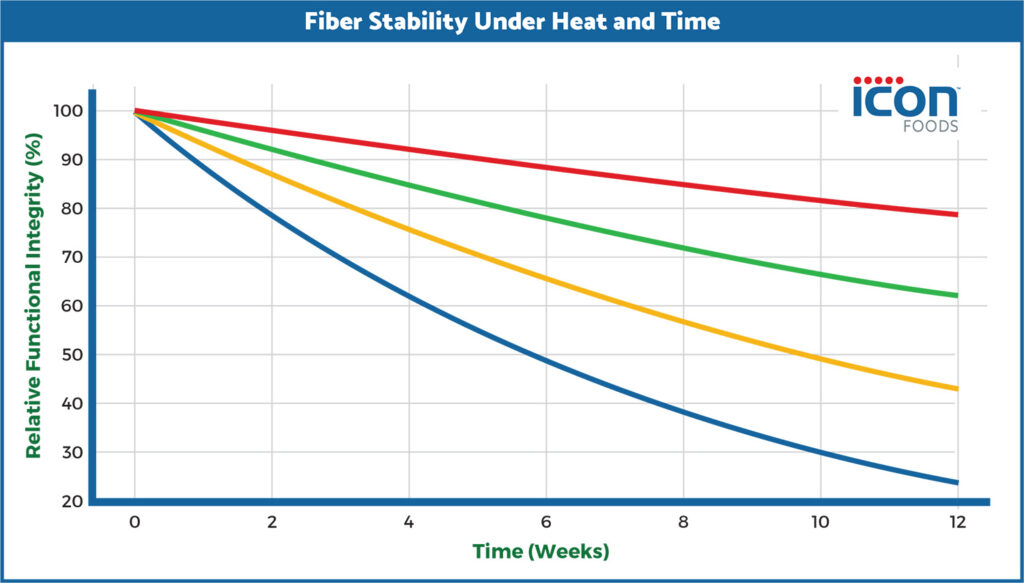
Fiber Stability Under Heat and Time
Pasteurization and processing are not neutral events.
- Heat accelerates hydrolysis
- Shear impacts molecular structure
- Time exposes weak links
Stable: PHGG, soluble tapioca, polydextrose
Condition-dependent: inulin
RTD Bottom Line
If your beverage:
- starts full and ends thin
- separates
- tastes hollow
You didn’t lose sweetness. You lost structure.
Bars: Water Activity and the Slow March to Brick
Bars are not a sweetness problem. They are a water activity problem disguised as a snack.
Water Activity Targets
- Chewy protein bars: 0.50–0.65
- Layered/crisp bars: 0.35–0.50
- Fruit-based bars: 0.55–0.70
Miss this window and you get:
- too low → hardening, brittleness
- too high → stickiness, microbial risk
Moisture Redistribution
Water moves. Always. Over time:
- water migrates from wetter zones to drier ones
- proteins tighten
- syrups equilibrate
- fibers either stabilize or fail
Hardening Curves (what actually happens)
- Week 0–2 → soft, compliant
- Week 3–6 → tightening begins
- Week 6+ → structural rigidity shows up
Why it happens:
- insufficient humectancy
- poor water binding
- protein network tightening
- wrong fiber balance
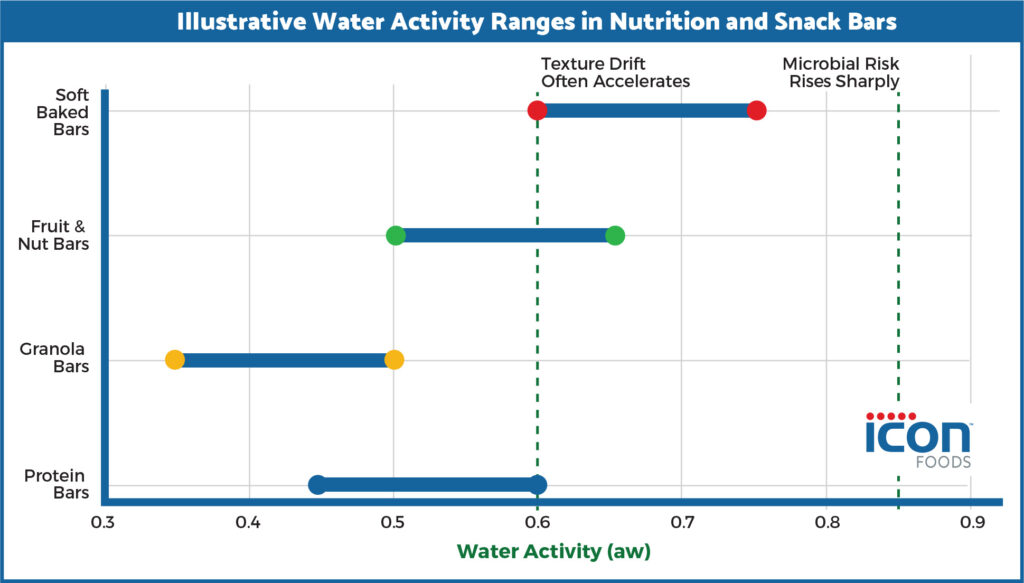
That graph below shows the illustrative water activity windows where different bar formats usually behave best:
- Granola bars: lower aw, typically ~0.35 to 0.50
- Protein bars: usually ~0.45 to 0.60
- Fruit and nut bars: often ~0.50 to 0.65
- Soft-baked bars: typically ~0.60 to 0.75
The important part is not the pretty little lines. It’s the physics:
- Below the target zone: bars get hard, brittle, or stale
- Inside the zone: texture is stable and predictable
- Above ~0.60: texture drift tends to accelerate
- Above ~0.85: microbial risk starts getting loud and obnoxious
For bars, texture failure is usually a water migration problem wearing a different hat. The protein, fibers, syrups, humectants, particulates, and inclusions are all fighting over the same water. Whoever wins changes the bite.
Fiber Roles in Bars
- Soluble tapioca fiber: primary water manager
- Polydextrose: softness retention and humectancy
- Inulin: early texture enhancement
- PHGG: tolerance support
Bar Bottom Line
If your bar turns into a brick, it’s not a processing issue. It’s a water system failure.
Baked Goods: Moisture Migration and Controlled Decay
Baked goods start degrading the second they leave the oven. Everything after that is a race between:
- moisture migration
- starch retrogradation
- environmental loss
Crumb vs Crust Dynamics
- Moisture moves from crumb → crust
- Crust softens
- Crumb dries
- Texture shifts
If not controlled:
- dry interior
- sticky exterior
- loss of structure
Moisture Migration Over Shelf Life
- Stage 1: Post-bake equilibration – Internal moisture redistributes
- Stage 2: Early shelf life – Texture stabilizes (if designed correctly)
- Stage 3: Mid shelf life – Water loss and retrogradation begin dominating
- Stage 4: Late shelf life – Staling becomes consumer-visible
Role of Humectants vs Water Binders
This is where most people get it wrong.
- Water binder fibers (soluble tapioca): hold water in place
- Humectant fibers (polydextrose): keep water functionally available
You need both.
Fiber Roles in Baked Systems
- Soluble tapioca fiber: water control and retention
- Polydextrose: moisture preservation and softness
- Inulin: texture enhancement, short-term benefit
- PHGG: minimal structural role
Baked Goods Bottom Line: Staling is not just time. It’s uncontrolled moisture movement.
System-Level Formulation Strategy
This is where it all comes together. A working reduced-sugar system is layered.
Base Layer (Water + Solids)
- Soluble tapioca fiber
- Controls water
- Builds foundation
Texture Layer (Mouthfeel)
- Inulin
- Adds body and creaminess
Tolerance Layer
- PHGG
- Allows higher fiber inclusion without texture penalty
Adjustment Layer
- Polydextrose
- Fine-tunes bulk and moisture retention
No single ingredient carries the system. Each one does a job.
Series Close
Reduced-sugar formulation is not about removing sugar. It’s about rebuilding what sugar was doing in the first place.
- Sweeteners handle perception
- Fibers handle structure
- Systems determine success
And the difference between a product that works and one that doesn’t is rarely obvious on day one.
It shows up over time:
- in viscosity drift
- in texture breakdown
- in shelf-life failure
- in consumer tolerance
That’s not a formulation mistake. That’s a system that was never rebuilt.
At Icon Foods, we don’t approach sugar reduction as an ingredient swap. We approach it as system design. Because the goal isn’t to make something that tastes good in a benchtop sample. The goal is to build something that: holds up in processing, survives shelf life, and performs the same way on day ninety as it did on day one. That’s not formulation. That’s engineering.
Reach out to your Icon Foods representative for fibers , high intensity sweetener, sweetness modulators and sweetening systems, samples, documentation formulation and usage guidance.
Since 1999 Icon Foods has been your reliable supply chain partner for sweeteners, fibers, sweetening systems, inclusions and sweetness modulators.
Taste the Icon difference.
Order Samples of Icon’s Fibers