The Polyol That Shows Up, Does the Work, and Doesn’t Need Applause
Summary
IMT1020™ NF Grade Isomalt isn’t a flashy sugar substitute—it’s a structural workhorse designed for real-world formulation. This white paper positions isomalt as a process-stable, low-glycemic polyol that delivers consistent performance across heat, humidity, and complex systems. With low hygroscopicity, no Maillard browning, and excellent thermal and pH stability, it enables cleaner labels and more predictable outcomes in hard candy, baked goods, nutraceuticals, and coatings. While its sweetness is moderate, its true strength lies in providing bulk, structure, and stability—making it an ideal backbone in blended systems with high-intensity sweeteners. Combined with strong GI tolerance and NF-grade purity for regulated applications, IMT1020™ offers formulators a dependable alternative to volatile ingredients like erythritol. In short, it’s not trying to replace sugar’s personality—it’s replacing its unpredictability with disciplined, scalable performance.
Thom King, CFS, Food Scientist
Chief Innovations Officer, Icon Foods
Procurement pros. Gather round.
If erythritol is the volatile startup founder and sucrose is the retired CEO living on nostalgia, isomalt is the disciplined Swiss engineer quietly building bridges that don’t collapse under heat, humidity, or gastric drama.
Let me introduce you to IMT1020™ NF Grade, Non-GMO Crystalline Isomalt from Icon Foods. This is not trendy. It is not flashy. It is reliable, process-stable, low-glycemic, tooth-friendly architecture in crystalline form. And if you build food systems for a living, you know architecture wins.
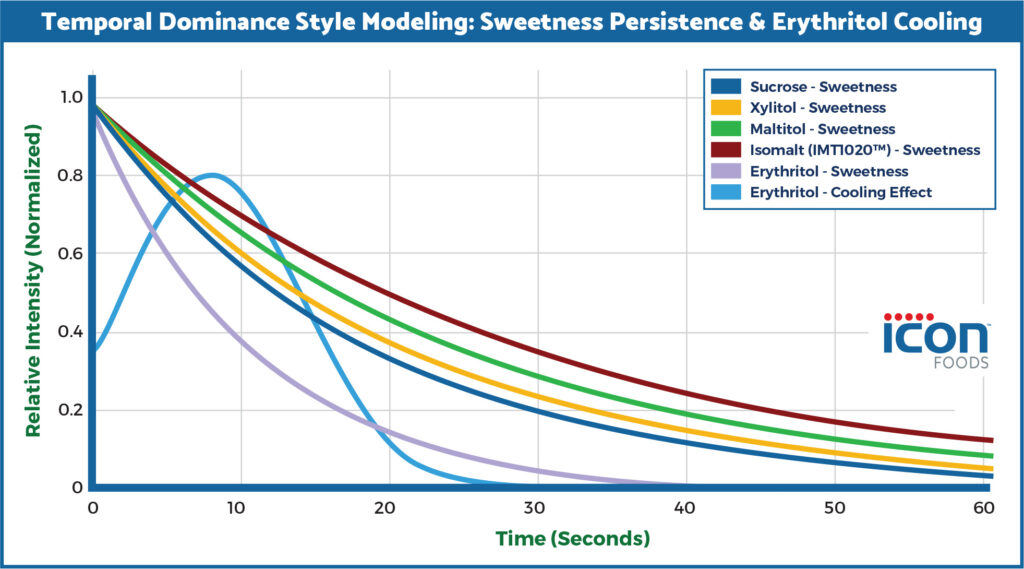
This visually communicates what panels often report:
- Erythritol: fast onset, rapid sweetness decay, cooling dominates early mid-phase
- Sucrose: balanced rise and clean fade
- Maltitol: fuller mid-palate persistence
- Isomalt: slower, longer structural sweetness tail
- Cooling lingers independently of sweetness in erythritol systems
What Makes Isomalt Unique?
Isomalt is a disaccharide polyol produced by hydrogenating isomaltulose derived from sucrose. Chemically, it’s a mixture of:
- Gluco-mannitol
- Gluco-sorbitol
That structural tweak does three powerful things:
- Reduces glycemic impact
- Slow digestion. Minimal insulin response compared to sucrose.
- Reduces hygroscopicity
- Less moisture pickup than many polyols. Translation: crunch stays crunch.
- Prevents Maillard browning
- It’s non-reducing. That means no runaway browning in protein systems.
Sweetness sits around 45–65% of sucrose, clean profile, minimal cooling effect compared to erythritol.
It’s not trying to be sugar.
It’s trying to be better behaved.
Thermal Stability: Bring the Heat
IMT1020™ is extremely heat stable.
- Melting point: ~145–150°C
- Decomposition: well above typical baking and confectionery ranges
- Stable during extrusion, baking, and panning
- No caramelization like sucrose
- No Maillard browning like reducing sugars
What This Means for You
- Hard candies without unexpected color shift
- Baked goods without over-browning
- Protein systems without glycation surprises
- High-shear processing stability
Isomalt handles thermal processing like a seasoned line cook who never burns the sauce.
pH Stability: Calm Under Pressure
Isomalt is stable across a wide pH range typical for food systems.
- Stable in neutral and mildly acidic systems
- No hydrolysis issues like sucrose inversion
- Maintains structural integrity in confectionery, lozenges, compressed tablets
In acidic beverages? It works, but remember sweetness intensity is moderate, so it’s often part of a blend strategy.
It doesn’t degrade, split, or get moody.
Best Applications
- Sugar-Free Hard Candy The gold standard.
- Excellent clarity
- Low hygroscopicity
- Stable glass transition
- Reduced stickiness
- Nutraceutical & Functional Confectionery NF grade matters here.
- Pharmacopeia compliant
- Suitable for lozenges and compressed tablets
- Minimal interaction with actives
- Baked Goods & Protein Systems
- Bulking without Maillard browning
- Synergy with high intensity sweeteners (stevia, monk fruit)
- Improves structure vs high-intensity sweeteners alone
- Chocolate & Compound Coatings
- Lower hygroscopicity than many polyols
- Improves snap stability
- Reduces bloom risk when properly formulated
- Sugar Replacement Systems Blend with:
- Allulose for browning
- Maltitol for sweetness lift
- Stevia or monk fruit for top note
- Isomalt is the backbone. Others are the flair.
Best Practices for Formulators
- Don’t Ask It to Be 100% of the Sweetness
- It’s a structural polyol first. Use HIS to complete the sweetness curve.
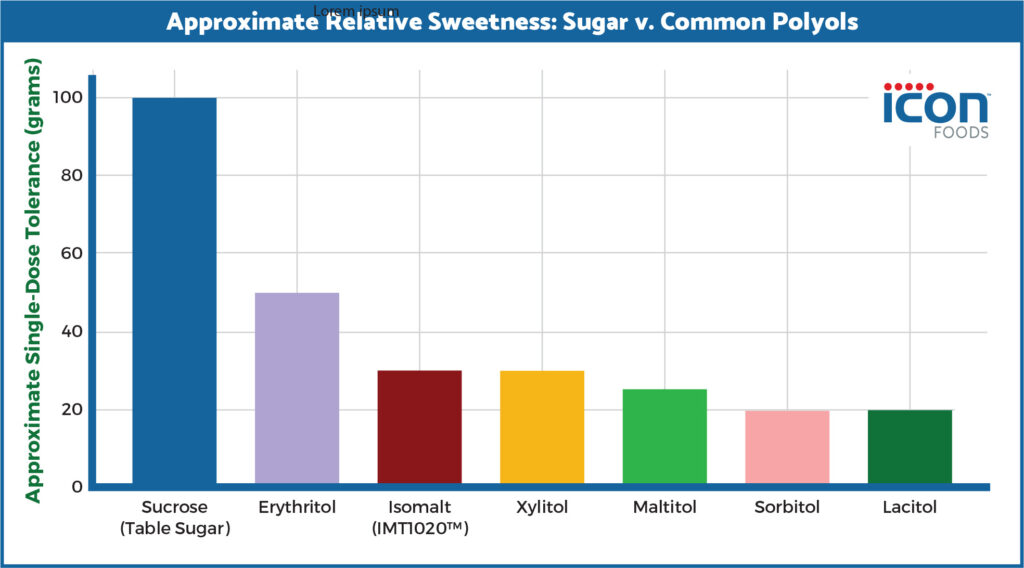
The graph above illustrates relative sweetness comparison (with sucrose = 1.0) across common polyols, including IMT1020™ isomalt.
- Watch Total Polyol Load
- GI tolerance is dose dependent.
- Blend strategy improves digestibility profile.
- Understand Glass Transition
- In confections, moisture management is everything. Isomalt’s lower hygroscopicity is your friend, but water activity still rules the kingdom.
- Texture Engineering
- Isomalt provides body and bulk. In baked systems, combine with fibers or resistant dextrins for improved crumb structure.
GI Impact and Tolerance
Compared to maltitol, isomalt typically exhibits:
- Slower fermentation
- Lower osmotic effect
- Better tolerance at moderate doses
This is not permission to dump 40 grams into a single serving. It is permission to design intelligently.
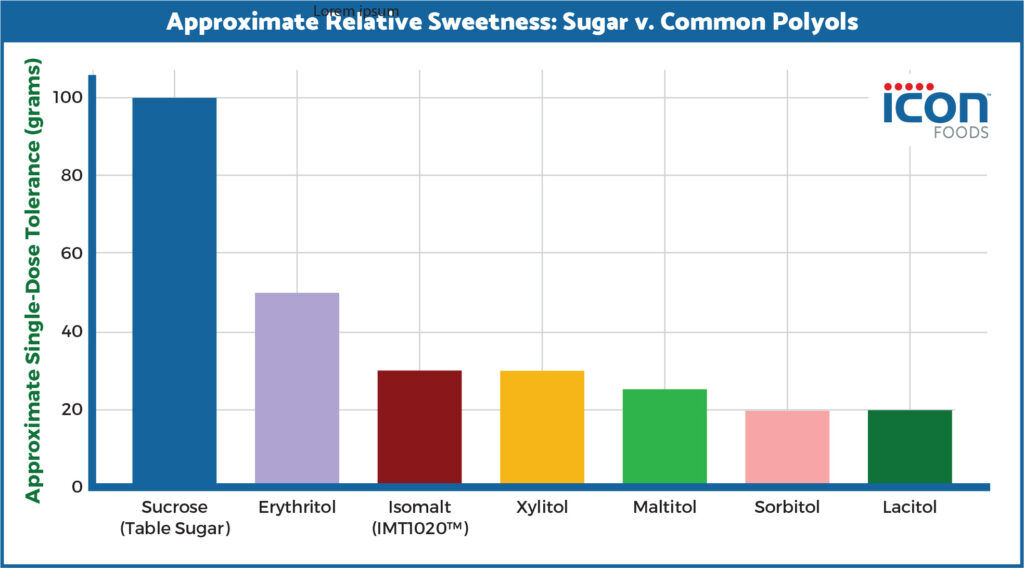
The graph above illustrates the comparative GI tolerance chart using approximate single-dose laxation thresholds from published human tolerance studies.
Technical context for your R&D and regulatory teams:
- These values are mid-range literature averages. Individual tolerance varies widely.
- Tolerance is dose-dependent and strongly influenced by delivery matrix, water activity, gastric emptying rate, and polyol blending.
- Isomalt, maltitol, sorbitol, and lactitol reach the colon in varying amounts and undergo fermentation, increasing osmotic load and gas production.
- Blending polyols often improves tolerance versus single-polyol systems due to fermentation kinetics diversity.
Why NF Grade Matters
IMT1020™ is NF Grade. That means:
- Conforms to USP/NF monograph
- Verified purity standards
- Suitable for pharmaceutical and nutraceutical applications
If you sell into supplement, functional confectionery, or regulated categories, NF grade isn’t a luxury. It’s risk mitigation. Procurement people sleep better with NF on the spec sheet.
Why Icon Foods Is the Right Supply Chain Partner
Now let’s talk about the grown-up stuff.
You don’t just need isomalt. You need:
- Multi-source security
- Forecast visibility
- Blanket PO programs
- Pallet configuration discipline
- On-time, in full, performance
We operate on 6–12 month blanket programs.
We build pipeline visibility into every spec. We engineer supply stability.
Where IMT1020™ Fits in You Portfolio
If you are:
- Reformulating away from sucrose
- Replacing erythritol due to supply chain, tariff, duties, or regulatory noise
- Designing sugar-free confections
- Engineering better-for-you baked systems
- Building GLP-1 aligned reduced sugar products IMT1020™ becomes a foundational tool.
It is not trendy.
It is dependable.
Isomalt is what happens when sweetness grows up and learns discipline.
IMT1020™ NF Grade Isomalt is clean label compatible, process stable, pharmacopeia compliant, and supply chain secure.
At Icon Foods, we’re already helping brands make the transition. Let’s build your next-generation formulation before the next ruling drops.
Reach out to your Icon Foods representative for IMT1020™ NF Grade Isomalt, sweeteners, fibers and modulator, samples, documentation formulation and usage guidance.
Since 1999 Icon Foods has been your reliable supply chain partner for sweeteners, fibers, sweetening systems, inclusions and sweetness modulators.
Taste the Icon difference.
Order samples of these polyols!