Sugar’s Overachieving Cousin with a Lab Degree
Summary
Icon Foods’ MLT1100™ NF Grade Maltitol Powder delivers what most sugar alternatives promise but rarely achieve: real sugar functionality without sugar’s baggage. Unlike high-intensity sweeteners that only chase sweetness, maltitol brings bulk, texture, and process stability, behaving much like sucrose in applications ranging from confectionery and chocolate to bakery and nutrition systems. It dissolves cleanly, performs reliably under typical heat and pH conditions, and avoids the harsh cooling effect associated with other polyols. While formulators must manage GI tolerance through smart dosing and system design, MLT1100™ offers a balanced, practical solution for building reduced-sugar products that still meet consumer expectations for taste and performance. Backed by Icon Foods’ disciplined sourcing, consistent quality, and supply chain reliability, it’s not just an ingredient, it’s a dependable foundation for modern formulation.
Thom King, CFS, Food Scientist
Chief Innovations Officer, Icon Foods
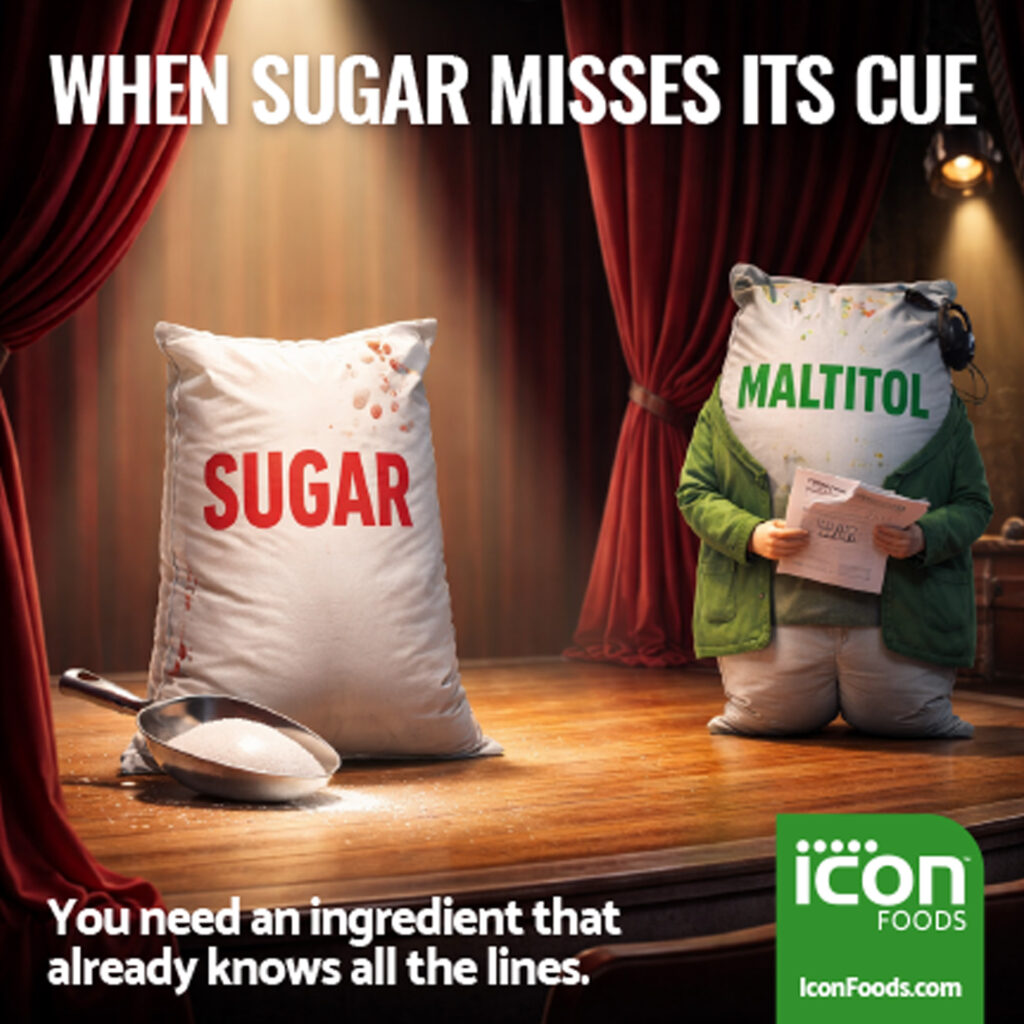
Sugar had a good run. It built empires, fueled bake sales, and caramelized its way into every comfort food on the planet. But now it shows up to the formulation meeting with baggage: glycemic spikes, label drama, regulatory side-eye, and consumers reading panels like forensic accountants. Enter Icon Foods MLT1100™ NF Grade Maltitol Powder. This is not some wispy high-intensity sweetener whispering sweetness from the sidelines. This is bulk. This is structure. This is “yes, I can survive your bake cycle and still behave.” It pours, it dissolves, it sweetens with intention, and it shows up in confections, bakery, chocolate, and nutrition systems ready to do real work. For formulators, it’s a sucrose understudy who learned the lines. For procurement leaders, it’s a spec you can lock down without waking up at 3 a.m. wondering where your next container is. Let’s talk about how to use it, why it performs, and why sourcing it through Icon Foods is the adult decision in a market that still occasionally acts like a toddler.
Icon Foods MLT1100™ NF Grade Maltitol Powder
A sucrose impersonator with a lab coat and better behavior in processing (most days).
Who this is for:
- Formulators who need bulk, sweetness, and texture without bringing sucrose’s baggage.
- Procurement leaders, sick of supply drama, spec drift, and “we’ll have it next month”.
What MLT1100™ is (and why you should care)
Maltitol is a polyol (sugar alcohol) made by hydrogenating maltose. Functionally, it’s one of the closest “act like sugar” ingredients in the polyol family: strong sweetness, real bulk, sucrose-like solubility/viscosity behavior, and a clean profile.
Key performance notes you can actually use:
- Sweetness: typically, ~75–90% of sucrose (varies by form/system).
- Solubility & solution behavior: maltitol’s solubility curve is among the closest to sucrose and it’s freely soluble in water.
- Browning/Maillard: polyols don’t have a reducing carbonyl, so they generally don’t participate in Maillard browning the way reducing sugars do. Why MLT1100™ works in real formulations
It delivers “sugar mechanics,” not just sweetness
MLT1100™ isn’t a high-intensity sweetener cosplay. It brings mass + water activity effects + texture. That’s why maltitol shows up in chocolate, baked goods, ice cream, fillings, chewing gum, hard candy, and more.
Clean sweetness, low drama cooling
Compared with erythritol’s arctic blast, maltitol is typically perceived as less cooling (system dependent), which helps in chocolate and bakery where “minty for no reason” is not a flavor.
Moisture behavior you can manage
Maltitol is not extremely hygroscopic until very high relative humidity conditions (so it’s more stable in many dry systems than people fear, though you still need sane packaging and storage).
Thermal and pH stability
This is where procurement and R&D stop fighting and start holding hands.
Heat
Maltitol has good thermal stability in typical food processing ranges.
Decomposition/discoloration risk climbs above ~200°C (time/temperature dependent). Practical translation: most baking, pasteurization, hot-fill, cooked confections are fair game. Just don’t treat it like a “let’s see what happens at 230°C” experiment without expecting consequences.
pH
Polyols in general are considered stable across acidity/alkalinity and resistant to enzymatic/chemical degradation relative to sugars. Also, published work indicates maltitol can remain stable in typical food pH ranges, with greater risk only in very low pH extremes (especially under heat).
Rule of thumb: if your beverage or syrup is living around pH 3 to 7, you’re in the normal operating zone. If you’re below pH ~2 with heat, you’re in “test it like you mean it” territory.
Best practices (how to avoid the usual polyol faceplants) Handling & storage
- Keep moisture control tight: sealed liners, desiccant where appropriate, and avoid repeated opening/closing in humid rooms. Maltitol can pick up moisture at high RH.
- Design your plant flow so the bag isn’t sitting open while someone goes on a forklift treasure hunt.
Dissolution strategy
• For beverages/syrups: pre-wet and dissolve with agitation; warm water speeds dissolution (basic kinetics, not magic). Maltitol is freely soluble and behaves a lot like sucrose in solution.
Sweetness architecture
MLT1100™ is a bulk sweetener, not a “hit 12°Brix sweetness with no solids” solution.
- Pair with HIS (stevia/monk) or modulators (ThauSweet VRM/DRM) to close the last 10–25% sweetness gap while keeping solids where you need them.
- Watch total polyol load for GI tolerance (see below).
Browning and color control
Because polyols generally don’t drive Maillard browning, baked systems may look paler than sucrose controls. Fixes:
• Use natural color strategies (e.g., cocoa, coffee, caramel colors where appropriate), or Adjust bake profile and surface heat transfer, rather than forcing chemistry that isn’t there.
GI tolerance reality (no fairy tales)
Maltitol can cause GI distress at higher intakes, like most polyols (erythritol is the notable exception-ish). Set serving targets responsibly, and don’t surprise consumers with “enjoy this entire bag in one sitting.”
GI distress likelihood by polyol (relative chart)
(Assumes typical “real world” serving sizes in bars, candies, baked goods; IBS/FODMAP-sensitive consumers will skew higher across the board.)
| Polyol | Relative GI Risk | What that Usually Looks Like | Why |
|---|---|---|---|
| Erythritol | Lowest | Less colonic complaints for most people | Lowest fermentation/osmotic load vs. others |
| Isomalt | Moderate | Moderate gas/bloating/looser stools at higher intakes | Partly reaches colon; dose-dependent tolerance |
| MLT1100™ Maltitol | Moderate | Can tip into diarrhea at high doses | Poorly absorbed relative to others: sugar; osmotic + fermentation effects increase with dose |
| Xylitol | Moderate | Some people hit a “cliff” Variable tolerance | Dose-dependent |
| Lacitol | Moderate-High | Laxation more common at higher loads | Reaches colon readily |
| Sorbitol | High | Diarrhea risk rises fast | Low absorption; notable symptoms reported at relatively modest intakes |
| Mannitol | Highest/Among Highest | Low absorption; can trigger effects at low-to-moderate daily intakes |
Quick callout: where MLT1100™ lands
Maltitol is the “sucrose-behavior MVP,” but not the GI-tolerance MVP. It’s typically more GI-active than erythritol and often less harsh than sorbitol/mannitol, with big person-to-person variability and very clear dose dependence.
Formulation levers to reduce GI complaints (without neutering the product)
- Cap polyol load per serving and avoid “eat half the box to reach a serving” designs. Dose is king.
- Blend polyols (e.g., maltitol + isomalt) to spread osmotic load and manage sweetness/texture, then use HIS for top-notes. GI outcomes still depend on total grams.
- Mind the matrix: bars + added fibers + polyols is the perfect storm for gut mutiny; reduce one variable if you’re pushing another.
Best uses and high-probability applications Confectionery (hard candy, chewy, gum, panned goods)
• Great for sugar-free and reduced-sugar confections where you need bulk and processability.
Chocolate and coatings
- Used to replace sucrose while preserving body and sweetness without the erythritol cooling punch (system dependent). Bakery
- Useful as a bulk sweetener with solid thermal performance in typical bake ranges; plan for less browning than sucrose. Dairy/frozen
- Helps deliver sweetness and solids; manage total sweetness system and freezing point effects with the rest of your carbohydrate strategy (don’t make maltitol do algebra alone).
Dry mixes, bars, nutrition systems
• Powder format plays well in dry blending; moisture management matters for flow and shelflife.
Quick sidebar: what makes isomalt unique (since you asked)
Isomalt is the polyol you pick when you want low hygroscopicity and hard-candy stability without stickiness creep. It’s commonly described as low-hygroscopic, crystalline, and about 50–60% as sweet as sucrose, making it a workhorse for pulled sugar art, sugar-free hard candy, and crisp structures.
So, in a sentence:
- Maltitol = “sucrose-like sweetness + bulk”
- Isomalt = “dry, stable, crisp structure specialist” They’re friends, not rivals.
Why Icon Foods is the best supply chain partner for MLT1100™
Here’s the procurement-grade truth: ingredients like maltitol are easy to buy once. They’re hard to buy reliably. What “best partner” should mean on this spec:
NF-grade discipline
Tight documentation, consistent COAs, and supplier controls that match nutraceutical and food expectations.
Program buying, not spot panic
Maltitol is the kind of ingredient that gets ugly when the market tightens. The winning move is allocation planning, container cadence, and inventory visibility.
Packaging and pallet standards that don’t wreck your ops
Consistent bag specs, pallet configs, labeling, and lot traceability so receiving isn’t a weekly scavenger hunt.
Multi-source posture and logistics execution
Real resilience is optionality: qualified sources, managed lead times, and OTIF performance you can measure (not vibes).
At Icon Foods, we’re already helping brands make the transition. Let’s build your next-generation formulation before the next ruling drops.
Reach out to your Icon Foods representative for MLT1075™ NF Grade Maltitol Syrup, sweeteners, fibers and modulator, samples, documentation formulation and usage guidance.
Replacing sucrose without losing bulk, process stability, or sensory integrity is where most formulations break down. With the right polyol system and disciplined sourcing, those trade-offs become manageable rather than limiting. The result is a formulation that performs like sugar where it matters and behaves predictably from bench to production.
Since 1999 Icon Foods has been your reliable supply chain partner for sweeteners, fibers, sweetening systems, inclusions and sweetness modulators.
Taste the Icon difference.