The Ingredient Everyone Wants and Almost Nobody Can Get Enough Of
Summary
Organic allulose is rapidly becoming one of the most important ingredients in modern sugar-reduction strategies. As brands pursue clean label positioning, low-sugar nutrition panels, and premium product experiences, organic allulose offers a rare combination of functionality and consumer appeal. But supply is tightening just as demand accelerates. With formulators moving away from erythritol, organic brands seeking better sweetener systems, and new product pipelines locking in ingredients earlier than ever, organic allulose capacity is becoming a strategic resource. For companies building the next generation of better-for-you foods and beverages, securing supply early is no longer just good procurement practice. It is becoming a competitive advantage.
Thom King, CFS, Food Scientist
Chief Innovations Officer, Icon Foods
Let’s get right to it. Organic allulose has moved out of the “interesting ingredient” category and squarely into strategic weapon territory. If you’re building modern food and beverage products that hit low sugar, clean label, and premium positioning, organic allulose isn’t optional anymore. It’s a serious competitive advantage.
And here’s the reality most people in the industry are quietly discovering:
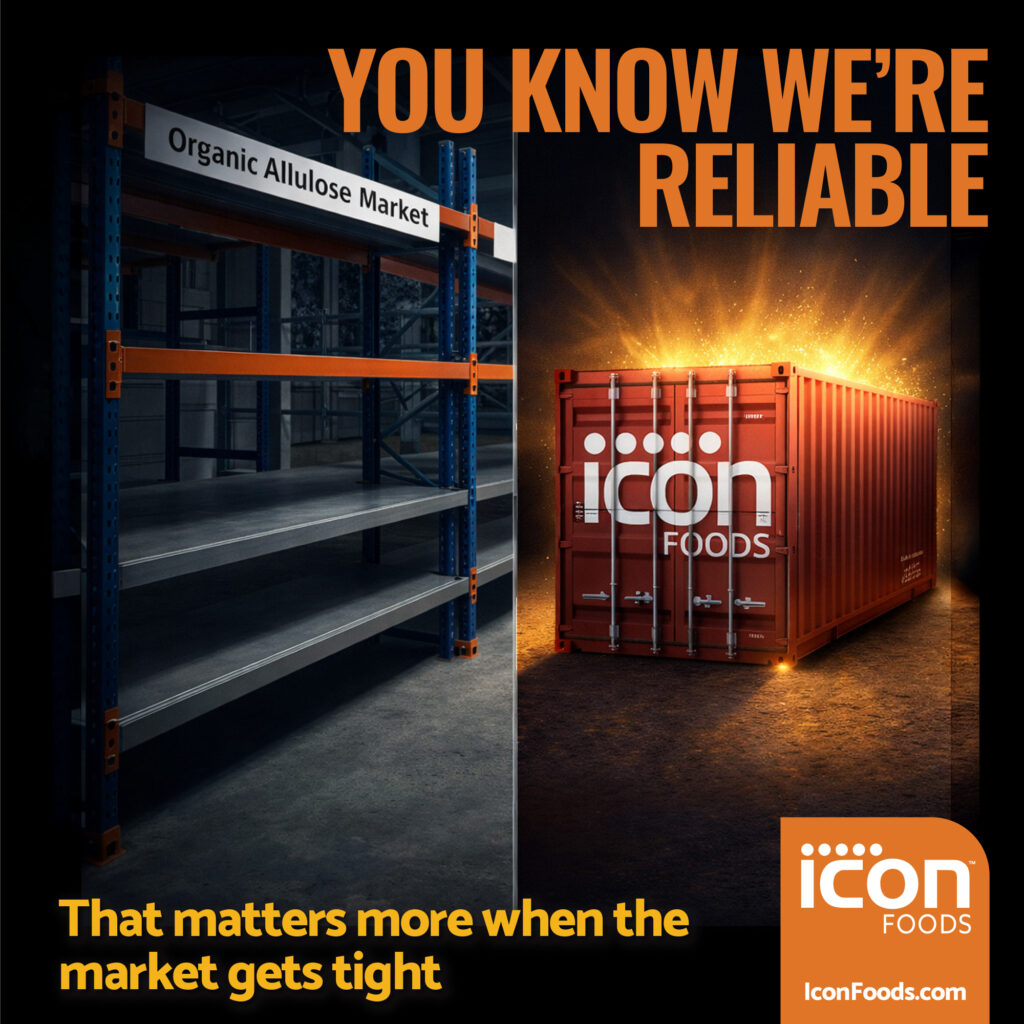
Supply is tight. Demand is climbing. And the companies that plan ahead are locking up capacity.
At Icon Foods, we’re actively bringing organic allulose capacity online to support our partners. But in markets like this, supply naturally flows toward the brands that commit early and plan intelligently.
Why Organic Allulose Supply Is Structurally Tight
Conventional allulose already requires sophisticated enzymatic conversion. Organic allulose adds another layer of complexity.
You’re dealing with:
- Certified organic feedstock streams
- Enzymatic systems that meet organic processing requirements
- Extensive documentation and traceability audits
- A much smaller pool of qualified producers
In other words, you can’t just flip a switch and double production.
Even with capital investment and expansion underway across the industry, new organic capacity takes time to qualify, certify, and ramp. Meanwhile, demand keeps marching upward.
Demand Isn’t “Growing” – It’s Moving
Several major forces are colliding at once.
The Erythritol Retreat
Across the industry, formulators are quietly reducing their reliance on erythritol.
Reasons are piling up:
- Anti-dumping and countervailing duties
- Price volatility
- Lingering negative press around cardiovascular studies
- Consumer perception issues
As R&D teams rebuild sweetness systems, allulose is often the first ingredient back on the whiteboard. And when the product sits in a premium or natural channel? Organic allulose becomes the obvious choice.
This shift is already underway in R&D labs, pilot plants, and reformulation pipelines across the industry.
Organic + “No Added Sugar” Is a Formulator’s Dream
Organic brands face a tricky formulation problem.
They want:
- Participation in Maillard and browning
- Bulk and mouthfeel, not just high-intensity sweetness
- Labels that avoid the words “sugar alcohol”
- Nutrition panels that support low sugar positioning
Organic allulose solves those problems elegantly.
It behaves like sugar in many systems, supports clean label positioning, and plays nicely with stevia, monk fruit, fibers, and rare sugars.
For formulators, it’s one of the few ingredients that actually makes the math work.
Product Pipelines Are Locking In
If you’ve worked in CPG long enough, you know the rhythm.
Brands don’t wait until launch to source ingredients. They lock formulations and procurement well before production begins.
Which means companies planning 2026 and early-2027 launches are securing supply now.
The buyers who delay decisions often end up shopping the spot market, which is where prices and lead times become… creative.
What Happens in Tight Ingredient Markets
This is not the first time the industry has seen a supply squeeze.
When demand outpaces available production, the same pattern usually unfolds:
- Allocation replaces open availability
- Spot premiums appear (often 15–25% higher)
- Lead times stretch
- Procurement teams lose flexibility
- R&D timelines get uncomfortable
Waiting rarely improves leverage in these environments.
Planning ahead usually does.
What Icon Foods Is Doing About It
At Icon Foods, we’ve been preparing for this moment. We’re actively expanding organic allulose capacity through:
- Long-term upstream sourcing agreements
- Strategic production partnerships
- Forecast-driven capacity planning
- Container-level logistics optimization
The goal is simple:
Give our customers stability in a market that is becoming increasingly volatile. But like any constrained ingredient, capacity will naturally favor companies that:
- Forecast their needs
- Commit volume
- Plan forward
That’s how continuity works in specialty ingredient markets.
The Smart Buyer Move
If organic allulose sits anywhere in your product roadmap, the playbook is straightforward:
- Secure supply before formulation deadlines
- Lock pricing while capacity is available
- Protect launch timelines and margin structure
- Avoid spot-market roulette later
Organic allulose is entering its next stage as a mainstream functional sweetener for premium products. The brands that win in this environment are rarely the ones scrambling for supply at the last minute. They’re the ones who saw the curve coming and got ahead of it.
If you want to talk through organic allulose supply, formulation strategy, or how it fits into your sugar-reduction roadmap, the team at Icon Foods is happy to dive in. We spend our days helping formulators solve exactly these problems. This isn’t the future. It’s already here. And the brands that move early, with the right partner, won’t just participate. They’ll define the category.
Reach out to your Icon Foods representative for KetoseSweet™ Organic Allulose samples, documentation formulation and usage guidance.
Since 1999 Icon Foods has been your reliable supply chain partner for sweeteners, fibers, sweetening systems, inclusions and sweetness modulators.
Taste the Icon difference.
We’ve got samples!