A Formulator’s Field Guide to Maltitol, Isomalt, and Erythritol
Summary
Panned confections may look simple on the outside, but the glossy shell that defines them is the result of careful ingredient strategy and processing control. As sugar reduction becomes a priority, formulators are increasingly turning to polyols such as maltitol, isomalt, and erythritol to replicate the performance of sucrose while addressing modern nutritional expectations. Each ingredient brings distinct strengths and challenges: maltitol delivers sweetness and processing familiarity, isomalt provides structural stability and humidity resistance, and erythritol offers metabolic advantages but demands careful handling. The real magic happens when these systems are blended, balancing crystallization, sweetness, and environmental stability to create coatings that look beautiful on day one and remain shelf-stable months later. Understanding how these ingredients behave in the pan is the key to building sugar-free or reduced-sugar confections that still deliver the indulgent experience consumers expect.
Thom King, CFS, Food Scientist
Chief Innovations Officer, Icon Foods
Panned confections are theater. A humble center enters a rotating drum and comes out wearing a glossy tuxedo. Chocolate lentils, almonds, peanuts, espresso beans, gummies. The pan doesn’t care. What matters is the coating system: how it flows, how it crystallizes, how it survives humidity, heat, and the long, lonely shelf life of retail. Sugar used to run this show uncontested. Then metabolic reality showed up and flipped the table. Enter polyols. Specifically, maltitol, isomalt, and erythritol. Each one brings gifts. Each one brings baggage. Your job as a formulator is knowing which suitcase to open and which one to leave on the carousel.
Maltitol: the sugar impersonator with a good memory
If sucrose had a well-behaved cousin who went to business school, it would be maltitol. From a processing standpoint, maltitol is friendly. Very friendly. Solubility is high, crystallization is predictable, viscosity curves behave, and it plays well in traditional hard and soft panning processes. You can build layers efficiently, polish to a clean gloss, and maintain structural integrity without reinventing your pan room. Sweetness sits around 85–90% of sucrose, which means fewer gymnastics to hit target sensory profiles. Mouthfeel is dense and satisfying, without the chalk or aggressive cooling you get from other systems.
Where maltitol starts asking tough questions is labeling and tolerance. It’s still a polyol with calories. It still carries laxation risk if you let serving sizes get sloppy. And consumers who read labels like forensic accountants know it’s not “sugar-free magic,” it’s sugar’s pragmatic understudy. In confections where indulgence is the point and sugar reduction is the mandate, maltitol remains the workhorse. Reliable, scalable, and boring in the best possible way.
Isomalt: the structural engineer
Isomalt doesn’t show up to be sweet. It shows up to build bridges. With roughly half the sweetness of sucrose, isomalt’s real value is physical performance. Extremely low hygroscopicity, excellent crystallization control, and rock-solid stability under heat and humidity. If your panned product needs to survive summer logistics without sweating like a sinner in church, isomalt deserves a long look.
In hard panning, isomalt shines. Shells build cleanly, edges stay sharp, and finished products resist stickiness even in less-than-ideal environments. The tradeoff is sweetness density and mouthfeel. On its own, isomalt can taste hollow. Slightly dry. A little too virtuous. Most successful systems pair it with high-intensity sweeteners or blend it with maltitol to round out sweetness and weight. Digestive tolerance is generally better than maltitol, which gives you more room to maneuver on serving size and claims.
Erythritol: the chaos agent
Erythritol is the rebel. Zero calories. Zero net carbs. Almost zero forgiveness. From a metabolic and labeling standpoint, it’s a dream. From a panning standpoint, it’s a high-maintenance artist with a very specific rider. Solubility is low. Crystallization is fast and aggressive. Cooling effect is real and unforgiving if unmanaged. Get the process wrong and you’ll see bloom, cracking, grainy surfaces, and shells that look like they were applied with a sandblaster.
That said, when erythritol behaves, it really behaves. Thin, glassy coatings. Clean sweetness onset. No glycemic impact worth mentioning. The trick is dilution and control. Erythritol almost never wants to work alone. Blends with maltitol or isomalt slow crystallization, reduce cooling shock, and improve adhesion. Process temperatures matter. Syrup solids matter. Drying phases matter. This is not a “turn the pan on and see what happens” ingredient. This is chess, not checkers.
Blends win. Always.
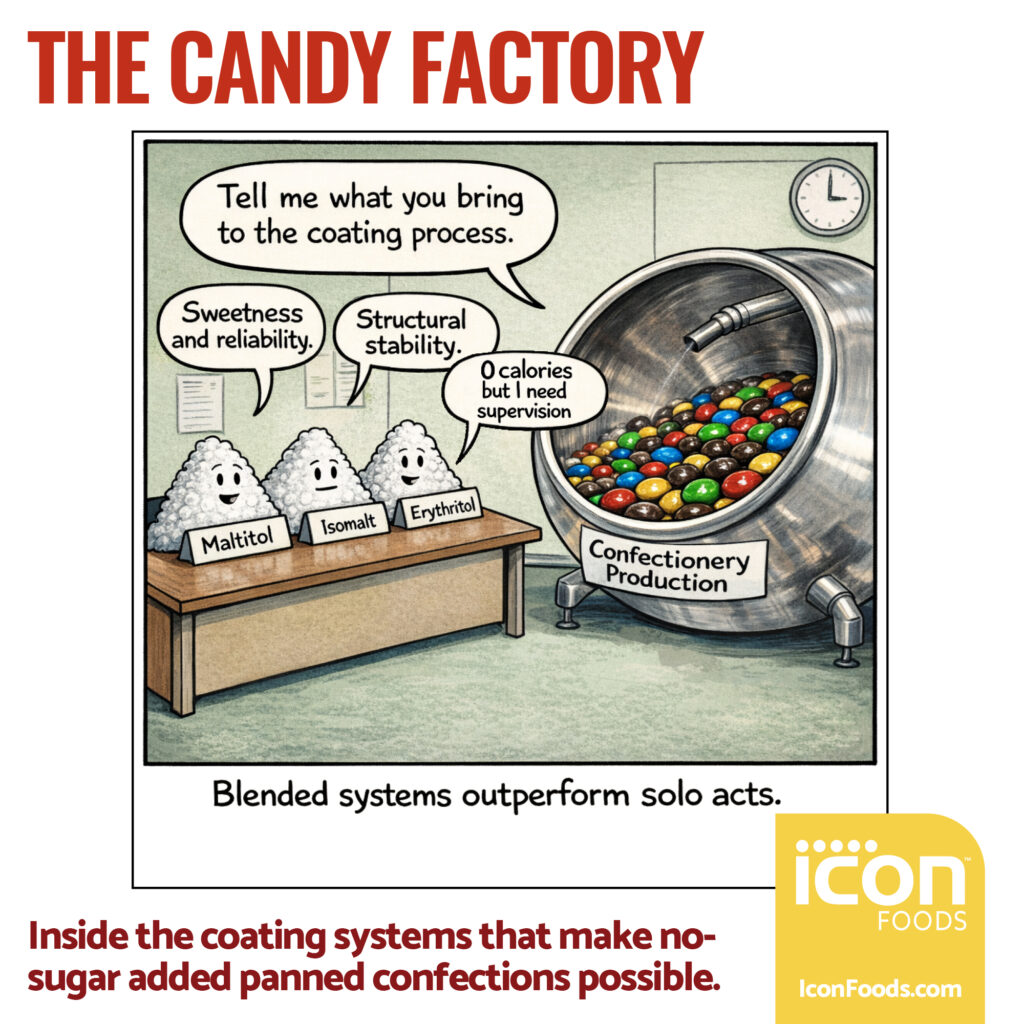
If there’s a unifying lesson in modern panned confections, it’s this: no single polyol is the hero. Blended systems outperform single-ingredient approaches every time. Maltitol brings sweetness and flow. Isomalt brings structure and environmental stability. Erythritol brings metabolic credibility and label appeal. The art is in balancing crystallization rates, sweetness curves, and thermal behavior so the coating looks good on day one and still looks good six months later under fluorescent lights.
High-intensity sweeteners can fine-tune sweetness without adding bulk. Small amounts of fibers can help with film formation and moisture control. Polishing agents and surface treatments still matter. This isn’t nostalgia candy-making. It’s applied physical chemistry in a spinning drum.
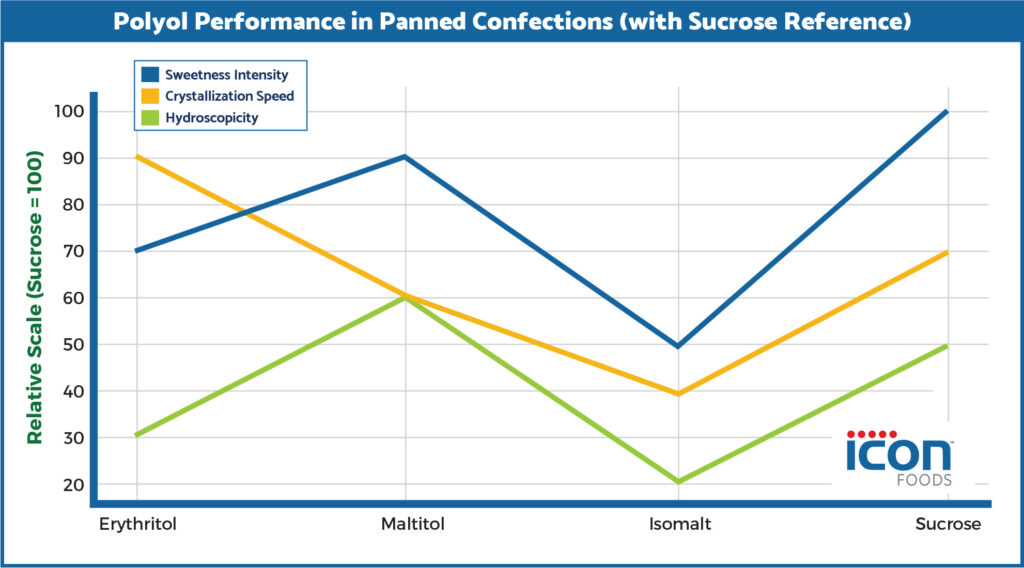
How to interpret this without kidding yourself
Sucrose is set as the 100-point reference, because that’s the ghost every panned confection is chasing whether we admit it or not.
Sweetness
- Sucrose is still the gold standard. No surprises.
- Maltitol runs impressively close, which is why it feels “right” in classic panning.
- Erythritol trails and shows its limits fast.
- Isomalt was never trying to win this category.
Crystallization speed
- Erythritol crystallizes faster than sucrose, which explains the brittleness and surface defects when processing gets sloppy.
- Maltitol is slower and more forgiving than sucrose.
- Isomalt is deliberately slow, which is exactly why it builds stable shells.
- Sucrose sits in the middle, predictable and boring.
Hygroscopicity
- Maltitol is more moisture-loving than sucrose, which matters in humid environments.
- Erythritol and isomalt both outperform sucrose here, especially for summer logistics and long shelf life.
The unvarnished truth
Sucrose is still the sensory and processing benchmark. But it’s also metabolically obsolete.
Final word from the pan room
Panned confections are deceptively complex. They reward patience, precision, and respect for the physics of sugar replacement. Maltitol, isomalt, and erythritol each solve different problems. Used lazily, they disappoint. Used intelligently, they open the door to confections that satisfy indulgence while acknowledging metabolic reality. The pan doesn’t lie. It reflects exactly how well you understand your ingredients.
And that glossy shell? It’s not decoration. It’s data.
Reach out to your Icon Foods representative for sweeteners, fibers and modulator, samples, documentation formulation and usage guidance.
Since 1999 Icon Foods has been your reliable supply chain partner for sweeteners, fibers, sweetening systems, inclusions and sweetness modulators.
Taste the Icon difference.
Order Samples