Why PreBiotica™ Deserves a Permanent Seat in Your Fiber Stack
A Field Guide for Formulators Who Are Tired of One-Note Solutions Pretending to be Systems
Summary
Most fiber strategies miss the point. Fiber isn’t a checkbox on a label, it’s a functional system inside your formulation. And when that system breaks, so does everything else: texture, sweetness, stability, and consumer tolerance. This paper reframes the role of fiber through the lens of performance, positioning PreBiotica™ Organic Agave Inulin as a quiet but critical structural tool. Unlike one-note fibers that solve a single problem, agave inulin works across multiple dimensions, building body, smoothing sweetness curves, and supporting gut-friendly fermentation without the usual sensory or digestive trade-offs. More importantly, it reveals how fiber stacking transforms isolated ingredients into cohesive, high-performing systems that actually replace sugar instead of imitating it. If your reduced-sugar products feel thin, unstable, or incomplete, the issue isn’t just what you’re using, it’s how you’re thinking. This is a field guide to building fiber systems that hold up in the real world.
Thom King, CFS, Food Scientist
Chief Innovations Officer, Icon Foods
Let’s get one thing straight right out of the gate, fiber isn’t an ingredient. It’s a behavioral system inside your formula. And if your fiber strategy is a single SKU tossed into a spec sheet to hit a label claim, you’re not formulating. You’re decorating. Now that we’ve cleared the air, let’s talk about one of the most underutilized, quietly powerful tools in your arsenal:
PreBiotica™ Organic Agave Inulin
This isn’t just another soluble fiber. It’s a structural, metabolic, and sensory lever that earns its keep across multiple axes when you actually know how to use it.
The Reality: Not All Fibers Pull Their Weight
Most fibers show up to do one job and one job only:
- Resistant dextrins → low viscosity, easy handling, minimal functionality
- IMO → label-friendly until it isn’t, glycemic creep, digestive roulette
- Polydextrose → functional, but let’s not pretend it’s a sensory darling
- Chicory root inulin → useful, but can bring bitterness and short-chain GI fireworks when pushed
Agave inulin walks in differently.
What Makes Agave Inulin Different
PreBiotica™ Organic Agave Inulin is a long-chain fructan with a cleaner fermentation profile and better sensory behavior than most of its peers. Translation for real-world formulation:
- It Builds Body Without Getting in the Way
- Agave inulin gives you:
- Soft, rounded mouthfeel
- Subtle viscosity without gumminess
- Improved solids contribution
- This matters when you’re replacing sugar, because sugar isn’t just sweet. It’s architecture. Agave inulin helps rebuild that architecture without hijacking the system.
- It Plays Nice With High-Intensity Sweeteners
- If you’re working with:
- Stevia (RM95, RM95D, RA99M)
- Monk fruit (V40, V50, blends)
- Thaumatin systems
- You already know the battlefield: temporal gaps, lingering sweetness, off-notes, thin mid-palate.
- You already know the battlefield: temporal gaps, lingering sweetness, off-notes, thin mid-palate.
- Agave inulin acts like a buffer layer:
- Smooths onset and decay
- Fills in the mid-palate
- Reduces perceived sharpness and bitterness
- It doesn’t sweeten much. It supports sweetness. That’s a completely different job.
- It’s a Fermentation Asset, Not a Liability
- Here’s where things get interesting.
- Agave inulin is:
- Prebiotic
- Slowly fermented
- More tolerable at higher inclusion levels vs shorter-chain FOS
- That means:
- Better gut tolerance
- More stable SCFA production
- Less consumer backlash from fiber bombs
- Less gas kinetics
- If you’re building products for GLP-1 users, metabolic health, or general wellness positioning, this is not optional. This is table stakes.
- It Survives the Real World
- Formulators don’t live in ideal conditions. You live in:
- Heat
- Shear
- Acid
- Time
Agave inulin holds up well in:
- Baked goods
- RTD beverages (with proper system design)
- Dairy and alt-dairy
- Bars and inclusions
It’s not indestructible, but it’s predictable. And predictable wins.
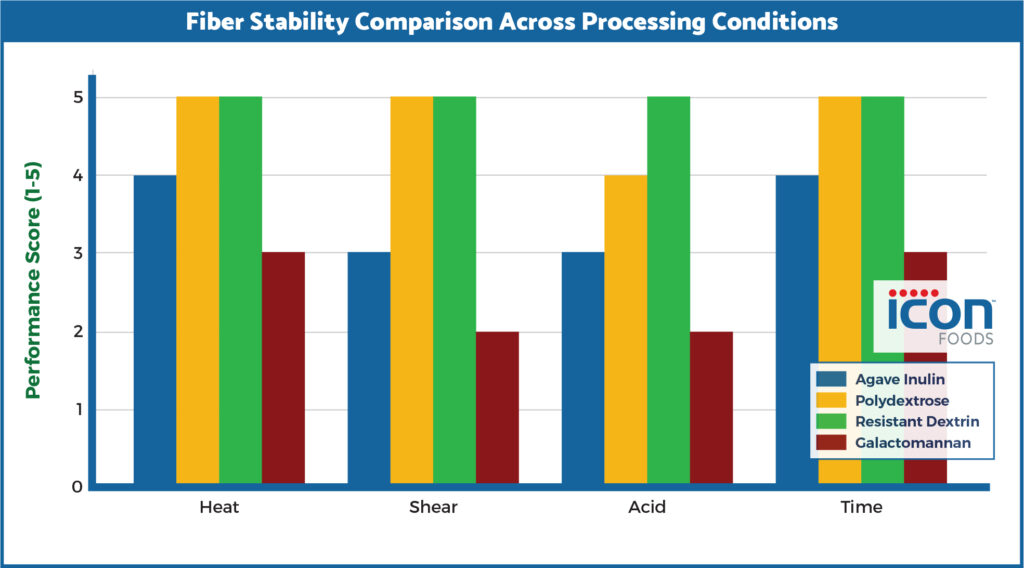
What the above chart is really telling you
- Resistant dextrin is the tank. It shrugs at heat, shear, acid, time like it’s bored. That’s why beverage guys love it. It’s almost too well-behaved… which also means it doesn’t do much structurally.
- Polydextrose is the reliable workhorse. Strong across all conditions, slightly softer under acid. Good bulk, decent stability, but sensory can get… let’s call it industrial chic.
- Agave inulin is the specialist, not the brute It holds up well to heat and time, but:
- Shear starts to chip away at structure
- Acid will hydrolyze it over time (especially low pH + heat)
That’s not a flaw. That’s chemistry doing its job. You just design around it.
- Galactomannans (guar, locust bean) are fragile under pressure
- Shear knocks viscosity down fast
- Acid + heat will break them
- Great texture tools… until you abuse them
Where Agave Inulin Shines (Applications That Actually Matter)
Beverage Systems (RTD, Dairy, Alt-Dairy)
Use it to:
- Build body and mouthfeel in reduced-sugar systems
- Support high-intensity sweetener curves
- Add fiber without wrecking clarity (at controlled levels)
Typical use: 1–3%, depending on system and clarity targets
Baked Goods
This is where it earns a standing ovation. Agave inulin contributes to:
- Moisture retention
- Tender crumb
- Reduced water activity
- Shelf-life extension
Typical use: 3–8%, often paired with allulose or glycerin for full functionality
Nutrition Bars & Snacks
- Binds without excessive stickiness
- Improves chew
- Supports fiber claims without GI rebellion
Typical use: 5–15%, usually in a fiber stack
Confectionery
- Adds bulk
- Softens texture
- Reduces sugar load without turning your product into a science experiment
The Real Power Move: Fiber Stacking
Here’s where most people miss the plot. Agave inulin is not the hero. It’s the keystone. A high-functioning fiber system might look like:
- Agave inulin > structure, tolerance, mid-palate
- Soluble tapioca fiber > bulk, low viscosity
- Gum acacia > emulsification, digestive tolerance
- PHGG > gut health positioning, low viscosity
Each fiber does a job. Together, they behave like a system that actually replaces sugar instead of pretending to.
Formulation Reality Check
Let’s cut through the marketing fog:
- Agave inulin alone will not fix your product
- Overuse will still lead to GI issues
- It requires balance with sweeteners, acids, and processing conditions
But when used correctly? It becomes one of the cleanest, most elegant tools you have.
Why PreBiotica™ Specifically
You’ve got options in the market. Most are inconsistent, poorly characterized, or come with supply chain baggage. PreBiotica™ Organic Agave Inulin brings:
- Organic certification
- Consistent DP profile
- Reliable supply
- Clean sensory performance
That last one matters more than most people admit.
If your reduced-sugar product tastes hollow, collapses under heat, or leaves consumers wondering why their gut is staging a protest, it’s not your sweetener. It’s your system. And PreBiotica™ Organic Agave Inulin is one of the smartest ways to start fixing it. If you want to build products that actually survive contact with reality, stop thinking in single ingredients. Start building systems. And make sure agave inulin is in the room when you do.
Reach out to your Icon Foods representative for And PreBiotica™ Organic Agave Inulin samples, documentation formulation and usage guidance.
Since 1999 Icon Foods has been your reliable supply chain partner for sweeteners, fibers, sweetening systems, inclusions and sweetness modulators.
Taste the Icon difference.
Order Samples of PreBiotica™ Organic Agave Inulin