Formulating the Next Wave of Non-Alcoholic Beverages
Summary
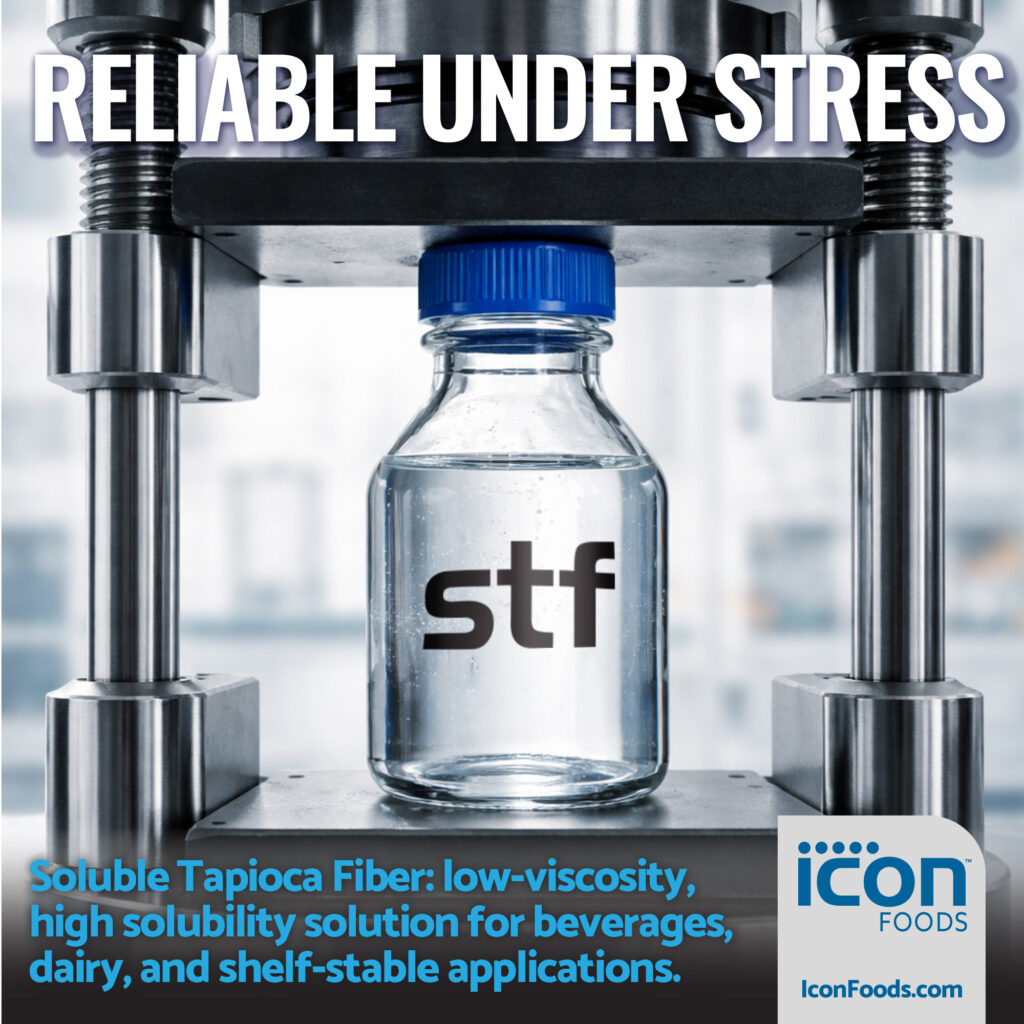
Soluble tapioca fiber, also known as tapioca-derived resistant dextrin, is emerging as a quiet hero in modern formulation, delivering fiber functionality that holds up under the real-world pressures of heat and acidity. In this white paper, Thom King explores the chemistry behind how this ingredient maintains its structure through low-pH environments and demanding thermal processes like pasteurization, hot-fill, UHT, and baking. Drawing from regulatory guidance, peer-reviewed research, and industry data, the paper shows how soluble tapioca fiber offers formulators a reliable, low-viscosity, high-solubility solution for beverages, dairy, and shelf-stable applications, without sacrificing label integrity or performance when conditions get tough.
Thom King, CFS, Food Scientist
Chief Innovations Officer, Icon Foods
Soluble tapioca fiber, chemically a resistant dextrin (RS4) produced by acid/heat dextrinization and trans-glucosidation of tapioca starch, exhibits high solubility, low viscosity, and demonstrated stability across acidic pH and common thermal processes (pasteurization, hot-fill, retort, UHT, baking). Converging evidence from a U.S. FDA GRAS dossier specific to tapioca-derived resistant dextrin, peer-reviewed studies on resistant dextrin formation and behavior, and technical bulletins on structurally analogous resistant dextrins shows minimal degradation (no meaningful molecular-weight loss) at pH 2–7 over storage and thermal resilience up to 150–200 °C for typical dwell times. Practical guidance is provided for beverage pH 2.5–4.2, RTD dairy pH ~6.6, and high-temperature processes. Contrasts with isomaltooligosaccharides (IMO) are noted for completeness. (U.S. Food and Drug Administration)
Background & Chemistry
Resistant dextrin (RD) is generated when starch is thermally treated under mildly acidic, low-moisture conditions, breaking α-1,4/α-1,6 linkages and re-polymerizing into a random matrix of α- and β-glycosidic linkages (e.g., β-1,2; β-1,4; β-1,6) that are poorly hydrolyzed by human enzymes. Tapioca starch is a validated substrate; GRAS Notice No. 1045 names the material “resistant dextrin (tapioca), aka soluble tapioca fiber” and documents its identity, manufacture, and intended food uses (including beverages). This chemistry underpins the ingredient’s acid/thermal robustness relative to native starch or conventional maltodextrin. (U.S. Food and Drug Administration)
Key production chemistry and process parameters (pyro-/dextrinization with acid catalyst; moisture ≤ ~5%; T ≥ 100 °C) have been described across tuber and cereal starches, and they directly relate to downstream stability in low-pH matrices. (ScienceDirect)
Evidence for Acid Stability (Low pH)
- Regulatory/primary identity (tapioca-specific)
- FDA GRAS Notice No. 1045 (Aug 2024) for tapioca-derived resistant dextrin (FibRefine®-tapioca) confirms intended uses across beverages and other acidic foods, supporting the ingredient’s suitability in low-pH systems from a safety and identity standpoint. While the dossier centers on safety, it consolidates literature showing compositional similarity and functional parity with corn/wheat resistant dextrins that are established as acid-stable. (U.S. Food and Drug Administration)
- Roquette NUTRIOSE® technical data demonstrate solution stability from pH 2–7 with no meaningful molecular-weight (MW) decrease during 90-day storage at 20 °C, and MW unchanged through common food processes (incl. beverage processing, sterilized soups, yogurts, breads, confectionery). These datasets are widely referenced to substantiate acid stability at soda/juice pH (≈ 2.5–3.8). (Scribd)
- Recent reviews summarize RD’s stability in both acidic and alkaline environments, aligning with the technical bulletins above. (ScienceDirect)
- Stability data from structurally analogous resistant dextrins
- Roquette NUTRIOSE® technical data demonstrate solution stability from pH 2–7 with no meaningful molecular-weight (MW) decrease during 90-day storage at 20 °C, and MW unchanged through common food processes (incl. beverage processing, sterilized soups, yogurts, breads, confectionery). These datasets are widely referenced to substantiate acid stability at soda/juice pH (≈ 2.5–3.8). (Scribd)
- Recent reviews summarize RD’s stability in both acidic and alkaline environments, aligning with the technical bulletins above. (ScienceDirect)
Formulation implication: For acid beverages (pH 2.5–4.2), tapioca RD behaves like other resistant dextrins: fully soluble, low viscosity, and acid-stable, with no need for pH neutralization or starch protection strategies. (Scribd)
Evidence for Thermal Stability
- Thermal processes and typical limits
- Multiple technical sources on resistant dextrin (including RD used in carbonated beverages) report heat stability up to 150–200 °C for up to ~60 min, spanning pasteurization, hot-fill/retort, and UHT conditions. MW is not affected by representative processes, indicating no chain scission of practical concern under standard thermal profiles. (satorianutrisentials.com)
- Bench and literature signals
- Peer-reviewed work on resistant dextrin formation and characterization shows that heating time, pH, and temperature affect solubility; once formed, RD preparations exhibit very high solubility (~99%) and solution stability. (PMC)
- Production studies across tuber starches (incl. potato; model for tapioca) confirm thermally robust RD matrices post-dextrinization. (MDPI)
Formulation implication: HTST pasteurization, hot-fill (85–95 °C), retort, and UHT (135–145 °C) are compatible with soluble tapioca fiber without protective carriers. Expect no viscosity drift and no loss of fiber content at application-standard dwell times. (satorianutrisentials.com)
Practical Data Summary (from cited sources)
| Property | Reported Range / Observation | Source(s) |
|---|---|---|
| Solubility | ≈ 99% soluble RD (post-production); solutions clear at 10% | (PMC) |
| pH Stability (solutions) | pH 2–7: no MW loss over 90 days @ 20 °C (acid beverages compatible) | (Scribd) |
| Thermal Resilience | 150–200 °C up to ~60 min; MW not affected by common food processes (baking, sterilization, UHT) | (Biogreen Science) |
| Viscosity | Low and shear/temperature-tolerant; beverage-friendly | (roquette.com) |
| Processing formats | Syrup/powder; pH of syrups typically ~3.5–5.5; beverage, gummies, baked goods | (Sgnutri INC.) |
| Regulatory identity (tapioca) | GRAS 1045: “resistant dextrin (tapioca)” / “soluble tapioca fiber” intended for use incl. beverages | (U.S. Food and Drug Administration) |
Formulation framework (clean-label, low-sugar)
Because “soluble tapioca fiber” is sometimes confused with IMO, it’s useful to separate the two:
- IMO: Several sources note good pH stability (often cited pH ~2–9) but flag potential degradation with prolonged heat in high-acid systems, relevant to retort and extended hot-hold scenarios. (Bayn Solutions)
- Tapioca RD (resistant dextrin): Built from more diverse linkage patterns (including β-linkages) and documented to withstand low pH and high heat with MW preserved under common processing stresses. (U.S. Food and Drug Administration)
Bottom line: If your goal is maximum fiber retention and label-friendly performance under acid + heat, tapioca RD provides a wider operating window than IMO in aggressive thermal profiles. (Biogreen Science)
Formulation & Process Guidance
- Beverages (pH 2.5–4.2, carbonated or still)
- Use 2–5% w/w for fiber claims/bulking; expect clear solutions and low viscosity.
- Thermal steps (tunnel pasteurization, hot-fill) are compatible; no neutralization needed. (Scribd)
- UHT dairy & protein RTDs (pH ~6.6–7.0)
- Indirect or direct UHT (135–145 °C, seconds) maintains fiber integrity; watch minerals/protein interactions for haze, not RD degradation. (satorianutrisentials.com)
- RD tolerates baking and short-time high-heat without MW loss; use for bulk, binding, and water activity management. (Biogreen Science)
- Baking/extrusion/confectionery
- RD tolerates baking and short-time high-heat without MW loss; use for bulk, binding, and water activity management. (Biogreen Science)
- Do’s & Don’ts
- Do add RD to syrup phases early; it hydrates quickly and stays clear.
- Do validate finished-goods fiber by AOAC 2009.01/2011.25 in final matrices. (U.S. Food and Drug Administration)
- Don’t assume all “tapioca fibers” are equivalent, verify resistant dextrin vs IMO on spec sheets and GRAS/DF status. (U.S. Food and Drug Administration)
- Limitations & Considerations
- Most pH/heat datasets with detailed MW tracking are from corn/wheat RD (e.g., NUTRIOSE) but are chemically and functionally representative of tapioca RD per FDA GRAS 1045 and comparative literature on RD across starch sources. Always confirm source-specific specs (linkage distribution, DP, ash, pH) with your supplier. (U.S. Food and Drug Administration)
Conclusion
The weight of evidence supports that soluble tapioca fiber (tapioca-derived resistant dextrin) is fit-for-purpose in low-pH beverages and robust to thermal processing, with documented stability at pH 2–7 and temperature tolerance up to at least typical UHT/baking conditions without loss of functional MW or labeled fiber. For formulators under tariff/tolerance pressure to move away from polyols or IMO in acidic RTDs, tapioca RD offers a clean-label, stable path that preserves fiber claims and sensory performance. (Scribd)
Since 1999, Icon Foods has been your reliable supply-chain partner for sweeteners, fibers, sweetening systems, inclusions, and sweetness modulators.
Reach out to your Icon Foods representative samples, documentation, and formulation guidance for: FibRefine P90 and L90 soluble tapioca syrup or powder.
Taste the Icon Difference
References (selected)
- FDA GRAS Notice No. 1045 – Resistant dextrin (tapioca), identity, manufacture, intended uses, analytical methods. U.S. Food & Drug Administration (Aug 15, 2022). (U.S. Food and Drug Administration)
- Trithavisup K. et al. In-depth study of the changes in properties and molecular structure of resistant dextrin during dextrinization. Food Chem. 2019. Notes acid/heat pyro-conversion parameters related to downstream stability. (ScienceDirect)
- Zhen Y. et al. Purification and Characterization of Resistant Dextrin. Foods 2021. Reports very high solubility and discusses pH/temperature influences on RD solutions. (PMC)
- Dong K. et al. Physicochemical properties and health benefits of resistant dextrins. Curr Opin Food Sci 2025. Summarizes RD heat and acid stability in applications. (ScienceDirect)
- Roquette NUTRIOSE® stability bulletins (solutions pH 2–7 stable over 90 days; MW unaffected by common processes; rated “5/5” solubility at acid pH and “5/5” heat stability). Technical sheets and conference data. (Scribd)
- Satoria Nutrisentials articles (industry technical summaries): RD heat tolerance 150–200 °C, acid stability; application to carbonated drinks and UHT/processing. (Use as corroborative tech notes alongside peer-reviewed/regulatory sources.) (satorianutrisentials.com)
- Specification examples for tapioca RD syrup (pH 3.5–5.5; ≥ 90% fiber) indicating inherent acid environment and application in beverages. (Spec sheets should be validated with your supplier.) (Sgnutri INC.)
- Contrast references for IMO stability claims (generally ok in acid, but watch prolonged heat in high-acid systems). (Bayn Solutions)
Appendix A: Quick Validation Protocols (R&D)
- Bench test (acid beverage): 10% RD solution, pH 2.8 and 3.5, 20 °C and 40 °C, 90 days; measure DP/MW by SEC-MALS and fiber content by AOAC 2009.01 at T0/T30/T60/T90. Expect no significant MW loss and fiber label claim preserved. (Scribd)
- Process stress test: Simulate UHT 140 °C/6 s, hot-fill 92 °C/30 s, and bake 180 °C/10 min; re-assay MW and AOAC fiber. Expect no practical degradation. (Biogreen Science)
Order Samples
x