And If Your Formulation Hasn’t, Your Product Will Tell on You
Summary
Stevia didn’t fail—our expectations did. For years, it was treated as a one-for-one replacement for sugar, leading to products that tasted thin, unbalanced, or just “off.” The issue was never sweetness alone. Sugar is a system, contributing bulk, water management, browning, texture, and timing. Remove it, and you create a structural gap that stevia cannot fill on its own. What’s changed today isn’t just better stevia—it’s a better understanding of how to use it. When stevia is treated as a precision tool within a broader formulation system—supported by allulose, polyols, and fibers—the result is no longer a compromise, but a complete, high-performing product.
Thom King, CFS, Food Scientist
Chief Innovations Officer, Icon Foods
For years, stevia was sold as a replacement for sugar. Natural, zero calorie, hundreds of times sweeter, problem solved. That thinking produced a decade of products that all shared the same fate: they tasted like something was missing. Because something was. Sugar is not just sweetness. It is bulk, water management, browning, texture, and timing. Pull it out and you don’t have a sweetness problem. You have a structural problem. Stevia was never going to fix that on its own.
What has changed is not just the quality of stevia. It’s the understanding of how to use it. Today, stevia works, but only when it’s treated as one part of a system instead of the solution itself.
Stevia Is Finally Acting Like a Tool
The industry spent too long pretending all stevia was the same. It isn’t. Modern systems are built around specific glycoside behavior:
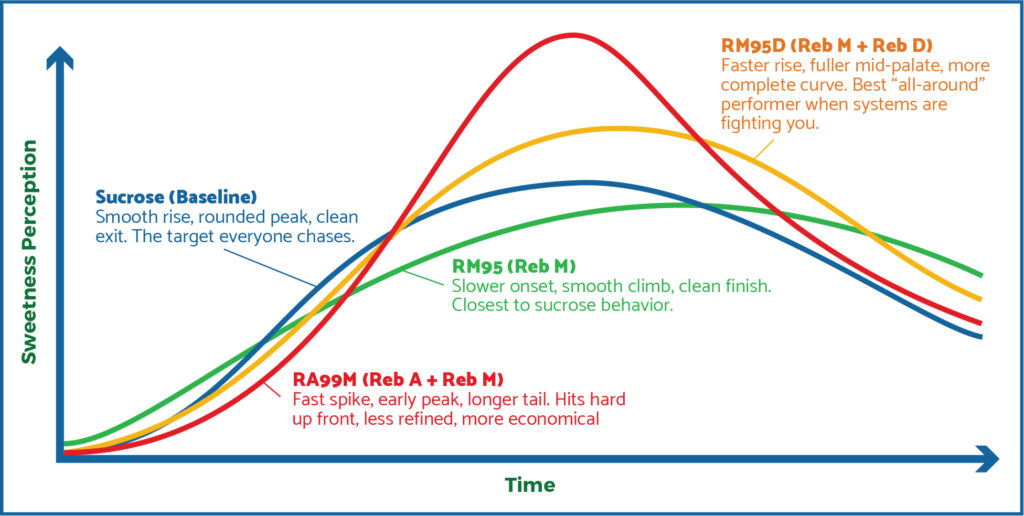
- RM95 (Reb M) delivers the cleanest, most sugar-like profile. Smooth, controlled, and relatively free of bitterness when used correctly.
- RM95D (Reb M + Reb D) adds shape to the sweetness curve. Faster onset, more presence in the mid-palate, better performance in difficult systems.
- RA99M (Reb A + Reb M) brings speed and cost efficiency. More aggressive up front, less refined, but highly useful in the right applications.
These are not upgrades of the same ingredient. They are different tools for different jobs. And none of them replace sugar alone.
The Real Shift: From Sweetener to System
hen sucrose comes out, you create a gap. Not just in sweetness, but in structure. That gap gets rebuilt using four levers:
Allulose carries the load. It brings bulk, contributes to browning, depresses freezing point, and helps rebuild the mid-palate that disappears when sugar is removed.
Polyols restore solids and drives down water activity. Erythritol, glycerin, isomalt, and maltitol each solve different problems, with trade-offs in cooling, tolerance, and cost.
Fibers do the quiet work. They bind water, build viscosity, smooth out temporal gaps, and extend sweetness perception. They are also where nutritional positioning starts to show up.
Stevia sits on top of all of it. It controls sweetness intensity, but it is not responsible for structure.
That’s the system. When it works, the product feels complete. When it doesn’t, the defects are obvious.
Where Formulations Usually Break
Most reduced-sugar products fail in predictable ways:
They taste thin because bulk wasn’t replaced.
They dry out because water wasn’t managed.
They spike and fade because the sweetness curve wasn’t built.
They linger because stevia was pushed too hard without support.
Changing the stevia rarely fixes these problems. Rebuilding the system does.
How the Stack Plays Out in the Real World
In clear beverages, where there’s nowhere to hide, allulose provides just enough body to keep the system from feeling hollow, a small amount of erythritol can sharpen the profile if used carefully, and a light fiber layer smooths the finish. This is where RM95D tends to outperform, because the system needs help on the front end.
In dairy and frozen applications, fat and protein give you some cushion, but they also expose off notes. RM95 often wins here for its cleaner profile, supported by allulose for bulk and inulin for creaminess and water control.
Protein systems are less forgiving. Bitterness, astringency, and mineral interference show up quickly. This is where the stack matters most, fiber to buffer, allulose to round, and typically RM95D to ensure the sweetness shows up before the protein does.
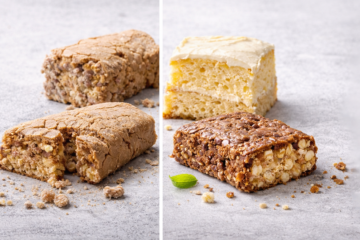
Bakery is where the illusion breaks completely. Sugar is doing too many jobs to ignore. Allulose drives browning and moisture, polyols rebuild solids, fibers control water and softness over time, and stevia simply finishes the sweetness. When bakery fails, it’s almost never because of the stevia choice. It’s because the structure wasn’t rebuilt.
Confection and chewy systems are a timing exercise. Polyols carry the bulk, allulose softens the bite, fiber adjusts chew, and the stevia system determines how the sweetness rises and falls. Here again, RM95D often provides the most complete curve.
Across categories, the pattern holds: stevia is the smallest component by weight and the easiest to blame, but rarely the root cause.
The Quiet Advantage: Fiber and Metabolic Response
There’s another layer to this that formulators are starting to pay attention to. When fiber is doing its job structurally, it also changes how the product behaves metabolically. Higher soluble fiber levels slow glucose response, contribute to satiety, and align with how consumers, especially those influenced by GLP-1 therapies, are now eating.
Those consumers are not chasing maximum sweetness. They’re looking for control, stability, and products that don’t trigger overconsumption. That lines up directly with:
- moderated sweetness curves
- higher fiber inclusion
- lower glycemic load systems
In other words, the same formulation decisions that fix texture and stability also create a more relevant nutritional profile. That’s not a marketing layer added after the fact. It’s a formulation advantage built in from the start.
Choosing the Right Stevia Within the System
If the system is built correctly, the choice of stevia becomes clearer:
- Use RM95 when you want the cleanest, most refined sweetness and the system already has enough support.
- Use RM95D when the formula is more demanding and needs help with onset, balance, and a slower decay rate.
- Use RA99M when cost, speed, and impact matter, and the rest of the system can carry the edges.
The mistake is expecting any of them to carry the full load.
The industry spent years asking whether stevia could replace sugar. That was the wrong question. The real question is: Can your formulation replace what sugar actually does? Because sugar isn’t an ingredient. It’s a system. And once you understand that, stevia stops being a problem and starts being a precision tool. Everything else is how well you build around it.
Reach out to your Icon Foods representative for SteviaSweet stevia samples, documentation formulation and usage guidance.
Taste the Icon difference.
Order free samples from Icon