— with Botanicals and Adaptogens
Summary
Functional beverages packed with botanicals and adaptogens present a unique sweetness challenge, especially in low-pH systems where acidity, bitterness, and astringency can distort taste perception. This white paper explores how stevia and monk fruit behave under these demanding conditions and shows why successful formulation depends on synergy rather than single-sweetener solutions. By combining high-purity stevia glycosides, monk fruit extracts, polyols, fibers, and natural flavor modulators, formulators can build layered sweetness curves that restore early onset, mid-palate depth, and clean finish, even in complex botanical matrices. The paper outlines the chemistry behind sweetness suppression at low pH, the sensory impact of adaptogens and plant extracts, and practical stacking strategies that improve balance, mouthfeel, and consumer acceptance. The result is a framework for creating clean-label functional beverages that taste intentional, not engineered, and deliver both performance and pleasure in every sip.
Thom King, CFS, Food Scientist
Chief Innovations Officer, Icon Foods
The Better-for-You Beverage Boom
The functional beverage market is evolving faster than ever. Once upon a time, you could slap “Vitamin Enhanced” or “Natural Energy” on a label and call it innovation. Today, consumers want more, adaptogens, nootropics, botanicals, fibers, prebiotics, and of course, clean label sweetness.
But as formulators know, sweetness in these systems isn’t plug-and-play. When you drop stevia or monk fruit into a low-pH, botanical-heavy matrix, the chemistry, and the sensory perception, start doing backflips. The challenge is no longer how to sweeten, but how to make it feel right in the mouth, nose, and brain.
The Chemistry of Sweetness at Low pH
Functional beverages often sit around pH 3.2–3.9, depending on the acidulants used (citric, malic, tartaric, phosphoric, etc.). At these levels:
- Stevia glycosides (Reb A, D, M) remain stable under pasteurization but can exhibit slightly higher astringency and delayed onset due to increased protonation at low pH.
- Monk fruit mogrosides (primarily V) are remarkably stable under acid conditions but can take on metallic or lingering notes if the system doesn’t provide enough mid-palate weight.
- The acid-base interplay also affects sweetness perception. Sourness suppresses sweetness, meaning your 8° Brix sweetness equivalency at neutral pH can feel like 5° Brix in a botanical energy drink.
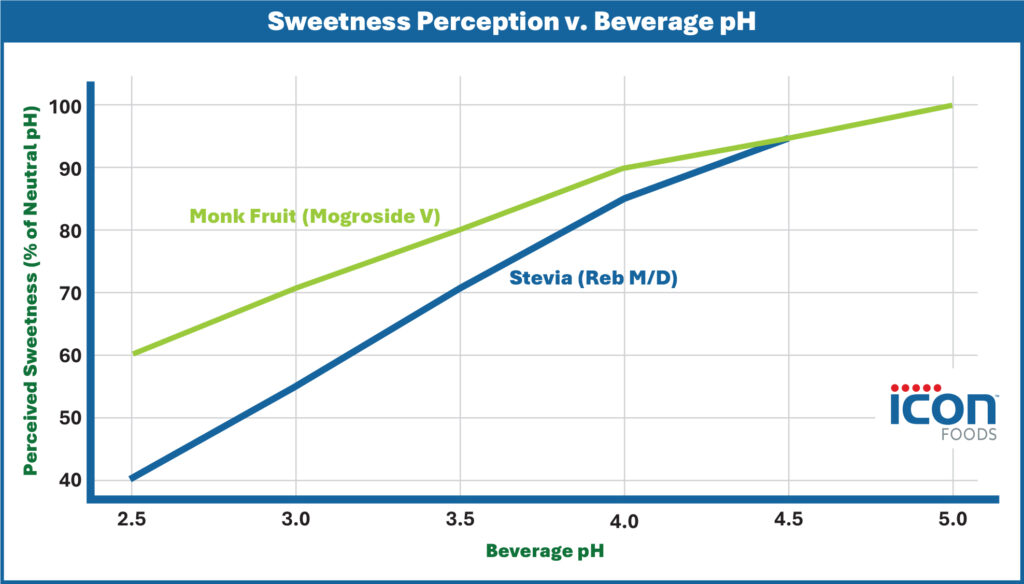
The above chart illustrates Sweetness Perception vs Beverage pH — showing how both stevia and monk fruit lose sweetness intensity as acidity increases, with monk fruit maintaining slightly higher perceived sweetness below pH 4.
The Botanicals Factor: When Nature Fights Back
Botanical extracts and adaptogens, think ashwagandha, rhodiola, schisandra, ginseng, maca, holy basil, each bring their own set of bitter alkaloids, tannins, and terpenes to the party. These compounds can bind to sweet receptors, mask sweetness, and introduce off-flavors that amplify stevia’s bitterness or monk fruit’s lingering licorice notes.
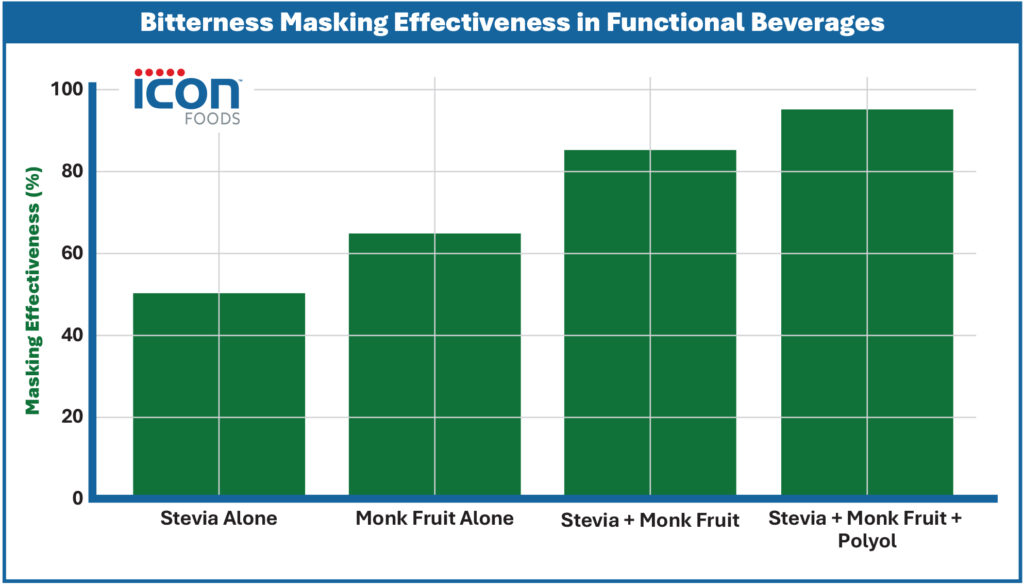
The above graph illustrates Bitterness Masking Effectiveness — demonstrating how combining stevia, monk fruit, and a polyol (like allulose or erythritol) significantly improves balance and reduces bitterness in functional beverage matrices.
The Sensory Knock-On Effects:
- Bitterness masking becomes harder as pH drops below 3.8.
- Astringent compounds (polyphenols, flavonoids) enhance dryness perception, making the beverage feel less sweet.
- Volatile botanicals (ginger, citrus, mint, adaptogenic roots) can “fight” with stevia’s lingering sweetness for attention in the retronasal phase.
This is why functional beverage formulation is less about picking the right sweetener, and more about orchestrating a flavor matrixthat respects sweetness dynamics.
The Sweetener System: Crafting the Perfect Stack
To build a beverage that tastes naturally sweet and balanced in a low-pH, functional system, think synergy over singularity. Here’s a tested framework:
| Component | Function | Use Level (typical) | Notes |
|---|---|---|---|
| SteviaSweet™ RM95 or RA99M | High-purity rebaudiosides (M or D preferred) | 80–120 ppm | Clean sweetness, minimal bitterness when paired with monk fruit |
| MonkSweet™ V50 | Mogroside V extract | 0.004–0.008% | Adds roundness and mid-palate depth |
| Allulose or Erythritol | Bulking and early sweetness perception | 0.5–2% | Bridges the temporal gap in sweetness |
| PreBiotica™ Inulin or FibRefine™ Soluble Tapioca Fiber | Mouthfeel and rounding | 1–3% | Adds body, improves top notes of fruit and tea botanicals |
| Natural flavor modulator (e.g., thaumatin, brazzein, or proprietary sweet enhancer) | Enhances sweetness intensity | 10–50 ppm | Counteracts adaptogen bitterness and supports sugar-like onset |
Best Practices for Success
- Target a Blended Sweetness Curve
Don’t chase sucrose equivalence point-for-point. In low-pH beverages, aim for a perceived sweetness of 7°–8° Brix (sucrose equivalent), not 10°. This allows botanicals and acids to breathe while maintaining balance. - Front-load sweetness perception.
Allulose, erythritol, and flavor modulators can push sweetness forward on the curve, offsetting stevia’s delayed onset. - Use stevia + monk fruit together.
The combination flattens bitterness, rounds the curve, and adds complexity that mirrors sucrose’s fast rise and clean finish. - Pre-condition stevia extracts in acidic environments.
Dissolving stevia into an acidified pre-blend (citric/malic buffer) for 24 hours before batching can mellow sharp notes. - Leverage fibers for mouthfeel.
Tapioca- or chicory-based fibers like FibRefine™ or PreBiotica™ mimic the “sugar weight” that’s often missing in zero-sugar systems. - Flavor maskers ≠ silver bullets.
Use natural flavors that complement botanicals, e.g., citrus + ashwagandha, berry + rhodiola, instead of masking across the board. - Test sweetness perception in context.
Always run sensory panels with the full functional matrix, adaptogens, acidulants, flavors, and carbonation, since sweetness perception is nonlinear in low-pH systems.
The Takeaway: Sweetness Is Contextual
In the clean-label, functional beverage world, sweetness isn’t just chemistry, it’s choreography. Stevia and monk fruit are powerful tools, but their performance depends on the pH, the botanical entourage, and the modulating agents that shape the flavor experience.
A well-balanced system doesn’t hide the functional ingredients, it frames them. The goal isn’t to mimic sugar, it’s to create a drinking experience that feels both authentic and intentional. And that’s where the real magic, and margin, live.
Order Samples