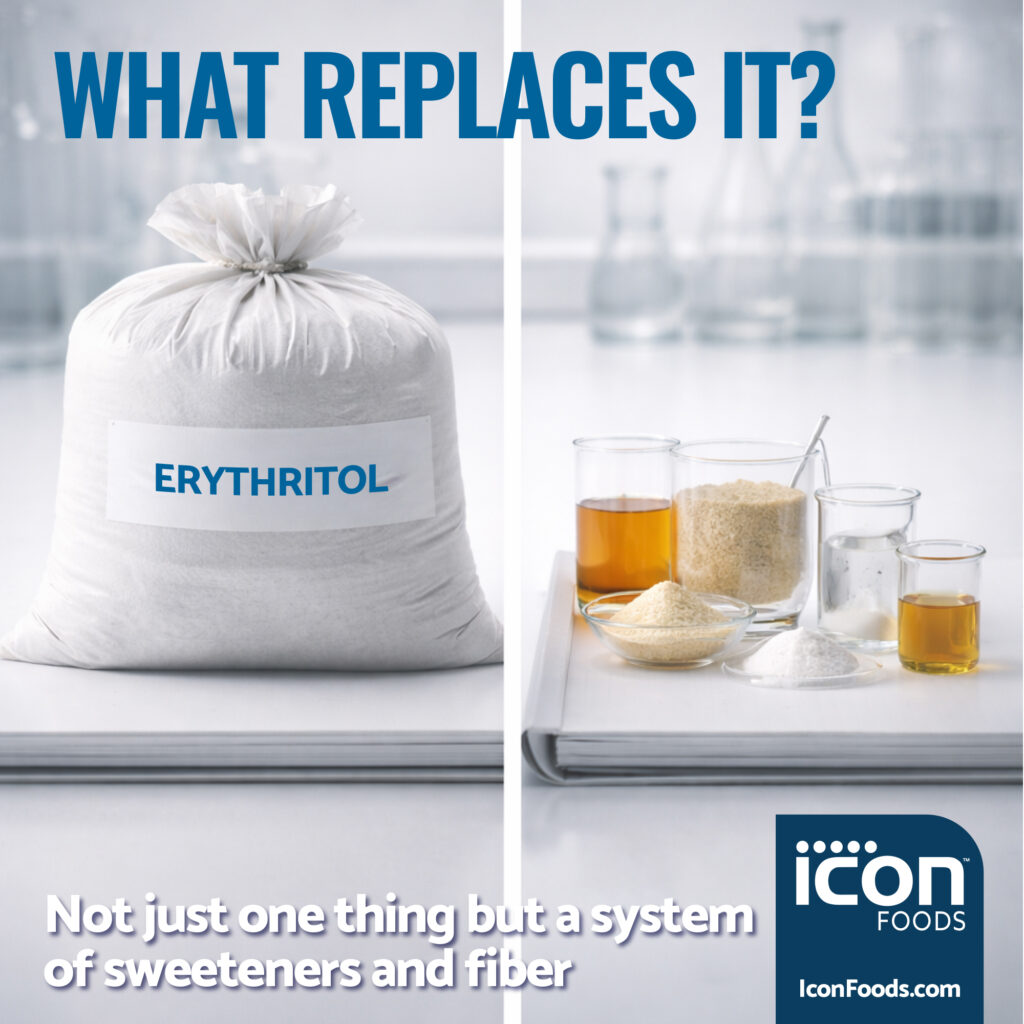
Sweetener Breakups Are Hard: Why the Industry Is Quietly Moving on from Erythritol (and What to Do Instead)
Summary
Erythritol hasn’t been banned, and it hasn’t stopped functioning. What’s changed is risk. Once a quiet, reliable workhorse in sugar reduction, erythritol now carries perception volatility and trade exposure that smart brands can’t ignore. The real issue isn’t safety, it’s dependency. As consumer headlines linger and global supply pressures threaten margin stability, one-to-one ingredient swaps simply won’t solve the problem. Modern sugar reduction demands systems thinking: blending rare sugars like allulose, soluble fibers, advanced steviol glycosides, and selective polyol use to distribute functional, regulatory, and cost risk. The brands that win won’t react under pressure. They’ll transition strategically, designing formulations built to survive volatility before it hits.
Thom King, CFS, Food Scientist
Chief Innovations Officer, Icon Foods
Erythritol didn’t ghost us. It didn’t get banned. It didn’t suddenly stop working. What it did do is drift from “safe, boring, and reliable” into “controversial, trade-exposed, and margin-risky.” And in formulation, boring is beautiful. Risky is not.
For years, erythritol was the dependable friend who showed up on time, didn’t complain, and paid for half the meal. Then the headlines hit. Then the trade noise started. Then procurement ran the numbers and stopped smiling.
This paper isn’t a hit piece. It’s a reality check. Because the problem isn’t erythritol itself. The problem is how much of the industry quietly built its house on it.
The Real Issue: Dependency, Not Ingredients
Two forces changed the calculus.
First, consumer perception. Epidemiological studies linking elevated circulating erythritol levels with cardiovascular events entered the media cycle and never left. The science is nuanced. The headlines were not. In the consumer’s mind, erythritol now shares a table with ingredients that may be safe but are emotionally suspect. In better-for-you categories, that matters. A lot.
Second, trade risk. The U.S. erythritol supply is still heavily import-dependent, with China historically dominating production. Antidumping and countervailing duty petitions are no longer hypothetical. Anyone who lived through stevia extract duties, citric acid enforcement, or vitamin C volatility knows the movie. When duties land, COGS spike, pricing breaks, contracts get reopened, and margins evaporate before finished goods pricing can catch up.
Erythritol didn’t become unusable. It became unpredictable. And formulation hates unpredictability.
Why Simple Swaps Fail
Erythritol worked because it quietly did five jobs at once: bulk, sweetness delivery, solubility, cooling, and flavor moderation. That convenience bred laziness. Many formulations weren’t designed to be sweet. They were designed to be erythritol-compatible.
So when teams ask, “What replaces erythritol?” the honest answer is: nothing, one-to-one.
Which brings us to the polyol question.
Maltitol and Isomalt: Tools, Not Saviors
Yes, maltitol and isomalt are options. No, they are not magic.
Maltitol
Maltitol behaves well. It delivers about 90 percent of sucrose sweetness, provides excellent bulk, and avoids erythritol’s aggressive cooling effect. It performs beautifully in chocolate, bars, coatings, and fillings where texture matters more than metabolic purity.
The trade-offs are real: calories, higher glycemic impact, and GI tolerance limits. Maltitol is a functional replacement, not a metabolic one. If your brand promise allows calories and your priority is structure and mouthfeel, it earns its place. If your value proposition is zero-everything, it does not.
Isomalt
Isomalt is structural, not sweet. Low hygroscopicity, high thermal stability, clean crystallization. It shines in hard candy, panning, lozenges, and decorative confections.
But isomalt needs help. Sweetness onset is slow, intensity is low, and it still carries polyol GI considerations. Think scaffolding, not centerpiece.
The industry mistake would be swinging from erythritol dependence to polyol dependence. That just trades one risk concentration for another.
The Smarter Path: Systems, Not Swaps
Modern sugar reduction isn’t about hero ingredients. It’s about unbundling functions and spreading risk.
Allulose
Allulose behaves like food, not chemistry. Bulk, browning, freezing point depression, and a sweetness curve that plays nicely with real systems. It’s not cheap, and it requires supply planning, but from a formulation standpoint it solves problems instead of creating them.
If erythritol steps back, allulose steps forward.
Soluble Fibers
Soluble tapioca fiber, resistant dextrins, and inulin now carry real weight in formulation. They provide solids, round mouthfeel, stabilize sweetness delivery, and improve nutritional storytelling without hijacking flavor.
Fibers don’t need to be sweet. They make sweetness behave.
Polydextrose
Not trendy. Still effective. Polydextrose remains a workhorse bulking agent in beverages, bars, and baked systems when GI tolerance is handled correctly. It’s predictable, heat-stable, and boring in the best possible way.
What Smart Teams Are Actually Doing
They’re not ripping erythritol out overnight. They’re reducing dependency.
They are:
- Lowering erythritol inclusion instead of centering it
- Pairing allulose and other polyols with fibers for bulk and texture
- Using modern steviol glycoside blends and sweetness modulators for lift, not brute force
- Designing formulations that survive trade shocks, perception shifts, and supply volatility
This is formulation as risk management, not ideology.
Where Icon Foods Comes In
This is exactly where Icon Foods operates.
Icon Foods doesn’t push single-ingredient dogma. We build sweetening systems that deliberately spread functional, regulatory, perception, and COGS risk.
That means:
- Rare sugars like allulose for real sugar functionality
- Soluble fibers to carry bulk and mouthfeel
- Next-generation steviol glycoside blends and sweetness modulators for clean lift
- Strategic, restrained use of polyols only when function truly demands it
The outcome is formulations that hold up in processing, shelf life, sensory reality, and procurement meetings.
The Bottom Line
Erythritol isn’t evil. It’s just no longer boring. And boring is what formulators and procurement teams should demand from core ingredients. Brands that wait will reformulate under pressure, with retailers watching and margins bleeding. Brands that act now can transition quietly, intelligently, and profitably. Clean label today isn’t just about what’s on the ingredient deck. It’s about how fragile your formulation is when the market shifts.
The future belongs to systems thinkers. And the ground is already moving.
Reach out to your Icon Foods representative for sweeteners, fibers and modulator, samples, documentation formulation and usage guidance.
Since 1999 Icon Foods has been your reliable supply chain partner for sweeteners, fibers, sweetening systems, inclusions and sweetness modulators.
Taste the Icon Difference
Order samples here!