The Part Everyone Tastes, but Few Talk About
A formulator’s field guide to why sweetness timing matters, what goes wrong, and how to fix it
Summary
Sweetness isn’t just about how strong it is. It’s about how it behaves over time. In this white paper, Icon Foods’ Chief Innovation Officer Thom King explores sweetness decay rate, the often overlooked factor that determines whether a reduced-sugar product tastes clean and balanced or artificial and lingering. While formulators often focus on sweetness intensity, consumers actually experience sweetness as a timeline: how fast it appears, how it peaks, and how smoothly it fades. Many high-intensity sweeteners fail not because they are bitter, but because their sweetness lingers long after flavor has disappeared, creating an unbalanced finish. This guide explains why decay rate matters, how different sweeteners behave across the palate, and practical strategies for engineering sugar-like sweetness curves using layered sweetener systems, solids, and modulators. The takeaway is simple but powerful: successful sugar reduction isn’t just about replacing sugar. It’s about designing the timing of sweetness so it enters and exits the palate at exactly the right moment.
Thom King, CFS, Food Scientist
Chief Innovations Officer, Icon Foods
Let’s start with a confession we’ve all lived through: You dial in sweetness intensity perfectly… and the product still tastes off.
That’s not a potency problem. That’s decay rate, and it’s one of the most under-appreciated levers in modern sugar reduction.
I like to say: Consumers don’t taste sweetness as a number. They taste it as a story over time. If the story’s pacing is wrong, no amount of bench-top heroics will save you.
What Is Sweetness Decay Rate (in plain English)?
Decay rate is how sweetness fades after the initial hit. Along with onset (how fast sweetness appears) and linger (how long it hangs around), it defines the temporal profile of a sweetener.
- Fast onset + clean decay → reads as sugar-like
- Slow onset + long linger → reads as diet, artificial, or chemical
- Fast onset + sharp drop → reads as thin, hollow, or watery
Sucrose remains the gold standard because its sweetness rises and falls symmetrically with flavor release. Most alternative sweeteners… do not.
Why Decay Rate Matters (Especially Now)
As formulators push:
- Lower added sugar
- Lower total carbs
- Clean label
- Thermal stability
- Cost containment
…we’re forced into high-intensity sweeteners (HIS) and systems, not single ingredients.
And here’s the rub:
Most HIS don’t fail because they’re bitter. They fail because they don’t leave the party on time. That lingering sweetness collides with acids, botanicals, caffeine, proteins, or heat-generated notes, and suddenly your product tastes wrong at the swallow.
That’s decay rate doing damage.
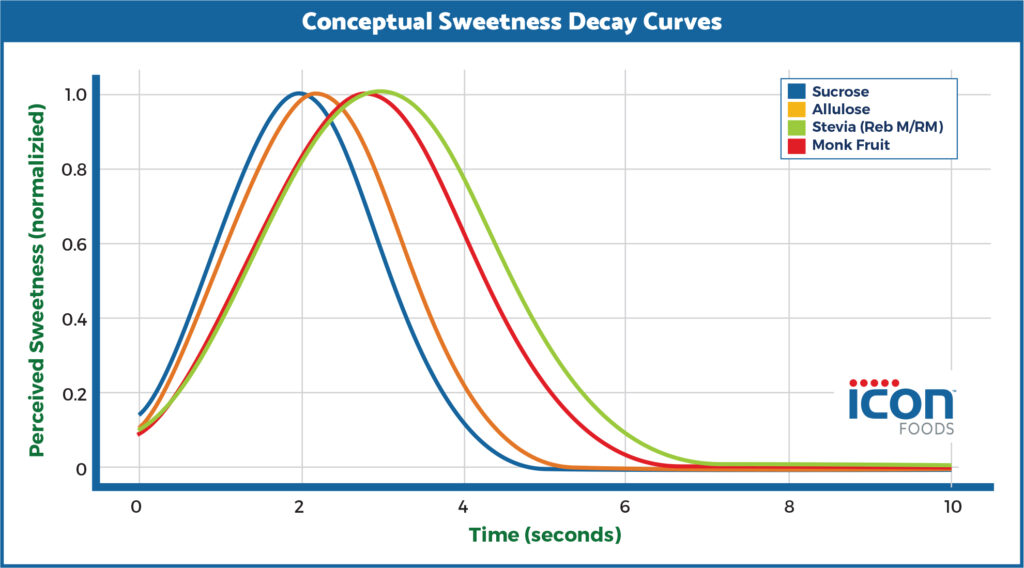
Here’s a conceptual sweetness decay curve comparing sucrose, allulose, stevia, and monk fruit—normalized to make the timing differences obvious rather than absolute sweetness.
How to read this graph (important for formulators)
- X-axis (Time): what the consumer experiences from first contact through the swallow
- Y-axis (Perceived Sweetness): normalized intensity (not SE%)
- Peak position: perceived onset speed
- Right-hand tail: decay rate / linger risk
Common Sweetener Decay Profiles (Field Notes)
- Sucrose (Reference Standard)
- Onset: Immediate
- Peak: Rounded
- Decay: Smooth, flavor-synchronous
- Takeaway: Matches flavor release; exits clean
- Sucralose
- Onset: Fast
- Decay: Long, sticky
- Issue: Sweetness outlives flavor → metallic tail, sweetness fatigue
- Fix: Use at lower ppm, blend with fast-decay bulking sweeteners
- Acesulfame-K
- Onset: Very fast
- Decay: Sharp and bitter echo
- Issue: Front-loaded sweetness with a clipped finish
- Fix: Pair with slow-onset sweeteners or solids for body
- Steviol Glycosides (Reb A → Reb M)
- Onset: Slower than sugar
- Decay: Variable, often long
- Issue: Sweetness lingers after flavor has dropped
- Fix: Use higher-purity fractions + modulators + solids
- Monk Fruit (Mogrosides)
- Onset: Moderate
- Decay: Long, sometimes hollow
- Issue: Clean upfront, problematic swallow
- Fix: Anchor with fast-decay sweeteners and mouthfeel builders
Where Formulators Get Burned
Let me be blunt. These are the landmines:
Designing to Peak Sweetness Only
You hit 8–10% SE and stop testing. Consumers swallow. You should too.
Ignoring Matrix Effects
Protein, acid, carbonation, alcohol, and heat all stretch or compress decay.
Over-reliance on a Single HIS
No HIS behaves like sugar alone. None.
Forgetting That Flavor Has a Decay Curve Too
Sweetness that outlives flavor creates perceived imbalance.
Best Practices: How to Engineer a Clean Exit
- Build Sweetness in Layers
Think orchestration, not soloists.
- Fast onset: small amount of simple sugar or fast-decay bulk sweetener
- Mid-palate: stevia or monk fruit
- Control decay: modulators + solids
You’re not sweetening, you’re timing sweetness.
- Use Solids to Shape Decay
Decay rate isn’t just about sweeteners.
Soluble fibers, glycerin, rare sugars, and low-DP carbohydrates:
- Slow sweetness perception slightly
- Shorten harsh linger
- Synchronize sweetness with flavor
Mouthfeel = temporal control.
- Match Sweetness Decay to Flavor Decay
Ask this question during sensory, not just Is it sweet enough? But: Does sweetness leave when the flavor leaves? If the answer is no, the system isn’t finished.
- Design for the Swallow
The swallow is where products fail.
- Stevia bitterness
- Monk fruit hollowness
- Sucralose cling
Train panels to focus there. Consumers do, even if they can’t articulate it.
- Test Warm, Cold, and Post-Thermal
Decay rate changes with:
- Temperature
- Pasteurization
- Retort
- Storage time
Sweetness that behaves at bench scale can misbehave after heat.
The Big Idea (This Is the Part to Remember)
Sugar reduction didn’t get hard because sweeteners got worse. It got hard because we’re no longer allowed to be lazy. Modern formulation is temporal engineering.
- Onset
- Peak
- Decay
- Linger
Get those right, and bitterness, metallic notes, and diet perception largely disappear. Miss them, and no label claim will save you.
Where Icon Foods Fits (Because This Is What We Do)
At Icon Foods, we don’t sell ingredients. We build sweetness systems designed around decay control.
That means:
- Pairing HIS with the right solids
- Using modulators to shorten linger
- Designing sweetness curves that behave through processing
- Matching sweetness timing to real-world flavor systems
Because the goal isn’t less sugar. The goal is no one noticing you took it out. And that, friends, lives in the decay curve.
Reach out to your Icon Foods representative for sweeteners, fibers and modulator, samples, documentation formulation and usage guidance.
Since 1999 Icon Foods has been your reliable supply chain partner for sweeteners, fibers, sweetening systems, inclusions and sweetness modulators.
Taste the Icon difference.
Order Samples