Summary
Tagatose vs. Allulose: A Comparative Analysis for Food and Beverage Formulators dives into two of the most promising rare sugars shaping the future of better-for-you formulation. Both deliver sugar-like sweetness with dramatically fewer calories and minimal glycemic impact, but when it comes to functionality, metabolism, and especially Nutrition Facts Panel labeling, their differences matter. This white paper breaks down how tagatose behaves like a traditional sugar on labels despite its metabolic benefits, while allulose’s FDA exemption from total and added sugars gives brands a powerful advantage for keto, diabetic-friendly, and reduced-sugar claims. From browning and crystallization to digestive tolerance and blending strategies, Icon Foods explores how formulators can leverage each sweetener’s strengths or combine them to achieve taste parity, clean labels, and standout market positioning. With decades of rare sugar expertise, Icon is your strategic partner for formulating smarter, sweeter solutions without compromise.
Thom King, CFS, Food Scientist
Chief Innovations Officer, Icon Foods
When it comes to next-gen rare sugars, tagatose and allulose are two of the brightest stars in the “better-for-you” galaxy. Both are epimers of fructose, both deliver sugar-like functionality with dramatically lower caloric loads, and both are GRAS-affirmed under U.S. FDA regulations. Yet they behave—and are labeled—very differently on the Nutrition Facts Panel (NFP). Let’s break down what matters most for formulators.
1. Molecular and Functional Interview
| Attribute | Tagatose | Allulose (D-Psicose) |
|---|---|---|
| Sweetness | ~92% of sucrose | ~70% of sucrose |
| Calories | ~1.5 kcal/g (metabolized in small intestine, fermented in colon) | ~0.2-0.4 kcal/g (minimally metabolized, largely excreted) |
| Glycemic Impact | Very low; may blunt postprandial glucose | Negligible; minimal insulin response |
| Heat Stability | Moderately heat-stable; can brown via Maillard | Good heat stability; mild browning possible |
| Hygroscopicity | Slightly higher than allulose | Lower; better shelf stability |
| Crystallization | Crystallizes readily (useful in confections) | More soluble; less crystallization tendency |
| Taste Profile | Very sugar-like with mild cooling | Clean sweet onset, no cooling, short finish |
2. Nutritional Facts Panel (NFP) Implications
| NFP Line Item | Tagatose | Allulose (D-Psicose) |
|---|---|---|
| Total Sugars | Counts as sugar (chemically a monosaccharide; FDA includes it under “Total Sugars”) | Exempt from Total and Added Sugars per FDA guidance (April 2019 enforcement discretion) |
| Added Sugars | Included if added as an ingredient | Excluded – may be declared separately as a footnote or within parentheses (“includes 0 g added sugars; X g allulose”) |
| Calories (per g) | 1.5 kcal/g | 0.4 kcal/g |
| Dietary Fiber | None | None |
| Carbohydrate Contribution | Contributes to “Total Carbohydrates” | Contributes to “Total Carbohydrates,” but not to “Total Sugars” |
| Footnote Requirements | No special footnote required | Optional: “Allulose provides 0.4 Calories per gram” |
In short:
- Tagatose behaves like a sugar nutritionally and legally. It increases “Total Sugars” and “Added Sugars” on the NFP—even though it’s lower in calories and glycemic impact.
- Allulose, on the other hand, enjoys FDA’s unique exemption—you can sweeten at full functionality without inflating the sugar line. That gives brands a massive labeling advantage when marketing “No Added Sugar” or “Keto-Friendly” claims.
3. Regulatory Context
- Allulose: In 2019, FDA issued a guidance for industry granting enforcement discretion to exclude allulose from “Total Sugars” and “Added Sugars.” This recognition stemmed from metabolic studies showing it contributes negligible calories and doesn’t raise blood glucose.
- Tagatose: Though GRAS (GRN 208, 498), it’s metabolized more like a low-digestible sugar— thus, FDA still requires it to be included in the sugars count. Ongoing petitions have sought similar treatment, but as of 2025, no exemption has been granted.
4. Functional and Formulation Considerations
| Use Case | Tagatose Advantage | Allulose Advantage |
|---|---|---|
| Maillard Browning / Caramelization | Excellent: performs like sucrose in baked goods | Mild; often requires blending with other browning agents |
| Frozen Systems | Strong freezing point depression; softer ice cream | Moderate depression; good texture balance |
| Bulking | Denser, crystalline; provides sucrose-like body | Slightly lower bulk; often paired with fibers |
| Blending Potential | Works well with high-intensity sweeteners (stevia, monk fruit) | Excellent synergy with HIS and polyols |
| Digestive Tolerance | Good up to ~30 g per serving; excess may cause GI distress | Generally well tolerated up to ~50 g per serving |
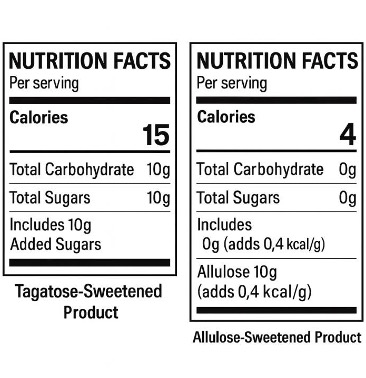
5. Labeling Example
- Tagatose-Sweetened Product (per serving)
- Total Carbohydrates 10 g
- Total Sugars 10 g
- Includes 10 g Added Sugars
- Calories 15 kcal
- Allulose-Sweetened Product (per serving)
- Total Carbohydrates 10 g
- Total Sugars 0 g
- Includes 0 g Added Sugars
- Allulose 10 g (adds 0.4 kcal/g)
- Calories 4 kcal
6. Bottom Line
- Allulose wins the label optics game—its exclusion from “Total Sugars” and “Added Sugars” makes it ideal forketo, diabetic-friendly, and reduced-sugar claims.
- Tagatose, while metabolically beneficial and functionally superior in some systems (especially for browning and mouthfeel), still shows up as sugar on the NFP—making it harder to market in “no-added-sugar” SKUs despite its metabolic benefits.
For formulators chasing taste parity and clean-label claims, blending tagatose + allulose can offer the best of both worlds: authentic sucrose behavior from tagatose and consumer-friendly labeling from allulose.
Since 1999, Icon Foods has been your reliable supply-chain partner for sweeteners, fibers, sweetening systems, inclusions, and sweetness modulators.
Reach out to your Icon Foods representative for a gummy formulating toolkit with samples, documentation, and formulation guidance for: KetoseSweet+ and Allulose blends.
Taste the Icon difference.
x