How to rebuild structure once sugar is gone (part 2 of 3)
Summary
Once sugar is removed from a formulation, structure doesn’t disappear—it shifts, and in most systems that burden falls squarely on fiber. Yet too often, fiber is treated as a label claim rather than what it truly is: a functional engineering tool, leading to products that look right at launch but fail over time. This paper reframes fiber as a system, not a single ingredient, where each component plays a defined role—replacing bulk, managing water, stabilizing texture, and determining long-term performance—and success depends on assigning those roles intentionally, because without structure, formulations don’t just struggle, they unravel. Fibers are not interchangeable; differences in molecular structure, water interaction, viscosity, and tolerance thresholds demand precision through a role-based approach across structure, water control, and tolerance. The paper outlines four critical fibers and their functions: inulin for mouthfeel, soluble tapioca fiber as the structural backbone, PHGG as a low-impact fiber booster, and polydextrose for bulk and moisture control, working together as a balanced system with no redundancy. It also challenges static thinking, emphasizing that viscosity evolves and water exists in dynamic states—either bound and stable or free and destabilizing—meaning common failures like hardening, staling, and separation are often water system failures, not sweetener issues. The takeaway is clear: more fiber is not better formulation; without design, “fibermaxxing” leads to instability and tolerance problems, while high-performing systems rely on multiple fibers, clearly defined roles, and application-specific strategy—because in reduced-sugar formulation, fiber isn’t just part of the system, it is the system.
Thom King, CFS, Food Scientist
Chief Innovations Officer, Icon Foods
Fiber is where most formulations either get rebuilt or quietly fall apart. It’s treated like a label claim. It should be treated like an engineering tool. Because once sugar is gone, fiber is doing the heavy lifting whether you planned for it or not.
- It replaces bulk
- It manages water
- It stabilizes texture
- It determines whether your product holds up, or falls apart over time
And most formulations? They’re using fiber without assigning it a job.
Fiber as a Functional System
Fibers are not interchangeable. They differ in:
- molecular structure
- water interaction
- viscosity behavior
- tolerance thresholds
The only way this works is role-based design:
- Structure → body, bulk, viscosity
- Water control → binding, aw, distribution
- Tolerance → how far you can push inclusion
If you don’t assign roles, the system assigns failure.
The Four Fibers That Actually Matter
Inulin (chicory, agave) — Body and Cream, With Limits
- Builds early viscosity
- Adds fat-like mouthfeel
- Breaks down under acid + heat + time
- GI tolerance becomes noticeable above ~8–15g
Use it for feel. Don’t rely on it for total stability.
Soluble Tapioca Fiber — The Backbone
- Strong water binding
- High process stability
- Neutral flavor
- Low inherent viscosity
This is your structural chassis. It holds the system together.
Partial Hydrolyzed Guar Gum PHGG — The Invisible Lever
- Near-zero viscosity
- Extremely high tolerance
- Stable everywhere
Use it to increase fiber without changing texture. Nothing more.
Polydextrose — Bulk and Humectancy
- Adds solids
- Improves moisture retention
- Extends shelf life
Effective, but tolerance and label perception can become the story.
Callout Table: Practical Usage Levels by Application (Use this, not guesswork)
| Application | Inulin | Soluble Tapioca Fiber | PHGG | Polydextrose | Total Fiber |
|---|---|---|---|---|---|
| Clear RTD (acidic) | 0–2% | 2–5% | 2–6% | 0–2% | 3–8 g/serving |
| RTD (protein / neutral pH) | 2–5% | 2–4% | 2–5% | 0–3% | 5–12 g/serving |
| Nutrition bars | 3–8% | 10–25% (syrup basis) | 2–5% | 5–15% | 10–25 g/serving |
| Baked goods (cakes, muffins) | 2–6% | 5–12% | 1–3% | 5–10% | 5–15 g/serving |
| Cookies / brownies | 1–4% | 5–10% | 0–2% | 8–15% | 5–12 g/serving |
How to read this table (so you don’t misuse it)
- These are functional ranges, not maximum claims
- Percentages are formula weight basis (except where syrup noted)
- “Total fiber” is where GI tolerance starts to matter more than functionality
If you exceed these ranges, you better have a reason, and a test panel.
Viscosity Curves: Stop Thinking Static
Viscosity is not a number. It’s a moving target. It changes with:
- pH
- heat
- shear
- time
Behavior in real systems:
- Inulin → builds fast, then may degrade
- Soluble tapioca → stable, low-to-moderate
- Polydextrose → stable, moderate
- PHGG → negligible
Water Binding vs Free Water
This is the quiet killer. Water is either:
- Bound → stable, controlled
- Free → mobile, destabilizing
Functional hierarchy:
- Soluble tapioca fiber
- Polydextrose
- Inulin
- PHGG
If your product:
- Hardens
- Stales
- separates
…it’s not your sweetener. It’s your water system failing.
GI Tolerance (Reality, Not Marketing)
Let’s not pretend consumers don’t notice. Real-world thresholds for bowel tolerance:
- PHGG → ~20g+
- Soluble tapioca fiber → ~15–25g
- Inulin → ~8–15g
- Polydextrose → ~10–15g
Critical point: Stacking fibers doesn’t eliminate tolerance. It spreads it out. The gut still does the math.
Fibermaxxing: Smart vs Lazy
Fiber is trending. That part is real. But more fiber does not equal better formulation.
Smart fibermaxxing:
- multiple fibers (stacking)
- defined roles
- balanced system
Lazy fibermaxxing:
- single fiber overload
- no system design
- no tolerance consideration
Fiber is not a scoreboard. It’s a system.
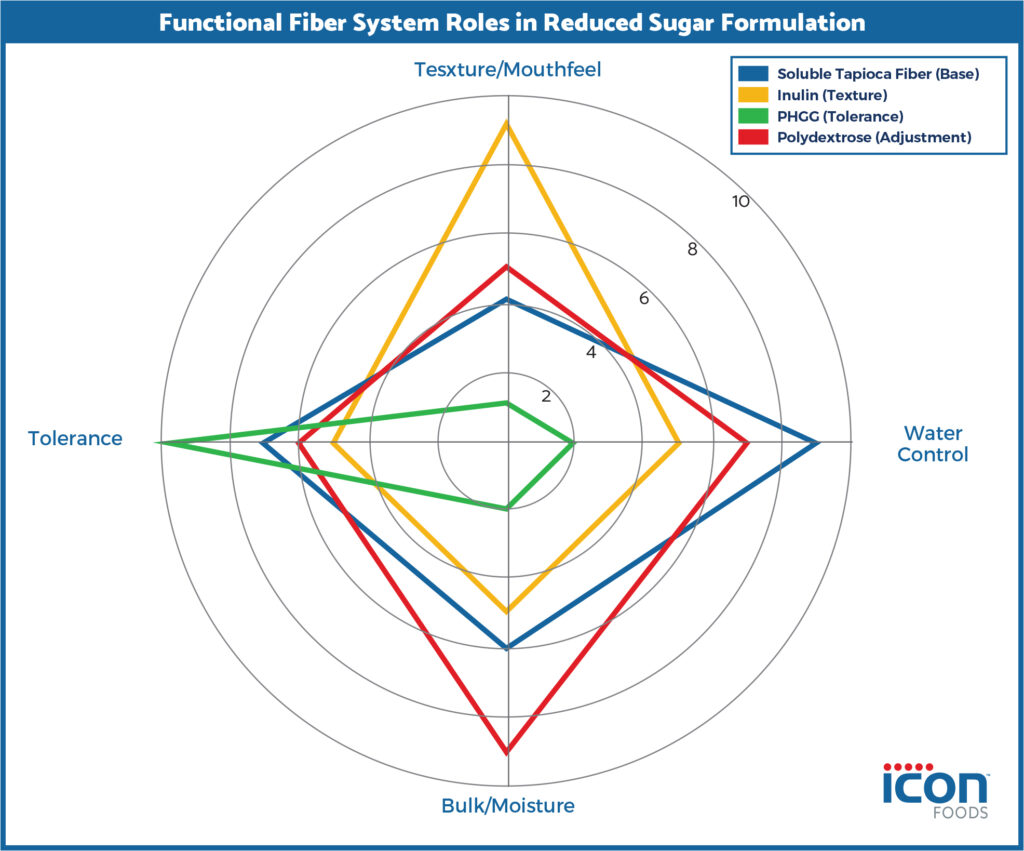
What a Functional System Actually Looks Like
- Base: soluble tapioca fiber (water + solids)
- Texture: inulin (mouthfeel)
- Tolerance: PHGG (fiber lift without viscosity)
- Adjustment: polydextrose (bulk + moisture control)
Each has a job. No overlap. No guessing.
Understanding fiber function is necessary. But it’s not sufficient. Because fiber behaves differently depending on the system:
- RTDs fight pH and time
- Bars fight water activity
- Baked goods fight moisture migration
Different systems. Different physics. Different failure modes. So, the real question is: How do you apply this without breaking the product somewhere between processing and shelf life? Check out part three of this three part series. But, while you’re here: reach out to your Icon Foods representative for fibers , high intensity sweetener, sweetness modulators and sweetening systems, samples, documentation formulation and usage guidance.
Since 1999 Icon Foods has been your reliable supply chain partner for sweeteners, fibers, sweetening systems, inclusions and sweetness modulators.
Taste the Icon difference.
Order Samples!