
A Guide to Sweet Protein – Taste Receptor Interactions – and How Not to Screw Them Up
Summary
The era of brute-force sugar reduction is over. Sweet proteins are here, and they demand a smarter hand. In this white paper, Thom King unpacks the receptor-level science behind thaumatin and brazzein, two intensely sweet proteins that behave very differently once they hit the tongue. From electrostatic receptor stabilization to precision binding dynamics, this guide explains why temporal sweetness curves matter, where each protein shines, where they fail, and how strategic stacking can create sugar-like performance without sweetness fatigue. Thaumatin and brazzein are not magic bullets. They are instruments. And modern formulation is about learning how to play them.
Thom King, CFS, Food Scientist
Chief Innovations Officer, Icon Foods
Sugar reduction has officially entered its “post–high-intensity sweetener” era. We’ve all played the stevia games. We’ve wrestled with monk fruit supply curves. We’ve argued with erythritol (and lost).
Now the conversation is shifting toward sweet proteins, not as silver bullets, but as precision tools. Two names keep popping up in R&D conversations like a whispered secret: Thaumatin and Brazzein.
They’re both proteins. They’re both intensely sweet. And they behave very differently once they hit the tongue.
Let’s unpack what’s really going on at the taste receptor level, and, more importantly, how formulators should be using (and not abusing) these tools.
The Tongue Is Not a Sugar Meter, It’s a Protein Sensor
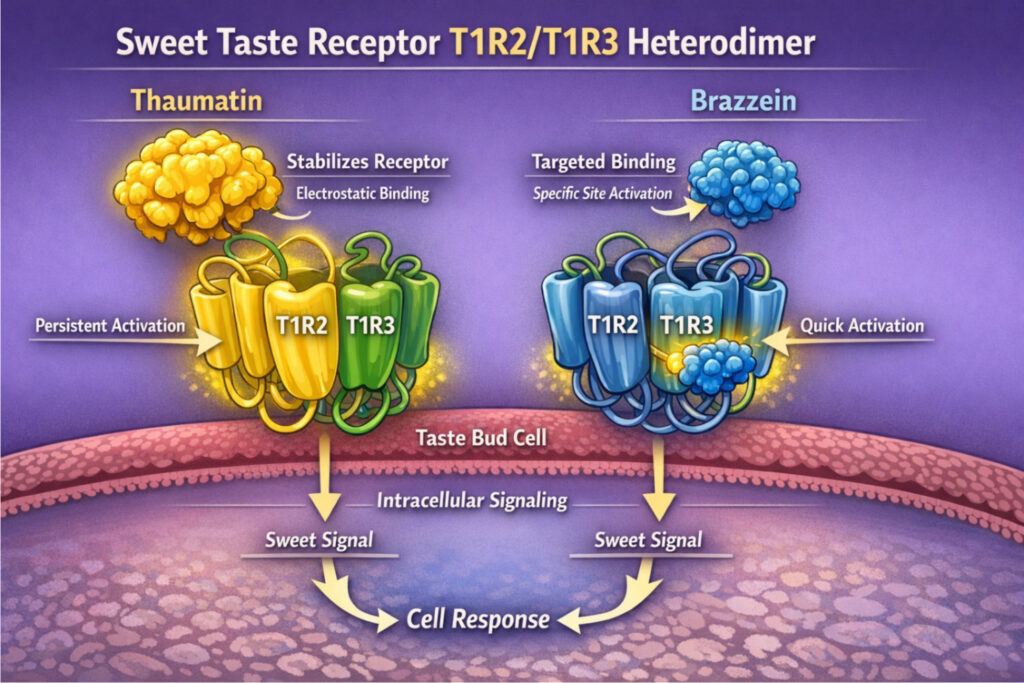
Sweetness perception is governed primarily by the T1R2/T1R3 heterodimer, a Class C GPCR sitting on the taste buds. Most sweeteners interact with this receptor in predictable ways:
- Small molecules (sucrose, glucose, allulose) bind within the Venus Flytrap domain
- High-intensity sweeteners (steviol glycosides, mogrosides) interact with both orthosteric and allosteric sites
- Sweet proteins? They don’t just “bind.” They dock, stabilize, and bias receptor signaling
This is where thaumatin and brazzein part ways.
Thaumatin: The Loud Whisperer – Receptor Interaction Mechanics
Thaumatin is a ~22 kDa protein with a highly charged surface. Instead of nestling into a single binding pocket, it electrostatically associates with the exterior of the T1R2/T1R3 complex, effectively stabilizing the receptor in its “on” conformation. Think of it less like a key and more like a paperweight holding the switch down.
What this means perceptually:
- Extremely high sweetness potency (2,000–3,000× sucrose)
- Rapid sweetness onset
- Very long sweetness persistence
- Minimal bitterness, but a distinct licorice / proteinaceous linger
Thaumatin doesn’t shout, it hangs around because of it very slow decay rate.
Where Thaumatin Shines
- Cocoa systems (chocolate, mocha, brownie)
- Coffee and roasted flavor matrices
- Masking bitter notes from:
- Caffeine
- Polyphenols
- Electrolytes
- certain botanicals
Where It Breaks Down
- Clean, bright beverage systems
- Citrus-forward profiles
- High-acid RTDs
- Applications where sweetness needs to get out of the way
Best Practices (Thaumatin)
- Use at micro-levels (often <5 ppm)
- Never let it carry sweetness alone, pair with:
- Allulose or other low intensity sweeteners
- Low-dose high intensity sweeteners like RebM and MV50
- Treat it as a sweetness extender, not a sweetener
- Always evaluate finish length, not just initial sweetness
Brazzein: The Precision Tool – Receptor Interaction Mechanics
Brazzein is smaller (~6.5 kDa), structurally tight, and unusually efficient. It binds more specifically and reversibly to the sweet receptor, engaging key residues on T1R3 that influence temporal signaling. Translation: It turns sweetness on and off cleanly.
Perceptual impact:
- Clean sweetness
- Faster decay than thaumatin
- Less lingering
- Closer to sucrose temporal dynamics
- Minimal off notes when properly dosed
If thaumatin is a sustained note on a synthesizer, brazzein is a well-played piano key.
Where Brazzein Excels
- Carbonated beverages
- Flavored waters
- Tea and juice blends
- Dairy alternatives
Where It Needs Help
- Heavy bitterness loads
- Dark cocoa or roasted matrices
- Systems relying on sweetness “weight”
Best Practices (Brazzein)
- Use as a primary sweet protein, not just a modulator
- Pair with bulk sweeteners for mouthfeel
- Evaluate synergy curves, not linear sweetness
- Watch thermal and shear conditions, structure matters
Thaumatin vs. Brazzein , Formulator Reality Check
| Attribute | Thaumatin | Brazzein |
|---|---|---|
| Molecular Size | Large | Small |
| Binding Style | Receptor stabilization | Targeted interaction |
| Sweetness Onset | Fast | Fast |
| Sweetness Decay | Very long | Moderate |
| Lingering | High | Low |
| Flavor Impact | Masking, rounding | Clarity, precision |
| Best Role | Modulator | Sweetener + modulator |
The Real Power Move: Stacking, Not Choosing
Here’s where experienced formulators separate themselves from label readers.
Thaumatin + Brazzein together can:
- Create early sweetness (brazzein)
- Extend perception (thaumatin)
- Reduce total high intensity sweetener load
- Improve temporal alignment with sugar
But, and this is critical, stacking without restraint creates sweetness fatigue. Your tongue is forgiving. Your consumer is not.
Smart Stack Framework
- Bulk sweetener sets baseline (allulose, polyols, soluble fiber)
- Brazzein defines sweetness curve
- Thaumatin trims bitterness and extends finish
- High intensity sweeteners used where necessary to level sweetness curve
Final Thought: Sweet Proteins Aren’t Replacements, They’re Instruments
- Thaumatin and brazzein don’t replace sugar.
- They don’t replace stevia.
- They don’t replace monk fruit.
They replace guesswork.
Used thoughtfully, they allow us to:
- Lower total sweetener load
- Improve sweetness realism
- Reduce bitterness masking gymnastics
- Build systems that behave like sugar without pretending to be sugar
And that’s where modern formulation is headed, less brute force, more receptor-level finesse.
If you want to talk through which protein belongs in which system, or how to build a clean-label stack that survives scale-up, you know where to find me.
Reach out to your Icon Foods representative for sweeteners, fibers and modulator, samples, documentation formulation and usage guidance.
Since 1999 Icon Foods has been your reliable supply chain partner for sweeteners, fibers, sweetening systems, inclusions and sweetness modulators.