


Where this paper started, It didn’t start in a lab. It started with a needle drop. I was listening to Paranoid… really listening, not just letting it run in the background. Somewhere between War Pigs and Iron Man, it clicked: This isn’t just music. This is system design.
Four guys. Minimal tracks. No digital safety net. And yet the sound carries weight, structure, timing, and emotional impact that most modern productions still struggle to replicate.
That doesn’t happen by accident. That’s architecture. It gave me a renewed respect for Ozzy Osbourne, Tony Iommi, Geezer Butler, and Bill Ward. What they built wasn’t just the foundation of heavy metal. They built a system where every element had a job, and nothing was there by accident. And the parallel to formulation was immediate.
Because what they were doing with sound is exactly what we’re supposed to be doing in food and beverage systems. Not adding more. Not chasing trends. But understanding function, and engineering impact.
Heavy Is Not Loud. It’s Engineered
Let’s get one thing straight. “Heavy” isn’t about volume. It’s about how a system is built and delivered over time. At its core, heavy metal operates as a multi-variable sensory system:
| Metal Function | Sensory Outcome | Formulation Equivalent |
| Low tuning | Physical impact | Bulk / solids system |
| Distortion | Density | Mouthfeel / viscosity |
| Tempo | Perceived weight | Temporal release |
| Silence | Contrast | Sweetness restraint |
| Dissonance | Tension | Off-note management |
Sound familiar? It should. That’s the same job description sugar has been quietly running for decades.
The Problem: We’re Still Thinking in Ingredients, Not Systems
Most reduced-sugar formulations fail before they even start. Why? Because we approach them like this: “What can replace sugar?” That question is flawed. Sugar was never just an ingredient. It was a multi-functional system:
-
- Sweetness
-
- Bulk
-
- Water activity control
-
- Texture
-
- Browning
-
- Temporal delivery
Trying to replace that with a single input is like trying to recreate Paranoid with just a guitar. It’s not going to land.
The Physics of Heavy (Applied to Formulation)
-
- Bulk Phase = Low Frequency (You Have to Feel It)
When Tony Iommi tuned down, he shifted energy into lower frequencies. You don’t just hear it, you feel it. That’s your bulk phase. In formulation, this is your:
-
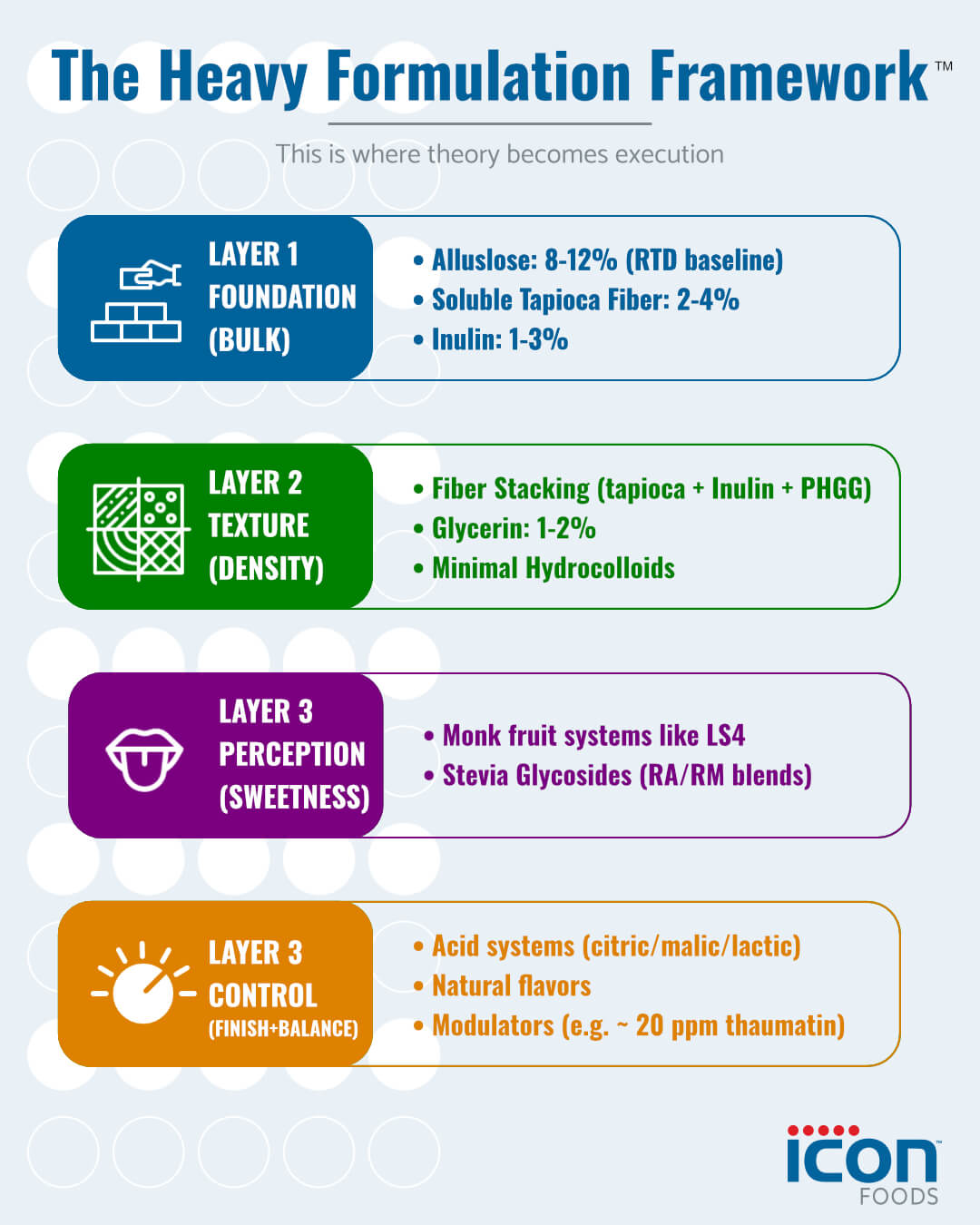
- Allulose
-
- Soluble tapioca fiber
-
- Inulin
-
- Polyols
These provide mass, presence, and structure. If your system feels thin, it’s not a flavor problem. It’s a structural one.
-
- Mouthfeel = Harmonic Density (Not Just Thickness)
Distortion adds harmonics, increasing perceived density without increasing volume. Mouthfeel works the same way. Layering:
-
- Soluble fibers
-
- Inulin
-
- PHGG
-
- Polydextrose
…creates a multi-dimensional texture, not just viscosity. The mistake most teams make? Overbuilding. Too much gum. Too much fiber. Too much “help.” That’s the equivalent of cranking distortion until everything turns to mud.
-
- Temporal Release = Tempo (Where the System Lives or Dies)
A slow riff feels heavy because your brain has time to process impact. Flavor works the same way. Poor systems:
-
- Hit fast
-
- Fade quickly
-
- Leave a hollow finish
Engineered systems:
-
- Build gradually
-
- Hold through mid-palate
-
- Finish clean
This is where:
-
- Stevia (RM95 or RM95D)
-
- Monk fruit (MV50)
-
- Allulose
…must be designed as a sequence, not a stack.
-
- Restraint = Space (The Most Underrated Lever)
Heavy music breathes. Space between notes creates impact. In formulation:
-
- Over-sweetening kills contrast
-
- Over-flavoring muddies perception
-
- Over-engineering creates fatigue
The best products are not the most loaded. They’re the most intentional.
-
- Off-Notes = Dissonance (You Don’t Eliminate It, You Resolve It)
The tritone in early metal creates tension. In formulation, tension shows up as:
-
- Bitterness
-
- Astringency
-
- Metallic linger
You don’t eliminate these entirely. You manage and resolve them over time. Using:
-
- Glycoside systems (RM95D, MonkSweet LS4, RA99M)
-
- Acid balance
-
- Sweetness modulators (ThauSweet DRM and ThauSweet VRM)
Application Snapshots
RTD Beverages (pH 2.8–4.2)
-
- Bulk: 8–12%
-
- Light viscosity
-
- High reliance on acid + modulators
Bars (a_w 0.55–0.75)
-
- Bulk: 20–35%
-
- Glycerin + fiber for plasticity
-
- Water migration control is everything
Frozen Systems
-
- Allulose drives freezing point depression
-
- Glycerin stabilizes texture
-
- Off-note management amplified at low temperature
The Heaviness Scorecard (QC Tool)
| Metric | Question | Fix |
| Impact | Does it hit? | Increase bulk |
| Density | Feels thin? | Add fiber layering |
| Timing | Spike & crash? | Rebalance sweetener system |
| Fatigue | Too much? | Reduce sweetness / simplify |
| Finish | Lingering off? | Add modulators / adjust acid |
Brutal Truth
Most formulations fail because they try to compensate instead of design. They add:
-
- More sweetness
-
- More flavor
-
- More texture
And end up with noise. The best systems do the opposite. They:
-
- Strip unnecessary inputs
-
- Build functional layers
-
- Control timing – think sweetness curve
-
- Deliver impact efficiently
Final Thought
Black Sabbath didn’t invent heavy by adding more. They did it by:
-
- Understanding the system
-
- Respecting space
-
- Maximizing impact per note
That’s the shift for formulators. Not more ingredients. Better architecture. Because at the end of the day, the products that win aren’t the ones that test well in a lab. They’re the ones that hit, hold, and finish clean in the real world. And just like a great riff, you feel them before you analyze them.
Why Icon Foods
Let’s keep this simple. At Icon Foods, we don’t just supply ingredients. We help you solve the system.
-
- Multi-source supply chain reliability
-
- Concierge level service – for real
-
- Formulation expertise across sweeteners, fibers, and polyols (by yours truly)
-
- Clean-label solutions that hold up in real products, not just presentations
Reach out to your Icon Foods representative for clean label sugar reduction starter kit, documentation formulation and usage guidance.
Since 1999 Icon Foods has been your reliable supply chain partner for sweeteners, fibers, sweetening systems, inclusions and sweetness modulators.
Experience the Icon difference.