
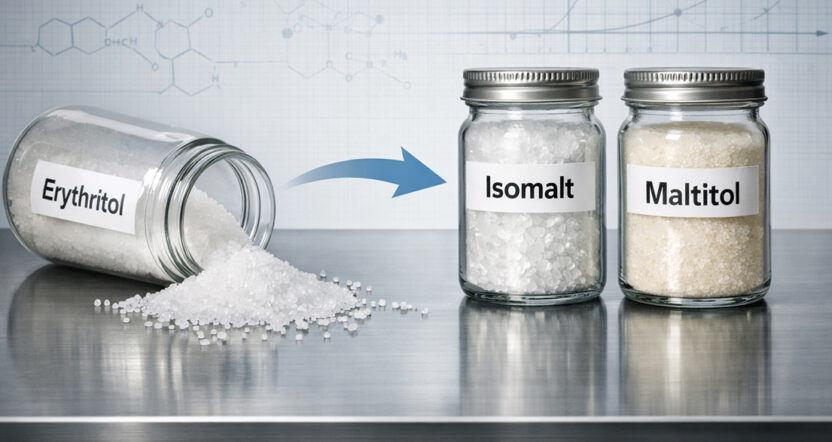
Why Isomalt + Maltitol Might be your Post-Erythritol Power Couple
Summary
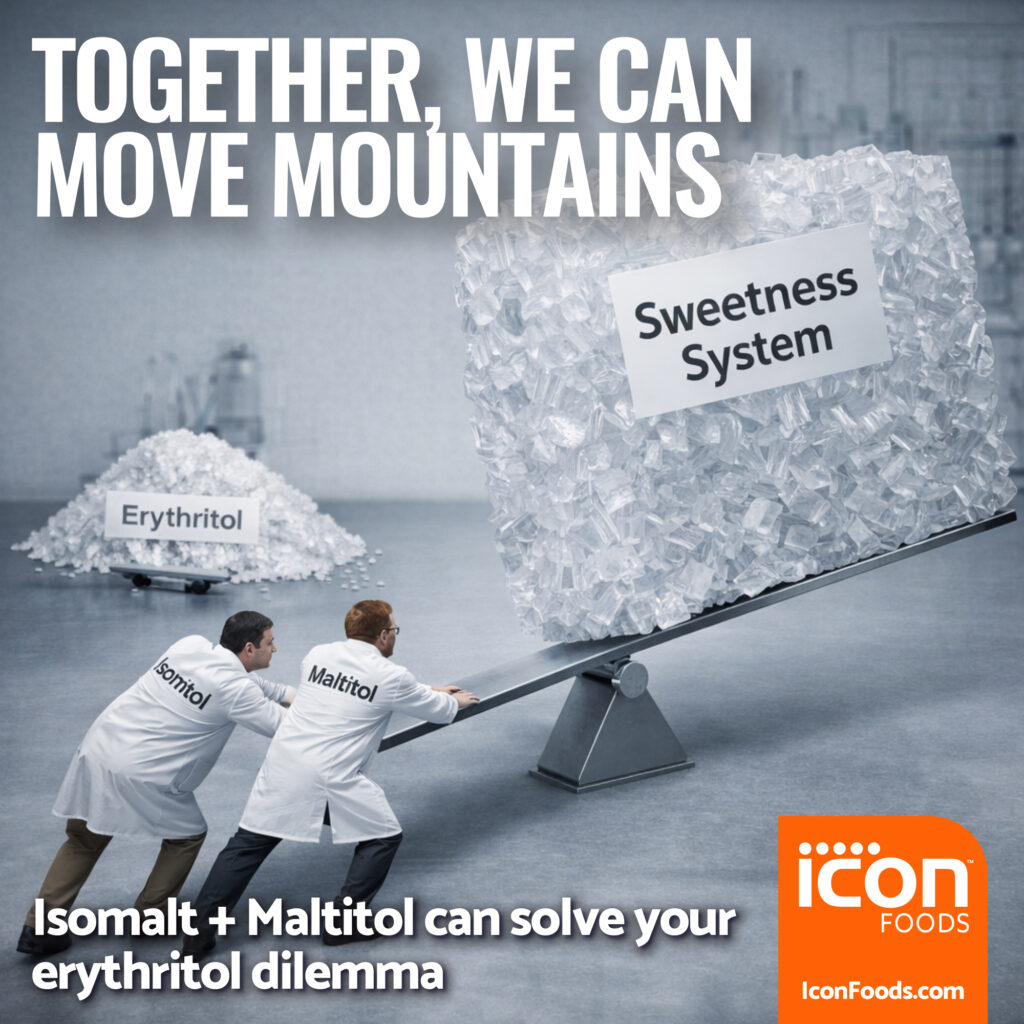
Formulators facing rising erythritol costs and shifting market sentiment are reevaluating their sweetness systems. One promising alternative is a strategic blend of isomalt and maltitol, two polyols that work together to balance sweetness, texture, and digestive tolerance. Isomalt contributes structural stability, low hygroscopicity, and slow fermentation, while maltitol delivers a more sucrose-like sweetness curve and improved mouthfeel. When used together, the pair can reduce erythritol’s cooling effect, improve product texture, and distribute digestive load more evenly across metabolic pathways. The result is a technically sound, reliable formulation strategy that helps brands maintain clean-label sugar reduction while adapting to a rapidly changing ingredient landscape.
Thom King, CFS, Food Scientist
Chief Innovations Officer, Icon Foods
For years erythritol was the golden retriever of polyols. Low glycemic impact. Clean sweetness. Minimal GI drama compared to its sugar alcohol cousins. It fetched bulk, freezing point depression, crystallization control, and clean label credibility without much fuss.
Then tariffs and anti-dumping, and countervailing duties hit. Pricing went vertical. Clinical headlines spooked consumers. Supply chains tightened. Suddenly formulators were staring at their spec sheets like they’d just been ghosted.
So, let’s talk about the pragmatic pivot.
Enter: isomalt + maltitol. Not as flashy. Not as Instagram-friendly. But technically elegant when used correctly. And when paired with intention, they may deliver something erythritol alone never could: better functional balance with moderated GI response.
Let’s break it down.
Isomalt: The Structural Diplomat
Isomalt is a disaccharide polyol derived from sucrose. About 45–65% as sweet as sugar, with roughly 2 kcal/g. It shines in:
- Low hygroscopicity
- High stability under heat
- Excellent glass formation
- Low glycemic response
- Slow fermentation in the colon
Translation: it behaves itself.
Isomalt’s slow fermentation profile often makes it more GI-forgiving than rapidly fermented polyols. It is commonly used in hard candies and lozenges for a reason. It forms stable matrices and does not aggressively pull moisture out of the air like erythritol can.
Its weakness? It’s not sweet enough on its own for many applications. And in higher loads, it can still contribute to laxation due to osmotic activity.
Maltitol: The Sensory Heavyweight
Maltitol sits closer to sucrose in sweetness, about 75–90%. Roughly 2.1–2.4 kcal/g. It brings:
- Sucrose-like sweetness curve
- Good humectancy
- Excellent chocolate compatibility
- Creamier mouthfeel in frozen desserts
But here’s the rub: maltitol is partially absorbed in the small intestine and partially fermented in the colon. At higher doses, that fermentation can turn your digestive tract into a brass band.
Used alone at aggressive levels, it’s the reason sugar-free gummies occasionally become cautionary tales.
Used intelligently, it’s a powerful tool.
The Synergy: Why Tandem Use Makes Technical Sense
When you combine isomalt and maltitol strategically, interesting things happen:
- Sweetness Layering
- Maltitol provides sweetness backbone. Isomalt provides structure and dilution.
- Osmotic Load Distribution
- GI distress from polyols is largely dose-dependent and osmotic. By splitting total polyol mass across two molecules with different absorption and fermentation kinetics, you avoid hammering one pathway exclusively.
- Think of it as metabolic load balancing.
- Fermentation Rate Modulation
- Isomalt ferments more slowly. Maltitol ferments more readily. The blend tempers rapid colonic fermentation peaks, potentially smoothing SCFA production curves and reducing acute bloating.
- Is it magic? No. It’s kinetics.
- Improved Texture vs. Erythritol
- Erythritol can crystallize aggressively and contribute to cooling. Isomalt reduces recrystallization. Maltitol restores sucrose-like mouthfeel.
- Together they can produce better chew, less snap-fracture, and reduced cooling effect in chocolate, coatings, and gummies.
- Reduced Cooling
- Erythritol’s negative heat of solution gives that cooling blast. Sometimes welcome. Often distracting. Isomalt and maltitol have milder thermal effects, which makes flavor systems easier to manage.
Can This Replace Erythritol?
In many applications, yes. With caveats.
- Confections
- Excellent candidate
- Structure from isomalt.
- Chocolate and Coatings
- Maltitol shines. Isomalt helps reduce hygroscopic creep and bloom risk.
- Gummies
- Blends work well when paired with soluble fiber systems and high-intensity sweeteners.
- RTDs
- Less ideal. Polyols contribute calories and can cause GI sensitivity at beverage doses. Allulose and fibers are often superior here.
The key difference versus erythritol: you trade ultra-low calories for better texture and less cooling. Caloric contribution rises modestly. Glycemic response remains low relative to sucrose.
This is not a downgrade. It is a repositioning.
Best Practices for Formulators
- Blend Intentionally
- Keep Total Polyol Load Sensible
- Dose makes the poison. Stay below known tolerance thresholds. For many adults, single servings above 30–40 g total polyol increase risk of laxation. Design responsibly.
- Use Glycoside Support
- Add high purity steviol glycosides or monk fruit extracts to reduce total polyol load while achieving sweetness equivalence.
- Pair with Soluble Fiber
- Tapioca fiber, inulin, or resistant dextrins can help distribute solids, improve mouthfeel, and shift fermentation toward saccharolytic pathways.
- Manage Water Activity
- Isomalt reduces hygroscopicity. Maltitol increases it. Monitor Aw carefully in gummies and baked systems.
- Conduct Tolerance Testing
- Real humans. Real doses. Real feedback. Do not rely solely on literature.
GI Impact: The Honest Conversation
Polyols are not villains. They are dose-dependent osmotic agents. By reducing reliance on a single polyol and layering functionality, you may:
- Lower peak osmotic load
- Slow fermentation kinetics
- Reduce rapid gas production
The blend approach spreads metabolic processing across absorption and fermentation mechanisms rather than overloading one.
This is formulation as physiology.
Where Icon Foods Fits
At Icon Foods, we approach polyols as part of a broader clean-label architecture, not a one-ingredient solution.
We provide:
- NF grade, non-GMO isomalt
- Non-GMO NF grade maltitol syrup and crystalline
- High purity steviol glycosides
- Monk fruit extracts
- Allulose systems
- Soluble fiber platforms
- Sweetness modulators
- NSA inclusions
But more importantly, we provide blending intelligence.
Replacing erythritol is not about swapping molecules. It’s about recalibrating sweetness curves, water activity, fermentation kinetics, and cost structure simultaneously.
The better-for-you category is maturing. Consumers are savvier. Regulators are watching. Margins are tight. Ingredient roulette is not a strategy.
Taste the Icon Difference