Why 4 to 5 Grams of Sugar is the New “No Added Sugar” in Better-For-You Beverages and Snacks
Summary
The pursuit of zero sugar has pushed many brands into a sensory corner, creating beverages and snacks that check regulatory boxes but fall short of flavor, mouthfeel, and consumer satisfaction. This white paper reframes the conversation, showing why the real sweet spot for better-for-you formulation isn’t zero grams of sugar but a strategically designed 4–5 grams per serving. By pairing small, purposeful amounts of sugar with modern sweetener stacks—stevia, monk fruit, allulose, and advanced modulators—formulators can create products that taste more natural, perform more consistently, and still qualify for reduced-sugar or no-added-sugar claims under the right conditions. Inside, we break down the science, application strategies, and real-world formulation scenarios that help developers hit that balanced target where flavor, function, and label integrity finally align.
Thom King, CFS, Food Scientist
Chief Innovations Officer, Icon Foods
Let’s face it: the obsession with “zero sugar” has gotten a little out of hand.
We’ve built a better-for-you (BFY) landscape on a foundation of cold turkey sugar elimination, because, well, the market said it wanted it. But when you taste a zero-sugar beverage that drinks like liquid regret, or a no-sugar protein bar that chews like a protein-packed drywall sample, you’ve got to ask: is this what consumers are craving?
Here’s the sweet truth: a little sugar goes a long way. This is true, especially, when you pair it strategically with natural high-intensity sweeteners, fibers, and modulators. That’s why the new bullseye for BFY brands isn’t zero grams; it’s four to five grams of total sugar per serving.
Let me show you why that target isn’t just realistic, it’s the golden mean between flavor, function, and market appeal.
The 4-5 Gram Strategy: Not Quite Sugar-Free, but Damn Smart!
Why not zero? Because complete sugar elimination can lead to:
- Off-notes that no amount of flavor masking can hide
- Compromised mouthfeel, especially in emulsified or protein-rich applications
- Poor glycemic realism—some “zero sugar” products don’t taste natural because, well, they aren’t
Why 4–5 grams? Because that’s:
- Enough to provide top notes and signal sweetness naturally
- Low enough to earn “reduced sugar” or “no added sugar” claims (with caveats)
- Supportive of blood sugar management when paired with low-GI sweeteners and fibers
- Label-friendly in an environment where consumers are reading every carb and added sugar
It’s the sweet spot (pun intended).
The Sugar Reduction Dream Team: Stevia, Monk Fruit, Allulose, and Sweetness Modulators
Let’s break down how each of these ingredients helps you hit the 4–5g target without giving up sensory satisfaction.
Stevia (SteviaSweet™ Line)
Best Use: Clear beverages, confections, dairy, protein powders
- Function: High-intensity sweetness from steviol glycosides like Reb A, Reb D, and Reb M (up to 300x sweeter than sugar)
- Usage Level:
- Reb M: 0.01–0.08%
- Reb A 99: 0.02–0.10%
- Application Tip: Pairs beautifully with erythritol or allulose to boost bulking and blunt bitterness. Consider SteviaSweet™ RM95D in beverages and RA99M in confections.
- Flavor Hack: Stevia is your mid-note harmonizer — It’s the cushion between sugar’s up-front hit and stevia’s lingering finish.
Monk Fruit (MonkSweet™ Line)
Best Use: Sodas, gummies, bars, nut butters
- Function: Mogroside V delivers sweet, clean finish—great for beverages and snacks
- Usage Level:
- Mogroside V 50%: 0.015–0.06%
- Mogroside V 25%: 0.05–0.10%
- Application Tip: Blends well with stevia to round out the bitterness; MonkSweet™ LS4 (Mogroside V + Reb M) delivers an amazing sweetness curve for functional sodas.
- Flavor Hack: Monk fruit is your top-end sweetness layer—ideal for the “pop” at the front of the taste curve.
Allulose (KetoseSweet+™ or standard crystalline allulose)
Best Use: Bakery, sauces, frozen desserts, RTD protein
- Function: Rare sugar, about 70% as sweet as sucrose, with bulking power and freeze point depression
- Usage Level: 2–6g per serving (ideal to hit that 4–5g total sugar target with FDA non-sugar labeling advantage)
- Application Tip: Supports mouthfeel and Maillard browning. In frozen novelties, allulose delivers scoopability and softness without added sugar.
- Flavor Hack: Allulose is your structural sweetener—it provides the body and texture sugar usually handles.
Sweetness Modulators (ThauSweet™ DRM & VRM)
Best Use: Protein-rich applications, citrus-forward beverages, dairy-based formulations
- Function: Enhance sweetness perception, smooth bitterness, extend sweetness curve
- Usage Level: 10–50 ppm (yes, you read that right—these guys are potent)
- Application Tip: ThauSweet™ DRM is ideal in whey-based RTDs where dairy off-notes need masking. VRM works well in citrus/acidic environments.
- Flavor Hack: These are your stealth tools—like the EQ knobs on a studio mixer, they balance sweetness without adding sugar or volume.
Let’s Talk Formulation Scenarios
| Application | Sugars Target | Sugar Source | Sweetener Stack |
|---|---|---|---|
| RTD Protein Shake | 4.5g | Cane sugar (2g), Allulose (3g eq.) | SteviaSweet™ RM95D, ThauSweet™ DRM |
| Better-for-You Soda | 5g | Fruit juice (2g), Allulose (3g eq.) | MonkSweet™ LS4, SteviaSweet™ RA99M, ThauSweet™ VRM |
| No-Bake Snack Bar | 4g | Honey (1g), Allulose syrup (3g) | MonkSweet™ V40, SteviaSweet™ RA98, PolySweet™ for bulking |
| High-Protein Gummy | 5g | Tapioca syrup (2g), Allulose (3g) | SteviaSweet™ RA60, MonkSweet™ LS, PreBiotica™ FOS P95 for prebiotic + masking |
Why Formulators Should Embrace the 4–5g Range
- Flavor Realism: It’s what your tongue expects. No uncanny valley here.
- Label Leverage: Depending on sugar sources, you can still claim “No Added Sugar” under CFR 21 101.9(c)(6)(iii).
- GI-Friendly: Allulose and fibers like soluble tapioca or PHGG buffer glycemic load.
- Consumer Compliance: Most shoppers aren’t keto zealots—they’re just looking to make better choices. 4–5g is psychologically easier to accept than zero with a flavor tax.
Final Thought from the Sweetening Trenches
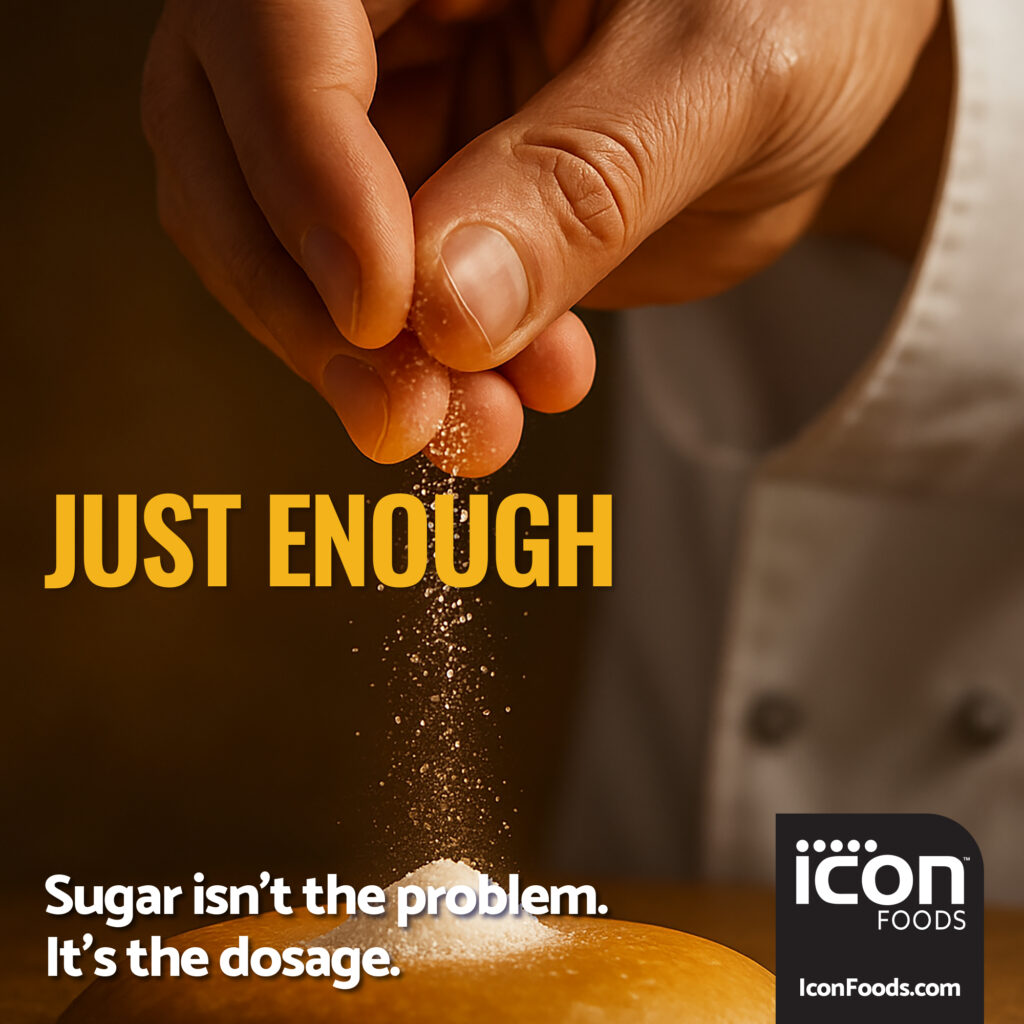
Sugar isn’t the villain — it’s the dosage. The 4–5 gram per serving target lets us flex our food science muscles, creating satisfying, craveable products that stay firmly in the better-for-you lane. With the right stack of stevia, monk fruit, allulose, and modulators, we can engineer indulgence without compromise.
So next time you’re in the lab, don’t aim for zero, but instead aim for balance. Because in the world of BFY formulation, a little sugar goes a long way… especially when it’s riding shotgun with the right crew.
At Icon Foods, we don’t just sell sweeteners. We engineer sugar reduction solutions. Our deep bench of clean-label sweeteners, rare sugars, prebiotic fibers, and flavor modulators are curated with one goal in mind: to help you formulate better-for-you products that don’t taste like compromises. With our concierge-level technical support, multi-source supply chain resilience, and a relentless obsession with flavor fidelity, Icon Foods gives you more than ingredients. We give you an edge. When it comes to threading the needle between functionality, flavor, and compliance, we’re the partner behind the better in better-for-you.
Taste the Icon difference.
Want to Try Some Samples?
x