
by Thom King CFS – Founder, Chief Innovation Officer, Food Scientist, Icon Foods
Allulose has become one of the most interesting tools in the sugar-reduction toolbox. It behaves far more like sugar than most high-intensity sweeteners, contributes bulk, participates in browning chemistry, depresses freezing point, and delivers roughly 70% of the sweetness of sucrose. But there is a wonderfully nerdy question hiding behind the ingredient declaration: Where the hell does allulose actually come from?
It occurs naturally in small quantities in foods such as figs and raisins, but nobody is sending armies of workers into orchards with tiny allulose extraction buckets. Natural abundance is far too low for commercial extraction to make economic sense.
Commercial allulose is therefore primarily made through bioconversion, most commonly by enzymatically converting fructose into allulose. Modern research is also developing fermentation and alternative enzymatic pathways, but fructose epimerization remains the industrial workhorse. And the chemistry behind it is surprisingly elegant.
Fructose and Allulose Are Molecular Cousins
The most important thing to understand is that manufacturers are not building allulose molecule-by-molecule from some exotic chemical feedstock. They start with another familiar sugar, D-fructose. Allulose, historically called D-psicose, is a monosaccharide and specifically the C-3 epimer of D-fructose. Both have the molecular formula: C₆H₁₂O₆.
Same carbon count. Same hydrogen count. Same oxygen count. What changes is the three-dimensional configuration around one carbon atom. Think molecular chiropractic.
The molecule doesn’t need a new engine, transmission and chassis. We rotate one important piece of its geometry and suddenly its biological behavior changes dramatically. That small structural change is why enzymatic production works.
The Commercial Production Playbook
At its simplest, industrial allulose production looks something like this: starch or carbohydrate feedstock → glucose → fructose → allulose → purification → concentration → syrup or crystallization.
Not every producer starts at the same point. Some manufacturing systems begin with purified fructose syrup, while vertically integrated processes can begin farther upstream with corn or another carbohydrate source.
One FDA GRAS dossier, for example, describes an allulose process beginning with corn, progressing through glucose and fructose intermediates, and ultimately producing either allulose syrup or crystalline allulose. Let’s take awalk down the production line.
Step 1: Start With a Carbohydrate Feedstock
A common industrial pathway begins with starch, frequently corn-derived. Starch is basically glucose molecules holding hands in very long chains. Those chains can be hydrolyzed using enzymes such as α-amylase and glucoamylase, producing glucose. The glucose can then be converted into fructose using glucose isomerase. If that sounds familiar, it should. We have been doing this at enormous industrial scale for decades in starch sweetener manufacturing.
Conceptually:
Starch
↓ enzymatic hydrolysis
Glucose
↓ glucose isomerase
Fructose
And now we have arrived at the starting line for the interesting part.
Step 2: Fructose Gets the Enzyme Treatment
This is where allulose production separates itself from conventional fructose syrup manufacturing. The fructose solution is exposed to an enzyme capable of changing the stereochemical configuration at carbon 3. The star player is generally: D-allulose 3-epimerase, often abbreviated DAEase. Other ketose 3-epimerases can also perform the transformation. The reaction is essentially: D-Fructose ⇌ D-Allulose. Notice that double arrow. That sucker matters.
Step 3: Epimerization Changes the Sugar
An epimerase is an enzyme that changes the stereochemical configuration around a particular carbon atom. In this case, D-allulose 3-epimerase catalyzes the conversion of fructose into its C-3 epimer, allulose.
This is not fermentation in the conventional beer, yogurt or kombucha sense. The traditional commercial pathway is better described as enzymatic bioconversion or enzymatic epimerization.
The enzyme is a molecular mechanic. Fructose drives into the garage. The enzyme grabs it. The orientation at carbon 3 changes. Allulose drives out. Same atoms. Different geometry. Completely different nutritional personality.
Step 4: The Conversion Isn’t 100%
Here’s where the food scientist has to ruin the marketing department’s beautifully simple diagram. The epimerization reaction is reversible.
DAEase does not simply march every fructose molecule obediently into the allulose locker room. The system moves toward equilibrium, leaving a mixture containing allulose and unconverted fructose.
This thermodynamic limitation is one of the major technical challenges in commercial allulose manufacturing and an active area of enzyme and process engineering research. That means the manufacturing challenge isn’t merely, can we make allulose? We absolutely can. The harder question is, Can we economically separate the allulose we made from all the fructose we didn’t convert? This is where the conundrum of inefficiency lives. Welcome to downstream processing, where elegant biochemistry meets expensive stainless steel.
Step 5: Purification Begins
After enzymatic conversion, manufacturers have a sugar stream rather than a bottle of pristine allulose. Depending on the process, purification may involve combinations of:
- filtration,
- activated carbon treatment,
- ion-exchange purification,
- evaporation or concentration, and
- chromatographic separation.
An FDA-filed manufacturing flow chart describes fructose solution being mixed with an allulose epimerase system, followed by carbon and/or ion-exchange purification, filtration or evaporation, chromatographic sugar separation, additional purification and ultimately crystallization or drying.
This downstream processing is enormously important. Making some allulose is relatively easy. Making high-purity food-grade allulose economically at industrial scale is the championship game.
Step 6: Chromatography Separates the Sugars
One of the critical operations is separating allulose from remaining fructose and related carbohydrates. Industrial chromatography can accomplish this because different sugars interact differently with the stationary phase inside the separation system.
Instead of thinking of chromatography as something involving tiny laboratory columns and grad students who haven’t slept since Tuesday, imagine it at industrial scale. A mixed sugar stream enters. The carbohydrates move through the system differently. Different fractions emerge. The desired allulose-rich fraction is collected. Remaining carbohydrate streams can potentially be recovered or recycled depending upon the manufacturing design.
An FDA GRAS manufacturing description specifically identifies separation chromatography as the step used to separate allulose from the fructose substrate. And this is one reason allulose economics are more complicated than simply asking what fructose costs. Conversion efficiency + separation efficiency + recycling + energy + water + purification = allulose economics.
The enzyme gets the headlines. The separation plant pays the bills.
Step 7: Purification and Concentration
Once the allulose-rich fraction has been separated, additional purification can remove color bodies, minerals, ionic material and other impurities. Ion-exchange resins and activated carbon are common tools. The purified solution can then be concentrated through evaporation. At this point the manufacturer has a choice depending on the desired commercial ingredient. The product can remain a, high-solids allulose syrup, or continue downstream toward, crystalline allulose.
Step 8: Making Crystalline Allulose
For crystalline material, the purified allulose solution is further concentrated and brought into conditions that promote crystallization. Think super saturation. Allulose crystals form, like the grade school experiment you did with a sugar water solution and a string. Remember?
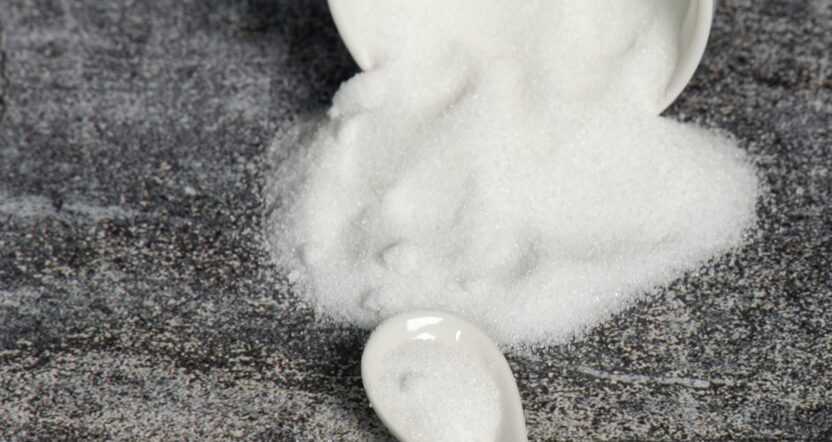
Those crystals can then be separated from the mother liquor, washed and dried. One FDA-filed process describes crystallization followed by centrifugal separation, washing and/or drying. Another describes purification followed by concentration, crystallization, collection of the crystalline material and drying. The result is the familiar white crystalline ingredient formulators can handle much like other bulk crystalline carbohydrates. So our complete journey becomes:
Starch
↓
Glucose
↓
Fructose
↓
D-Allulose 3-Epimerase
↓
Fructose + Allulose Mixture
↓
Purification
↓
Chromatographic Separation
↓
Allulose-Rich Stream
↓
Concentration
↙︎ ↘︎
Allulose Syrup Crystallization
↓
Crystalline Allulose
Voila, that is the basic industrial playbook.
Where Do the Enzymes Come From?
Now things get even nerdier. D-allulose 3-epimerases originate from microorganisms. Different commercial processes have employed different enzyme systems and microbial sources.
FDA GRAS notices describe several approaches, including immobilized enzyme or cell systems associated with organisms such as Microbacterium foliorum, Corynebacterium glutamicum, Arthrobacter globiformis and others.
Immobilization is particularly interesting industrially. Instead of tossing enzyme into every batch and saying goodbye to it afterward, an immobilized enzyme system can hold the catalytic machinery in a reactor while fructose solution flows through it. That can improve:
- enzyme reuse,
- operational stability,
- reactor productivity,
- continuous processing capability, and
- overall manufacturing economics.
Enzyme immobilization and enzyme engineering remain major research areas because enzyme stability, temperature tolerance, activity and lifetime directly influence the economics of allulose production.
For formulators, this distinction is worth remembering, the enzyme is the processing tool. Allulose is the product.
Is Allulose “Natural”?
Here comes the regulatory-and-marketing banana peel. Chemically, commercially produced D-allulose is the same sugar molecule that occurs naturally in small quantities. But commercial allulose generally isn’t extracted from those naturally occurring food sources. It is manufactured through biological conversion of another carbohydrate, usually fructose. That distinction makes a difference when marketing departments start throwing around words such as, natural, naturally derived, fermented, plant-based, clean, minimally processed or whatever linguistic confetti happens to be fashionable this quarter.
Those claims should be evaluated separately against the actual source material, manufacturing process and regulations governing the market where the finished food will be sold. Don’t let chemistry write checks regulatory can’t cash.
Is Allulose Made Using GMOs?
Another question formulators and customers frequently ask deserves a more nuanced answer than yes or no. It depends on the manufacturing process and supplier. Different allulose manufacturing systems can use different microorganisms and enzyme-production technologies.
FDA GRAS documentation includes processes involving both recombinant microorganisms and non-GMO production microorganisms. One notice, for example, describes a non-GMO Microbacterium foliorum system containing D-allulose 3-epimerase, while comparing it with other previously notified systems using recombinant organisms. Therefore, while Icon Foods produces only non-GMO material, do not assume that all allulose has the same GMO status simply because the final molecule is chemically identical.
If Non-GMO Project verification, organic compatibility or another sourcing claim matters to your formulation, get the supplier documentation. Icon Foods has this verification and can provide it upon request.
Why Not Just Chemically Synthesize It?
Technically, chemical synthesis routes exist. Commercially, however, enzymatic bioconversion offers tremendous advantages because enzymes are remarkably selective molecular tools. Chemical synthesis can create problems with unwanted side reactions, by-products, purification complexity and process economics. Biocatalysis allows manufacturers to perform an extraordinarily specific structural transformation under comparatively mild processing conditions. That’s the beauty of industrial biotechnology. Instead of attacking the molecule with a chemical sledgehammer, we hand an enzyme a molecular torque wrench.
The Next Generation: Making Allulose More Efficiently
The current fructose-to-allulose pathway works, but scientists are trying to improve it because reversible epimerization creates an inherent conversion limitation. Research is investigating:
- improved D-allulose 3-epimerases,
- enzyme engineering,
- thermostable enzymes,
- immobilized biocatalysts,
- metabolic engineering,
- multienzyme pathways,
- direct microbial production,
- alternative carbohydrate feedstocks, and
- thermodynamically driven reaction systems.
One particularly interesting direction starts even farther upstream. Researchers have demonstrated or proposed enzymatic pathways where starch is hydrolyzed into glucose, glucose is converted into fructose and fructose is subsequently converted into allulose.
Meanwhile, 2026 research reviews describe engineered microbial systems capable of producing allulose through several alternative metabolic routes. The future question may no longer be: how efficiently can we convert purified fructose into allulose? It may become, what is the cheapest sustainable carbon source we can feed into a biological system and have allulose come out the other end? That’s a much bigger game.
Why Formulators Should Care How Allulose Is Made
It is tempting to treat manufacturing as the supplier’s problem. Don’t. Understanding production gives formulators insight into cost, purity, specifications, sourcing, availability and functionality. Purity matters. Residual fructose or other carbohydrates can influence sweetness, browning, nutritional composition and analytical results.
Feedstock matters. Corn, cane or other carbohydrate sources may matter for customer sourcing requirements and certification programs.
Manufacturing technology matters. Different purification technologies and process designs can affect specifications and economics.
Physical form matters. Allulose syrup and crystalline allulose are not interchangeable pound-for-pound without considering solids, water contribution and process conditions. Icon Foods does have a formula for this conversion. Simply ask and it will be waiting for you in your inbox.
Supply chain matters.
If allulose production depends upon carbohydrate feedstocks, enzymes, chromatography capacity, energy and sophisticated purification equipment, increasing global demand cannot necessarily be answered by simply turning a valve farther open.Capacity takes capital.
The Big Takeaway
Commercial allulose production is a beautiful example of what modern food biotechnology does well. We start with abundant carbohydrates. We convert starch into glucose. We can convert glucose into fructose. Then an exquisitely selective enzyme changes the stereochemistry of fructose at one carbon atom, creating D-allulose. After that, industrial separation and purification technologies isolate the desired sugar, concentrate it and deliver it as syrup or crystalline allulose.
Fructose → enzymatic epimerization → separation → purification → allulose.
That’s the core story. And here’s the part I find fascinating. The breakthrough isn’t really that humans figured out how to manufacture another sweetener. We figured out how to use biological machinery to rearrange an ordinary carbohydrate with extraordinary precision. One carbon changes orientation. Same molecular formula. Different sugar. Different metabolism. Different regulatory treatment. Different formulation opportunity. Sometimes food science doesn’t need to reinvent the molecule. Sometimes it just needs to move the furniture.
References & Further Reading
- U.S. Food and Drug Administration. GRAS Notice No. 624: D-Allulose Manufacturing Process. Includes an industrial process flow from fructose solution through enzymatic conversion, purification, chromatography and crystallization. FDA GRAS Notice 624
- U.S. Food and Drug Administration. GRAS Notice No. 893: Allulose. Describes production beginning with corn and progressing through glucose and fructose intermediates to syrup or crystalline allulose. FDA GRAS Notice 893
- U.S. Food and Drug Administration. GRAS Notice No. 828: D-Allulose. Describes enzymatic epimerization of fructose and several enzyme-production and immobilization systems. FDA GRAS Notice 828
- Zhu J., et al. Research progress in microbial synthesis of D-allulose using metabolically engineered microbes. Trends in Food Science & Technology, 2026. Reviews current industrial epimerization and emerging microbial production pathways. 2026 review of microbial allulose production
- The Engineering, Expression, and Immobilization of Epimerases for D-Allulose Production. Reviews D-allulose 3-epimerase engineering, immobilization and industrial-scale manufacturing challenges. PubMed review of allulose epimerases
- Comprehensive Analysis of Allulose Production: A Review and Update. Reviews starch-to-glucose-to-fructose-to-allulose pathways and newer production technologies. Full-text allulose production review