

by Thom King CFS – Founder, Chief Innovation Officer, Food Scientist, Icon Foods
Chocolate Has an Identity Crisis. Tagatose May Be the Answer.
There is a peculiar problem hiding inside the sugar-reduction movement. We have become remarkably good at making things sweet without sugar. We have steviol glycosides. Monk fruit. Sucralose. Thaumatin. Sugar alcohols. Fibers. Rare sugars. Flavor modulators. We can build sweetness systems that would have looked like molecular wizardry twenty years ago.
Then we walk into the chocolate lab. And the rulebook walks in behind us. Chocolate isn’t just a flavor. In the United States, many forms of chocolate are standardized foods, governed by FDA standards of identity in 21 CFR Part 163. That distinction matters.
You can formulate something that tastes like chocolate, snaps like chocolate, melts like chocolate and makes everyone in the sensory panel start quietly stealing samples. But if the formulation doesn’t meet the applicable federal standard, you may not be able to call it what you want to call it. And this is where D-tagatose gets very interesting.
Because buried in the chocolate regulations are three words that deserve far more attention from formulators: Nutritive carbohydrate sweetener. Those three words may provide an unusually compelling regulatory and technical pathway for using tagatose as the primary bulk sweetener in standardized chocolate.
Not a chocolate-flavored coating. Not a “chocolatey” confection. Potentially chocolate.
Let’s unpack this carefully, because regulatory language is not a place for creative interpretation after three espressos.
First: Chocolate Has Rules
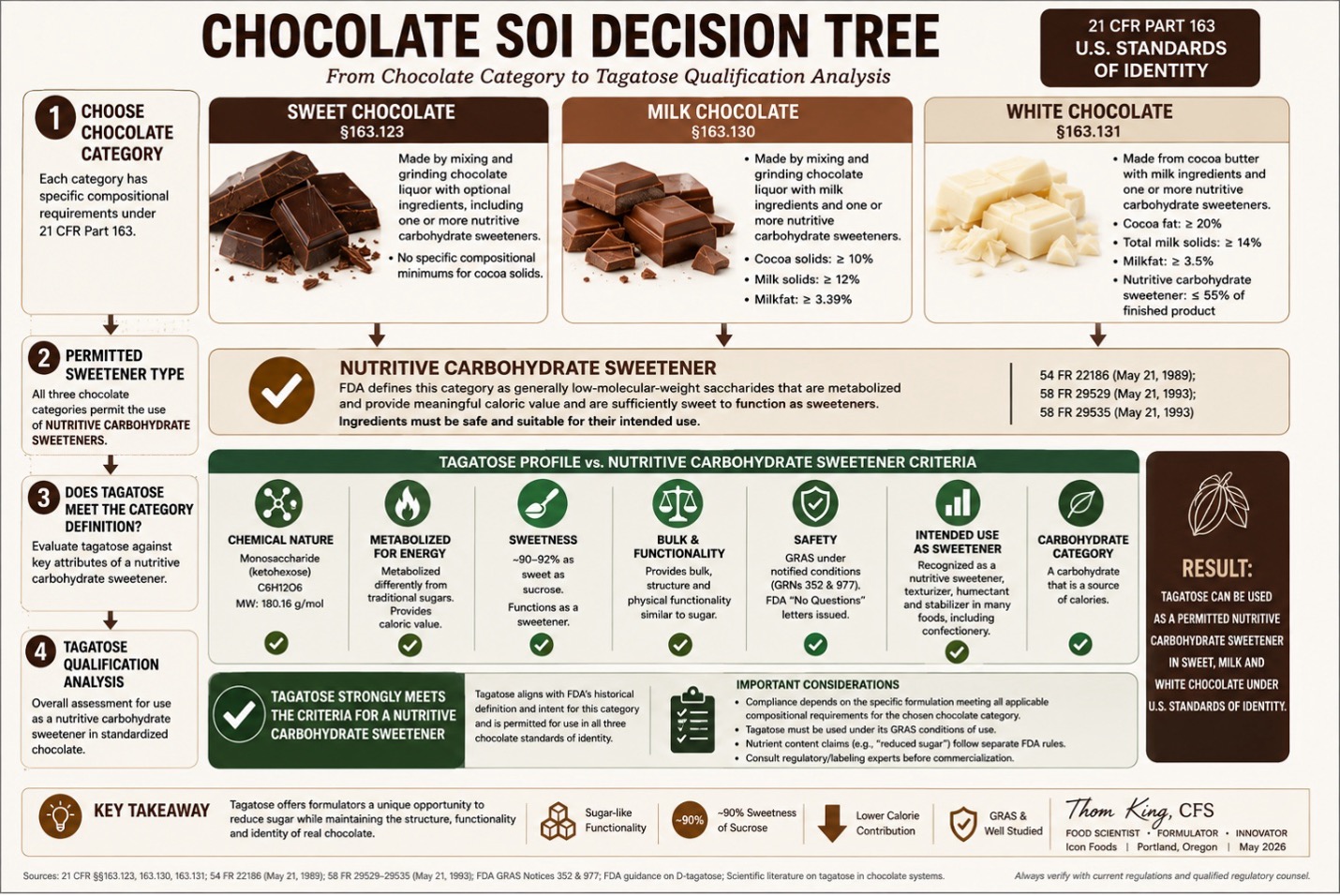
Under 21 CFR §163.123, FDA defines sweet chocolate as a solid or semiplastic food prepared by mixing and grinding chocolate liquor with one or more optional nutritive carbohydrate sweeteners. The regulation specifically lists nutritive carbohydrate sweeteners among the safe and suitable optional ingredients. The same basic concept appears in milk chocolate.
Under 21 CFR §163.130, milk chocolate is made by mixing and grinding chocolate liquor with dairy ingredients and one or more optional nutritive carbohydrate sweeteners.
White chocolate follows the same playbook. Its standard permits nutritive carbohydrate sweeteners, although white chocolate also carries its own compositional requirements, including minimum cacao fat and dairy solids and a maximum level of nutritive carbohydrate sweetener. FDA’s guidance confirms that white chocolate must contain at least 20% cacao fat, at least 14% total milk solids, at least 3.5% milkfat and no more than 55% nutritive carbohydrate sweetener.
That wording is enormously important. The regulations do not simply say “sucrose.” They say: Nutritive carbohydrate sweeteners. That was intentional.
FDA Left the Door Open
This isn’t regulatory archaeology for its own sake. The history tells us why the language matters. When FDA modernized the cacao standards in the early 1990s, the agency deliberately moved away from a narrow list of individual sweeteners and toward the broader functional category of “nutritive carbohydrate sweeteners.”
FDA explained that this approach could minimize the need to continually amend the chocolate standards whenever new carbohydrate sweeteners became commercially available. That is a pretty remarkable bit of regulatory foresight.
In discussing the category, FDA described nutritive carbohydrate sweeteners using several characteristics. They are generally relatively low-molecular-weight saccharides, they are metabolized and provide meaningful caloric value, and they possess sufficient sweetness to function as sweeteners. They must also be safe and suitable for the intended use.
Now put tagatose on the scouting report. Tagatose is:
- A monosaccharide.
- A carbohydrate.
- Sweet.
- Metabolized.
- Caloric, although substantially less caloric than sucrose.
- A bulk sweetener rather than a high-intensity sweetener.
- GRAS under notified conditions of use.
- Approximately 90 to 92% as sweet as sucrose.
- Physically capable of replacing significant amounts of sucrose.
Suddenly this starts looking less like regulatory gymnastics and more like tagatose walking onto the field wearing the correct uniform.
Is Tagatose a Nutritive Carbohydrate Sweetener?
This is the million-dollar question. Chemically, tagatose is a ketohexose monosaccharide with the molecular formula C₆H₁₂O₆. Its molecular weight is approximately 180.16 g/mol. It has a crystalline appearance remarkably similar to sucrose and delivers roughly 90% of sucrose’s sweetness.
FDA recognizes D-tagatose as a sugar that is metabolized differently from traditional sugars.FDA has also evaluated multiple GRAS notices for D-tagatose. GRN 352 describes its intended use as a sweetener, texturizer, humectant and stabilizer in numerous foods, including confectionery, and FDA responded that it had no questions regarding the notifier’s GRAS conclusion.
More recently, GRN 977 described D-tagatose as a nutritive sweetener, flavor enhancer, humectant, texturizer and stabilizer, with intended levels ranging from 1 to 100% depending upon the food category. FDA again responded that it had no questions regarding the GRAS conclusion. Tagatose therefore checks the major conceptual boxes FDA historically associated with a nutritive carbohydrate sweetener.
But here’s the regulatory grown-up sentence: I would not treat that conclusion as an automatic FDA blessing that every tagatose-sweetened formulation qualifies as standardized chocolate.
The chocolate standard does not specifically name D-tagatose, and the ultimate compliance determination depends upon the ingredient, its conditions of use, the finished formulation, the applicable chocolate category and labeling.
Before commercial launch, regulatory counsel or a qualified labeling specialist should confirm that the specific tagatose being used and the finished product meet the applicable standard. But from a food science and regulatory interpretation standpoint? There is a strong case worth pursuing. And that makes tagatose fundamentally different from many of the tools we traditionally use to make reduced-sugar chocolate.
Why High-Intensity Sweeteners Don’t Solve the Chocolate Problem
Here’s where formulation reality starts throwing elbows like DiJonai Carrington after Sophie Cunningham. Sucrose isn’t simply there to make chocolate sweet. Sucrose is structure. In conventional chocolate, sugar contributes:
- Bulk
- Particle architecture
- Rheology
- Mouthfeel
- Solids loading
- Sweetness
- Processing behavior
- Flavor release
- Perceived melt characteristics
Remove 35 grams of sucrose from a formula and replace its sweetness with 100 milligrams of a high-intensity sweetener and congratulations, you solved the sweetness problem. You also created a 34.9-gram hole in your formula. Chocolate notices holes like Swiss cheese.
So formulators start adding fibers, polyols and bulking systems to put the furniture back into the room. And that’s often where the Standard of Identity problem gets ugly. Tagatose approaches the problem differently. It isn’t merely bringing sweetness. It brings mass. That is a huge distinction.
Tagatose Plays the Same Position as Sugar
At roughly 90 to 92% of sucrose sweetness, tagatose lives in the same general formulation neighborhood as sucrose. That means we’re not dealing with a sweetener measured in hundreds of parts per million. We’re dealing with kilograms. That’s exactly what chocolate formulation needs.
If sucrose is the starting quarterback of conventional chocolate, tagatose isn’t the kicker trying to run the offense. It actually plays the position. It supplies solids while contributing substantial sweetness, which gives the formulator a much more conventional starting architecture.
That doesn’t mean a 1:1 replacement automatically produces perfect chocolate. It means we’re starting on the opponent’s 40-yard line instead of our own end zone. That is a very different formulation problem.
And Tagatose Actually Works in Chocolate
This isn’t purely theoretical. Researchers have investigated tagatose directly in chocolate systems. One early study comparing chocolate made with tagatose against sucrose reported that viscosity was approximately comparable, while melting point and melting enthalpy were also similar. The tagatose chocolate was somewhat softer.
Other work has examined tagatose-containing chocolate for rheology, texture and crystallization behavior. Research published in Food Chemistry found that alternative sweetener systems containing tagatose could be incorporated into dark compound chocolate, although crystal morphology, particle size and hygroscopicity influenced rheological and textural behavior.
Another study examining chocolate bloom reported that tagatose-containing chocolate showed slower changes in fat crystal formation and the lowest progression of bloom among the systems examined. That doesn’t mean tagatose magically fixes chocolate. It means we have enough evidence to say, this ingredient belongs in the chocolate laboratory.
The Formulator’s Sweet Spot
The first mistake I would avoid is assuming that sucrose replacement should automatically equal tagatose replacement gram-for-gram. Start with the sensory target. If sucrose is treated as 1.00 relative sweetness and tagatose is roughly 0.90 to 0.92, complete replacement on a weight basis may leave a modest sweetness deficit.
That deficit can potentially be closed with a small secondary sweetness system. And now we get into one of my favorite formulation strategies, let the bulk sweetener do the heavy lifting. Tagatose supplies, bulk + primary sweetness + sugar-like temporal profile. Then a carefully selected high-intensity sweetener or sweetness modulator supplies, the final few percentage points of sweetness intensity.
That is generally a much easier sensory problem than asking a high-intensity sweetener to replace the entire sucrose sweetness curve. You aren’t rebuilding the quarterback. You’re adjusting the throwing mechanics.
Particle Size Still Runs the Show
Chocolate doesn’t care how beautiful your ingredient deck looks. It cares about physics. Particle size distribution remains critical. The tongue becomes remarkably good at detecting particles once chocolate solids become sufficiently coarse. Meanwhile, driving particle size unnecessarily low increases total surface area, which increases the amount of fat required to coat those particles and can send viscosity climbing. Tagatose therefore needs to be treated as a chocolate solid, not simply dumped into a formulation as though we’re sweetening iced tea. Evaluate:
- D10 / D50 / D90 distribution
- Crystal morphology
- Refining behavior
- Casson yield stress
- Plastic viscosity
- Fat demand
- Lecithin or emulsifier requirement
- Conching behavior
The research on alternative sweeteners in chocolate reinforces this point: particle geometry, particle size and moisture behavior can materially influence chocolate rheology. The ingredient may be chemically brilliant and still turn your chocolate into drywall compound if you ignore particle engineering. Physics always gets the last possession of the ball.
Watch the Maillard Reaction
There is another important difference between tagatose and sucrose. Tagatose is a reducing sugar. Sucrose isn’t. It is actually classified as a non-reducing sugar because both of the reactive carbon atoms needed to donate electrons are tied up in the bond connecting its two single sugar rings, glucose and fructose. Tagatose therefore participates readily in Maillard browning and can caramelize more readily than sucrose at elevated temperatures.
For dark chocolate, this can potentially contribute interesting roasted, caramelized and malty flavor dimensions. For milk chocolate and white chocolate, pay much closer attention. You’ve now got: reducing sugar + milk protein + heat + time. That’s a Maillard offense with four receivers downfield.
Depending upon temperature, residence time and water activity, you may see increased browning and flavor development during processing. That isn’t automatically bad. It simply means your sucrose conching profile shouldn’t be blindly copied into a tagatose formulation. Run the experiment. Track color. Track flavor. Track moisture. Track viscosity. Track thermal history. Your process is part of the formula.
Where Tagatose Could Really Shine: Milk Chocolate
This is the category that gets particularly exciting. Traditional reduced-sugar milk chocolate is difficult because you’re simultaneously managing sweetness, bulk, dairy solids, cocoa solids, fat, texture and regulatory identity. Tagatose brings something unusual to that equation. It is a sugar. It behaves as a bulk carbohydrate sweetener. It has sucrose-like sweetness. It interacts with dairy proteins through Maillard chemistry. And FDA’s milk chocolate standard expressly permits nutritive carbohydrate sweeteners. That combination deserves serious commercial development. Imagine approaching sugar reduction not by asking: “How do I remove sugar from chocolate?” but instead: “How do I redesign the carbohydrate phase of chocolate?” That is a much better formulation question.
White Chocolate May Be Even More Interesting
White chocolate has always been a fascinating formulation beast because there are no nonfat cacao solids available to hide behind. You’ve got cocoa butter, dairy, sweetener and flavor. Everything is standing naked under fluorescent lighting.
FDA permits nutritive carbohydrate sweeteners in standardized white chocolate and caps them at 55% of the finished product. Tagatose therefore presents an intriguing route to a reduced-sugar-style white chocolate architecture while maintaining the bulk characteristics expected from a crystalline carbohydrate sweetener. But remember the Maillard warning. Tagatose plus milk proteins can mean significantly greater browning potential than sucrose. That could create a gorgeous caramelized milk profile. Or beige chocolate. Your process decides which one shows up.
Don’t Confuse “Reduced Sugar” With “Sugar Free”
This is where marketing needs to stay out of the formulation lab until regulatory has checked the homework. Tagatose is chemically a sugar.
FDA specifically identifies D-tagatose among sugars that are metabolized differently from traditional sugars. Its Nutrition Facts treatment has also evolved. FDA previously stated that D-tagatose must be declared as an added sugar while allowing enforcement discretion around calculation of its Added Sugars Daily Value based upon its lower caloric contribution.
Therefore, Standard of Identity compliance and nutrient-content claims are two entirely different regulatory questions. A product potentially qualifying as “milk chocolate” under the chocolate Standard of Identity does not automatically qualify for “sugar free,” “no sugar,” “zero sugar” or similar front-of-pack language. Those are separate regulatory lanes. Don’t merge onto the highway without looking.
My Starting Formulation Strategy
If I were developing a tagatose-sweetened chocolate tomorrow, I would not begin by trying to reinvent chocolate. I would begin with the existing sucrose control. Then I would systematically replace the sucrose fraction with tagatose while holding the cocoa system, fat system and dairy solids as constant as practical.
My development ladder would look roughly like this:
- Control – 100% sucrose-based sweetener phase.
- Prototype 1 – 25% sucrose replacement with tagatose.
- Prototype 2 – 50% replacement.
- Prototype 3 – 75% replacement.
- Prototype 4 – 100% tagatose replacement.
Then evaluate each prototype for:
- Sweetness intensity
- Sweetness onset and decay
- Cocoa perception
- Bitterness
- Astringency
- Caramelization notes
- Milk flavor
- Casson viscosity
- Yield stress
- Particle-size distribution
- Hardness
- Snap
- Melt
- Temper behavior
- Fat bloom
- Shelf stability
Only after understanding that curve would I introduce a secondary high-intensity sweetener or sweetness modulator. Why? Because otherwise you have too many players running onto the field simultaneously and no idea who blew the coverage. Good formulation is controlled experimentation.
Tagatose Isn’t Just Another Sugar Substitute
This is the bigger point. Most sugar-reduction conversations begin with sweetness. Chocolate forces us to think about structure. And structure is where tagatose becomes interesting. Tagatose isn’t simply trying to imitate sucrose’s sweetness. It brings, crystalline solids, bulk, approximately 90% sucrose sweetness, sugar-like temporal sweetness, reduced caloric contribution compared with sucrose, Maillard activity. caramelization potential, useful physical functionality, and potentially, most importantly, a credible argument for fitting within the nutritive-carbohydrate-sweetener framework used by U.S. chocolate Standards of Identity. That final point could be enormous.
The Regulatory Opportunity
For decades, reduced-sugar chocolate development has frequently involved an uncomfortable trade, improve the nutrition profile and potentially lose the standardized identity. Tagatose may offer another path. FDA intentionally wrote the chocolate standards around a functional category of sweeteners rather than permanently locking the industry into sucrose. The agency’s regulatory history explicitly contemplated technological development and new carbohydrate sweeteners. Tagatose arrived later.
But chemically and functionally, it looks remarkably well suited to the framework FDA created. That doesn’t eliminate the need for regulatory review. It makes that review worth doing. Because if the interpretation holds for a particular formulation, the question changes dramatically. We’re no longer asking: “Can we make something that tastes like reduced-sugar chocolate?” We’re asking: “Can we make better chocolate with a different sugar?” That is a much more interesting game. And for food formulators, it may be one worth playing.
Related Icon Foods Ingredients and Papers
- Tagatose: bulk TagaLite™ supplier and formulation guide
- TagaLite™ tagatose
- Confectionery ingredients for sugar free candy and chocolate
- Sugar free chocolate chips and inclusions
- Tagatose in frozen desserts: engineering sweetness below zero
- Request a TagaLite™ sample
References & Regulatory Resources
1. U.S. Food and Drug Administration. 21 CFR §163.123 — Sweet Chocolate.
Defines standardized sweet chocolate and identifies nutritive carbohydrate sweeteners among the safe and suitable optional ingredients. 21 CFR §163.123 — Sweet Chocolate
2. U.S. Food and Drug Administration. 21 CFR §163.130 — Milk Chocolate.
Defines standardized milk chocolate, including minimum chocolate liquor, milk solids and milkfat requirements, and permits nutritive carbohydrate sweeteners. 21 CFR §163.130 — Milk Chocolate
3. U.S. Food and Drug Administration. 21 CFR §163.124 — White Chocolate.
Defines standardized white chocolate as containing at least 20% cacao fat, 14% total milk solids and 3.5% milkfat, with nutritive carbohydrate sweeteners limited to no more than 55% by weight.
21 CFR §163.124 — White Chocolate
4. U.S. Food and Drug Administration. Federal Register, Vol. 58, No. 97, May 21, 1993. Standards of Identity for Cacao Products.
This is arguably the most important regulatory reference in the paper. FDA explains why it adopted the broader term “nutritive carbohydrate sweeteners” to provide greater flexibility and reduce the need to continually amend cacao standards as additional safe and suitable carbohydrate sweeteners are developed. FDA 1993 Cacao Products Final Rule — Federal Register
5. U.S. Food and Drug Administration. GRAS Notice No. 352 — D-Tagatose.
FDA evaluated a GRAS notice covering D-tagatose for use as a sweetener, texturizer, humectant and stabilizer in numerous food categories, including confectionery. FDA responded that it had “no questions” regarding the notifier’s GRAS conclusion. FDA GRAS Notice 352 — D-Tagatose
6. U.S. Food and Drug Administration. GRAS Notice No. 977 — D-Tagatose Produced via Novel Enzymatic Cascade.
Particularly relevant to the chocolate SOI argument because the notice specifically describes D-tagatose’s intended use as a “nutritive sweetener,” as well as a flavor enhancer, humectant, texturizer and stabilizer. FDA issued a “no questions” letter. FDA GRAS Notice 977 — D-Tagatose
7. U.S. Food and Drug Administration. Sugars That Are Metabolized Differently Than Traditional Sugars.
FDA specifically identifies D-tagatose as a sugar that meets the chemical definition of sugar but is metabolized differently from traditional sugars such as sucrose. FDA — Sugars Metabolized Differently Than Traditional Sugars
8. U.S. Food and Drug Administration. November 21, 2025 Response Regarding D-Tagatose Nutrition Labeling.
This is a major regulatory development. FDA states that it intends to exercise enforcement discretion permitting D-tagatose to be excluded from Total Sugars and Added Sugars declarations on the Nutrition Facts label and recognizes a caloric value of 1.5 kcal/g. FDA also confirms D-tagatose as an eligible noncariogenic sweetener for the dental-caries health claim authorized under 21 CFR §101.80. FDA November 2025 D-Tagatose Letter
Regulatory Note
The argument presented in this paper is based on the language of the applicable chocolate Standards of Identity, FDA’s regulatory history surrounding the term “nutritive carbohydrate sweetener,” FDA GRAS notices concerning D-tagatose, and current FDA guidance and enforcement policy.
FDA’s 1993 rulemaking is especially significant because the agency expressly stated that the broader category of nutritive carbohydrate sweeteners was intended to provide flexibility as additional safe and suitable carbohydrate sweeteners became available. D-tagatose was subsequently identified in GRAS Notice 977 specifically as a nutritive sweetener.
However, FDA does not appear to have issued a specific determination stating that every D-tagatose-sweetened formulation automatically qualifies as standardized sweet chocolate, milk chocolate or white chocolate. Compliance ultimately depends upon the complete formulation, applicable Standard of Identity, conditions of use, manufacturing process and labeling.
Commercial formulations should therefore undergo regulatory review before launch.