
by Thom King CFS – Founder, Chief Innovation Officer, Food Scientist, Icon Foods
Allulose is one molecule. Same six carbons. Same molecular weight. Same approximately 70% sweetness relative to sucrose. Same reducing-sugar chemistry. Put it in a formulation in the United States and you have one regulatory conversation. Drive that formulation north into Canada and the conversation changes. Fly it across the Atlantic into the European Union and somebody takes the ball away entirely.
Welcome to international food regulation, where chemistry remains stubbornly consistent while regulatory classifications develop frequent-flyer personalities.
For food and beverage formulators, allulose provides a particularly fascinating case study because the science surrounding the molecule is increasingly mature, while regulatory acceptance remains decidedly geographical. As of August 2026:
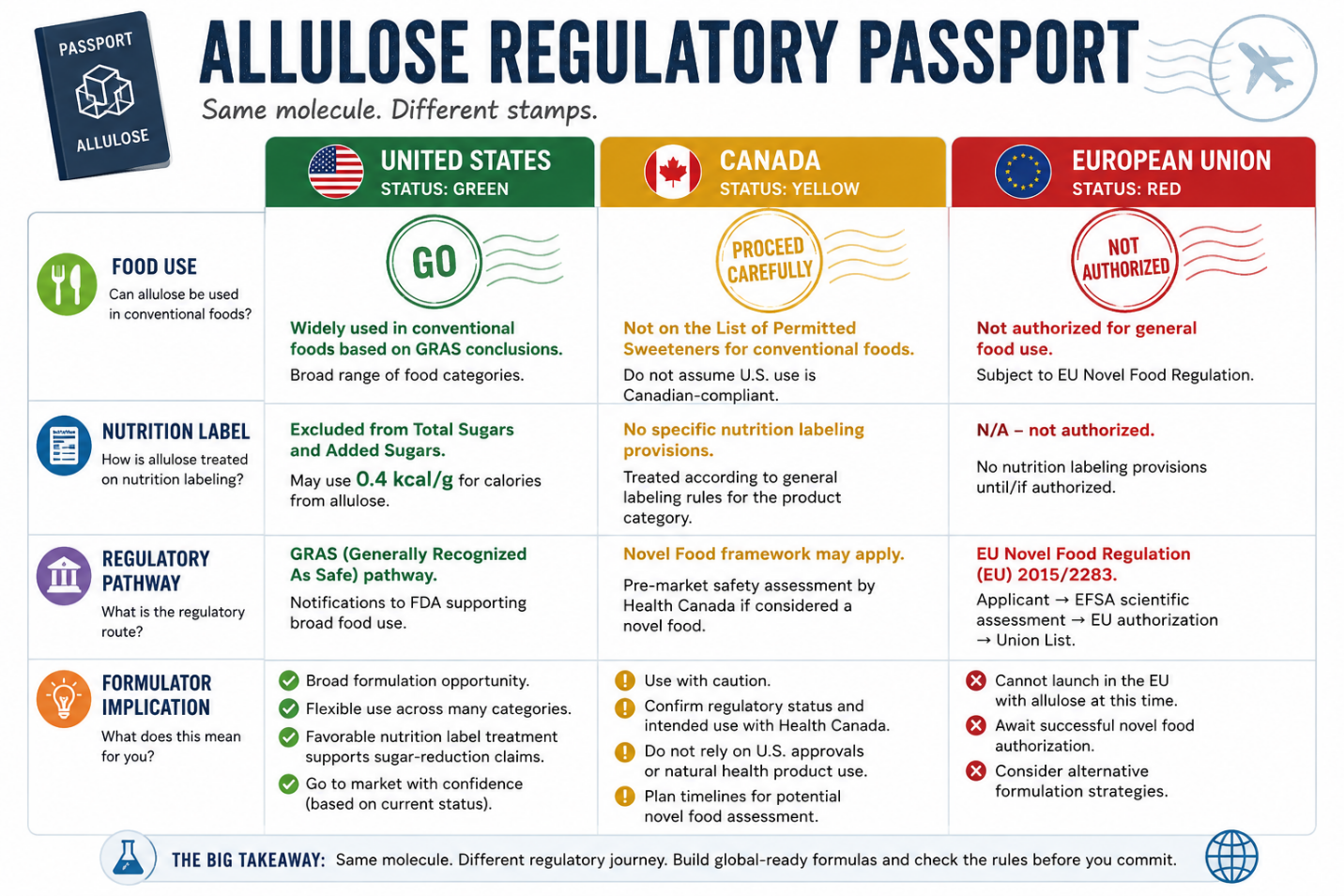
United States: allulose is commercially used in conventional foods under GRAS conclusions and enjoys unusually favorable nutrition-label treatment.
Canada: allulose does not appear on Health Canada’s current List of Permitted Sweeteners for conventional foods, although D-allulose does appear as a non-medicinal ingredient in some licensed natural health products.
European Union: allulose has not been authorized for general food use under the EU Novel Food Regulation.
Same molecule. Three regulatory scoreboards. Let’s unpack this.
First: What Exactly Is Allulose?
Allulose, historically called D-psicose, is a monosaccharide and the C-3 epimer of fructose. Translation from food-science Klingon: Take fructose. Rearrange the stereochemistry around one carbon. Suddenly the resulting molecule behaves very differently metabolically.
Commercial allulose is typically manufactured through enzymatic epimerization of fructose, followed by purification and concentration or crystallization. Allulose delivers roughly 70% of the sweetness of sucrose, although perceived sweetness varies with the food matrix, temperature, acidity, flavor system and accompanying sweeteners. But sweetness isn’t why formulators get excited about allulose. We’ve already got plenty of molecules that can make things sweet. The magic is that allulose can perform some of the physical jobs of sugar. It provides bulk. It contributes solids. It participates in Maillard browning. It affects freezing depression point. It contributes to mouthfeel. It can modify water activity.
And its temporal sweetness profile is considerably more sugar-like than many high-intensity sweeteners. That makes allulose something much more useful than simply another sweetener. It is a functional carbohydrate. And that’s where regulatory classification starts getting interesting.
Three Countries Walk Into a Formulation Lab
Imagine we’ve developed a reduced-sugar protein bar containing allulose. Same formula. Same manufacturing process. Same finished product. Now we’re going to sell it in three markets. Here’s the regulatory snapshot.
| Market | Current Position | Practical Formulator Takeaway |
| United States | Commercially used in conventional foods under GRAS conclusions | Broad formulation opportunity |
| Canada | Not listed as a permitted conventional-food sweetener | Do not assume U.S. formulation is Canadian-compliant |
| European Union | Not currently authorized for general food use as a novel food | Cannot simply launch the U.S. formulation in the EU |
That table should be taped to the wall of every formulation lab developing global reduced-sugar products. Because one of the most expensive sentences in food development is: “We already finished the formula. Can Regulatory check it now?” No. Regulatory should have been in the huddle before kickoff.
The United States: Allulose Gets the Ball
The United States has taken the most commercially accommodating position toward allulose. Multiple allulose ingredients have been the subject of GRAS notices to FDA, supporting use across a broad range of food categories. But the regulatory development that really changed the game came from nutrition labeling. FDA issued guidance allowing allulose to be excluded from the amounts declared for Total Sugars and Added Sugars on the Nutrition Facts label.
FDA also indicated that manufacturers may use 0.4 kcal/g when calculating calories from allulose. That is a radically different nutritional treatment from ordinary sugars. For formulators, this creates an unusual combination: Sugar-like functionality without conventional sugar labeling treatment. That’s a hell of a formulation tool.
Then We Drive North
Cross the Canadian border and things change. This is where American formulators need to resist a very dangerous assumption: “FDA accepts it, therefore Canada probably does too.” Canada is not FDA with better hockey. Health Canada operates under its own regulatory framework. Health Canada’s List of Permitted Sweeteners identifies sweeteners authorized as food additives, the foods in which they may be used and their conditions of use. Allulose does not currently appear on that list. That means formulators should not simply take a U.S. product containing allulose as a sweetener, slap bilingual packaging on it and ship it north. That’s not regulatory strategy. That’s more like regulatory roulette.
But Canada Has an Interesting Allulose Wrinkle
Here’s where Canada becomes particularly interesting. Health Canada’s databases show D-allulose being used as a non-medicinal ingredient in licensed natural health products. That tells us something important, but it needs to be interpreted correctly. It does not establish broad authorization for allulose as a sweetener in conventional foods. A natural health product and a conventional food operate under different regulatory frameworks. This is exactly the kind of nuance that gets murdered in a Google search. Someone finds a Canadian product containing allulose and concludes: “Allulose is approved in Canada.” Not necessarily. The regulatory question is not simply: Does some product somewhere in Canada contain allulose? The correct question is: Is allulose legally permitted for my intended use, at my intended level, in my specific product category under the regulatory framework governing that product? That’s the question formulators need to ask every single time.
Canada’s Novel Food System Adds Another Layer
Canada also has a pre-market safety framework for novel foods. Health Canada describes novel foods as foods or ingredients that do not have a history of safe food use or foods produced through processes that create a major change. Novel foods require safety assessment before sale in Canada. Health Canada evaluates matters including:
- composition;
- nutritional quality;
- potential toxicity;
- allergenicity;
- dietary exposure;
- manufacturing methods; and
- other safety considerations.
But Canada’s regulatory framework and Europe’s Novel Food Regulation should not be treated as interchangeable. The fact that an ingredient encounters regulatory hurdles in both jurisdictions doesn’t mean those hurdles are legally identical.
For a Canadian commercialization project involving allulose, the prudent move is therefore to establish the ingredient’s regulatory status and intended use with Health Canada before locking the commercial formulation. The regulatory classification comes first. The ingredient purchase order comes considerably later.
Now We Fly to Europe
Europe gives allulose an entirely different workout. Under Regulation (EU) 2015/2283, foods without a history of significant consumption within the European Union before May 15th 1997 may fall within the Novel Food Regulation. Allulose does. Novel foods require authorization before being placed on the EU market. The process essentially runs: Applicant → European Commission → EFSA scientific assessment → regulatory decision → Union List authorization. And allulose hasn’t crossed that finish line.
The 2025 EFSA Opinion
This is probably the most misunderstood part of the European allulose story. In June 2025, EFSA published a scientific opinion concerning D-allulose following a novel-food application. The headline conclusion was: The safety of D-allulose could not be established based on the available information. Stop there and it sounds terrible. Keep reading. EFSA identified data gaps involving areas including:
- identity;
- production process;
- proposed uses and use levels;
- genotoxicity; and
- human data.
EFSA requested additional information from the applicant. According to EFSA, the applicant did not provide the requested additional information despite multiple contacts. EFSA therefore concluded that safety could not be established from the information available. That is not remotely the same scientific statement as: “Allulose has been demonstrated to be unsafe.” Those statements should never be conflated.
Safety Not Established Doesn’t Equal Unsafe
This distinction is Regulatory Science 101. Suppose we’re validating a thermal kill step. I ask for the time-temperature data. You hand me half the records. I ask for the missing records. You don’t send them. I cannot conclude the process is safe. But I also haven’t demonstrated that the process is unsafe. I have demonstrated something much less exciting: I don’t have enough data.
That’s essentially the problem EFSA encountered. The assessment failed to reach a positive safety conclusion because the dataset was insufficient. That leaves the scientific door open for another properly supported dossier. And several companies have shown interest in getting allulose through that door.
Why Europe Cares About Exposure
One of the biggest issues surrounding allulose authorization isn’t simply whether humans can tolerate a spoonful of the stuff. Regulators have to consider aggregate dietary exposure.
Imagine allulose becomes commercially successful. It’s no longer just in a protein bar. Now it’s in:
- beverages;
- yogurt;
- cookies;
- chocolate;
- frozen desserts;
- sauces;
- cereal;
- chewing gum;
- nutrition bars; and
- tabletop sweeteners.
A consumer could encounter allulose six times before dinner. That’s why proposed use levels matter. Gastrointestinal tolerance is particularly important for carbohydrates that are incompletely absorbed or metabolized differently from conventional sugars. The dose makes the digestive drama.
And Canada Will Care About Exposure Too
This is where the Canadian and European regulatory philosophies start to rhyme even though they aren’t singing exactly the same song. Health Canada also uses pre-market safety assessment when novel foods are involved. That means a serious Canadian allulose strategy would need to consider not merely: “Is allulose toxic?” but: “What happens when Canadians consume realistic quantities across the proposed food categories?” That’s a much better scientific question. Ingredient safety is rarely just about molecular identity. It’s: Identity × Dose × Exposure × Population × Food Matrix × Frequency. That equation should live in every formulator’s head.
Why Are We Fighting This Hard for One Sugar?
Because allulose can do something most high-intensity sweeteners cannot. It can work. Sugar reduction is frequently discussed as though sucrose has one job, sweetness. We all know that’s nonsense. Sucrose contributes:
- sweetness;
- bulk;
- solids;
- viscosity;
- texture;
- mouthfeel;
- water activity;
- freezing-point depression;
- browning;
- flavor development;
- crystallization behavior; and
- preservation effects.
Remove 100 grams of sugar and replace its sweetness with 300 milligrams of a high-intensity sweetener and congratulations: You’ve replaced the sweetness. You’ve also created a 99.7-gram hole in your formulation. Have fun filling it. Allulose helps fill that hole.
Allulose and Browning
Allulose is a reducing sugar, sucrose is not. Therefore it can participate readily in Maillard chemistry when amino compounds and appropriate processing conditions are present. This can be fantastic. Or it can torch your formulation. In bakery systems, bars, sauces and confectionery, allulose can create desirable browning and flavor development. But replacing sucrose one-for-one without reconsidering thermal processing can dramatically alter finished-product color and flavor. Your golden cookie can become a hockey puck with trust issues. Time, temperature, moisture, pH and protein content all matter.
Allulose in Frozen Desserts
Here’s another place allulose earns its paycheck. Allulose can strongly influence freezing-point depression. That means it can dramatically change:
- hardness;
- scoopability;
- ice fraction;
- melting behavior;
- storage stability; and
- sweetness balance.
A reduced-sugar ice cream therefore isn’t solved by simply asking: “How much allulose replaces the sugar?” The better question is: “What combination of carbohydrates, bulking agents and sweeteners gives me the sweetness, solids and freezing curve I need?” That’s formulation rather than substitution. Big difference.
Beverage Formulation
Beverages provide another excellent example. Removing sucrose eliminates more than sweetness. Body disappears. Flavor delivery changes. Acid perception changes. Aromatics change. Sweetness timing changes. Allulose can restore some of that missing body while contributing a relatively sugar-like sweetness profile.
But because allulose is less sweet than sucrose, using it alone may require more material than is commercially, sensorially or physiologically desirable. That’s where blended systems become powerful. Allulose can establish: bulk + mouthfeel + early sweetness. while high-intensity sweeteners or sweetness modulators close the remaining sweetness gap. Now we’re playing chess rather than Whac-A-Mole.
The Global Formulator’s Problem
This brings us to the bigger issue. Imagine you’re developing one product for: United States + Canada + European Union. If allulose forms the structural foundation of your formula, you may have just designed yourself into a regulatory corner. The U.S. version might work beautifully. The Canadian version may require a different regulatory strategy or reformulation. The EU version currently requires another solution altogether. So instead of thinking about one formula, think about a global formulation platform.
Build Modular Sweetness Systems
This is where formulators can get ahead of regulatory affairs instead of handing them a grenade with the pin already removed. Separate your sweetness system conceptually into functional modules:
- Module 1: Bulk – What replaces sugar solids?
- Module 2: Sweetness – What generates sweetness intensity?
- Module 3: Temporal Profile – What provides sucrose-like onset and decay?
- Module 4: Mouthfeel – What restores body and viscosity?
- Module 5: Processing – What happens during baking, extrusion, UHT, retort or freezing?
- Module 6: Nutrition – What happens to calories, sugars, carbohydrates and claims?
Now individual components can change by geography without forcing you to reinvent the entire product. That’s regulatory portability. And increasingly, it’s going to be a competitive advantage.
The Three-Market Scoreboard
The allulose situation can therefore be summarized pretty simply. United States, most commercially permissive of the three. Allulose is already being used broadly in food formulation, with particularly favorable FDA nutrition-label treatment.
Canada, Proceed carefully. Allulose is not currently included in Health Canada’s List of Permitted Sweeteners for conventional foods. D-allulose does appear in certain licensed natural health products, but that should not be interpreted as blanket approval for conventional food applications. Talk to regulatory before commercialization. Preferably before you’ve ordered 40,000 printed wrappers.
European Union, not currently authorized for general food use. Allulose remains subject to the EU novel-food authorization process. EFSA’s 2025 assessment did not establish safety because requested supporting information was not supplied. That was an unsuccessful dossier assessment, not affirmative evidence that allulose is unsafe. For now.
The Bigger Lesson
Allulose exposes one of the most fascinating tensions in modern food science. We’re developing carbohydrates that don’t behave metabolically like the sugars our regulatory systems were built around tagatose, allulose, and other rare sugars coming behind them. The traditional regulatory buckets of sugar versus sweetener are getting increasingly uncomfortable. Because these molecules can be carbohydrates. They can provide bulk. They can participate in Maillard chemistry. They can affect freezing behavior. They can contribute sweetness. Yet physiologically they can behave very differently from sucrose or glucose. The molecules changed. The regulatory filing cabinets haven’t completely caught up.
Food For Thought
Allulose is an extraordinary example of why modern food formulators need to understand regulatory science almost as well as ingredient science. In the United States, allulose is already a serious commercial formulation tool.
In Canada, its use in conventional foods requires substantially more regulatory caution, and formulators should not infer broad food authorization from its appearance in licensed natural health products.
In the European Union, allulose remains outside general food authorization pending a successful novel-food pathway.
None of that changes the molecule. What changes is the regulatory framework surrounding it. And that’s the lesson formulate globally from day one. Don’t build a product for America and then try to force it through Canadian and European regulatory systems afterward. Build a sweetness architecture that can travel. Because in the next generation of sugar reduction, the winning formulations won’t merely taste good. They’ll taste good, perform properly, survive manufacturing, meet nutritional objectives and cross borders without Regulatory Affairs chasing the formulation team through the parking lot. That’s the real sweet spot.
References & Further Reading
European Food Safety Authority (EFSA). Safety of D-allulose as a novel food pursuant to Regulation (EU) 2015/2283. EFSA Journal, 2025. EFSA concluded that safety could not be established from the available information after requested additional data were not supplied.
European Food Safety Authority. Novel Foods. Overview of the EU novel-food framework and pre-market safety assessment.
European Commission. Regulation (EU) 2015/2283 on Novel Foods. Establishes the regulatory framework governing novel foods within the European Union.
Health Canada. List of Permitted Sweeteners. Official list identifying food additives authorized for sweetening purposes in Canada and their permitted conditions of use.
Health Canada. Novel Foods: Overview. Describes Canada’s regulatory definition and pre-market safety assessment process for novel foods.
Canadian Food Inspection Agency. Labelling Requirements for Sweeteners and Foods That Contain Sweeteners. Guidance concerning permitted sweeteners and labeling requirements in Canada.
Health Canada, Licensed Natural Health Products Database. Entries identifying D-allulose as a non-medicinal ingredient in certain licensed natural health products. These should not be interpreted as authorization for unrestricted conventional-food use.
U.S. Food and Drug Administration. Guidance for Industry: The Declaration of Allulose and Calories from Allulose on Nutrition and Supplement Facts Labels. Describes FDA’s enforcement discretion regarding exclusion of allulose from Total Sugars and Added Sugars declarations and use of 0.4 kcal/g for calorie calculations.
Build Modular Sweetness Systems
This is where formulators can get ahead of regulatory affairs instead of handing them a grenade with the pin already removed. Separate your sweetness system conceptually into functional modules:
• Module 1: Bulk – What replaces sugar solids?
• Module 2: Sweetness – What generates sweetness intensity?
• Module 3: Temporal Profile – What provides sucrose-like onset and decay?
• Module 4: Mouthfeel – What restores body and viscosity?
• Module 5: Processing – What happens during baking, extrusion, UHT, retort or freezing?
• Module 6: Nutrition – What happens to calories, sugars, carbohydrates and claims?
Now individual components can change by geography without forcing you to reinvent the entire product. That’s regulatory portability. And increasingly, it’s going to be a competitive advantage.
The Three-Market Scoreboard
The allulose situation can therefore be summarized pretty simply. United States, most commercially permissive of the three. Allulose is already being used broadly in food formulation, with particularly favorable FDA nutrition-label treatment.
Canada, Proceed carefully. Allulose is not currently included in Health Canada’s List of Permitted Sweeteners for conventional foods. D-allulose does appear in certain licensed natural health products, but that should not be interpreted as blanket approval for conventional food applications. Talk to regulatory before commercialization. Preferably before you’ve ordered 40,000 printed wrappers.
European Union, not currently authorized for general food use. Allulose remains subject to the EU novel-food authorization process. EFSA’s 2025 assessment did not establish safety because requested supporting information was not supplied. That was an unsuccessful dossier assessment, not affirmative evidence that allulose is unsafe. For now.
The Bigger Lesson
Allulose exposes one of the most fascinating tensions in modern food science. We’re developing carbohydrates that don’t behave metabolically like the sugars our regulatory systems were built around tagatose, allulose, and other rare sugars coming behind them. The traditional regulatory buckets of sugar versus sweetener are getting increasingly uncomfortable. Because these molecules can be carbohydrates. They can provide bulk. They can participate in Maillard chemistry. They can affect freezing behavior. They can contribute sweetness. Yet physiologically they can behave very differently from sucrose or glucose. The molecules changed. The regulatory filing cabinets haven’t completely caught up.
Food For Thought
Allulose is an extraordinary example of why modern food formulators need to understand regulatory science almost as well as ingredient science. In the United States, allulose is already a serious commercial formulation tool.
In Canada, its use in conventional foods requires substantially more regulatory caution, and formulators should not infer broad food authorization from its appearance in licensed natural health products.
In the European Union, allulose remains outside general food authorization pending a successful novel-food pathway.
None of that changes the molecule. What changes is the regulatory framework surrounding it. And that’s the lesson formulate globally from day one. Don’t build a product for America and then try to force it through Canadian and European regulatory systems afterward. Build a sweetness architecture that can travel. Because in the next generation of sugar reduction, the winning formulations won’t merely taste good. They’ll taste good, perform properly, survive manufacturing, meet nutritional objectives and cross borders without Regulatory Affairs chasing the formulation team through the parking lot. That’s the real sweet spot.
References & Further Reading
European Food Safety Authority (EFSA). Safety of D-allulose as a novel food pursuant to Regulation (EU) 2015/2283. EFSA Journal, 2025. EFSA concluded that safety could not be established from the available information after requested additional data were not supplied.
European Food Safety Authority. Novel Foods. Overview of the EU novel-food framework and pre-market safety assessment.
European Commission. Regulation (EU) 2015/2283 on Novel Foods. Establishes the regulatory framework governing novel foods within the European Union.
Health Canada. List of Permitted Sweeteners. Official list identifying food additives authorized for sweetening purposes in Canada and their permitted conditions of use.
Health Canada. Novel Foods: Overview. Describes Canada’s regulatory definition and pre-market safety assessment process for novel foods.
Canadian Food Inspection Agency. Labelling Requirements for Sweeteners and Foods That Contain Sweeteners. Guidance concerning permitted sweeteners and labeling requirements in Canada.
Health Canada, Licensed Natural Health Products Database. Entries identifying D-allulose as a non-medicinal ingredient in certain licensed natural health products. These should not be interpreted as authorization for unrestricted conventional-food use.
U.S. Food and Drug Administration. Guidance for Industry: The Declaration of Allulose and Calories from Allulose on Nutrition and Supplement Facts Labels. Describes FDA’s enforcement discretion regarding exclusion of allulose from Total Sugars and Added Sugars declarations and use of 0.4 kcal/g for calorie calculations.