
A Formulator’s Guide to Smarter Sugar Reduction
By Thom King, CFS — Chief Innovation Officer, Icon Foods
Every food scientist has seen it. A package of sugar-free candy carries the familiar disclaimer: “Excess consumption may have a laxative effect.” It is one of the most recognized warnings in the reduced-sugar world, yet remarkably few formulators can fully explain why it exists. The answer is not simply “polyols cause diarrhea.” The answer is rooted in chemistry, thermodynamics, physiology, and molecular structure. Understanding these principles changes the way we formulate.
Instead of viewing bowel tolerance as an ingredient problem, we begin viewing it as a systems problem involving molecular architecture, intestinal absorption, osmosis, fermentation, and dose. Once you understand the mechanism, predicting gastrointestinal tolerance becomes far easier than memorizing individual ingredients.
The Molecule That Changed Everything
One tiny functional group largely explains why carbohydrates behave the way they do. The hydroxyl group. Chemically represented as -OH, every hydroxyl group contains one oxygen atom covalently bonded to one hydrogen atom. That tiny structure completely changes the personality of a molecule. Hydroxyl groups make carbohydrates hydrophilic. They readily hydrogen bond with water. The more hydroxyl groups present, the greater the opportunity for water interaction, hydration, and solubility. In many respects, carbohydrates are simply carbon skeletons decorated with hydroxyl groups. The chemistry of those decorations determines much of their functionality.
Water Is Always Playing Defense
Water is not passive. It constantly seeks equilibrium. Whenever a selectively permeable membrane separates two solutions having different concentrations of dissolved molecules, water moves toward the side containing the greater concentration of osmotically active particles.
This phenomenon is known as osmosis. Importantly, water is not “attracted” to polyols. Rather, physics favors equalizing chemical potential. Nature continually attempts to reduce concentration differences. Our intestines simply obey the laws of thermodynamics.
Why Polyols Behave Differently Than Sugar
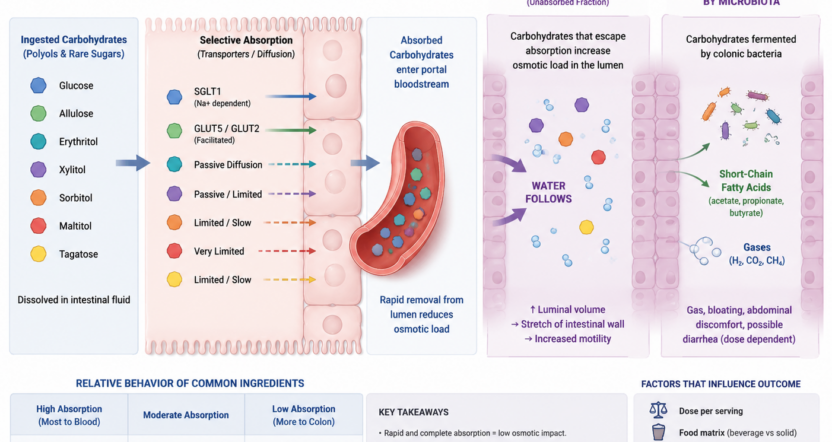
Sucrose is efficiently digested. Glucose and fructose are rapidly transported across the intestinal wall through specialized transport proteins. Very little remains within the intestinal lumen. Consequently, very little osmotic pressure develops.
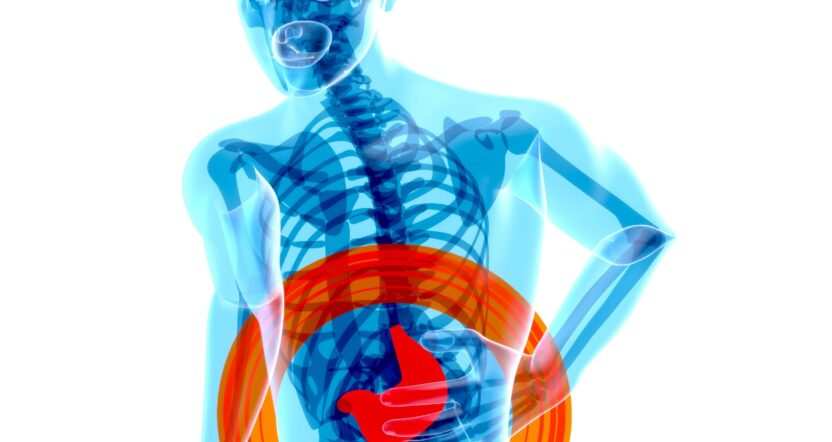
Polyols tell a different story. Most are absorbed incompletely. The fraction that remains inside the intestine continues to exist as dissolved, osmotically active molecules. Because they remain in solution, they increase luminal osmolarity. Water follows. As water enters the intestine, stool volume increases. Stretch receptors within the intestinal wall activate. Transit accelerates. When enough water accumulates, disaster pants may result. This process is known as osmotic diarrhea. The intestine is not rejecting polyols. It is obeying physics.
Hydroxyl Groups Are Part of the Story, But Not the Entire Story
One common misconception deserves clarification. It is tempting to conclude that molecules with more hydroxyl groups necessarily produce greater osmotic effects. Reality is more nuanced. Hydroxyl groups improve water solubility. They increase hydrogen bonding. They help molecules remain dissolved. However, poor intestinal absorption is the primary determinant of bowel tolerance.
A highly water-soluble molecule that is almost completely absorbed produces little osmotic load. Conversely, a poorly absorbed molecule that remains dissolved within the intestinal lumen continues exerting osmotic pressure. Hydroxyl groups make the molecule compatible with water. Poor absorption allows it to remain in the gut long enough to matter.
Why Erythritol Behaves So Differently
Erythritol demonstrates why absorption matters more than hydroxyl count. Although highly water soluble, approximately 90% of ingested erythritol is absorbed in the small intestine and later excreted unchanged in urine. Very little reaches the colon. Consequently, erythritol generally produces substantially better bowel tolerance than sorbitol or maltitol at comparable sweetness replacement levels. Its chemistry did not change. Its absorption did.
Rare Sugars Rewrite the Conversation
Rare sugars deserve consideration within this framework because they challenge traditional assumptions. Both allulose and tagatose possess multiple hydroxyl groups and exhibit excellent water solubility. Yet their gastrointestinal behavior differs significantly from many traditional polyols.
Allulose
Allulose is absorbed to a much greater extent than most polyols, with the absorbed fraction largely excreted unchanged in urine rather than extensively metabolized. Because less allulose reaches the colon than sorbitol or maltitol, gastrointestinal tolerance is generally improved, although large single doses can still create an osmotic load.
Tagatose
Tagatose follows a different path. Only part is absorbed within the small intestine. The remainder reaches the colon where it undergoes bacterial fermentation. Unlike many polyols, fermentation produces substantial quantities of short-chain fatty acids that may support colonic health, although excessive intake can still produce gas, bloating, and loose stools in susceptible individuals. Understanding these differences allows formulators to predict consumer experience rather than relying solely upon historical ingredient reputation.
Comparison of Common Polyols and Rare Sugars: Molecular Properties and Gastrointestinal Behavior
| Ingredient | Chemical Class | Hydroxyl Groups (-OH) | Molecular Weight (g/mol) | Small Intestinal Absorption | Colonic Fermentation | Relative Osmotic Potential* | Typical Bowel Tolerance |
| Glucose | Monosaccharide | 5 | 180.16 | ~99-100% | Minimal | Very Low | Excellent |
| Fructose | Monosaccharide | 5 | 180.16 | High (dose dependent) | Low to Moderate | Low | Excellent in most people |
| Sucrose | Disaccharide | 8 | 342.30 | Nearly complete after hydrolysis | Minimal | Very Low | Excellent |
| Allulose | Rare sugar | 5 | 180.16 | ~70-85% | Low to Moderate | Low to Moderate | Good |
| Tagatose | Rare sugar | 5 | 180.16 | ~20-30% | High | Moderate | Moderate to Good |
| Erythritol | Polyol | 4 | 122.12 | ~90% | Minimal | Low | Excellent |
| Xylitol | Polyol | 5 | 152.15 | ~50% | Moderate | Moderate | Moderate |
| Sorbitol | Polyol | 6 | 182.17 | Low | High | High | Fair to Poor |
| Mannitol | Polyol | 6 | 182.17 | Low | Moderate | High | Fair |
| Isomalt | Polyol (disaccharide alcohol) | 11 | 344.31 | Low | High | High | Fair |
| Maltitol | Polyol (disaccharide alcohol) | 11 | 344.31 | Partial | High | High | Fair to Poor |
| Lactitol | Polyol (disaccharide alcohol) | 11 | 344.31 | Very Low | Very High | High | Poor |
* Relative osmotic potential assumes comparable gram doses in solution. The actual osmotic effect depends on the number of molecules remaining in the intestinal lumen, which is determined primarily by absorption and dose.
Bowel Tolerance Is Better Viewed as an Equation
Rather than asking, “Does this ingredient cause diarrhea?” Formulators should ask, What osmotic load and fermentable load does this formulation create? Conceptually, Bowel Tolerance ≈ Osmotic Load + Fermentable Load + Dose + Consumer Sensitivity This simple mental model explains most gastrointestinal responses observed in reduced-sugar products.
Beverage Formulation Changes Everything
Beverages deserve special consideration. Unlike solid foods, beverages empty from the stomach rapidly. The dissolved sweeteners arrive within the small intestine as a concentrated osmotic solution. If a beverage contains excessive concentrations of poorly absorbed carbohydrates, the osmotic challenge occurs quickly.
For this reason, beverage formulators often achieve superior gastrointestinal tolerance by distributing sweetness across multiple mechanisms rather than relying heavily upon any single bulk sweetener. Lower osmotic load. Lower fermentable load. Equivalent sweetness. Better consumer experience.
Formulation Is About Distribution, Not Concentration
One of the most common formulation mistakes is asking one ingredient to perform every job. Bulk, sweetness. temporal profile, mouthfeel. freezing point depression, humectancy, cost, and bowel tolerance.
No ingredient excels at all of them. Modern sugar reduction succeeds by distributing functionality. Rare sugars contribute bulk and sucrose-like temporal characteristics. Polyols contribute texture and stability through lower water activity. High-intensity sweeteners provide sweetness efficiency. Sweet proteins and modulators improve temporal profile while reducing overall sweetener load. Each ingredient performs the task it does best. The result is greater than the sum of its parts.
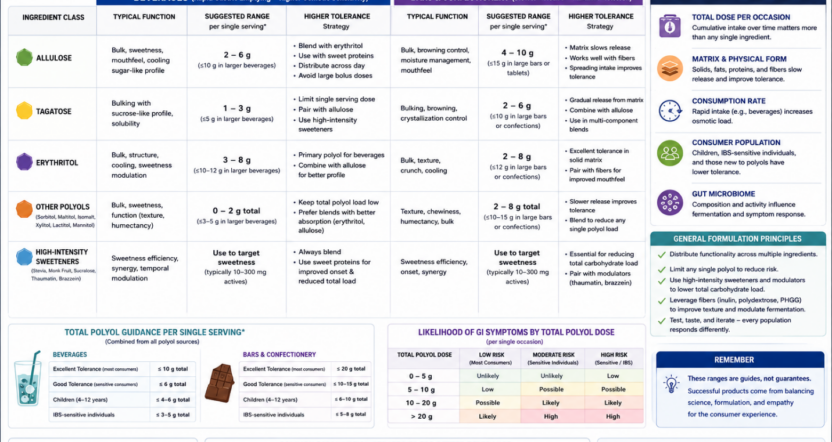
Consumers rarely experience molecules. They experience formulations. Our responsibility as formulators is not simply achieving sweetness. It is engineering an enjoyable physiological experience from first sip to final digestion.
When we understand hydroxyl groups, hydrogen bonding, osmosis, intestinal absorption, and microbial fermentation, gastrointestinal tolerance becomes predictable rather than mysterious. Ultimately, successful sugar reduction is not about replacing sugar. It is about understanding chemistry well enough that the body barely notices the substitution.
For more than 25 years, Icon Foods has helped food and beverage manufacturers move beyond ingredient substitution toward intelligent formulation.