
By Thom King, CFS, Founder & Chief Innovation Officer, Icon Foods
Every few years the food industry develops a new villain. Fat was evil. Then carbs were evil. Then artificial sweeteners were evil. Most recently, erythritol found itself wearing the black hat. The reality is far less dramatic.
For formulators, erythritol remains one of the most useful tools available for sugar reduction. Despite recent headlines and social media panic, erythritol continues to offer a unique combination of functionality that is difficult, and often impossible, to fully replace.
It provides bulk. It contributes sweetness. It lowers water activity. It supports self-life. It has minimal calories. And perhaps most importantly, it exhibits the highest digestive tolerance of any commonly used polyol. The challenge isn’t whether erythritol works. The challenge is knowing when and how to use it. Let’s separate formulation science from internet noise and click bait.
What Is Erythritol?
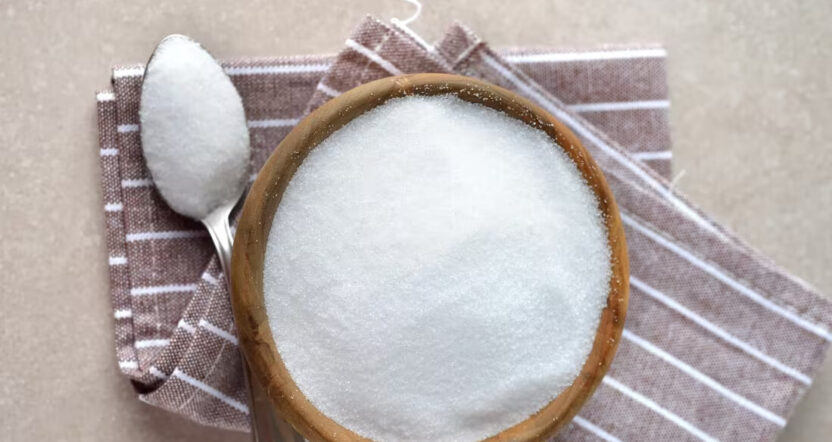
Erythritol is a four-carbon sugar alcohol produced through fermentation of glucose by naturally occurring yeasts. Unlike most polyols, approximately 90% is rapidly absorbed in the small intestine and excreted unchanged in urine. Very little reaches the colon where fermentation occurs. That simple physiological fact explains why erythritol consistently demonstrates superior digestive tolerance compared to virtually every other polyol.
Digestive Tolerance: The Unsung Superpower
One of the biggest misconceptions surrounding sugar alcohols is that they all behave the same. They do not. Maltitol, sorbitol, xylitol and even isomalt can create gastrointestinal discomfort at higher usage levels because significant portions reach the large intestine where bacteria ferment them. Erythritol largely bypasses this process.
Published Human Tolerance Data
| Ingredient | Typical GI Threshold* |
| Erythritol | 0.8-1.0 g/kg body weight |
| Isomalt | 0.25-0.40 g/kg |
| Maltitol | 0.30-0.40 g/kg |
| Xylitol | 0.30-0.50 g/kg |
| Sorbitol | 0.20-0.30 g/kg |
*Approximate ranges based on published human tolerance studies.
For a 180 lb (82 kg) adult:
| Ingredient | Approximate Single-Serving Tolerance |
| Erythritol | 65-82 g |
| Isomalt | 20-33 g |
| Maltitol | 25-33 g |
| Sorbitol | 16-25 g |
This is why erythritol became the backbone of reduced-sugar products long before consumers knew how to pronounce it.
Water Activity: The Secret Weapon
Formulators often focus exclusively on sweetness. Microbes do not. Water activity (Aw) is frequently the deciding factor between a product that survives distribution and one that turns into an expensive science experiment. Erythritol is exceptionally effective at binding free water.
Relative Water Activity Reduction
| Ingredient | Water Activity Reduction Efficiency |
| Erythritol | Excellent |
| Allulose | Very Good |
| Maltitol | Moderate |
| Isomalt | Moderate |
| Sucrose | Baseline |
Typical Effect in Confections
| Solids System | Typical Aw |
| Sucrose System | 0.65-0.75 |
| Allulose Blend | 0.55-0.70 |
| Erythritol Blend | 0.45-0.65 |
| Erythritol + Fiber System | 0.40-0.60 |
The practical result? Longer shelf life. Better microbial stability. Improved texture retention. Reduced stickiness. Fewer headaches.
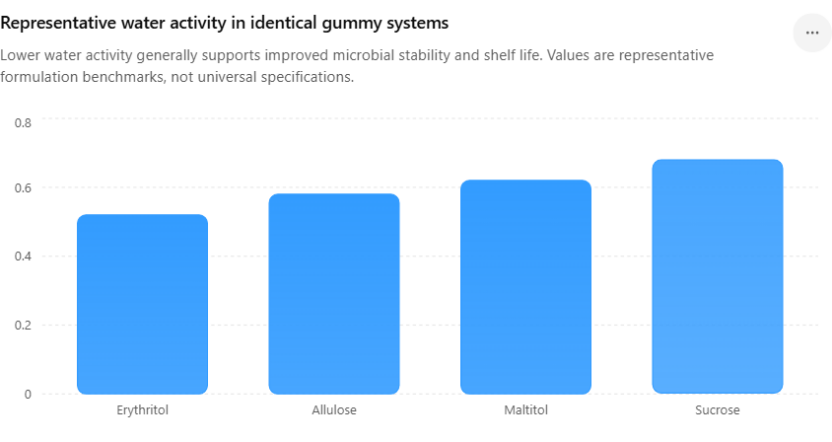
What This Means in the Real World
Erythritol is the heavyweight champion of water activity reduction. It aggressively ties up free water, helping reduce microbial risk, minimize stickiness, and extend shelf life.
Allulose performs surprisingly well and brings the added benefit of browning and sugar-like flavor. Many modern gummies use erythritol and allulose together because the combination balances texture, sweetness, and shelf life.
Maltitol provides excellent body and sweetness but is not nearly as effective at depressing water activity.
Sucrose remains the baseline. It provides excellent texture but leaves more free water available compared with erythritol-rich systems.
Sweetness and Bulking Characteristics
No high-intensity sweetener can replace sugar by itself. Products need mass. Products need solids. Products need structure. This is where erythritol shines.
Relative Sweetness
| Ingredient | Relative Sweetness |
| Sucrose | 100% |
| Allulose | 70% |
| Erythritol | 60-70% |
| Maltitol | 75-90% |
| Isomalt | 45-65% |
Relative Bulking Value
| Ingredient | Bulking Capability |
| Sucrose | Excellent |
| Erythritol | Excellent |
| Allulose | Excellent |
| Maltitol | Excellent |
| Isomalt | Excellent |
Unlike stevia, monk fruit, thaumatin, or sucralose, erythritol actually occupies physical space in a formulation. That matters. A lot.
Erythritol vs Allulose vs Isomalt vs Maltitol
Formulator Decision Matrix
| Attribute | Erythritol | Allulose | Isomalt | Maltitol |
| Sweetness | 60-70% | 70% | 45-65% | 75-90% |
| Calories | 0.2 kcal/g | 0.4 kcal/g | 2.0 kcal/g | 2.1 kcal/g |
| Glycemic Impact | Near Zero | Near Zero | Low | Moderate |
| Digestive Tolerance | Excellent | Excellent | Good | Moderate |
| Water Activity Control | Excellent | Very Good | Moderate | Moderate |
| Cooling Effect | High | Low | Low | Low |
| Browning | None | Excellent | Minimal | Moderate |
| Humectancy | Moderate | High | Moderate | High |
| Shelf-Life Support | Excellent | Excellent | Good | Good |
| Cost Efficiency | Good | Moderate | Good | Good |
Where Erythritol Wins
Protein Bars
Typical Use: 5-20% – Provides bulk, sweetness support, moisture control, shelf-life extension, and helps control water migration.
Gummies
Typical Use: 3-12% – Supports sugar reduction while helping manage stickiness and water activity.
Hard Candy
Typical Use: 20-60% – Works particularly well when combined with isomalt.
Chocolate
Typical Use: 10-40% – Provides bulk while supporting reduced sugar claims.
Powdered Beverages
Typical Use: 5-25% – Excellent carrier and bulking component with minimal calories.
Functional Foods
Typical Use: 3-20% – Works synergistically with fibers and high-intensity sweeteners.
Where Erythritol Can Struggle
No ingredient is perfect. Erythritol’s biggest challenge is its cooling effect. That cooling sensation can become excessive in:
- Certain baked goods
- Some dairy applications
- High-inclusion chocolate systems
- Warm beverage applications
This is where blending becomes critical. At Icon Foods we often pair erythritol with allulose, soluble fibers, tagatose, monk fruit, stevia, or thaumatin to create a more sugar-like sensory profile. Think orchestra, not soloist.
The Smart Way to Use Erythritol in 2026
The best formulators aren’t asking: “Can erythritol replace sugar?” They’re asking: “What job do I need erythritol to perform?”
Need bulk? Erythritol. Need water activity reduction? Erythritol. Need digestive tolerance? Erythritol. Need shelf-life support? Erythritol. Need sweetness? Pair it with a high-intensity sweetener. Need browning? Bring in allulose or tagatose. Need softness? Add fibers. The winning formulation isn’t about finding a single ingredient that does everything. It’s about building a team where every ingredient has a position to play.
Reports of erythritol’s death have been greatly exaggerated. While headlines have focused on emerging research and generated considerable discussion, formulators continue to face the same practical realities they always have: products need bulk, stability, shelf life, sweetness, texture, and consumer acceptance. Erythritol still solves many of those challenges better than almost any other ingredient in the reduced-sugar toolbox.
The future of sugar reduction isn’t erythritol versus allulose. It isn’t erythritol versus tagatose. It isn’t erythritol versus fibers. The future belongs to intelligently designed systems that combine the strengths of each. And erythritol remains one of the most valuable players on that team.
References
Arrigoni E, et al. Human intestinal absorption of erythritol.
Bornet FRJ, Blayo A, Dauchy F, Slama G. Gastrointestinal response and plasma glucose response to erythritol.
Munro IC, et al. Erythritol: An interpretive summary of biochemical, metabolic, toxicological and clinical data.
Oku T, Noda K. Influence of erythritol on gastrointestinal tolerance in healthy subjects.
Storey D, et al. Gastrointestinal tolerance of erythritol, xylitol and sorbitol in healthy adults.
European Food Safety Authority (EFSA) Scientific Opinions on Polyols and Sweeteners.
Institute of Food Technologists (IFT) publications on water activity and shelf-life management.