

A Formulator’s Guide to Building Better Cold Brew
by Thom King CFS – Founder, Chief Innovation Officer, Food Scientist, Icon Foods
“Cold brew coffee isn’t just iced coffee with better marketing. It’s an entirely different extraction system. And if you formulate it like hot coffee poured over ice, you’re already playing from behind.”
The cold brew category continues to evolve. Consumers are demanding less sugar, fewer artificial ingredients, lower acidity, functional benefits, and an authentic coffee experience that doesn’t taste like it was rescued from the back corner of a gas station refrigerator. For formulators, that creates an interesting challenge.
Coffee is one of the most chemically complex beverages we work with. Over 1,000 volatile compounds contribute to aroma and flavor. Managing bitterness, acidity, body, sweetness, and shelf stability is a balancing act.
Enter tagatose. Tagatose doesn’t simply replace sugar. In cold brew, it behaves more like a formulation partner. Let’s dive into why.
Why Cold Brew Is Different
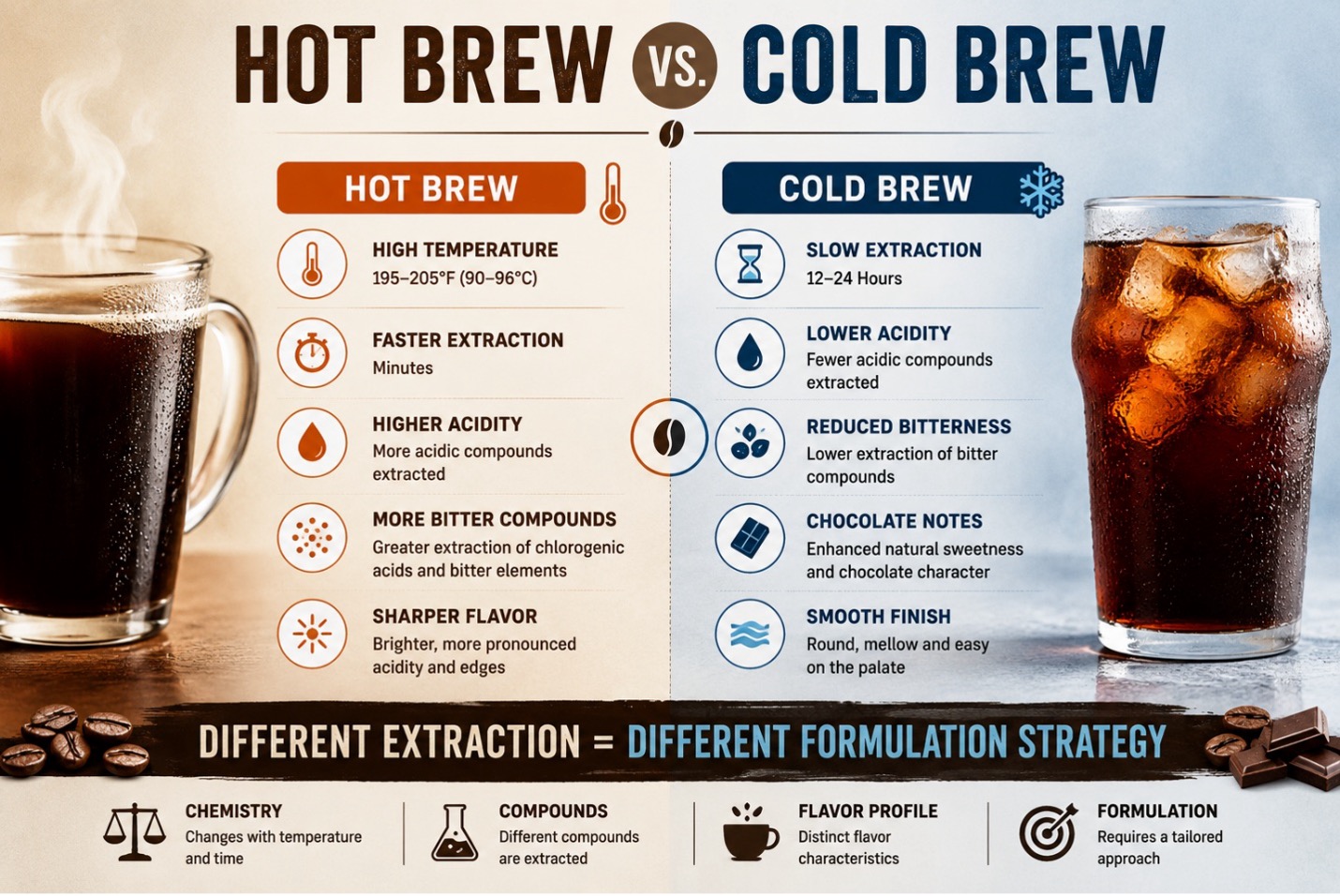
Cold brew is produced by extracting roasted coffee with cold water over 12 to 24 hours. Without heat, extraction chemistry changes dramatically. You obtain:
- Lower titratable acidity
- Reduced chlorogenic acid extraction
- Less bitterness
- Lower perceived astringency
- Greater chocolate and caramel notes
- Fuller mouthfeel
- Smoother finish
This smoother flavor profile is exactly why cold brew has exploded in popularity. Unfortunately, when formulators remove sugar, they often remove the very thing that ties all those flavors together.
Sugar Does More Than Sweeten
Sugar is often misunderstood. It’s easy to think sweetness is the job. It’s only one of them. Sugar also contributes:
- Body
- Mouthfeel
- Flavor integration
- Aroma release
- Bitterness suppression
- Acidity balancing
- Lingering finish
When sugar disappears, coffee can suddenly taste:
- Thin
- Hollow
- Sharp
- Metallic
- Dry and astringent
- Bitter
That’s why replacing sugar gram-for-gram rarely works. You’re replacing sweetness. Not function.
Why Tagatose Works So Well
Tagatose is unusual among rare sugars because its sensory profile closely resembles sucrose. Unlike many high-intensity sweeteners, tagatose contributes:
- Bulk
- Mouthfeel
- Clean sweetness
- Excellent flavor carry
- Natural sweetness onset
- Minimal lingering aftertaste
For coffee, those characteristics matter tremendously. Instead of fighting coffee’s inherent bitterness, tagatose softens it. Instead of masking roast notes, it frames them. Think of a great picture frame. You don’t notice the frame. You notice the artwork.
The Science Behind the Smoothness
Coffee bitterness originates from several compounds including:
- Caffeine
- Chlorogenic acid lactones
- Phenylindanes (particularly in darker roasts)
- Quinic acid degradation products
Bitterness itself isn’t bad. Unbalanced bitterness is. Sweetness shifts perception through well-established sensory interactions. Activation of sweet taste receptors reduces perceived bitterness through central sensory integration in the brain.
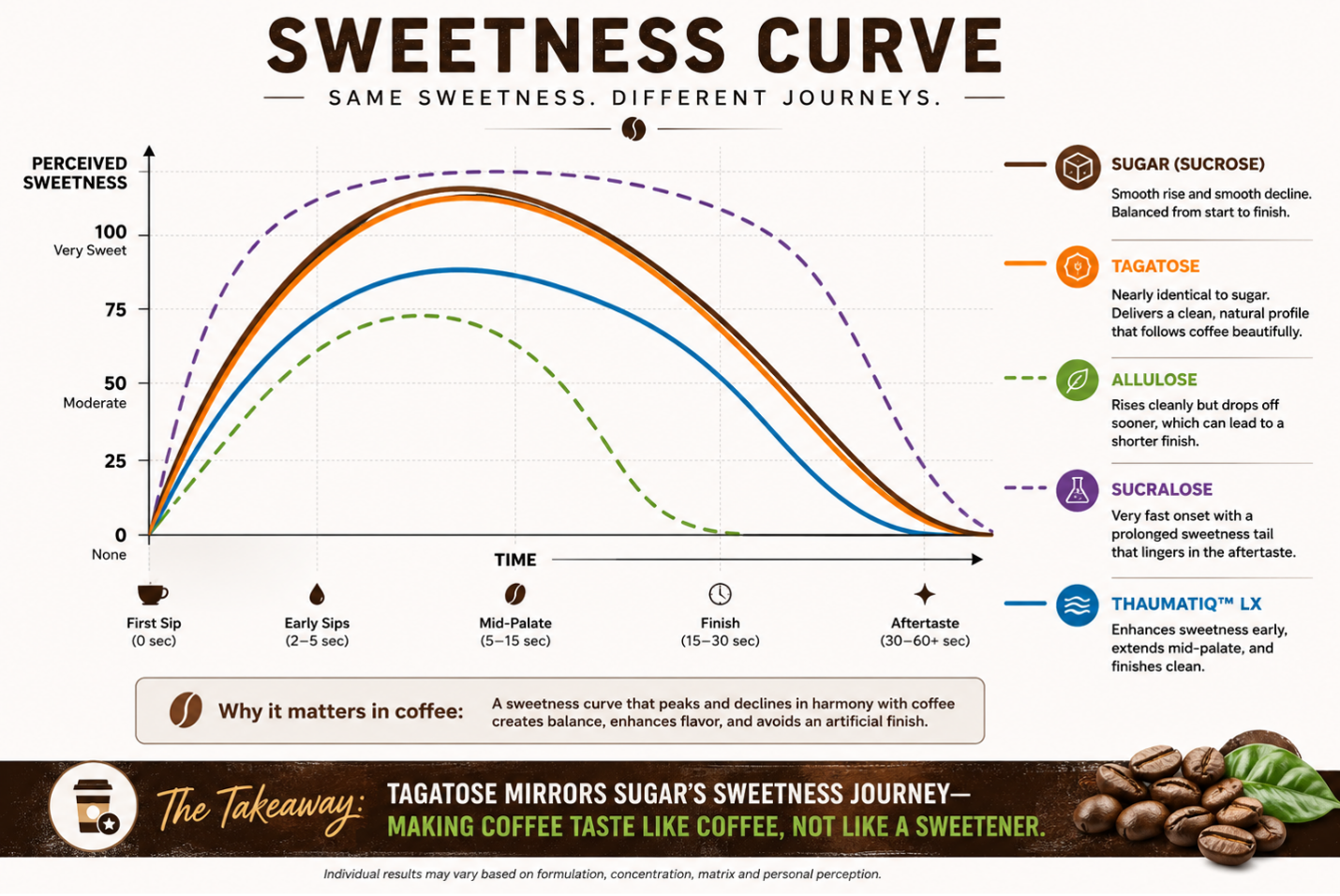
Tagatose provides this effect while maintaining a remarkably sugar-like temporal profile. Unlike some alternative sweeteners that arrive quickly and disappear just as fast, tagatose follows coffee. Not the other way around.
Sweetness Curve Matters
Coffee unfolds in stages. Aroma. Initial sip. Mid-palate and finish. If sweetness disappears too early, the finish becomes bitter. If sweetness lingers too long, coffee tastes artificial.
Tagatose closely mirrors sucrose’s temporal profile. That means:
- Balanced entry
- Rounded mid-palate
- Clean finish
- Better harmony with roasted flavors
This is especially noticeable in premium single-origin cold brews where subtle flavor notes matter.
Coffee Loves Body
One of the most overlooked aspects of cold brew formulation is viscosity. Consumers often describe excellent cold brew as:
- Rich
- Velvet-like
- Rounded
- Smooth
- Full
They’re not describing sweetness. They’re describing texture. Tagatose contributes solids that help restore body often lost when reducing sugar. It helps create, better viscosity, fuller mouthfeel and a more satisfying finish without relying on excessive gums or stabilizers.
Lower Acidity Doesn’t Mean Flavorless
Cold brew naturally extracts fewer acidic compounds. That’s wonderful for consumers seeking a smoother beverage. But acidity also contributes brightness. A formulation without sufficient balance can become flat. Tagatose helps bridge this gap.
Its sweetness lifts chocolate, nutty, caramel, vanilla, and fruit notes without overwhelming them. Instead of making coffee sweeter it makes coffee taste more like coffee. That’s an important distinction.
Pairing Tagatose with Different Roast Profiles
Light Roasts Highlights:
- Citrus
- Berry
- Floral
- Tea-like
Tagatose enhances:
- Fruit character
- Delicate aromatics
- Sweet finish
Medium Roasts Highlights:
- Chocolate
- Caramel
- Brown sugar
- Nuts
This is where tagatose truly shines. Its sugar-like profile amplifies these naturally occurring flavor notes.
Dark Roasts Highlights:
- Cocoa
- Smoke
- Molasses
- Roast
Here, tagatose softens aggressive bitterness while maintaining bold character. The coffee still tastes strong. Just less punishing.
The Functional Beverage Opportunity
Cold brew has become far more than coffee. Today’s products frequently include:
- Protein
- Adaptogens
- Nootropics
- Mushroom extracts
- Electrolytes
- Collagen
- Fiber
- MCT oil
Each ingredient introduces its own sensory challenges. Many botanical ingredients increase bitterness. Tagatose helps restore balance. It doesn’t simply sweeten. It smooths. That makes it particularly attractive in functional coffee beverages.
Pairing with Sweet Proteins
One of my favorite formulation approaches combines tagatose with sweet protein flavor modulators. For example:
- Tagatose provides bulk and mouthfeel
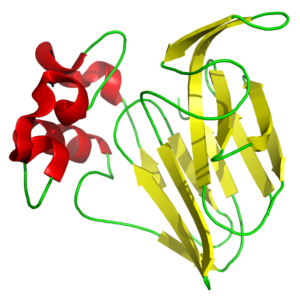
- Thaumatiq™ LX extends sweetness at 20 ppm
- Thaumatiq™ LX enhances vanilla perception at 10 ppm
- Thaumatiq™ LX suppresses bitterness at 20 ppm
- Overall sugar reduction increases dramatically at 25 ppm
The result is a layered sweetness profile that feels remarkably close to sucrose while minimizing calories and maintaining a clean label. Sometimes the best orchestra isn’t built around one instrument. It’s built around great teamwork.
Flavor Pairing Opportunities
Tagatose performs exceptionally well with:
Classic Coffee
- Vanilla
- Hazelnut
- Irish cream
- Mocha
- Caramel
Modern Profiles
- Lavender
- Orange
- Cardamom
- Maple
- Brown butter
- Pistachio
Functional Profiles
- Cacao
- Cinnamon
- Turmeric
- Lion’s Mane
- Reishi
- Ashwagandha
Processing Considerations
Cold brew presents relatively mild processing conditions compared to hot-filled coffee beverages. Tagatose performs well under refrigerated and ambient processing systems depending on the overall formulation and thermal treatment.
As always, validate performance within your specific process, particularly if using UHT, extended shelf-life processing, or aseptic packaging. Pilot work always beats PowerPoint.
Suggested Starting Usage Levels
| Target | Typical Starting Point |
| Light sweetness | 2 to 3% |
| Moderate sweetness | 3 to 5% |
| Premium café style | 4 to 6% |
| Sugar reduction blend | 2 to 4% tagatose plus high-intensity sweetener or sweet protein |
Every coffee origin behaves differently. Taste first. Optimize second.
Example Formulation Concepts
Café Style Vanilla Cold Brew
- Medium roast concentrate
- TagaLite™ Tagatose
- Thaumatiq™ LX (20 ppm)
- Natural vanilla flavor
- Sea salt
- Stabilizer system as required
Functional Protein Cold Brew
- Coffee concentrate
- Milk protein isolate
- TagaLite™ Tagatose
- Thaumatiq™ LX (20 ppm)
- FibRefine™ soluble tapioca fiber
- Natural vanilla
- Potassium citrate
Mocha Performance Brew
- Cold brew concentrate
- Cocoa
- TagaLite™ Tagatose
- Thaumatiq™ LX (20 ppm)
- Salt
- Natural chocolate flavor
Nitro Cold Brew
- Premium coffee concentrate
- TagaLite™ Tagatose
- Nitrogen infusion
Simple. Elegant. Very little else required.
What Consumers Notice
Consumers rarely say: “I appreciate the temporal sweetness profile.” Instead they say: “This tastes smooth.” “It isn’t bitter.” “It tastes like coffee.” “I could drink this every morning, noon and night.” Those comments are the sensory translation of good formulation.
Cold brew already gives formulators a tremendous head start. Lower acidity, smoother extraction, and naturally rich flavor create a beverage consumers genuinely enjoy.
The challenge begins when sugar comes out. That’s where tagatose earns its place. It restores body, rounds bitterness, supports roasted coffee character, and delivers a sweetness curve that behaves much like sucrose, all while enabling meaningful sugar reduction and supporting today’s demand for cleaner labels.
Coffee formulation has always been a little like tuning a championship race car. More horsepower alone doesn’t win the race. Balance does. Every adjustment to bitterness, sweetness, acidity, aroma, and texture affects the whole system.
Tagatose is one of those rare ingredients that doesn’t try to steal the spotlight. It simply helps the entire formulation perform better. And in cold brew, that’s exactly what you want.
References
- Specialty Coffee Association (SCA). Coffee Brewing Handbook.
- Illy, A., & Viani, R. Espresso Coffee: The Science of Quality. Academic Press.
- Clarke, R. J., & Macrae, R. Coffee Chemistry. Elsevier.
- Sunarharum, W. B., Williams, D. J., & Smyth, H. E. (2014). Complexity of coffee flavor: A compositional and sensory perspective. Food Research International, 62, 315-325.
- Frank, O., et al. (2007). Characterization of the coffee beverage by LC-MS and sensory analysis. Journal of Agricultural and Food Chemistry.
- Schiffman, S. S., & Gatlin, L. A. (1993). Sweeteners and taste interactions. Neuroscience & Biobehavioral Reviews.
- Livesey, G., et al. (2003). Health potential of polyols and rare sugars. Nutrition Research Reviews.
- Levin, G. V. (2002). Tagatose, the new GRAS sweetener and health product. Journal of Medicinal Food.
- ISO 18794: Coffee sensory analysis standards.
- FDA Guidance on Nutrition Labeling of D-Tagatose (2019).