


By Thom King, CFS, Founder and Chief Innovation Officer, Icon Foods
What decades of toxicology, human clinical trials, and regulatory evaluations actually tell us about the safety of this remarkable rare sugar. There is a question I hear increasingly from food and beverage formulators, regulatory professionals, and brand owners: “Is tagatose actually safe to consume?”
Fair question. Particularly when we are talking about an ingredient that tastes remarkably like sucrose, browns like sucrose, behaves like sucrose in many applications, yet delivers a substantially different metabolic response. If something sounds too good to be true, the food scientist in me wants to see the data. Preferably peer-reviewed, reproducible, and served with a healthy side of skepticism. Because in food science, enthusiasm is wonderful. Evidence is even better.
Tagatose has been studied for decades. Its safety has been evaluated by regulatory authorities around the world, including the U.S. Food and Drug Administration (FDA), Health Canada, and Food Standards Australia New Zealand (FSANZ). And while no ingredient deserves a free pass simply because it is naturally occurring, the evidence supporting the safety of D-tagatose for its evaluated food uses is substantial. There are caveats, of course. Gastrointestinal tolerance matters. Dose matters. Certain rare metabolic disorders matter. But let’s separate legitimate scientific considerations from the nutritional theater that occasionally passes for informed debate.
First, what exactly is tagatose?
D-tagatose is a naturally occurring rare monosaccharide, specifically a ketohexose with the molecular formula C₆H₁₂O₆. It is a stereoisomer of fructose, meaning it has the same molecular formula but a different three-dimensional arrangement of atoms. That seemingly modest structural difference has enormous consequences for how the human body processes it.
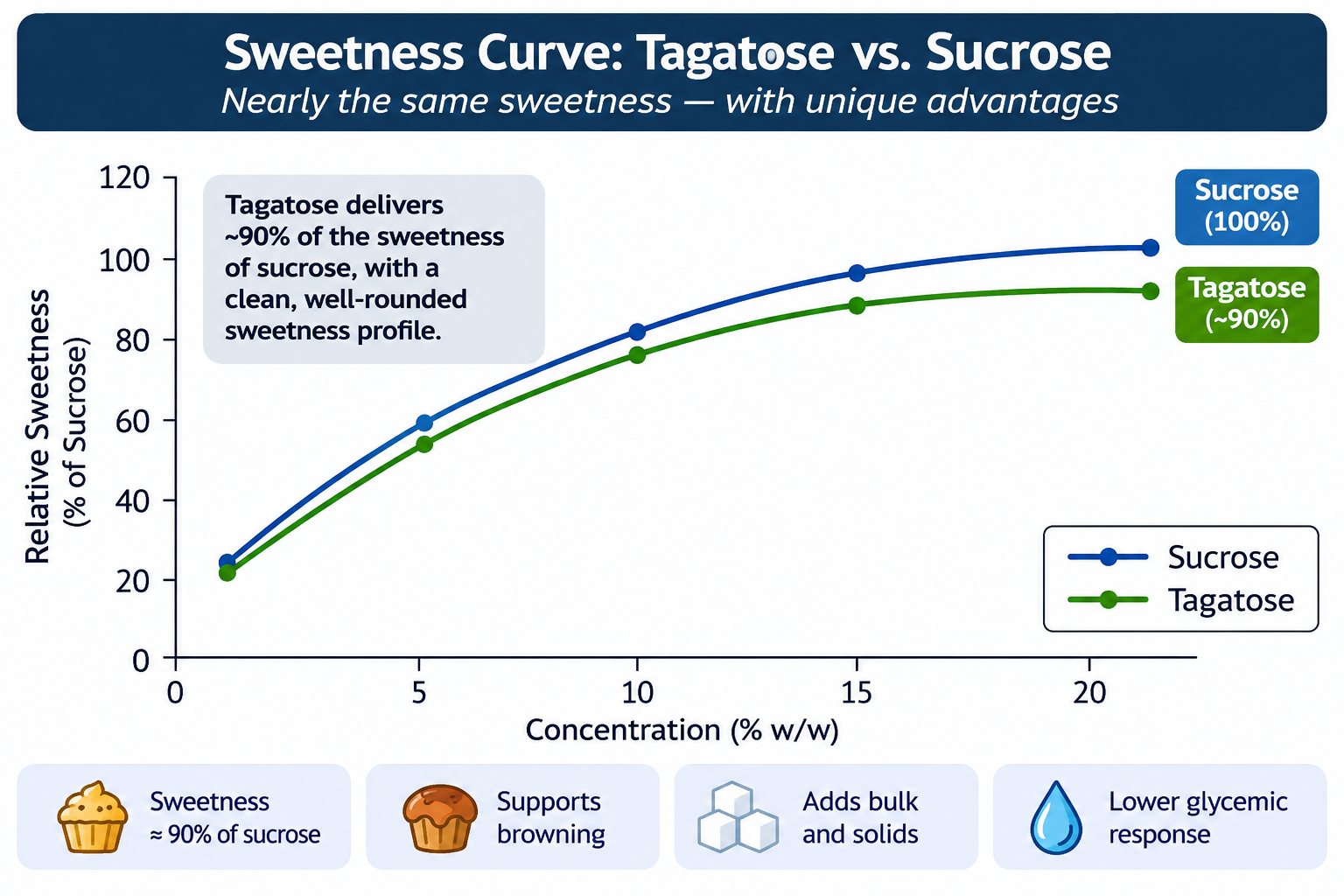
Tagatose occurs naturally in small quantities in certain fruits and heat-treated dairy products. Commercially, it can be manufactured through controlled enzymatic conversion processes, using appropriately qualified carbohydrate feedstocks. From a formulation standpoint, tagatose offers an unusually attractive collection of functional properties:
- Approximately 90% of the sweetness of sucrose, depending on the food matrix and testing conditions.
- A sucrose-like sweetness profile without the intense lingering sweetness associated with some high-potency sweeteners.
- Participation in Maillard browning reactions.
- Bulking and solids contribution.
- Freezing-point depression and humectant functionality.
- A substantially lower glycemic response than conventional sugar.
This is not another high-intensity sweetener attempting to impersonate sugar from the cheap seats. Tagatose actually performs several of sugar’s physical and chemical jobs.
The regulatory evidence: This is not an untested ingredient
Let’s begin with regulatory scrutiny.
United States: FDA GRAS evaluations
The FDA has evaluated multiple GRAS notices concerning D-tagatose. In its response to GRN 000977, the agency stated that it had no questions regarding the notifier’s GRAS conclusion for specified uses. That is not the same as an unrestricted approval for every conceivable food or dosage, but it is meaningful regulatory evidence.
Canada: Health Canada safety assessment
Health Canada concluded that D-tagatose does not present food-safety concerns preventing its use as a food ingredient or tabletop sweetener, while identifying gastrointestinal effects and hereditary fructose intolerance as important considerations.
Australia and New Zealand: FSANZ evaluation
FSANZ evaluated tagatose as a novel food and concluded that its approved uses did not raise public-health and safety concerns for the general population.
The important takeaway is that tagatose has been subjected to formal scientific safety evaluations. This is not simply an ingredient riding a wave of marketing enthusiasm. However, manufacturers must still confirm that their specific ingredient, production process, application, concentration, and target market comply with applicable requirements. GRAS is not a magic wand. It is a safety conclusion tied to defined conditions of use.
What happens when we consume tagatose?
This is where the biochemistry gets interesting. Unlike glucose, which is efficiently absorbed in the small intestine, tagatose is only partially absorbed. A substantial proportion reaches the large intestine, where it becomes available for microbial fermentation.
The absorbed fraction is metabolized differently from glucose, contributing to tagatose’s reduced available energy and relatively modest glycemic response. The unabsorbed fraction can undergo microbial fermentation, generating organic acids and gases. That combination explains both some of tagatose’s potential metabolic advantages and its principal tolerability limitation.
It also illustrates a foundational principle of food science, absorption, metabolism, fermentation, and physiological tolerance are four different questions.
What do human clinical trials actually tell us?
We now have something more valuable than isolated studies: a systematic review and meta-analysis published in the American Journal of Clinical Nutrition in 2026. The researchers examined 20 controlled intervention trials involving 1,033 participants across allulose and tagatose research. Eight of those trials investigated tagatose. The results were encouraging.
2026 Systematic Review: Tagatose Findings
- −1.03 Post-meal glucose. Standardized mean difference in postprandial glucose response
- −1.05 Post-meal insulin. Standardized mean difference in postprandial insulin response
- −0.25 HbA1c percentage points. Mean difference across the relevant trials; moderate certainty of evidence
These are pooled intervention effects, not percentage reductions or guaranteed individual outcomes. They do not establish that tagatose treats diabetes. The findings support the conclusion that tagatose can attenuate postprandial glucose and insulin responses under studied conditions. That is meaningful for formulators designing reduced-sugar foods.
But there is an important distinction between improving a metabolic marker and proving a long-term clinical benefit. The evidence does not establish that consuming tagatose prevents diabetes, cardiovascular disease, or obesity. Nor does it demonstrate a consistent improvement in blood lipids or body composition. Those questions require larger and longer clinical investigations. And the fact that tagatose has demonstrated favorable metabolic effects does not, by itself, establish safety. Safety rests on the broader toxicological, clinical, and exposure evidence.
Still, for an ingredient intended to replace part of the sugar in a food system, the metabolic findings are certainly worth paying attention to.
The elephant in the gastrointestinal tract
Now for the part that deserves a candid conversation. Tagatose can cause gastrointestinal discomfort when consumed in sufficiently large quantities. Not at the level polyols can. But, still, why?
Because the portion that escapes absorption reaches the colon, where bacteria can ferment it. Unabsorbed carbohydrate also contributes to osmotic effects in the intestinal lumen. The possible consequences include bloating, gas kinetics, abdominal discomfort, and loose stools.
In other words, the same fundamental digestive principles we encounter with many poorly absorbed carbohydrates.
Health Canada identifies approximately 30 grams per serving or 45 grams per day as examples of intakes at which gastrointestinal symptoms may occur. These are not universal toxicity thresholds, nor guarantees of tolerance below those amounts. Sensitivity varies considerably between individuals. I have dosed as high as 75 grams with no effect however, I am pretty well adapted.
One human study summarized in an FDA GRAS dossier reported gastrointestinal symptoms in all participants receiving 75 grams of tagatose, whereas symptoms were less frequent and generally mild at doses of 30 grams or less.
Another study reported that gastrointestinal discomfort during an initial adaptation period diminished over time with repeated consumption. That is useful information, but it is not permission to ignore serving size.
A practical formulation example
Consider two reduced-sugar baked goods.
- Product A delivers 5 grams of tagatose per serving.
- Product B delivers 25 grams per serving.
Both may be technically feasible. Both may deliver excellent sweetness and browning. But their gastrointestinal tolerance profiles may be very different, particularly if the consumer eats multiple servings. Now add inulin, soluble fiber, or another fermentable carbohydrate. Suddenly, we are not evaluating tagatose in isolation. We are evaluating the gastrointestinal burden of the entire formulation.
The consumer’s digestive tract does not care which ingredient supplier provided the fermentable carbohydrates. It receives the entire cast of characters at once. That is why a successful formulation requires more than an ingredient specification and a sweetness target. It requires an exposure assessment.
What about long-term toxicity, liver health, and cancer?
This is where we need to distinguish a genuine toxicological signal from a biochemical observation. Health Canada’s safety evaluation reviewed animal studies, including short-term toxicity, genotoxicity, developmental toxicity, and longer-term carcinogenicity investigations, alongside human data. The findings were reassuring.
The toxicological database did not demonstrate systemic toxicity or genotoxicity under the conditions studied. Some short-term animal investigations observed increased liver weight, hepatocellular enlargement, and glycogen accumulation at high dietary exposures.
Those observations deserve attention. However, subsequent 90-day and two-year rat studies did not identify corresponding adverse liver pathology that established those changes as toxicologically significant.
Health Canada identified a conservative no-observed-effect level (NOEL) of approximately 2.3 g/kg body weight per day from a 90-day rat study. Its estimated human dietary exposures remained below that value. A NOEL is not a recommended human consumption target. Nor is it a gastrointestinal tolerance threshold. It is a toxicological reference point used in evaluating exposure and safety margins.
And what about uric acid?
Because tagatose shares certain metabolic pathways with fructose, researchers have investigated whether its consumption can increase serum uric acid. Some studies observed temporary changes, but Health Canada’s review found no clinically significant increases at the investigated exposures, including single doses up to 30 grams and divided daily doses up to 75 grams. That is reassuring, although larger, longer studies in susceptible populations would strengthen our understanding.
The current evidence does not establish that ordinary dietary exposure to tagatose causes clinically meaningful liver injury, carcinogenic effects, or sustained hyperuricemia. It also does not justify claiming that every conceivable lifetime exposure has been proven harmless. Absence of a demonstrated hazard at evaluated exposures is meaningful evidence of safety. It is not a license to abandon dose-response science.
One important exception: Hereditary fructose intolerance
There is a very small segment of the population for whom tagatose should not be considered an appropriate sugar substitute. Individuals with hereditary fructose intolerance (HFI), a rare inherited disorder involving aldolase B deficiency, can experience serious adverse consequences from carbohydrates that enter fructose-related metabolic pathways.
Because absorbed tagatose shares relevant metabolic pathways with fructose, Health Canada and FSANZ identify it as unsuitable for people with HFI or certain disorders of fructose metabolism. This is not the same condition as ordinary fructose malabsorption, which primarily causes gastrointestinal symptoms.
For formulators, the distinction may be important. The ingredient declaration should clearly identify tagatose, and products intended for individuals with HFI should not use it without appropriate specialist evaluation.
Tagatose and Gut Health: Feeding the Good Guys
Here is where tagatose gets particularly interesting. It turns out this rare sugar may be doing double duty, sweetening our food while potentially supporting the microbial ecosystem living in our gut. According to the Global Prebiotic Association, approximately 80–85% of ingested tagatose escapes absorption in the small intestine and reaches the colon, where resident microorganisms can ferment it.
Research has demonstrated that tagatose can support the growth of beneficial bacteria, including certain Lactobacillus strains, while increasing the production of short-chain fatty acids (SCFAs), particularly butyrate. Now, butyrate is no lightweight in intestinal physiology. It is a primary energy source for colonocytes, the cells lining our colon, and plays an important role in maintaining intestinal barrier function and regulating inflammatory signaling. A human study by Venema and colleagues demonstrated increased colonic butyrate production following tagatose consumption, while subsequent ex vivo research reported increases in microbial activity and SCFA production, including butyrate and propionate.
Emerging animal research has also suggested potential protective effects on intestinal barrier integrity and inflammation, although those findings still require confirmation in human clinical trials. Does this mean we should start calling tagatose a miracle prebiotic? Not so fast, Sparky. The evidence supports promising prebiotic activity, but larger human intervention studies are needed to establish consistent, clinically meaningful gut-health benefits at practical dietary doses. And remember, fermentation is a double-edged sword. Feed the microbiome too aggressively, and your consumers may experience bloating and gas rather than digestive bliss.
For formulators, the opportunity is compelling: a sugar-like ingredient that may contribute to a healthier intestinal environment while delivering sweetness, bulking, and browning functionality. That is a pretty impressive résumé for a monosaccharide.
The 2026 regulatory landscape: Calories and labeling are not the same as safety
One of the most consequential developments for U.S. formulators came from the FDA’s November 21, 2025 letter concerning D-tagatose. The agency stated that it intended to exercise enforcement discretion concerning exclusion of D-tagatose from the declarations of Total Sugars and Added Sugars, while recognizing a caloric value of 1.5 kcal/g. That represents an important shift from the FDA’s earlier labeling position.
However, enforcement discretion is not identical to a final change in the underlying regulations. For food manufacturers, three questions must remain separate:
- Safety: Is the ingredient safe under its intended conditions of use?
- Labeling: How must the ingredient and its nutritional contribution be declared?
- Claims: What can the manufacturer lawfully communicate about the finished product?
The answers are related, but they are not interchangeable. And international manufacturers should not assume that U.S. nutritional conventions automatically apply elsewhere. Health Canada, for example, has referenced an energy conversion factor of 3 kcal/g in its assessment.
What should formulators actually do with this information?
Here is where we move from the scientific literature to the formulation bench. Consider the following framework for evaluating tagatose in a commercial product.
| Formulation consideration | Recommended approach |
|---|---|
| Ingredient quality | Verify identity, purity, contaminant limits, and food-grade specifications |
| Regulatory status | Confirm permitted use and applicable exposure assumptions |
| Serving size | Calculate actual grams of tagatose per serving |
| Cumulative intake | Model realistic consumption of multiple servings and products |
| Gastrointestinal tolerance | Conduct structured sensory and tolerance studies at intended and foreseeable intakes |
| Other fermentable ingredients | Evaluate combined exposure to fibers and other poorly absorbed carbohydrates |
| Metabolic positioning | Substantiate product-specific claims; do not extrapolate disease benefits |
| Vulnerable populations | Address hereditary fructose intolerance and intended consumer groups |
| Manufacturing | Validate processing stability, browning, and finished-product specifications |
A useful starting point for R&D
For an initial formulation screen, I would compare products delivering 5, 10, 15, and 20 grams of tagatose per serving, provided each level is appropriate for the intended product category and regulatory conditions. Those are experimental screening levels, not established safe-dose recommendations. I would then examine sweetness, flavor, browning, water activity, gastrointestinal tolerance, and total daily exposure.
If the formulation includes additional fermentable fibers, I would evaluate those combinations separately. In products where tagatose is being used primarily for its sugar-like functionality, there may be little reason to make it carry the entire sweetness load.
Why blending may be the smartest approach
At Icon Foods, our approach to sugar reduction has always been to understand the jobs sugar performs before deciding how to replace it. Sweetness is only one of those jobs.
Tagatose contributes solids, browning, mouthfeel, and a relatively familiar sweetness profile. High-potency sweeteners can supply additional sweetness without requiring large quantities of tagatose.
For example, TagaLite™ tagatose can be evaluated alongside carefully selected steviol glycosides, such as Reb M, or monk fruit extracts. A formulator might use tagatose to supply the physical and sensory foundation, then adjust the sweetness profile using a small amount of a high-intensity sweetener. That can reduce the amount of tagatose required per serving while preserving the desired sweetness. It can also create opportunities to manage ingredient cost and gastrointestinal exposure. However, the final blend must still be validated for sensory performance, process stability, labeling, and tolerance.
Reducing tagatose exposure does not automatically establish that the resulting product is better tolerated, particularly when other fermentable ingredients are present. The goal is not to use the maximum amount of any one ingredient. The goal is to use the right amount of the right ingredients to achieve the desired performance.
So, is tagatose safe to consume?
Based on the available toxicological evidence, human studies, and regulatory assessments, yes, D-tagatose is considered safe for the general population under its evaluated and appropriately controlled food uses. That conclusion comes with important qualifications.
Gastrointestinal discomfort is the most clearly established dose-related tolerability concern. Individuals with hereditary fructose intolerance should avoid tagatose. Manufacturers must also control ingredient purity, use levels, cumulative exposure, and regulatory compliance. There is encouraging evidence regarding postprandial glucose and insulin responses, but that should not be confused with proof of long-term disease prevention. And while the current safety database is substantial, continued research into chronic exposure, sensitive populations, and real-world consumption patterns remains valuable. For formulators, this is a very favorable scientific position.
We have an ingredient with sugar-like functionality, a comparatively low glycemic response, an established body of safety evidence, and clearly identifiable limitations that can be addressed through responsible formulation. Not bad for a six-carbon monosaccharide.
I have spent much of my career, hell, much of my life has been dedicated to helping food and beverage manufacturers solve the extraordinarily complicated problem of replacing sugar. And if there is one thing I have learned, it is that there are no free lunches in formulation. Every ingredient has a dose-response relationship. Every sweetening system involves tradeoffs. Every promising technology deserves scrutiny. Tagatose is no exception. But it is also not an experimental mystery ingredient waiting for science to catch up. It has a meaningful safety history, credible regulatory evaluations, and a growing clinical literature.
The real opportunity is not to convince consumers that tagatose is some miraculous substance. It is to use sound science to make better foods. Foods that taste terrific, perform reliably, reduce conventional sugar, and are designed with the consumer’s health and experience in mind. Because the best ingredient innovation is not the one that makes the loudest promises. It is the one that delivers the goods, consistently, safely, and without unnecessary drama.
And in my book, that is pretty sweet.
Related reading: Tagatose, A Sweetener That Feeds More Than Sweetness, Allulose, Tagatose, and the “Zero Sugar” Trap and From Whey to Wonder: How Tagatose Is Made and Why Formulators Should Care.
Scientific references and further reading
- Global Prebiotic Association. (2024). Prebiotic Type Spotlight: Tagatose.
- Venema, K., Vermunt, S. H. F., & Brink, E. J. (2005). D-tagatose increases butyrate production by the colonic microbiota in healthy men and women. Microbial Ecology in Health and Disease, 17(1), 47–57.
- Van den Abbeele, P., et al. (2023). Low-no-calorie sweeteners exert marked compound-specific impact on the human gut microbiota ex vivo. International Journal of Food Sciences and Nutrition, 74(5), 630–644.
- U.S. Food and Drug Administration. GRAS Notice GRN 000977, D-tagatose, and FDA response letter. FDA GRAS response
- Health Canada. Novel Food Information: D-tagatose. Detailed assessment of toxicology, metabolism, gastrointestinal effects, and ingredient specifications. Health Canada safety assessment
- Food Standards Australia New Zealand. Information about Tagatose for Individuals with Disorders in Fructose Metabolism. FSANZ safety guidance
- American Journal of Clinical Nutrition (2026). Glycemic and cardiometabolic effects of rare sugars allulose and tagatose: A systematic review and meta-analysis of controlled human intervention trials. Peer-reviewed systematic review
- U.S. Food and Drug Administration (2025). Letter addressing D-tagatose labeling and caloric value. FDA labeling letter
- U.S. Food and Drug Administration (2024). Response to petition for a qualified health claim for D-tagatose and reduced risk of type 2 diabetes. FDA health claim evaluation