


By Thom King, CFS, Founder and Chief Innovation Officer, Icon Foods
Let’s talk about one of the dirty little secrets of sugar reduction in baked goods. Sugar isn’t just there to make things sweet. It’s a structural engineer, moisture manager, texture technician, browning agent, and flavor developer. It wears more hats than a haberdasher.
Take sucrose out of a cookie, cake, muffin, or brownie, and suddenly you’ve got a formulation problem that goes well beyond sweetness. Your cookies may come out pale. Your cakes may lack tenderness. Your muffins may dry out. And that beautiful golden-brown crust that tells consumers something delicious is about to happen? Gone. That’s because sucrose participates in a complex network of physical and chemical processes that determine how baked goods look, taste, and feel.
High-intensity sweeteners can replace sweetness, but they can’t replace bulk, water management, or browning chemistry on their own.
Enter D-tagatose, a rare sugar with some rather interesting tricks up its molecular sleeve. Unlike many conventional sugar substitutes, tagatose is a reducing sugar. That means it can actively participate in the Maillard reaction, one of the most important flavor-development processes in baking.
Meet Tagatose: A Rare Sugar With a Familiar Personality
Tagatose is a naturally occurring ketohexose monosaccharide with the same molecular formula as fructose and glucose: C₆H₁₂O₆. Same molecular formula. Different molecular arrangement. Very different metabolic behavior. Tagatose is a C-4 epimer of D-fructose, meaning the two molecules differ in the configuration around one carbon atom. That seemingly minor structural distinction has significant consequences.
Tagatose delivers approximately 90% to 92% of the sweetness of sucrose, with a relatively clean, sugar-like sensory profile. Unlike sucrose, however, tagatose is only partially absorbed in the small intestine. A substantial portion reaches the large intestine, where it may undergo microbial fermentation.
Its energy contribution is commonly estimated at approximately 1.5 kcal/g in the United States, compared with approximately 4 kcal/g for sucrose. That makes tagatose particularly interesting for reduced-calorie and sugar-reduction applications. But its metabolic properties aren’t the only reason formulators should be paying attention. Tagatose behaves like a sugar in several important food-processing applications, particularly those involving heat. And that’s where things get tasty.
The Maillard Reaction: Where Chemistry Meets Culinary Magic
Let’s get into the science. The Maillard reaction is a complex series of chemical reactions between reducing sugars and amino groups, typically from amino acids, peptides, or proteins. It is responsible for much of the color, aroma, and flavor associated with baked, roasted, and toasted foods. Think freshly baked bread crust, toasted nuts, roasted coffee, and golden-brown cookies. That tastiness isn’t an accident. It’s chemistry.
When a reducing sugar reacts with an available amino group, it initiates a cascade of reactions that eventually generates numerous flavor-active compounds and brown-colored polymers called melanoidins. These reactions can produce desirable roasted, caramel-like, nutty, malty, and toasted sensory characteristics. Here’s where tagatose becomes particularly interesting. Tagatose is a reducing sugar. Sucrose is not. Doh! You read that right.
Sucrose can contribute to browning through caramelization or after hydrolysis into glucose and fructose. But intact sucrose cannot directly initiate the classic Maillard reaction. Tagatose can. And because tagatose is a ketose, its Maillard reaction behavior can be substantially different from that of glucose and other reducing sugars.
Depending on the formulation, temperature, pH, water activity, and available amino compounds, tagatose can generate browning relatively rapidly. In other words, it doesn’t just stand on the sidelines cheering for browning. It’s on the field, running plays.
What happens during tagatose-driven browning?
The simplified sequence looks something like this:
Step 1: Initial reaction
Tagatose reacts with available amino groups, forming early-stage glycation products.
Step 2: Molecular rearrangement
The initial reaction products undergo rearrangements and additional chemical transformations.
Step 3: Flavor development
Reactive intermediates participate in fragmentation, dehydration, and Strecker-related reactions, contributing to the formation of aroma-active compounds.
Step 4: Color development
Further reactions, condensation, and polymerization generate brown pigments, including melanoidins. The result can be the golden-brown appearance and developed baked flavor consumers associate with traditional sugar-containing products. And all of this can occur without relying on conventional added sucrose.
One important distinction: Maillard browning and caramelization are different chemical pathways. Both can contribute to baked color and flavor, but they shouldn’t be used interchangeably.
Why Tagatose Can Brown Faster Than You Expect
Here’s where formulators need to pay attention. Tagatose can exhibit relatively rapid Maillard browning under certain baking conditions, particularly compared with sucrose-containing control systems. This is useful when developing reduced-sugar baked goods that would otherwise lack color. But there’s a catch. Too much browning can turn a beautiful golden cookie into something resembling a hockey puck after three periods of overtime. Excessive browning can introduce bitter notes, dark surface color, and undesirable flavor development. The rate and extent of browning depend on several variables:
- Temperature: Higher temperatures generally accelerate reaction kinetics.
- Time: Longer thermal exposure increases opportunities for color and flavor development.
- pH: More alkaline conditions frequently accelerate Maillard reactions.
- Water activity: Intermediate water activity can favor Maillard chemistry, while very high or very low water availability may limit particular reaction steps.
- Protein and amino acid availability: Reactive amino groups provide the other half of the Maillard equation.
- Sugar concentration: Increasing tagatose changes the pool of reactive carbohydrate, although browning does not necessarily increase linearly.
- Formulation matrix: Fats, starches, fibers, proteins, and leavening agents influence heat transfer, moisture distribution, and reaction pathways.
This means tagatose isn’t necessarily a simple one-for-one replacement for sucrose. It’s a formulation tool that needs to be understood and managed. And that’s exactly what makes it valuable.
Applications: Where Tagatose Really Shines
Cookies: The Golden Opportunity
Cookies are one of the most promising applications for tagatose. Traditional sucrose contributes sweetness, spread, texture, moisture behavior, and color development. Replacing sucrose entirely with high-intensity sweeteners generally creates substantial structural challenges.
Tagatose can help restore bulk sweetness and promote the browning needed for a desirable finished appearance. In cookies, formulators should evaluate:
- Surface color development
- Spread ratio and diameter
- Moisture retention
- Snap, crunch, or chewiness
- Flavor development
- Shelf-life texture changes
Because tagatose can brown rapidly, oven temperature and bake time may need adjustment.
A practical development approach is to begin with a partial sucrose replacement, evaluate color and texture, and progressively increase the tagatose contribution. For more aggressive sugar reduction, tagatose can be combined with compatible bulking ingredients and high-intensity sweeteners. The objective isn’t merely to make the cookie sweet. It’s to make it behave like a cookie.
Cakes and Muffins: More Than Meets the Crumb
Cakes and muffins present a different challenge. Sucrose contributes to batter viscosity, aeration, starch gelatinization behavior, protein setting, and moisture management.
Tagatose can help replace some of the sweetness and soluble solids while supporting crust browning. However, it does not automatically reproduce every functional contribution of sucrose.
In cake and muffin systems, formulators should pay particular attention to batter rheology (how materials flow), specific gravity, volume, crumb structure, and moisture retention. The key is balancing sweetness, bulk, and structural development. Tagatose may be particularly useful in reduced-sugar muffins, snack cakes, breakfast bars, and other baked products where surface color is important.
Brownies: Bringing Back the Brown
Brownies might seem like an obvious application because they’re already brown. But color isn’t the whole story. Sugar influences the characteristic brownie crust, chewiness, moisture, and internal structure.
Tagatose can contribute sweetness and browning chemistry while helping build a more sugar-like formulation. However, the shiny, delicate brownie crust is influenced by sugar dissolution, egg proteins, and surface film formation. Tagatose alone does not guarantee that classic crackly finish.
Formulators should evaluate the balance between a tender interior, surface structure, and overall sweetness.
Biscuits, Crackers, and Baked Snacks
In savory and lightly sweetened baked products, tagatose may be especially interesting because relatively small concentrations can influence color development. This creates opportunities to improve visual appeal without introducing substantial sweetness.
Think crackers, biscuits, baked snack inclusions, and specialty bread products. The challenge is avoiding excessive browning during extended thermal processing. A little Maillard chemistry is wonderful. Too much, and your cracker starts auditioning for the role of charcoal.
Formulation Strategies: Building a Better Sugar-Reduced Bakery System
The most successful sugar-reduction systems rarely depend on a single ingredient. Sugar performs too many functions for that. Instead, I prefer thinking about sugar reduction as a coordinated formulation strategy. Tagatose provides sugar-like sweetness, soluble solids, and reducing-sugar chemistry. High-intensity sweeteners can provide additional sweetness without substantially increasing the carbohydrate load. Fibers and other bulking agents can help manage solids, viscosity, and texture. Together, these ingredients can create a more balanced formulation.
Example: A Functional Sugar-Reduction Toolkit
| Ingredient | Primary formulation contribution |
|---|---|
| Tagatose | Sugar-like sweetness, bulk, Maillard browning |
| Reb M stevia | High-intensity sweetness with a relatively clean profile |
| Monk fruit extract | Additional sweetness and sweetness-profile adjustment |
| Soluble tapioca fiber | Bulk, solids, and texture modification |
| Gum acacia | Soluble solids and selected structural functionality |
| Partially hydrolyzed guar gum | Soluble fiber contribution with relatively low viscosity |
| Thaumatin | High-intensity sweetness and potential sensory-profile modification |
Not every ingredient belongs in every formulation. The objective is to identify which functions sucrose performed in the original product and replace those functions deliberately. For example, a crispy cookie may need a very different bulking and moisture-management system than a soft muffin. A brownie may require different considerations altogether. And ingredient interactions play a big role.
Adding protein can increase the availability of amino groups and potentially influence Maillard browning. Changing the fiber system can alter water availability and dough rheology. Adjusting leavening chemistry can change pH and therefore influence color development. This is why successful sugar reduction requires formulation science, not simply swapping ingredients and hoping the oven sorts everything out. The oven is many things. A miracle worker isn’t one of them.
The Regulatory Advantage: A New Chapter for Tagatose
One of the most interesting recent developments involves the regulatory treatment of tagatose. In April 2026, the U.S. Food and Drug Administration announced an enforcement-discretion approach concerning the declaration of tagatose in the Total Sugars and Added Sugars lines of Nutrition Facts labeling.
Under the conditions described in that policy, FDA intends to exercise enforcement discretion for exclusion of tagatose from those sugar declarations. This is an important distinction, so listen up.
Tagatose remains chemically classified as a sugar. However, its physiological behavior differs from that of conventional sugars such as sucrose. The regulatory treatment recognizes that distinction for specified labeling purposes.
For formulators, this may create meaningful opportunities to develop baked goods with substantially reduced declared sugar content while preserving important sugar-like functionality. However, manufacturers must carefully evaluate the applicable FDA policy, documentation requirements, caloric declarations, ingredient labeling, and claims substantiation.
The policy is enforcement discretion, not a blanket statutory reclassification or an unconditional authorization for every possible sugar-related claim. And remember: replacing sucrose with tagatose does not automatically make a finished product sugar-free. Other ingredients may contribute sugars, and applicable nutrient-content claim requirements still apply. Regulatory science is not nearly as exciting as a warm chocolate chip cookie. But getting it wrong is considerably more expensive.
Practical Considerations: The Things That Can Bite You
As promising as tagatose is, there are a few technical realities worth understanding before charging into commercial production.
Excessive browning
Tagatose’s relatively high browning potential can be an advantage or a liability. Control it through ingredient concentration, thermal profile, pH, and moisture management.
Digestive tolerance
Because a significant portion of tagatose is not absorbed in the small intestine, excessive consumption can produce gastrointestinal symptoms, including gas, bloating, and laxation. Serving size and cumulative consumption matter. Keep it under 30 grams per serving.
Moisture and texture
Tagatose interacts with water differently from sucrose. Its effects on water activity, crystallization, moisture migration, and shelf life must be established in the actual food matrix.
Process conditions
Mixing, dissolution, dough handling, oven profile, and cooling conditions can all influence finished-product performance.
Commercial economics
Tagatose may carry a higher ingredient cost than conventional sucrose. However, the relevant calculation is the cost of the complete functional system, not simply the cost per kilogram of sweetener. If tagatose reduces the need for other ingredients or processing interventions, the economics may look different. Those savings need to be demonstrated, not assumed.
A Practical Starting Point for Bakery R&D
When evaluating tagatose in a baked application, I recommend beginning with a controlled experimental design. Start with a conventional sucrose-containing reference formula. Then develop several tagatose-containing variants, using partial replacement before moving toward more aggressive sugar reduction. Maintain consistent processing conditions during the initial comparison. Measure:
- Color: Instrumental L*a*b* measurements, especially L* for lightness and a* for red-brown development. All three coordinates measure different aspects of color.
- Texture: Hardness, fracturability, chewiness, or other relevant instrumental parameters.
- Moisture: Finished moisture content and water activity.
- Geometry: Spread, thickness, volume, or specific gravity as appropriate.
- Sensory performance: Sweetness, flavor, aftertaste, and overall acceptability.
- Shelf life: Texture evolution, moisture migration, packaging compatibility, and microbial stability.
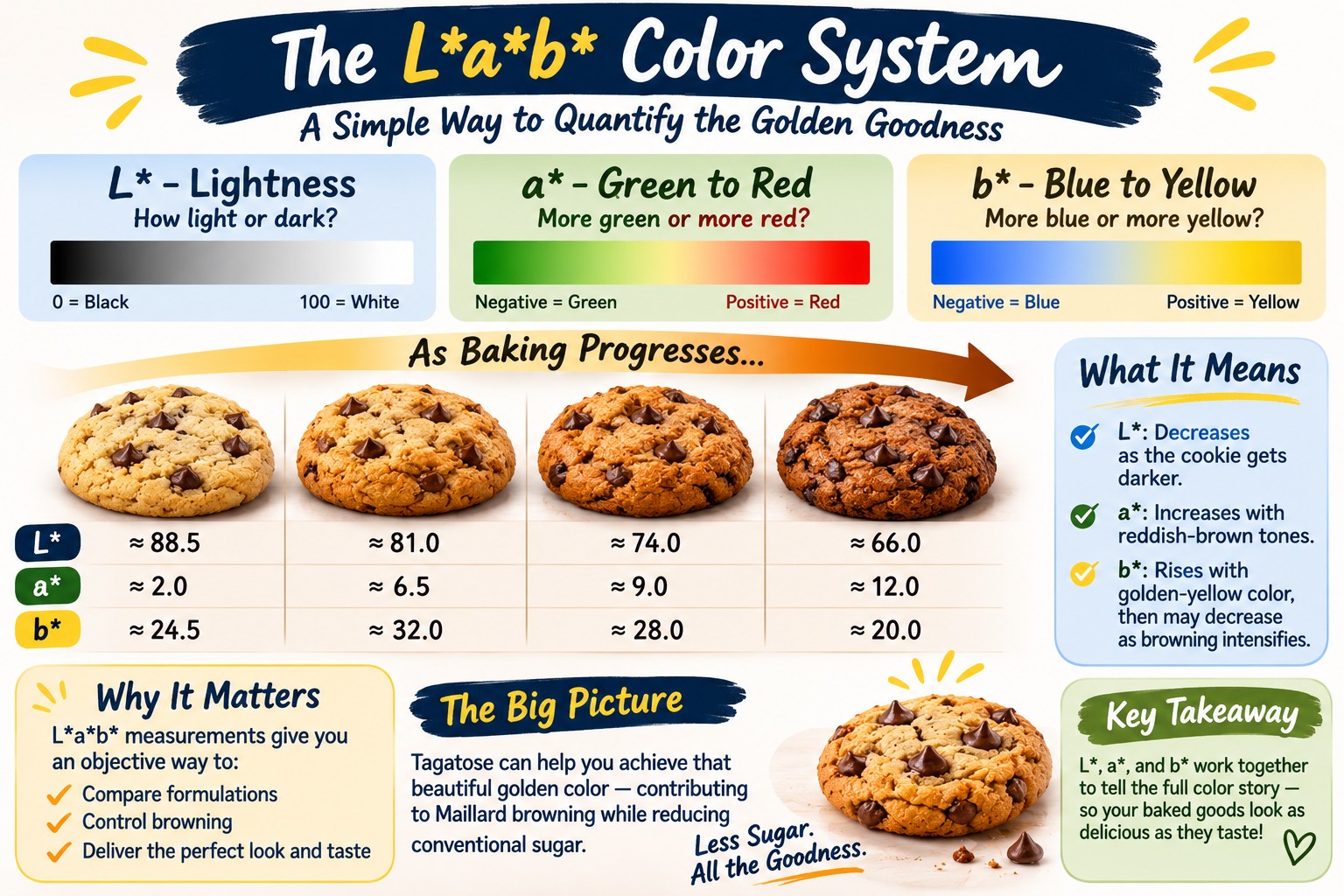
Once the formulation effects are understood, optimize bake temperature, bake time, and other processing variables. For higher-protein bakery products, pay particular attention to browning intensity and the possible formation of undesirable heat-generated compounds.
Acrylamide is one consideration in susceptible cereal-based products, especially those containing free asparagine. The finished product should be evaluated rather than assuming a reducing-sugar substitution reduces that risk. The goal is to develop the desired flavor and color while maintaining control over food safety and product quality.
The Bigger Picture: Sugar Reduction Without Sacrificing the Experience
Consumers don’t buy cookies because they’re fascinated by carbohydrate chemistry. They buy cookies because they want a cookie. They want that familiar golden color, the aroma of something freshly baked, the right texture, and the satisfaction that comes from a well-developed flavor profile.
The challenge for food scientists is delivering those experiences while reducing conventional sugar. Tagatose offers an interesting opportunity because it addresses more than sweetness. Its reducing-sugar chemistry allows it to participate directly in the reactions responsible for baked color and flavor development. Combined with thoughtfully selected high-intensity sweeteners, fibers, and bulking systems, it can become an important part of a broader sugar-reduction strategy.
Final Thoughts: Let Them Eat Cake. Just Rethink the Sugar.
For decades, sugar reduction in baked goods has been an exercise in compromise. Remove the sugar, and something usually suffers. Flavor. Texture. Color. Structure. Shelf life. Sometimes all five.
Tagatose gives formulators another tool for addressing that challenge. It provides sugar-like sweetness, contributes soluble solids, and participates in Maillard browning, opening opportunities to develop baked goods with less conventional sugar without abandoning the sensory characteristics consumers expect. The real opportunity isn’t simply making a lower-sugar cookie. It’s making a better lower-sugar cookie. Because at the end of the day, nobody wants to eat a nutritional compromise disguised as dessert.
Related reading: Tagatose, A Sweetener That Feeds More Than Sweetness, Sourdough Is Having a Rock Star Moment and Rheology vs. Viscosity: Because Thick Doesn’t Always Mean Better.


