
By Thom King, CFS, Founder, Chairman, Chief Innovation Officer Icon Foods
Monk fruit is a terrific sweetener. I like monk fruit. I formulate with monk fruit. I sell monk fruit. But monk fruit has become expensive enough that formulators need to ask a question we sometimes avoid when we’re in love with an ingredient, do I actually need this much monk fruit?
Because the objective isn’t to win an award for having the most expensive sweetener system in the building. The objective is to make food and beverages that taste great, hit the nutritional target, survive commercialization and make financial sense. And right now, that means taking another serious look at stevia.
Not old-school, face-puckering, licorice-tail stevia dumped into a formula at heroic levels. I’m talking about intelligently selected steviol glycosides, particularly Reb M and Reb D, used alone or as part of a deliberately constructed sweetener system.
Monk Fruit and Stevia Are Not the Same Ingredient
Let’s start with the chemistry. Monk fruit comes from Siraitia grosvenorii. Its sweetness is generated primarily by compounds called mogrosides, particularly mogroside V. Stevia comes from Stevia rebaudiana. Its sweetness comes from a family of compounds called steviol glycosides, including stevioside, Reb A, Reb D, Reb M and others. Both are extraordinarily potent compared with sucrose.
FDA reports monk fruit extract at approximately 100 to 250 times the sweetness of sucrose, depending on mogroside concentration, while steviol glycosides are generally reported at approximately 200 to 400 times sweeter than sucrose. That immediately tells us something important, neither ingredient should be evaluated primarily on dollars per kilogram. For a formulator, that’s almost useless. What matters is, cost per unit of delivered sweetness. And even that doesn’t tell the whole story. The number I really care about is, aost per unit of acceptable sweetness. Because if an ingredient is cheap but requires three masking flavors, two modulators and a small exorcism to make the finished beverage taste good, it wasn’t actually cheap.
Monk Fruit: Why Formulators Love It
Monk fruit earned its place in the sugar-reduction toolbox for good reasons. Its sweetness comes primarily from mogrosides, and commercial extracts are frequently differentiated by their mogroside V concentration. A V25 isn’t the same sensory beast as a V50.
As purity and mogroside concentration change, so do potency, flavor contribution and economics. Properly formulated monk fruit can provide a rounded sweetness profile that works beautifully in beverages, dairy, protein products, sauces, bakery and nutritional applications. It also carries something incredibly valuable, consumer-friendly label recognition and it says “fruit” on the ingredient deck, inferring something more natural.
Monk fruit extract is a pretty easy ingredient story to tell. Nobody needs a chemistry degree and a PowerPoint presentation to explain a fruit. But monk fruit has an Achilles’ heel. Supply.
Commercial monk fruit production remains heavily concentrated in southern China. That geographic concentration makes the supply chain more vulnerable to crop conditions, acreage decisions, agricultural variability and demand pressure. And when supply tightens, economics can move quickly. Suddenly that beautiful monk fruit formula becomes a very expensive way to sweeten water.
Enter Stevia
Stevia has a different problem. Its historical reputation was largely built around Reb A. Reb A works. It’s potent. It’s economical. But push it too hard and you can encounter bitterness, licorice character, delayed sweetness and lingering sweetness.
That created a generation of product developers who decided, “I don’t like stevia.” That’s a little like driving a 1987 Buick and concluding that you don’t like automobiles. Stevia chemistry has moved considerably beyond Reb A and the Delta 88.
Reb D and particularly Reb M can provide substantially cleaner sweetness profiles with reduced bitterness and more sucrose-like characteristics than traditional Reb A systems. They’re still not sucrose. Nothing is. Sucrose has a beautiful temporal profile, relatively fast onset, rounded peak and clean decay. High-intensity sweeteners don’t behave exactly that way. That’s why formulation is key.
The Real Sensory Difference
Think about sweetness as a movie instead of a photograph. A Brix reading or sweetness-equivalence number gives you the photograph. But your consumer experiences the movie. Onset → Peak → Mid-palate → Decay → Finish.
Sucrose gets that sequence remarkably right. Monk fruit and stevia tell different versions of the story. Monk fruit can produce a rounded sweetness profile, but depending on concentration and grade it can introduce lingering sweetness and characteristic flavor notes.
Traditional Reb A stevia tends to show a more obvious delayed and lingering profile and can introduce bitterness at elevated concentrations. Reb M changes the equation. It generally delivers smoother sweetness with fewer bitter and off-notes and a profile substantially closer to sucrose than older steviol glycosides. But here’s the important part, you don’t have to choose a team.
This isn’t Packers versus Vikings. Some of the best systems use monk fruit and stevia together.
Why Blending Works
This is where formulation becomes fun and interesting. Imagine a formula currently using monk fruit to provide essentially all of its high-intensity sweetness. If monk fruit prices increase substantially, procurement has three choices. Keep buying it and absorb the margin hit. Raise the finished product price. Or reformulate. I vote for Door Number Three. Instead of asking: “How do we replace monk fruit?” ask: “How much monk fruit do we actually need?” That is an entirely different formulation exercise.
Stevia can provide a substantial portion of the sweetness load while monk fruit is retained at a lower concentration to contribute sensory character, label recognition and sweetness architecture. The expensive ingredient stops doing all the heavy lifting. Now it has a supporting role. That’s usually where the economics get interesting.
The 80/20 Sweetness Strategy
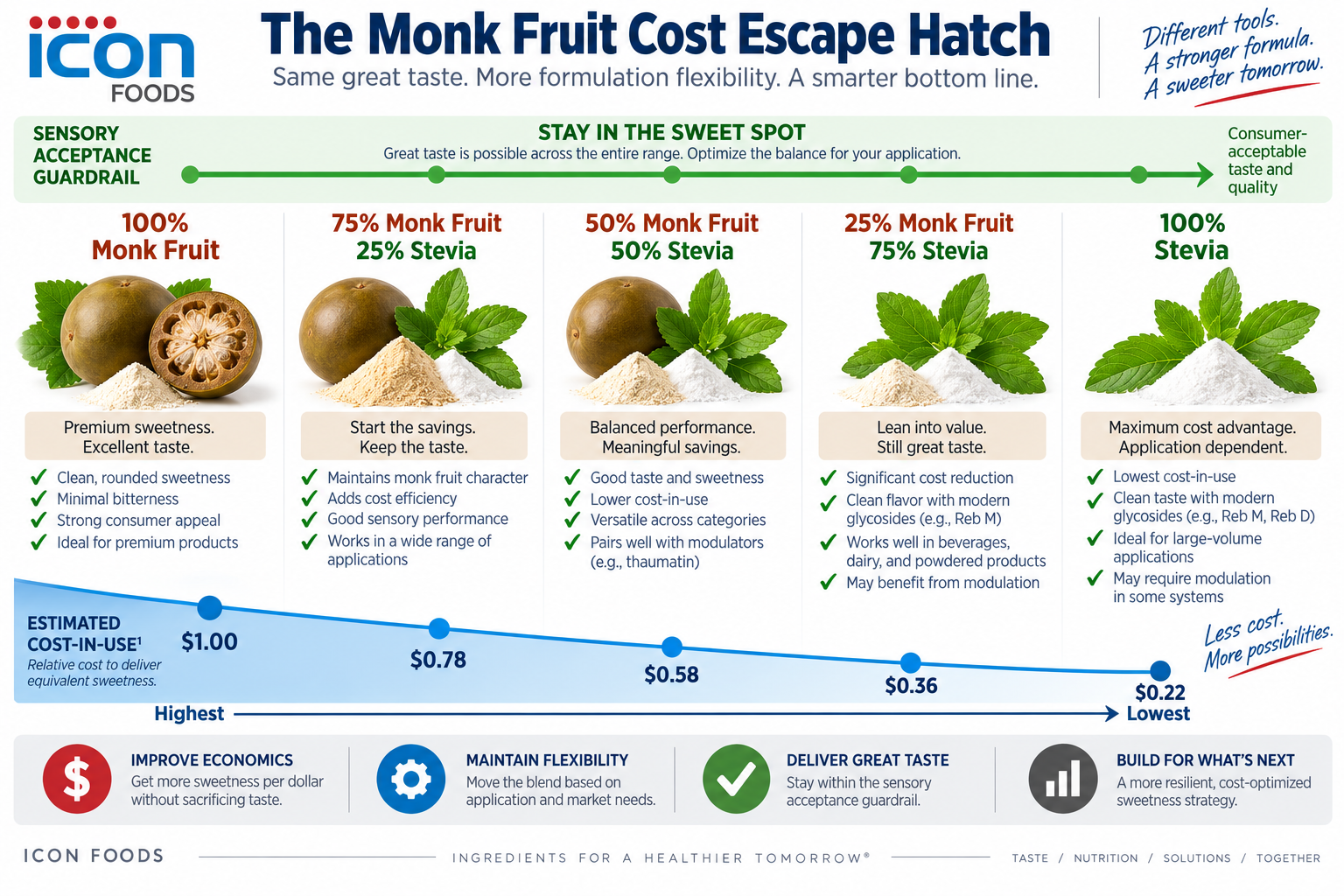
I’m not suggesting that every formula should literally be 80% stevia and 20% monk fruit. Formulation doesn’t work that way. But the concept is useful. If monk fruit is supplying 100% of your high-intensity sweetness today, start evaluating systems where stevia supplies progressively more of the sweetness contribution. For example, screen: 100% monk fruit against 75% monk fruit / 25% stevia then 50% monk fruit / 50% stevia then 25% monk fruit / 75% stevia and ultimately 100% stevia.
Those percentages should represent sweetness contribution, not necessarily ingredient weight. That distinction is key. Run those systems blind. Evaluate:
- sweetness onset
- peak intensity
- mid-palate
- bitterness
- astringency
- flavor interaction
- sweetness linger or tail
- overall preference
Then run the economics. You may discover something fascinating, the least expensive formula isn’t necessarily the one with zero monk fruit. Sometimes keeping a small amount of monk fruit allows you to use less stevia, fewer flavor maskers or less modulation while maintaining a better overall sensory profile. That’s formulation economics.
Reb A vs. Reb M Matters
Here’s another place people get themselves into trouble. They hear stevia is cheaper and immediately substitute commodity Reb A into a monk fruit formula. Then everybody tastes it. Everybody hates it. And somebody announces: “Stevia doesn’t work.” No. That stevia didn’t work.
Reb A and Reb M are not interchangeable sensory tools. Reb A can be an excellent option when aggressive cost reduction is required and the surrounding flavor system can tolerate or mask its characteristic profile.
Reb M should be evaluated when sensory quality is the higher priority. Reb D can occupy another useful position in the toolbox. And blends of steviol glycosides can often outperform individual glycosides. The correct question isn’t: “How much does stevia cost?” It’s: “Which steviol glycoside delivers the lowest cost-in-use while meeting my sensory target?”
Here’s How I Would Attack the Cost Problem
If I were reformulating a product today because monk fruit cost had gotten out of control, I wouldn’t start by deleting monk fruit. I’d establish the existing formula as the sensory control. Then I’d determine the sweetness contribution currently being supplied by monk fruit. Next, I’d build a replacement ladder using progressively greater contributions from Reb M or another appropriate stevia system. Then I’d taste everything blind. Only after establishing acceptable sensory boundaries would I run the economics.
Because purchasing ingredients based exclusively on price per kilogram is how you end up saving $0.03 on sweetener and spending $0.08 fixing what you just broke. That’s not cost reduction. That’s accounting cosplay.
Don’t Forget the Missing Sugar
There is another trap hiding underneath this entire conversation. Neither monk fruit nor stevia replaces the physical functionality of sugar. They’re high-intensity sweeteners. Sugar isn’t. Sugar provides, bulk, solids, viscosity, water activity management, freezing-point depression, browning, texture, mouthfeel and flavor development.
Pull 10 grams of sucrose out of a formulation and replace its sweetness with a few milligrams of stevia or monk fruit and congratulations, you’ve replaced the sweetness. You haven’t replaced the sugar.
This is why successful sugar reduction usually requires an architecture, not an ingredient. Depending on the application, that architecture might include: Allulose + Tagatose + Fiber + Stevia + Monk Fruit + Sweetness Modulation.
Each ingredient has a job. Bulk sweeteners rebuild solids and functionality. High-intensity sweeteners restore sweetness. Fibers can restore body and viscosity.
Modulators reshape the temporal profile and suppress off-notes. That’s how you rebuild sugar rather than simply removing it.
Where Stevia Can Save Serious Money
The biggest opportunities tend to appear in products where the high-intensity sweetener is doing a meaningful portion of the sweetness work:
- Carbonated beverages
- Energy drinks.
- Hydration products.
- Protein beverages.
- Powdered drink mixes.
- Dairy and dairy alternatives.
- Sauces and condiments.
- Nutritional products.
The larger the production volume, the more important tiny changes in cost-in-use become. Saving a fraction of a cent per serving doesn’t sound exciting in the lab. Multiply it by 50 million servings. Now finance is paying attention.
The Formulator’s Decision Matrix
| Monk Fruit | Stevia Reb A | Stevia Reb M/D | |
| Sweetness potency | Very high | Very high | Very high |
| Ingredient cost | Higher | Lower | Moderate |
| Cost-in-use potential | Moderate | Excellent | Very good |
| Sensory quality | Good to excellent | Application dependent | Very good to excellent |
| Bitter risk | Low to moderate | Higher | Lower |
| Lingering sweetness | Possible | Pronounced at higher use | Still possible |
| Label familiarity | Excellent | Excellent | Excellent |
| Supply diversification | More limited | Stronger | Stronger |
| Best role | Premium sweetness / blending | Cost optimization | Sensory + cost optimization |
The point isn’t that stevia beats monk fruit. The point is optionality. A formulator who only knows how to formulate with monk fruit is vulnerable to monk fruit pricing. A formulator who only knows Reb A is leaving sensory performance on the table. A formulator who understands monk fruit, Reb A, Reb M, Reb D, bulk sweeteners and modulation can move sweetness contribution around as economics change. That’s leverage.
Stop Buying Ingredients. Start Buying Performance.
This is probably the biggest lesson. Procurement buys kilograms. Consumers don’t. Consumers buy taste. The formulator’s job is to connect those two realities. If monk fruit prices rise, don’t panic and don’t immediately rip monk fruit out of the formula. Reduce its workload. Let stevia carry more of the sweetness. Let monk fruit provide the sensory contribution where it earns its keep. Use Reb M when you need a cleaner profile. Use Reb A where economics matter more and the matrix can support it. Use blends when they outperform either ingredient alone. And use modulation when the sweetness curve needs help.
The future of sugar reduction isn’t going to belong to the company that discovers one magical sweetener. There isn’t one. It’s going to belong to formulators who understand how to build sweetness systems that can adapt as ingredient prices, supply chains, consumer expectations and regulations change.
Monk fruit is a tool. Stevia is a tool. Use the right tool for the job. And when one of those tools suddenly costs a fortune? Don’t complain about the price of the hammer. Redesign the toolbox.
The science underneath it
I deliberately avoided claiming that stevia is universally better tasting or giving a fixed percentage cost saving. Those would be easy marketing claims and lousy food science. FDA puts high-purity steviol glycosides around 200–400× sucrose sweetness and monk fruit extracts around 100–250×, with actual performance depending heavily on composition[i]. Recent literature also supports the distinction between older Reb A systems and newer Reb M/D systems: Reb M and D generally have lower bitterness and more sucrose-like profiles, although lingering sweetness can remain[ii].
The other important piece is your blending argument. Published sensory work confirms that monk fruit and stevia have temporal and side-taste profiles that differ from sucrose, which makes straight sweetness-equivalence substitution a crude tool[iii]. And interestingly, this isn’t a new position for you: an older industry article actually quotes you making the case that monk fruit and stevia blends can offset one another’s off-notes[iv].
For the commercial argument, I anchored it around cost-in-use rather than $/kg. That’s the number customers should care about. Monk fruit’s supply remains geographically concentrated, and current industry reporting specifically identifies that concentration as a source of availability and price volatility.
I also wouldn’t position this as ditch monk fruit and switch to stevia. That’s the road I rejected. It turns a sophisticated formulation story into commodity ingredient selling. “Reduce monk fruit dependency through sweetness architecture” is much stronger. It protects your monk fruit business while opening the door to SteviaSweet™, Reb M/D, Thaumatiq™ modulation, and eventually the broader Icon toolbox. It also makes Icon the coach calling the offense rather than the guy selling footballs.
References:
[i] https://www.fda.gov/food/food-additives-petitions/aspartame-and-other-sweeteners-food
[ii] https://www.frontiersin.org/journals/nutrition/articles/10.3389/fnut.2026.1894194/
[iii] https://www.sciencedirect.com/science/article/pii/S0963996919301632
[iv] https://www.nutritionaloutlook.com/view/stevia-versus-monk-fruit-how-do-they-compare-formulation