

by Thom King CFS – Founder, Chief Innovation Officer, Food Scientist, Icon Foods
Something important just happened in alternative sweeteners. And if you formulate with allulose or tagatose, pay attention. The recent lawsuits challenging “Zero Sugar” claims on allulose-sweetened products are not really an indictment of allulose. They expose something much more interesting: The science of rare sugars has moved faster than the language of food-labeling regulations. That distinction is key because another remarkable rare sugar is rapidly entering commercial formulations, D-tagatose.
Tagatose brings its own impressive résumé. It provides bulk. It contributes approximately 92% of the sweetness of sucrose. It participates aggressively in Maillard browning. It provides approximately 1.5 kcal/g rather than the roughly 4 kcal/g associated with conventional sugars. It has a relatively modest glycemic response compared with sucrose. And FDA has recognized another particularly interesting property: D-tagatose is eligible as a noncariogenic sweetener under the authorized dental-caries health claim.
Then, in November 2025, FDA made an enormously important labeling move. The agency announced that it intends to exercise enforcement discretion allowing D-tagatose to be excluded from Total Sugars and Added Sugars on the Nutrition Facts panel. Sound familiar? It should. Because we have seen this movie before. Its name was allulose. And the sequel may involve tagatose.
The Problem Isn’t Allulose
Let’s start with what happened. In August 2026, lawsuits were filed challenging “Zero Sugar” and “0g Sugar” representations on products containing allulose, including products sold by Liquid Death and David Protein. Those cases followed the Seventh Circuit Court of Appeals decision in Franco v. Chobani on July 27, 2026.
The court considered products marketed as “sugar free” despite containing allulose. The manufacturer’s logic was understandable. FDA allows allulose to be excluded from Total Sugars and Added Sugars on the Nutrition Facts panel under enforcement discretion. Therefore, 0 g total sugars seem to logically lead to, zero sugar. Except the court didn’t see it that way. The underlying regulation defines sugars broadly enough to include free mono- and disaccharides. Allulose is a monosaccharide. FDA’s enforcement-discretion policy changed how allulose can be declared on the Nutrition Facts panel. It did not rewrite the underlying regulation governing nutrient-content claims. And therein lies the problem.
Now Enter Tagatose
Here’s where formulators should really start paying attention. D-tagatose is also a monosaccharide. FDA now intends to exercise enforcement discretion allowing tagatose to be excluded from both Total Sugars and Added Sugars on the Nutrition Facts panel. FDA also recognizes an energy contribution of 1.5 kcal/g for tagatose. That is a major regulatory and commercial development. But it potentially creates the same peculiar situation we now have with allulose. A tagatose-containing product could potentially have a Nutrition Facts panel displaying, Total Sugars 0 g and includes 0 g Added Sugars, while the formulation itself contains several grams of tagatose.
The science behind that treatment makes sense. Tagatose is metabolized differently from conventional sugars. But chemically? Tagatose remains a sugar. And that means formulators should not assume FDA’s Nutrition Facts enforcement discretion automatically provides protection for a front-of-pack zero sugar claim.
The Rare-Sugar Paradox
We have now entered a fascinating period in carbohydrate science. Consider these two molecules:
| Allulose | Tagatose | |
| Chemical class | Monosaccharide | Monosaccharide |
| Relative sweetness | ~70% sucrose | ~90%+ sucrose |
| FDA-recognized energy | ~0.4 kcal/g | ~1.5 kcal/g |
| Total Sugars declaration | Excluded under enforcement discretion | Excluded under enforcement discretion |
| Added Sugars declaration | Excluded under enforcement discretion | Excluded under enforcement discretion |
| Physiologically equivalent to sucrose? | No | No |
| Chemically a sugar? | Yes | Yes |
That final row is the one keeping regulatory attorneys employed. Allulose and tagatose behave differently in the human body than conventional sugars. FDA recognizes that. But the regulations governing certain nutrient-content claims were written around chemical categories that predate much of today’s rare-sugar innovation. Welcome to the collision between 1990s regulatory language and twenty-first-century carbohydrate science.
The Two-Lane Problem
Formulators now need to think about sugar labeling in two separate lanes.
LANE ONE: Nutrition Facts
For allulose, FDA currently exercises enforcement discretion allowing exclusion from Total Sugars and Added Sugars while permitting approximately 0.4 kcal/g for calorie calculation.
For D-tagatose, FDA now similarly intends to exercise enforcement discretion allowing exclusion from Total Sugars and Added Sugars while recognizing approximately 1.5 kcal/g.
These are enormous formulation advantages. They make rare sugars exceptionally interesting tools for calorie and conventional-sugar reduction. But now comes Lane Two.
LANE TWO: Front-of-Pack Claims
21 CFR §101.60 governs claims including: Sugar Free, Free of Sugar, No Sugar, Zero Sugar, Without Sugar, Sugarless. Generally, those claims require less than 0.5 g of sugars per reference amount customarily consumed and per labeled serving.
The regulation points to the definition of sugars that includes free mono- and disaccharides. And both allulose and tagatose are monosaccharides. That means the lesson coming out of Franco should not be interpreted narrowly as, be careful making Zero Sugar claims with allulose. The smarter interpretation is, be careful making absolute sugar claims with metabolically distinct sugars whose Nutrition Facts treatment depends upon FDA enforcement discretion rather than a corresponding rewrite of the nutrient-content-claim regulations. That is a much bigger deal.
The Formulator’s New Rule
Here is the rule I would put on the R&D laboratory wall, don’t formulate away from rare sugars. Formulate away from unnecessary absolute claims. Allulose didn’t suddenly stop working. Neither did tagatose. Their metabolic properties did not change because somebody filed a lawsuit. Their functionality didn’t change. Their sweetness didn’t change. Their caloric contribution didn’t change. What changed is our understanding of the litigation risk surrounding the words printed on the package. Keep the molecule. Fix the sentence.
Claims I Would Treat Very Carefully
If a formulation contains meaningful amounts of allulose or tagatose, I would currently treat these claims as higher-risk unless specifically cleared by qualified regulatory counsel:
ZERO SUGAR
SUGAR FREE
NO SUGAR
WITHOUT SUGAR
SUGARLESS
These are absolute statements. Absolute statements make wonderful marketing. They also make wonderful exhibits.
And What About “No Added Sugar”?
This deserves its own flashing warning light. The obvious reaction from marketing may be: “Fine. We’ll change Zero Sugar to No Added Sugar.” Not so fast. 21 CFR §101.60 contains specific requirements for No Added Sugar, Without Added Sugar, and, No Sugar Added.
Among those requirements is that sugars, as defined by the regulation, are not added during processing or packaging. Both allulose and tagatose are chemically sugars. Therefore, intentionally adding either ingredient creates a regulatory question that should not be waved away simply because FDA permits the ingredient to be excluded from the Added Sugars declaration on the Nutrition Facts panel. The Nutrition Facts panel and the marketing claim are two different regulatory questions. Changing ZERO SUGAR to NO ADDED SUGAR without doing the regulatory analysis may simply involve moving your lawn chair to another part of the minefield.
The Better Strategy: Make the Rare Sugar the Hero
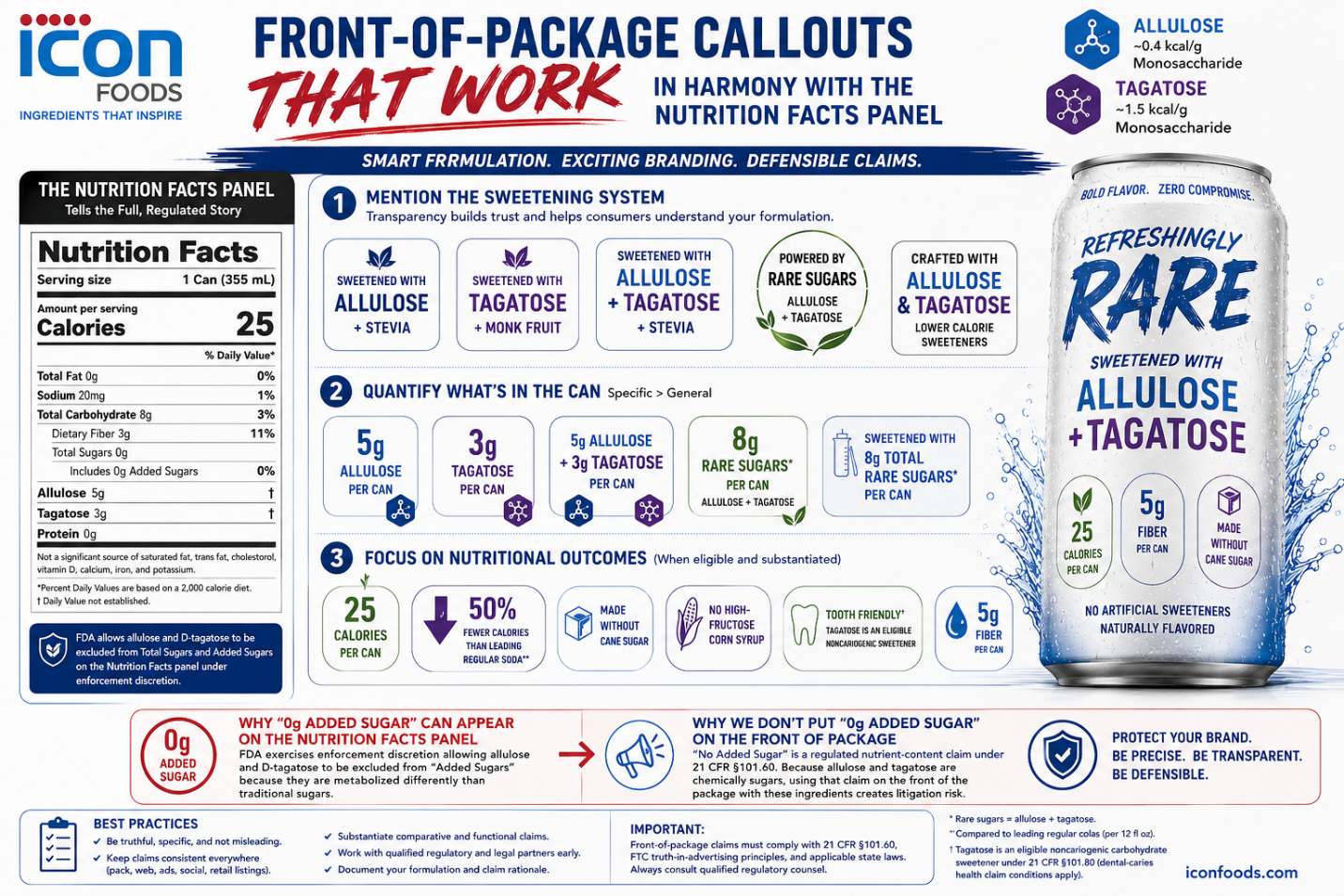
Here’s where this gets fun. Instead of hiding the sweetening system, explain it. For allulose formulations: SWEETENED WITH ALLULOSE or: SWEETENED WITH ALLULOSE + STEVIA
For tagatose formulations: SWEETENED WITH TAGATOSE or: SWEETENED WITH TAGATOSE + STEVIA or: SWEETENED WITH TAGATOSE + MONK FRUIT. And when both rare sugars are used: SWEETENED WITH ALLULOSE + TAGATOSE. Duh!
Of course assuming, obviously, every statement accurately describes the finished formulation. Now we’re telling consumers what is actually in the product rather than constructing an argument around what supposedly isn’t. That’s transparency. And transparency makes a pretty decent litigation strategy.
Quantify Instead of Generalize
Another useful approach is simply telling consumers what is there. For example: 5 g ALLULOSE PER SERVING or 4 g TAGATOSE PER SERVING, provided those numbers are analytically and formulation-wise accurate. Numbers narrow the promise.
“Zero Sugar” asks a philosophical question, Is this molecule sugar? While 4 g Tagatose makes a factual statement, there are four grams of tagatose. That is a much less interesting conversation for plaintiff counsel.
Tagatose Has Another Interesting Card to Play
Tagatose has one particularly interesting regulatory attribute that deserves attention. FDA recognizes D-tagatose as an eligible noncariogenic carbohydrate sweetener under 21 CFR §101.80. That regulation specifically identifies D-tagatose as a sugar that does not promote the development of dental caries when the conditions of the authorized claim are satisfied. Read that sentence again. FDA essentially recognizes, Tagatose is a sugar, and Tagatose behaves differently from conventional sugars in an important physiological context. That distinction captures the entire problem beautifully. Modern carbohydrate science isn’t binary. Something can chemically be a sugar while behaving very differently metabolically and physiologically from sucrose. That is precisely why formulators should stop trying to squeeze these ingredients into simplistic sugar, versus, not sugar marketing buckets. There are much more interesting stories to tell.
Sell Calories Where Appropriate
Allulose and tagatose both provide opportunities for calorie reduction. Allulose: ~0.4 kcal/g, Tagatose: ~1.5 kcal/g versus roughly: 4 kcal/g for conventional sugars such as sucrose.
That means calorie positioning may provide another useful avenue where the finished product meets applicable regulatory requirements.
Rather than, zero sugar, perhaps the strongest consumer proposition is simply, 35 calories per can or, 50 calories per serving. Now you are communicating the nutritional outcome the formulator actually engineered.
Comparative Sugar Claims Need Their Own Math
Claims such as, reduced sugar, less sugar, lower sugar can be attractive alternatives. But don’t assume they automatically work. FDA generally requires at least a 25% reduction compared with an appropriate reference food for these comparative claims.
And the relevant regulatory sugar calculation needs to be evaluated independently from what appears on the Nutrition Facts panel under enforcement discretion. This becomes particularly important with allulose and tagatose. The Nutrition Facts panel may say one thing. The nutrient-content-claim calculation may require another analysis. Formulation math and labeling math have officially stopped sharing a Netflix password.
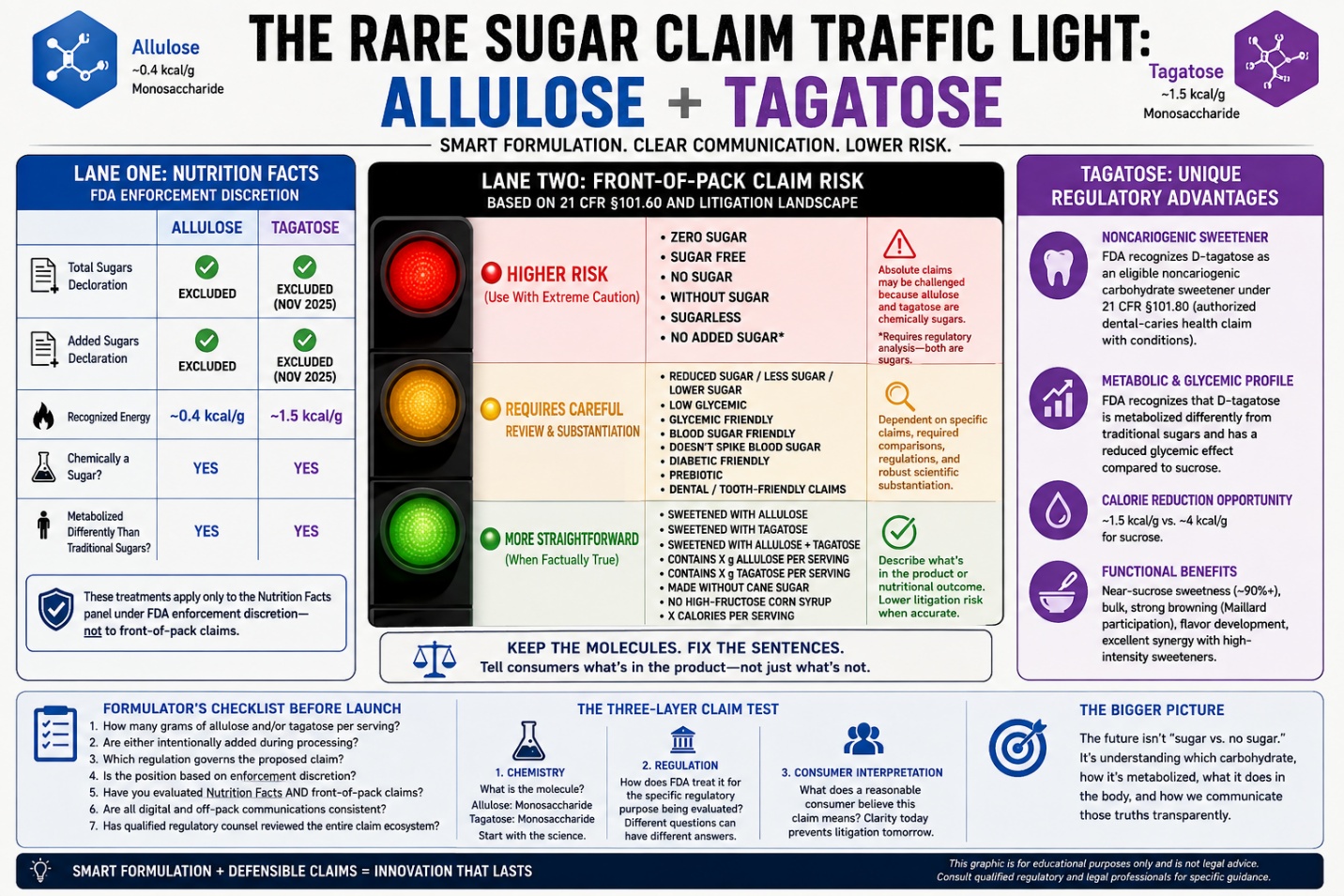
A Rare-Sugar Claim Risk Ladder
🔴 Higher Risk
When meaningful allulose or tagatose is intentionally present: Zero Sugar, Sugar Free, No Sugar, No Added Sugar, Without Sugar. Sugarless
🟡 Requires Careful Regulatory and Scientific Review
Reduced Sugar, Less Sugar, Lower Sugar, Low Glycemic, Glycemic Friendly, Blood Sugar Friendly, Doesn’t Spike Blood Sugar, Diabetic Friendly, Prebiotic. Dental Health / Tooth-Friendly Claims
Some are regulated nutrient-content claims. Others create physiological or health representations requiring appropriate scientific substantiation. Tagatose’s dental-caries opportunity is particularly interesting, but FDA specifies conditions and permitted claim architecture. It is not a blank check to freestyle dental claims.
🟢 Generally More Straightforward When Factually True
Sweetened With Allulose. Sweetened With Tagatose, Sweetened With Allulose + Tagatose. Contains X g Allulose Per Serving, Contains X g Tagatose Per Serving, Made Without Cane Sugar, No High-Fructose Corn Syrup, X Calories Per Serving
These still deserve regulatory review. But there is a fundamental difference, they describe what the product actually contains rather than making an absolute claim about what it doesn’t.
Build Claims From the Formulation Forward
Historically, product development often happened backwards. Marketing walked into R&D and announced, “We need a Zero Sugar beverage.” The food scientist then had to reverse-engineer the formulation around those two words. The better workflow is:
- Build the best formulation.
Choose the appropriate combination of:
- Allulose
- Tagatose
- Erythritol
- soluble fibers
- stevia
- monk fruit
- sweet proteins
- flavors
- acids
- salts
- texture systems
based upon the actual product requirements.
- Determine what is scientifically true.
Measure and calculate:
- Calories
- Carbohydrates
- conventional sugars
- rare sugars
- sweetness
- solids
- glycemic characteristics where substantiated
- physiological characteristics where substantiated
- Determine what is regulatorily claimable.
- Ask: What regulation governs this exact statement?
- Not: What does FDA generally think about this ingredient?
That distinction is precisely how we ended up here.
- Build marketing around those defensible truths.
Then marketing gets to have fun. But now the guardrails are installed before the car reaches Turn One.
The Three-Layer Claim Test
Every alternative-sweetener claim should pass three filters.
Layer One: Chemistry
What is the molecule? Allulose? Monosaccharide. Tagatose? Monosaccharide. Stevia glycoside?
Different animal entirely. Thaumatin? Protein. Erythritol? Polyol.
Start with chemistry. Marketing doesn’t get a vote on molecular structure.
Layer Two: Regulation
How does FDA treat that ingredient for the specific regulatory purpose being evaluated? This is the big one.
Tagatose provides a beautiful example. FDA currently allows enforcement discretion excluding it from Total Sugars and Added Sugars declarations. FDA recognizes approximately 1.5 kcal/g. FDA recognizes D-tagatose as an eligible noncariogenic carbohydrate sweetener. Yet tagatose remains chemically a sugar. Different regulatory questions can therefore produce different answers about the same molecule.
Layer Three: Consumer Interpretation
Finally ask, what does a reasonable consumer think this claim means? If the package screams: Zero Sugar and the ingredient list says Tagatose you had better be extraordinarily comfortable explaining why both statements coexist. Because someday the person asking the question may not be a consumer. They may be opposing counsel.
Do Not Panic-Reformulate
This may be the most important message in this entire paper. Do not abandon allulose and do not abandon tagatose. These are extraordinary formulation tools. Allulose provides valuable:
- Bulk
- Mouthfeel
- Solids
- Browning
- freezing-point depression
- sweetness synergy
- calorie reduction
Tagatose adds another remarkable toolbox:
- near-sucrose sweetness
- bulk
- strong browning potential
- flavor development
- reduced caloric contribution
- interesting glycemic characteristics
- noncariogenic properties
- excellent synergy opportunities with high-intensity sweeteners
The lawsuits aren’t telling us these molecules don’t work. They’re telling us our vocabulary hasn’t caught up with our chemistry. That’s a marketing problem. Not a formulation failure.
The Bigger Rare-Sugar Opportunity
Allulose was the opening act. Tagatose may be the next major chapter. And more metabolically distinct carbohydrates will follow. FDA itself recognizes that allulose and D-tagatose, are sugars that are metabolized differently from traditional sugars. That sentence should change how the food industry thinks about sugar reduction. The future isn’t, Sugar vs. No Sugar It is which carbohydrate? How is it metabolized? How many calories does it provide? What does it do to the finished food? How does it affect the consumer? And how do we communicate those differences truthfully? Those are much more interesting questions. And they lead to much better food science.
The Big Takeaway
Allulose isn’t the problem. Tagatose isn’t the problem. The problem is trying to fit metabolically distinct twenty-first-century carbohydrates into twentieth-century binary marketing language. Use these ingredients. Understand them. Declare them correctly. Explain them clearly.
And recognize that FDA permission to exclude a rare sugar from Total Sugars and Added Sugars on the Nutrition Facts panel does not automatically mean that an absolute front-of-pack sugar claim is equally protected.
Keep the molecules. Fix the sentences. Because in this new world of rare sugars, the strongest claim may not be Zero Sugar, it may simply be Here’s Exactly How We Sweetened It. And frankly, that’s a much better story.
Rare-Sugar Claim Checklist Before Launch
Before commercializing a product containing allulose or tagatose:
- Does the front panel say Zero Sugar, Sugar Free, No Sugar, Without Sugar, or No Added Sugar?
- How many grams of allulose and/or tagatose are present per serving?
- Are either intentionally added during processing?
- Which regulation specifically governs the proposed claim?
- Is the regulatory position based on an amended regulation or FDA enforcement discretion?
- Have you independently evaluated the Nutrition Facts declaration and front-of-pack claim?
- Does the website repeat or amplify the claim?
- What about Amazon, retailer listings, distributor pages, sell sheets, trade-show graphics, social media, and paid advertising?
- Could the benefit be communicated more precisely by identifying the sweetening system?
- Are metabolic, glycemic, prebiotic, dental, or physiological claims adequately substantiated?
- Has qualified regulatory counsel reviewed the entire claim ecosystem, rather than merely approving the Nutrition Facts panel?
Remember. a compliant Nutrition Facts panel does not magically sanitize an aggressive marketing claim somewhere else. The plaintiff’s screenshot button works just fine on Instagram.
References
U.S. Food and Drug Administration. November 21, 2025 Response Regarding D-Tagatose Labeling. FDA states that it intends to exercise enforcement discretion regarding exclusion of D-tagatose from Total Sugars and Added Sugars declarations and recognizes an energy value of 1.5 kcal/g.
U.S. Food and Drug Administration. Guidance for Industry: The Declaration of Allulose and Calories from Allulose on Nutrition and Supplement Facts Labels. FDA describes enforcement discretion permitting allulose to be excluded from Total Sugars and Added Sugars and permits use of 0.4 kcal/g for calorie calculations.
U.S. Court of Appeals for the Seventh Circuit. Franco v. Chobani, LLC, No. 25-2087, decided July 27, 2026.
21 CFR §101.60. Nutrient-content requirements governing “sugar free,” “zero sugar,” “no sugar,” “no added sugar,” and comparative sugar claims.
21 CFR §101.80. Health claims concerning dietary noncariogenic carbohydrate sweeteners and dental caries. The regulation expressly identifies D-tagatose among eligible noncariogenic carbohydrate sweeteners.
U.S. Food and Drug Administration. Sugars That Are Metabolized Differently Than Traditional Sugars. FDA discusses allulose, D-tagatose, and isomaltulose as sugars metabolized differently from traditional sugars.
Federal Trade Commission. Health Products Compliance Guidance.
BevNET. Brad Avery. Liquid Death, David Protein Facing Lawsuits Claiming Allulose Contradicts ‘Zero Sugar’ Claims.August 26, 2026.
This paper provides food-science and regulatory-strategy commentary and is not legal advice. Finished-product claims should be evaluated against the current formulation, current federal regulations and agency policy, applicable state law, scientific substantiation, and qualified regulatory/legal review.