

by Thom King, CFS, Founder, Chairman, Chief Innovation Officer Icon Foods
Sugar had a glorious reign. It built empires, balanced Aw, drove browning, depressed freezing points, and made texture feel inevitable. But the mood has shifted. Consumers want less and so do the feds. Retailers demand reformulation. GLP-1 is rewriting appetites. And suddenly every food and beverage formulator is staring at a formula thinking:
“How do I remove sugar without collapsing structure, killing browning, destabilizing viscosity, or creating a sensory mutiny?”
Because let’s be clear. Sugar is not just sweet. It is:
- Bulk
- Solids
- Water activity control
- Osmotic pressure
- Freezing point depression
- Texture architecture
- Shelf-life management
You don’t “replace sugar.” You rebuild a system.
That’s where Icon Foods MLT1075™ NF Grade Maltitol Syrup earns its keep. Not as a trendy sweetness hack. As a structural, sugar-like workhorse that behaves under heat, tolerates pH swings, and keeps production predictable.
Formulators need performance.
Procurement needs reliability.
MLT1075™ delivers both.
What MLT1075™ Actually Is
Maltitol is a polyol produced by hydrogenating maltose derived from starch. That hydrogenation step matters. It removes the reactive carbonyl chemistry that drives much of the Maillard browning and instability associated with reducing sugars.
In syrup form, maltitol provides:
- Approximately 75–90% the sweetness of sucrose
- Sugar-like bulk and solids
- Humectancy
- Viscosity contribution
- Reduced reactivity under heat
It is widely used in confectionery, bakery, fillings, dairy systems, and reduced-sugar formats because it behaves like sugar structurally, not just sensorially.
And then there’s the NF part.
Why NF Grade Matters (This Is Not Just Spec Theater)
NF stands for National Formulary, part of the USP–NF compendium. When a material is NF grade, it conforms to defined pharmacopeial standards for:
- Identity
- Assay and composition
- Limits on related polyols and impurities
- Heavy metals
- Microbial expectations
- Analytical verification standards
This matters in three very real ways.
- Formulation Stability Through Consistency
When maltitol content and impurity levels are tightly controlled, sweetness intensity, solids contribution, and osmotic behavior remain predictable. That reduces batch-to-batch variance.
Less variance means fewer late-night pilot autopsies.
- Regulatory and Customer Confidence
If you supply nutraceutical, medical-adjacent, premium clean-label, or audited retail channels, NF grade strengthens:
- Supplier qualification files
- QA documentation
- Audit readiness
- Customer trust
Procurement teams appreciate fewer compliance surprises.
- Risk Reduction
Lower impurity variability means:
- Reduced off-notes
- Controlled browning behavior
- Fewer unexpected thermal interactions
- Improved shelf-life predictability
NF grade narrows the performance band. Narrow bands are where operations thrive.
Performance Under pH Stress
Acid systems can be rough on sugars. Sucrose can hydrolyze under acidic, thermal conditions, shifting sweetness and altering functionality.
Maltitol is considerably more resistant to hydrolysis under acidic exposure compared to sucrose. In practical terms:
- Low pH beverages and syrups
- Acidic fillings
- Gummy systems
- Sauce applications
benefit from sweetness and solids stability without the same hydrolytic drift seen with traditional sugars.
That makes MLT1075™ particularly attractive in acid-forward systems where stability matters over extended processing or storage.
Thermal Processing Behavior
Let’s talk heat.
Maltitol is less reactive in Maillard pathways because it lacks the same reducing sugar chemistry that drives aggressive browning reactions.
Under thermal load:
- It maintains structural integrity
- It does not aggressively brown
- It contributes stable solids
- It supports viscosity control
For confectionery and high-solids cookups, that stability is a gift.
Important nuance: if your baked system depends on Maillard browning for color and flavor, maltitol will not spontaneously caramelize into nostalgia. You design for color intentionally.
In exchange, you get greater control and less unpredictability during high-heat processing.
Best Practices for Formulators
- Treat It as a System Builder
MLT1075™ contributes sweetness and solids and water activity modulation. When replacing sucrose: - Recalculate total solids
- Monitor Aw targets
- Adjust moisture accordingly
It is not a one-dimensional swap.
- Manage Viscosity Proactively
Syrup viscosity rises with solids and decreases with temperature.
Practical advice:
- Warm handling improves pumpability
- Design transfer lines appropriately
- Avoid cold-start thickening bottlenecks
- Plan for Browning
Because maltitol does not brown like reducing sugars, build color intentionally if needed through: - Controlled caramel flavors
- Cocoa or roasted inclusions
- Partial reducing sugar strategies if label allows
- Understand GI and Tolerance
Maltitol typically has a lower glycemic impact than sucrose, but not zero. As with all polyols, excessive consumption may cause gastrointestinal discomfort in sensitive individuals. Responsible labeling and usage levels matter.
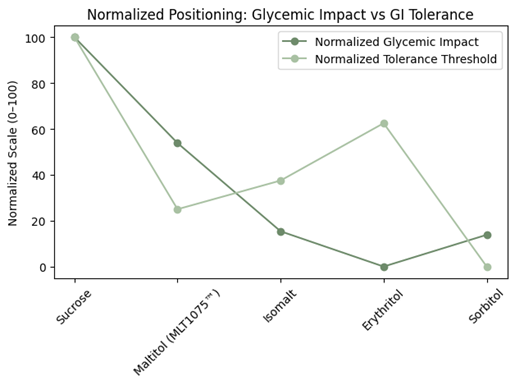
The graph above illustrates gastro-intestinal tolerance and glycemic impact comparison.
• Sucrose: High glycemic impact, high tolerance
• Erythritol: Near-zero glycemic impact, high tolerance
• Sorbitol: Low glycemic impact, low tolerance
• Isomalt: Low glycemic impact, moderate tolerance
• MLT1075™: Squarely in the middle
That “balanced middle” positioning is the story:
Lower glycemic impact than sugar
Better tolerance than sorbitol
More sugar-like functionality than erythritol
Operationally stable under heat and pH
Where MLT1075™ Shines
Confectionery
- Sugar-free chocolates and coatings
- Chewy candies
- Gummy systems
- Hard candy formats requiring clarity and solids control
Bakery and Snack Bars
- Soft-baked cookies
- Brownies
- High-protein bars requiring humectancy and texture stability
Dairy and Frozen
- Reduced-sugar frozen desserts
- Syrups and variegates
- Systems requiring freezing point management
Fillings, Sauces, Syrups
- Acidic fruit systems
- Shelf-stable fillings
- Reduced-sugar dessert toppings
Where sugar once acted as a structural pillar, MLT1075™ can step in and carry meaningful load.
Why Icon Foods Should Be Your Maltitol Supply Chain Partner
Now let’s talk about what procurement actually cares about. Ingredient selection is half science, half logistics discipline.
With Icon Foods, you get:
- Lot-to-lot consistency aligned with NF specifications
- Strong documentation and COA discipline
- Supply program structure rather than spot-market roulette
- Packaging and pallet configurations built for production reality
- Multi-source strategy and pipeline visibility
We understand formulation architecture.
We understand production throughput.
We understand landed cost volatility.
We don’t just sell maltitol syrup. We design programs that reduce operational friction. MLT1075™ is a structural tool. Icon Foods is the partner that makes sure that tool shows up on time, in spec, and without drama. Because reformulation is hard enough. Your supply chain shouldn’t be.
At Icon Foods, we’re already helping brands make the transition. Let’s build your next-generation formulation before the next ruling drops.
Reach out to your Icon Foods representative for MLT1075™ NF Grade Maltitol Syrup, sweeteners, fibers and modulator, samples, documentation formulation and usage guidance.
Since 1999 Icon Foods has been your reliable supply chain partner for sweeteners, fibers, sweetening systems, inclusions and sweetness modulators.
Taste the Icon difference.