
Icon Foods Market Intelligence Bulletin | November 5, 2026
Market intelligence for food and beverage manufacturers, formulators, and procurement professionals
The 2026 monk fruit harvest is presenting several developments that deserve the attention of food and beverage manufacturers relying on monk fruit as a primary or supporting sweetener.
Based on current supplier intelligence and regional market reporting, we are seeing indications of reduced crop availability, firmer raw-fruit prices, and potential variability in Mogroside V (MV) concentrations.
Our recommendation is straightforward: customers with predictable monk fruit requirements should consider securing their supply for the remainder of Q4 2026 and through Q1 and Q2 2027.
This is not a call for panic purchasing. It is a call for intelligent supply-chain planning. The most important consideration is that monk fruit availability is determined by more than the total weight of harvested fruit. The concentration of recoverable Mogroside V, the primary sweet compound in commercial monk fruit extracts, is equally important.
A smaller crop combined with lower extraction yields could create disproportionate pressure on finished extract availability and pricing.
The 2026 Harvest: Early Indicators Point Toward a Smaller Crop
Recent information received from our monk fruit supply network estimates the 2026 harvest at approximately 90,000–95,000 metric tons, compared with a reported 123,000 metric tons in 2025. If confirmed, these figures would represent a year-over-year contraction of approximately 23–27%.
Our suppliers also report that more than 70% of the harvest was completed by early November, with the remaining harvest expected to conclude later in the month. These are preliminary supplier estimates rather than independently confirmed national production totals. Nevertheless, they represent a meaningful potential reduction in raw-material availability. Regional Chinese market reporting provides additional support for a tightening environment.
October market reports described lower new-crop output, elevated fresh-fruit procurement costs, and increasing caution among buyers. Reporting from Yongfu County, Guangxi, indicated fresh-fruit purchasing prices around RMB 11 per kilogram in early November. Importantly, these regional prices should not be interpreted as standardized industry-wide prices for extraction-grade monk fruit. The emerging picture is a market experiencing supply pressure, although the final magnitude of the harvest contraction remains to be established.
Why Mogroside V Concentration Matters More Than Fruit Tonnage Alone
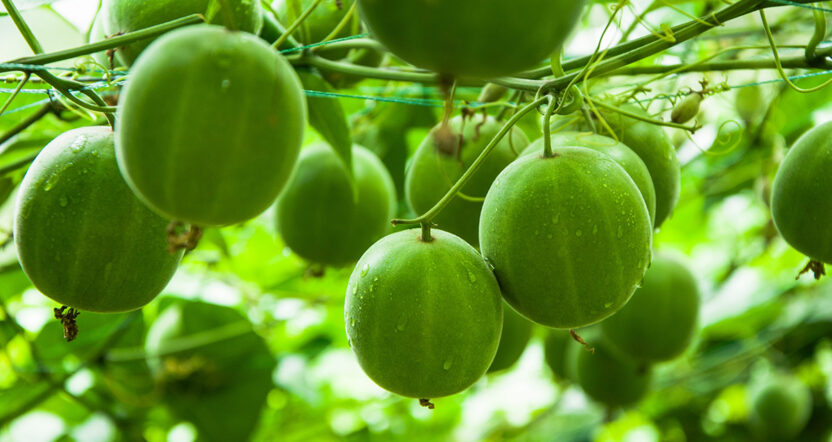
Here is where the science becomes especially important. Monk fruit (Siraitia grosvenorii) derives its characteristic sweetness from a family of triterpene glycosides known as mogrosides. Mogroside V is a principal contributor to the sweetness of many commercial monk fruit extracts. Processors extract, concentrate, and purify these compounds to manufacture standardized products such as Monk Fruit Extract MV25 and MV50.
Our supply network has reported some fresh-fruit lots containing approximately 0.30% Mogroside V, compared with approximately 0.40% under more favorable conditions. These values should be understood as supplier-reported observations, not confirmed averages for the entire 2026 harvest. Fruit composition varies by growing region, maturity, agricultural practices, and sampling conditions. But the potential economic implications are significant.
Consider the following theoretical comparison:
| Measurement | Higher-MV fruit | Lower-MV fruit |
|---|---|---|
| Mogroside V concentration | 0.40% | 0.30% |
| Theoretical fruit needed for 1 kg MV | 250 kg | 333 kg |
| Additional fruit required | Baseline | 33% |
This simplified illustration assumes identical analytical bases and unchanged extraction recovery. Actual manufacturing requirements depend on extraction efficiency, processing losses, and finished-product specifications.
A 25% reduction in fruit MV concentration means approximately 33% more fruit is required to recover the same quantity of Mogroside V, assuming equivalent extraction efficiency. Even if fruit prices remained unchanged, lower MV recovery could increase the raw-material cost associated with each kilogram of standardized extract. If raw-fruit prices also increase, the two pressures compound.
This is why evaluating monk fruit supply solely in terms of harvested tonnage can be misleading. The more meaningful metric is the quantity of commercially recoverable Mogroside V.
Grower Behavior Is Adding Another Variable
We are also receiving reports that some growers and inventory holders are reluctant to release fruit at prevailing prices because they anticipate stronger pricing later in the season. Regional market reports have independently described firmer seller expectations and higher fresh-fruit procurement prices. However, these observations do not establish that growers across all producing regions are withholding fruit. When growers delay sales, processors may face greater difficulty obtaining the quantities they need during critical purchasing periods. That can create several downstream effects:
- Increased competition for available raw fruit.
- Higher acquisition costs for extract manufacturers.
- Greater uncertainty around production scheduling.
- Potentially longer lead times or tighter allocations for finished extracts.
- Increased pricing volatility as manufacturers replenish inventory.
Not every processor will experience these conditions equally. Companies with contracted agricultural supply, existing inventories, or diversified sourcing relationships may be better positioned than buyers dependent on spot-market purchases.
What This Means for MV25 and MV50 Extracts
The implications are particularly relevant for manufacturers using standardized monk fruit extracts. MV25 and MV50 are generally standardized to approximately 25% and 50% Mogroside V, respectively, subject to the supplier’s analytical specifications.
Producing higher-purity extracts requires sufficient starting material, effective extraction, and downstream purification. If the concentration of Mogroside V in the incoming fruit declines, processors may require additional raw material to maintain finished-product output. The resulting cost pressure may affect both MV25 and MV50, although the actual impact will depend on each manufacturer’s process, recovery efficiency, existing inventory, and purchasing agreements.
As of this bulletin, we have not independently verified a consistent industry-wide increase in executable MV25 or MV50 contract prices, nor a widespread shortage of finished extract. We are therefore distinguishing between documented raw-material pressure and potential downstream extract-price increases.
The Outlook Through Q2 2027
The immediate concern is not simply the price of monk fruit today. It is the availability and replacement cost of finished extract during the first half of 2027. The annual harvest establishes an important portion of the raw-material supply available to processors in subsequent months.
If the final 2026 crop is materially smaller than the previous year’s crop, manufacturers could encounter tighter procurement conditions as existing inventories are consumed. Should lower MV yields prove widespread, the effective supply of recoverable sweet compounds could contract further. At the same time, customer demand, carryover inventories, processor recovery efficiencies, and existing contracts will determine how much of that pressure ultimately reaches finished-extract pricing. There are currently insufficient independently verified data to predict a specific percentage increase in 2027 extract prices. However, the available information supports taking a proactive approach to supply planning rather than waiting for a potential shortage or price increase to materialize.
Our Recommendations for Food and Beverage Manufacturers
At Icon Foods, our objective is to help customers protect formulation consistency, manage ingredient costs, and maintain uninterrupted production. We recommend that manufacturers using monk fruit take the following steps.
Review requirements through June 2027.
Evaluate expected consumption across all products containing monk fruit, including seasonal production and anticipated growth.
Discuss forward supply commitments.
Where forecasts are reasonably predictable, consider blanket purchase orders, scheduled releases, or other supply arrangements that establish agreed quantities and delivery windows.
Evaluate total formulation exposure.
Monk fruit may be present in multiple sweetener systems, including blends with stevia, thaumatin, or other ingredients. Understanding the total underlying monk fruit requirement is important when forecasting demand.
Avoid unnecessary reformulation.
Securing consistent extract specifications can help prevent changes in sweetness intensity, temporal profile, or flavor balance that may result from switching suppliers or grades under pressure.
Maintain appropriate inventory coverage.
Safety-stock requirements should reflect supplier lead times, production schedules, customer demand, and the commercial consequences of an interruption. Inventory decisions should be proportional to actual business requirements.
Work with suppliers like Icon Foods, who understand the chemistry.
Not all monk fruit extracts perform identically. Mogroside composition, purity, sensory characteristics, and processing conditions can influence finished-product performance. Technical equivalence matters just as much as price.
How Icon Foods Is Responding
Icon Foods is actively monitoring the 2026 harvest and its potential implications for 2027 supply. Our market surveillance includes agricultural production estimates, raw-fruit pricing, Mogroside V concentrations, extraction yields, processor capacity, available inventories, finished-extract pricing, and international logistics. We are also working with our supply partners to evaluate forward requirements and purchasing opportunities.
Our objective is to provide customers with the information and supply-planning support needed to make informed decisions before market conditions potentially become more challenging.
We encourage customers using our MonkSweet™ ingredients and monk-fruit-based sweetener systems to contact their Icon Foods representative to review projected requirements through Q2 2027.
Final Thoughts: Plan Ahead, Don’t Panic
Monk fruit remains an important ingredient in reduced-sugar and no-added-sugar food and beverage formulation. Its sweetness intensity, plant origin, and compatibility with other sweetening technologies make it valuable across a wide range of applications. However, agricultural ingredients are subject to agricultural realities. Harvest volumes fluctuate. Fruit chemistry varies. Grower economics change.
The 2026 harvest is providing early indications that these variables may be converging to create a tighter supply environment. At Icon Foods, we believe the best response is informed preparation, not speculation. Our advice is simple: if monk fruit is an important part of your 2027 production plan, now is the time to review your forecast and discuss securing your supply.
We will continue monitoring market conditions and communicating meaningful developments as new information becomes available.
Sources and Market Intelligence
- Icon Foods supplier intelligence, October–November 2026. Preliminary 2026 harvest projections, reported MV concentrations, and grower selling behavior. These observations have not been independently validated across the entire crop.
- Yaotong Chinese Medicinal Materials Market, October 31–November 1, 2026. Regional reports of reduced new-crop output, firmer procurement prices, and Yongfu fresh-fruit trading around RMB 11/kg. https://www1.yt1998.com/pzxq191.html
- China Financing Guarantee Industry Association, October 21, 2026. Yongfu harvesting and processing activity, including supply-chain financing and infrastructure development. https://www.chinafga.org/huydt/41248.jhtml
- China Ministry of Agriculture and Rural Affairs, September 24, 2026. Yongfu monk fruit production infrastructure, agricultural contracting, and processing development. https://jhs.moa.gov.cn/xdnyjs/202609/t20260924_6488108.htm
- International Journal of Food Science and Technology, August 22, 2026. Mogrosides: Natural Non-Caloric Sweeteners. Review of mogroside chemistry, characterization, processing, and sensory properties. https://doi.org/10.1093/ijfood/vvag184
Market information reflects conditions and intelligence available as of November 5, 2026. Forward-looking statements are estimates, not guarantees of future pricing or availability.
Related reading: The Freight Rate Roller Coaster: Protecting Your Ingredient Costs in 2027, The Monk Fruit Squeeze and Monk Fruit vs. Stevia: When the Price of Sweetness Gets Stupid.