

By Thom King, CFS, Founder, Chairman, Chief Innovation Officer Icon Foods
Why the Future of Sugar Reduction Isn’t More Sweetener. It’s Better Perception.
For the better part of three decades I’ve watched formulators chase the same rabbit. When sweetness falls short, we add more sweetener. A little more stevia. A little more monk fruit. A little more sucralose. Another masking agent. Another flavor. Another optimization. Eventually the formulation resembles a committee instead of a recipe. The reality is that consumers don’t buy sweetness. They buy delicious.
Those are two very different neurological experiences.
At Icon Foods we’ve spent years studying how sweetness is perceived rather than simply how it is measured. That journey led us to Thaumatiq™ LX, our flagship sweetness modulation technology built around two remarkably elegant ingredients:
- Organic Coconut Vegetable Glycerin
- Thaumatin (93% purity) extracted from the West African Katemfe fruit (Thaumatococcus daniellii)
Thaumatiq™ LX is not a sweetener. It is a clean-label flavor modulator designed to improve how sweetness is experienced.
Understanding Sweetness Is Like Coaching the Nervous System
Sweetness isn’t determined by grams of sugar. It is created inside the brain after receptors on the tongue send signals through multiple neural pathways.
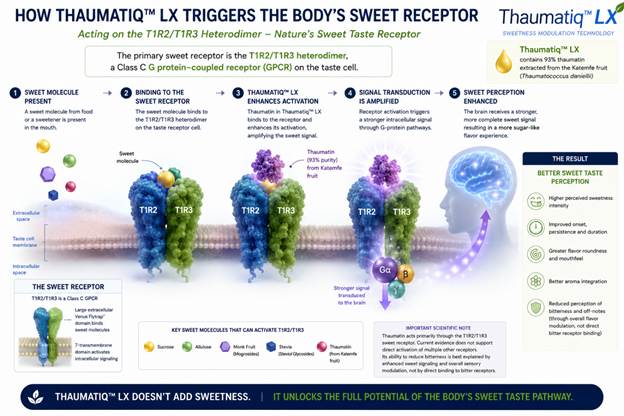
The primary sweet receptor is the T1R2/T1R3 heterodimer, a member of the Class C GPCR receptor family. Sucrose, allulose, tagatose, monk fruit mogrosides, steviol glycosides and thaumatin all interact with this receptor, although they do so through different binding mechanisms.
Thaumatin behaves differently than traditional sweeteners. Rather than functioning primarily as a bulk sweetener, it acts as an extremely potent sweet taste protein that binds to the extracellular domain of the receptor and significantly amplifies sweet taste signaling. This receptor interaction enhances:
- Sweetness intensity
- Sweetness persistence
- Flavor roundness
- Mouth-coating richness
- Aroma integration
The result is something consumers rarely describe as “sweeter.” Instead they say “It tastes more like sugar.” That distinction matters.
The Science Behind Thaumatiq™ LX
The active component in Thaumatiq™ LX is 93% thaumatin extracted from the Katemfe fruit (Thaumatococcus daniellii), one of nature’s most potent sweet taste proteins. Current scientific evidence indicates that thaumatin exerts its effects primarily through activation of the T1R2/T1R3 sweet taste receptor, the principal receptor responsible for human sweet taste perception. Unlike bulk sweeteners that contribute sweetness through concentration alone, thaumatin interacts with this receptor in a way that amplifies and extends sweet taste signaling, producing a more rounded, sugar-like sensory experience even at extraordinarily low usage levels.
One of thaumatin’s greatest strengths is its ability to improve the overall sensory profile of a formulation. Although it is often described as “masking bitterness,” the current body of scientific literature suggests that thaumatin does not directly bind to or inhibit bitter taste receptors (T2Rs). Instead, by enhancing activation of the sweet taste pathway, it shifts the brain’s overall perception of flavor, reducing the prominence of bitter, metallic, licorice-like, and lingering off-notes commonly associated with many high-intensity sweeteners. The result is a cleaner, more balanced flavor profile that consumers consistently perceive as being closer to sucrose.
This distinction is important. Thaumatiq™ LX is not another sweetener, nor is it simply a masking agent. It is a sweetness modulation technology designed to improve how existing sweetness systems are perceived. When paired with a suitable sweetness backbone, such as sucrose, allulose, tagatose, stevia, monk fruit, fruit concentrates, or carefully engineered sweetener blends, Thaumatiq™ LX enhances sweetness quality, flavor integration, temporal profile, and overall consumer acceptance without fundamentally changing the formulation’s sweetener architecture.
For formulators, the takeaway is straightforward: don’t think of Thaumatiq™ LX as adding sweetness. Think of it as unlocking the full sensory potential of the sweetness that’s already there.
The Orchestra Analogy
Think of sweetness like an orchestra. Sucrose is the brass section. Stevia might be the violins. Monk fruit adds percussion. Allulose and tagatose contributes the cellos. If everyone simply plays louder, the music becomes chaotic. Thaumatiq™ LX isn’t another instrument. It’s the conductor. It brings the entire performance into harmony. Instead of increasing sweetness, it improves the way existing sweetness is interpreted.
Flavor Modulation Versus Sweetening
This distinction is critical. Traditional sweeteners attempt to replace sucrose by supplying sweetness. Thaumatiq™ LX optimizes whatever sweetness system already exists. It performs best when paired with a sweetness backbone such as:
- Sucrose
- Allulose
- Tagatose
- Erythritol
- Monk fruit
- Stevia
- Fruit preps and concentrates
- Honey
- Agave
- Coconut sugar
Rather than replacing these ingredients, Thaumatiq™ LX elevates their overall sensory performance.
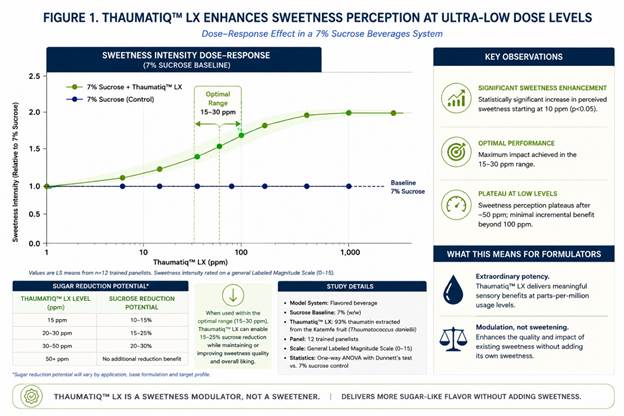
This often allows formulators to reduce total sweetener usage while simultaneously improving flavor quality.
What Thaumatiq™ LX Changes
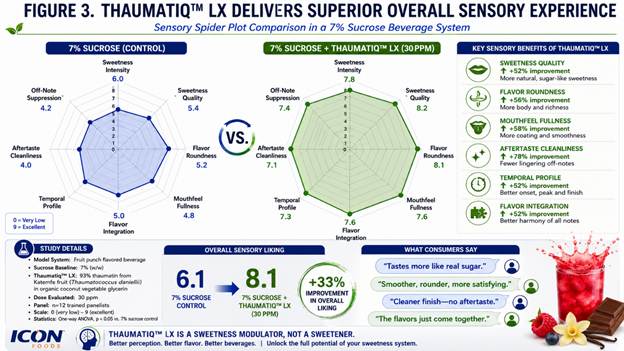
Our sensory work consistently demonstrates improvements in multiple attributes.
Enhanced Sweetness
The sweetness profile becomes fuller without requiring additional sweetener.
Reduced Bitter Perception
Many high-intensity sweeteners exhibit bitter or metallic side notes through activation of various bitter taste receptors (T2Rs). By increasing sweet receptor signaling and altering overall flavor balance, Thaumatiq™ LX substantially reduces the perception of these off-notes.
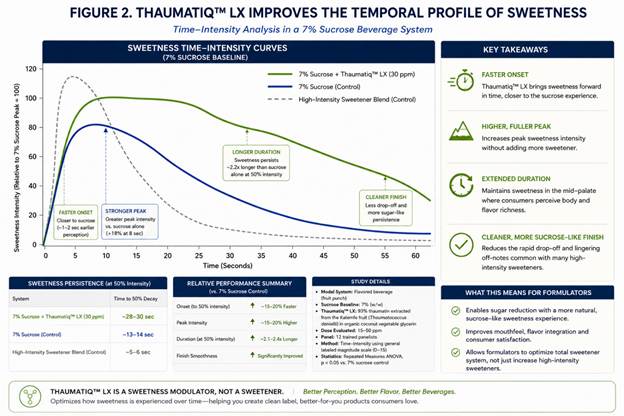
Improved Temporal Profile
Many sweeteners have undesirable timing characteristics.
- Slow onset
- Delayed peak
- Lingering finish
- Hollow mid-palate
Thaumatiq™ LX smooths these transitions into a profile that more closely resembles sucrose.
Greater Flavor Integration
Fruit flavors taste riper. Chocolate becomes rounder. Vanilla appears richer. Citrus gains body. The formulation feels more complete.
Recommended Usage Levels
Because thaumatin is extraordinarily potent, effective use occurs at extremely low concentrations.
| Application | Recommended Use Level |
| Ready-to-drink beverages | 15–30 ppm |
| Energy drinks | 15–35 ppm |
| Carbonated beverages | 20–35 ppm |
| Dairy beverages | 20–40 ppm |
| Protein beverages | 25–40 ppm |
| Yogurt | 25–40 ppm |
| Frozen desserts | 25–45 ppm |
| Nutrition bars | 30–50 ppm |
| Gummies | 20–40 ppm |
| Hard candy | 15–30 ppm |
| Chocolate | 20–35 ppm |
| Sauces & syrups | 20–50 ppm |
Small adjustments often produce meaningful sensory changes. In modulation, less is frequently more.
Best Formulation Practices
Start with a Strong Sweetness Backbone
Thaumatiq™ LX performs best when sweetness has already been established. Think of it as refinement rather than replacement.
Balance Before Optimizing
First establish sweetness. Then add Thaumatiq™ LX. Finally make only minor adjustments to the sweetener system. This sequence consistently produces better outcomes than building around the modulator.
Don’t Chase Maximum Sweetness
The objective isn’t higher sweetness. It’s higher quality sweetness. Consumers consistently reward balanced formulations over intensely sweet ones.
Allow the System to Settle
Like many natural flavor systems, sensory perception can continue to evolve after processing and during product equilibration. Allow appropriate time before conducting final sensory evaluations.
Where Thaumatiq™ LX Excels
Although broadly applicable, several categories consistently demonstrate exceptional performance.
Functional Beverages
Protein often introduces bitterness. Botanical extracts create harsh edges. Electrolytes contribute mineral notes. Thaumatiq™ LX dramatically softens these challenges while improving overall drinkability.
Carbonated Soft Drinks
High-intensity sweeteners often struggle to recreate the rounded profile of full-sugar beverages. Thaumatiq™ LX helps rebuild that missing mid-palate and finish.
Dairy
Milk proteins respond exceptionally well to sweetness modulation. Chocolate milk. Protein shakes. Coffee beverages. Greek yogurt.
These applications often exhibit significant improvements in richness and flavor integration.
Confectionery
Chocolate, gummies, chewy candies and hard candies all benefit from enhanced sweetness persistence and improved flavor continuity.
Baked Goods
Reduced-sugar cookies, muffins and snack bars frequently suffer from flat flavor. Thaumatiq™ LX restores sweetness perception without increasing sugar load.
Why Organic Coconut Vegetable Glycerin?
The organic coconut vegetable glycerin serves several important functions beyond simply acting as a carrier. It provides:
- Excellent ingredient dispersion
- Uniform dosing
- Improved manufacturing consistency
- Organic compatibility
- Outstanding shelf stability
- Easy incorporation into liquid processing systems
The result is a highly practical ingredient that integrates seamlessly into commercial manufacturing.
Clean Label Advantages
Today’s consumers continue demanding labels they recognize. Thaumatiq™ LX supports that movement. It contains:
- Organic Coconut Vegetable Glycerin
- Thaumatin (from Katemfe fruit)
No artificial sweeteners. No artificial masking agents. No artificial flavors. No synthetic enhancers. Simply modern sensory science built upon naturally derived ingredients.
Why Icon Foods?
A great ingredient solves one problem. A great formulation partner solves dozens. That distinction has defined Icon Foods for nearly three decades.
We don’t sell ingredients. We build complete sweetness systems.
Our team understand how sweeteners interact with acids, proteins, fibers, flavors, polyols, rare sugars, hydrocolloids, processing conditions and shelf life. That experience allows us to develop formulations that work not only in the laboratory, but also at commercial scale.
Whether you’re reducing sugar by 20% or removing it entirely, our formulation team can help optimize:
- Sweetness architecture
- Cost-in-use
- Label declaration
- Regulatory strategy
- Processing performance
- Flavor optimization
- Shelf-life stability
- Consumer acceptance
Thaumatiq™ LX represents the newest member of a much larger toolbox that includes rare sugars, soluble fibers, high-intensity sweeteners, sweetness enhancers and complete sugar reduction systems. No single ingredient wins the game.
The winning formulation always comes from understanding how every player works together. That’s where Icon Foods excels.
The Future of Sugar Reduction
The next generation of reduced-sugar products won’t be defined by how much sugar was removed. Consumers don’t celebrate subtraction. They celebrate products that taste amazing.
The future belongs to formulations that create more pleasure with fewer calories, cleaner labels and smarter ingredient systems.
Thaumatiq™ LX was designed precisely for that future. It doesn’t replace sweetness. It helps consumers experience sweetness the way nature intended.
And sometimes, changing perception is far more powerful than changing formulation.
References
- Ide, N., Masuda, T., Kitabatake, N., et al. Interactions of the Sweet-Tasting Proteins Thaumatin and Lysozyme with the Human Sweet Taste Receptor. Journal of Agricultural and Food Chemistry. 2009. Demonstrated that thaumatin activates the human T1R2/T1R3 sweet taste receptor in cell-based assays, consistent with sensory evaluation.
- Zhao, X., Wang, J., Liu, B., et al. Protein Sector and Its Role for Sweet Properties. Frontiers in Nutrition. 2021. Comprehensive review describing the interaction of sweet proteins with the T1R2/T1R3 receptor, the wedge model of receptor activation, and opportunities for protein engineering.
- Assadi-Porter, F.M., Maillet, E.L., Radek, J.T., et al. Interactions Between the Human Sweet-Sensing T1R2-T1R3 Receptor and Low Molecular Weight Sweeteners as well as Sweet Proteins. Chemical Senses. 2009. Reviews the molecular biology of the human sweet receptor and its interaction with diverse sweet molecules and sweet proteins.
- Tancredi, T., Pastore, A., Salvadori, S., et al. Interaction of Sweet Proteins with Their Receptor: A Theoretical Model. Cellular and Molecular Life Sciences. 2004. Introduced the mechanistic framework describing how sweet proteins, including thaumatin, interact with the T1R2/T1R3 receptor through complementary surface interactions.
- Treesukosol, Y., Blonde, G.D., Jiang, E., et al. The Functional Role of the T1R Family of Receptors in Sweet Taste and Feeding. Physiology & Behavior. 2011. Reviews the biology of the Class C G protein-coupled receptor (GPCR) family, including the T1R2/T1R3 heterodimer responsible for sweet taste perception.
- Masuda, T., Ide, N., Ohta, K., et al. Positive Charges on the Surface of Thaumatin Are Crucial for Interaction with the Sweet Receptor. Frontiers in Molecular Biosciences. 2018. Demonstrates that electrostatic interactions between thaumatin and the T1R2/T1R3 receptor are essential for sweetness perception and provides experimental support for the wedge model.
- Mahalapbutr, P., et al. Atomistic Mechanisms Underlying the Activation of the G Protein-Coupled Human Sweet Taste Receptor. Scientific Reports. 2019. Provides molecular modeling insights into activation of the human T1R2/T1R3 receptor by structurally diverse sweet compounds.
- Belloir, C., et al. A Receptor-Based Assay to Study the Sweet and Bitter Tastes of Sweetener Blends. Food Chemistry. 2024. Demonstrates receptor-level synergy between thaumatin and other sweeteners, including rebaudioside A and mogroside V, supporting the concept of sweetness modulation rather than simple sweetness addition.
Scientific Notes
- The statement that thaumatin primarily activates the human T1R2/T1R3 heterodimer is strongly supported by both receptor assays and structural studies.
- Current evidence does not support claims that thaumatin directly binds or inhibits human bitter taste receptors (TAS2Rs). Improvements in bitterness are best explained by enhanced sweet signaling and changes in overall flavor perception rather than direct antagonism of bitter receptors.
- Thaumatin is best described as a sweet taste protein and sweetness modulator when used at low concentrations alongside a sweetness backbone. This distinction is consistent with current sensory and receptor biology literature.