
by Thom King CFS – Founder, Chief Innovation Officer, Food Scientist, Icon Foods
There is an old formulation instinct that says if something isn’t working, add more. Or as my dad used to say, “the bigger the glob the better the job”. More sweetener. More flavor. More acid. More masking agent. Eventually you have seventeen ingredients trying to fix problems created by the other sixteen. Thaumatiq™ T10 takes almost the opposite approach.
Use less. Listen carefully. Titrate slowly.
T10 is a highly potent thaumatin-based sweetness and flavor-modulation system designed for use at extraordinarily low concentrations. It is built around thaumatin, the intensely sweet protein associated with the West African katemfe fruit, Thaumatococcus daniellii, and carried on a tapioca-derived powder system for practical handling and dispersion. My starting point with T10 is 10 ppm of the finished T10 system. Not 0.1%. Not 500 ppm. Ten parts per million. Then I titrate.
In most applications, I want to stay below 20 ppm unless the sensory data gives me a very good reason to go higher. Why? Because thaumatin has a superpower and a personality problem. The superpower is extraordinary potency, sweetness enhancement, bitterness suppression and flavor modulation. The personality problem is its long sensory tail.
Used correctly, that tail can extend sweetness, round a formulation and make another sweetener system behave better. Used carelessly, it hangs around after everybody else has left the party. That distinction is the entire game.
What Exactly Is Thaumatin?
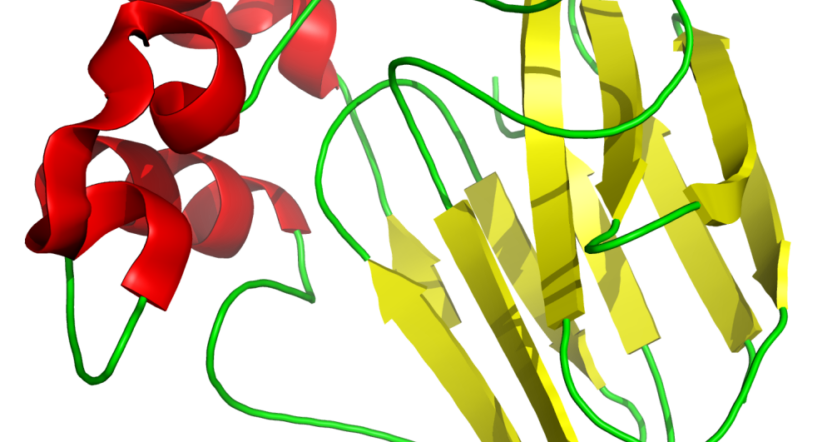
Thaumatin isn’t a sugar. It isn’t a polyol. It isn’t a steviol glycoside. It isn’t a small-molecule artificial high-intensity sweetener. It is a protein molecule.
Commercial thaumatin is principally composed of the closely related proteins thaumatin I and thaumatin II. International JECFA specifications describe thaumatin as being obtained from the arils of Thaumatococcus daniellii and specify material containing not less than 93% protein on a dried basis.
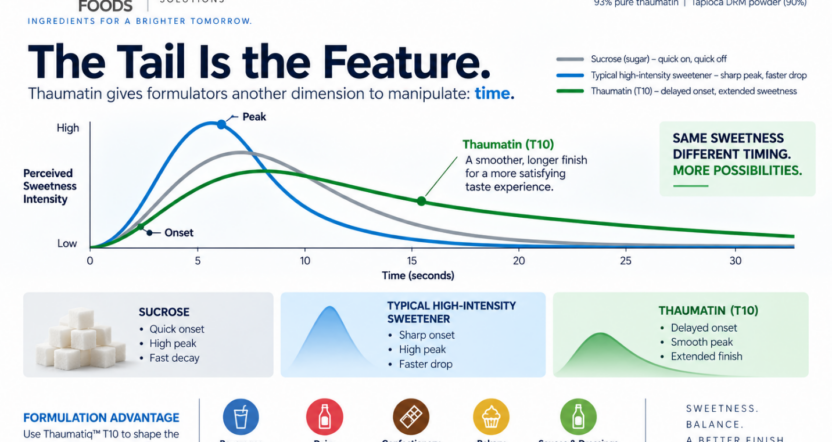
That’s key because thaumatin interacts with the human sweet-taste system differently from ordinary sugars and many small-molecule high-intensity sweeteners. Sucrose is essentially the point guard of sweetness. It gets the ball, delivers the signal quickly, and gets off the court.
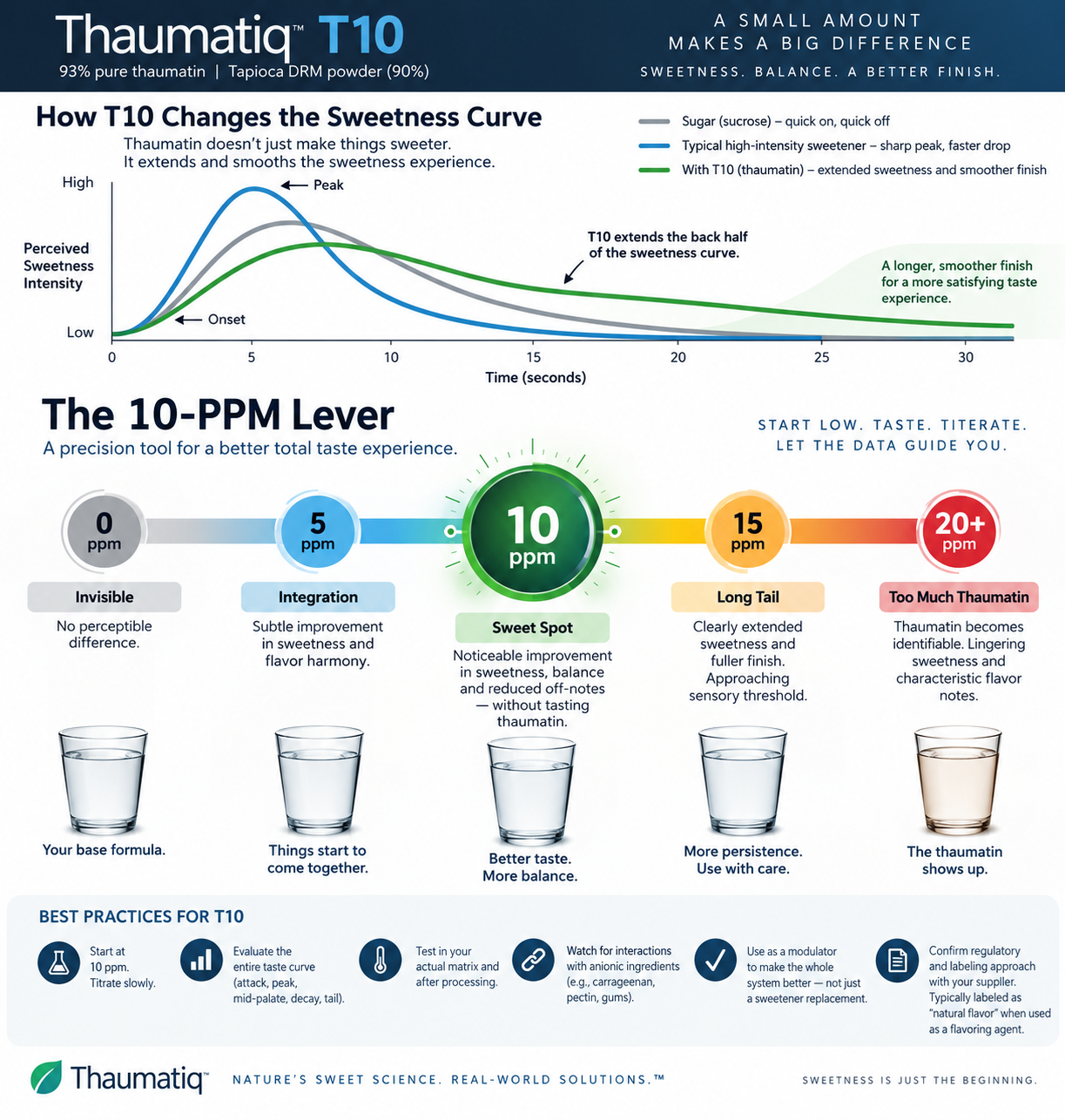
Thaumatin plays a much longer game. Its sweetness develops more slowly and persists substantially longer. That delayed onset and long decay are not defects to engineer out of thaumatin. They are properties to engineer around.
The Science: A Protein Talking to a GPCR
Human sweetness perception is primarily mediated through the heterodimeric T1R2/T1R3 sweet-taste receptor.
Sugars and many small sweet molecules interact with binding regions within this receptor complex. Sweet proteins are physically much larger, and research indicates that their interaction with the receptor is different.
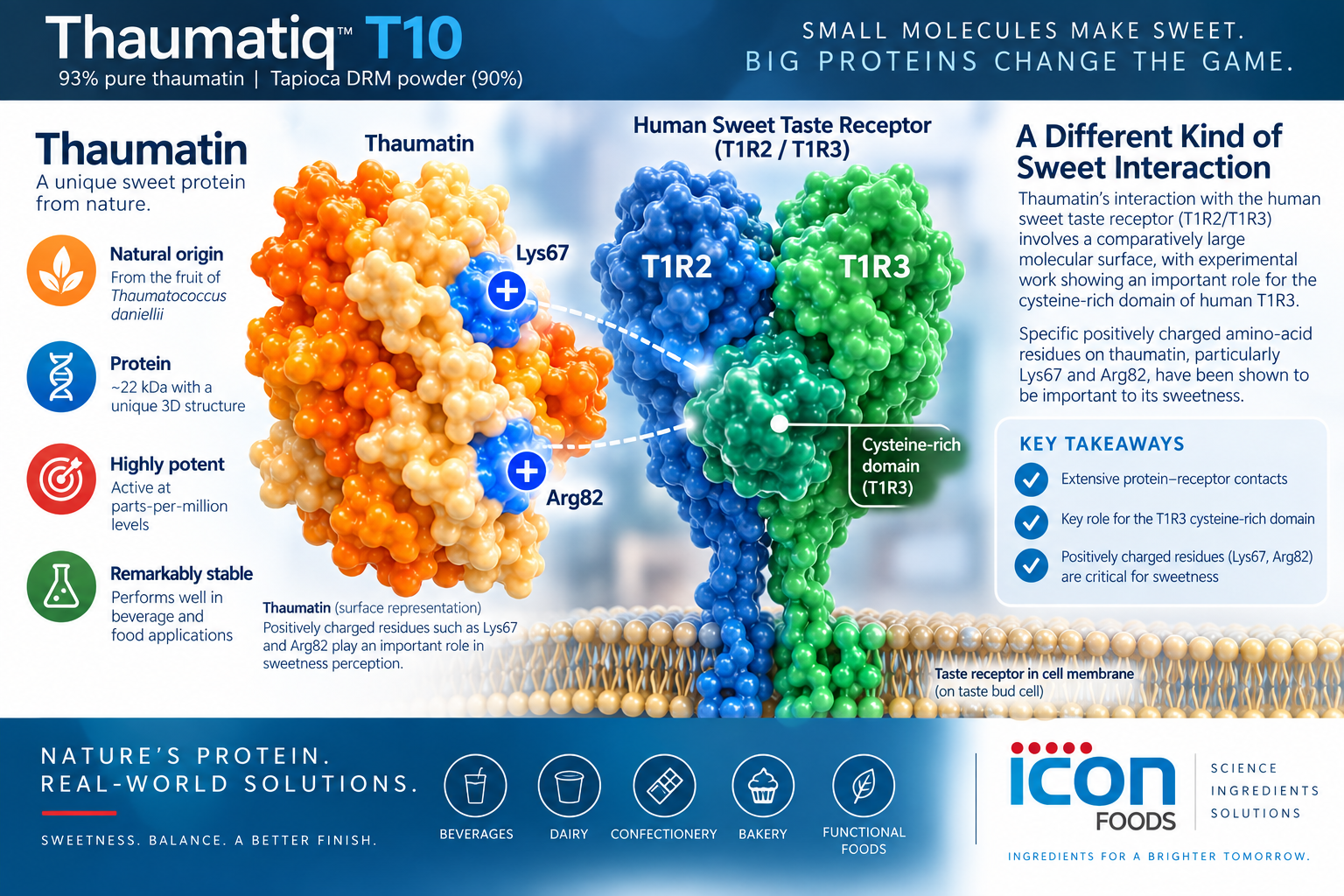
Thaumatin’s interaction involves a comparatively large molecular surface, with experimental work showing an important role for the cysteine-rich domain of human T1R3. Specific positively charged amino-acid residues on thaumatin, particularly residues such as Lys67 and Arg82, have been shown to be important to its sweetness.
More recent molecular modeling continues to support the idea that thaumatin interacts with the T1R2/T1R3 receptor through extensive electrostatic and protein-receptor interactions rather than behaving like a tiny sucrose molecule simply slipping into a conventional binding pocket.
That’s fascinating biochemistry. For a formulator, however, here’s the part that pays the mortgage, thaumatin does not produce a sucrose-shaped sweetness curve. Its temporal profile is different. And that means we shouldn’t formulate it as though it were sucrose.
The Tail Is the Feature
Imagine sweetness intensity plotted against time. Sucrose comes up relatively quickly, reaches its peak and decays. Thaumatin has a delayed onset and an unusually persistent finish. That gives the formulator another dimension to manipulate, time. Most sweetener discussions obsess over relative sweetness. That is only part of the equation. The better question is, when does the consumer experience the sweetness?
A reduced-sugar beverage can have exactly the right sweetness intensity on a bench measurement and still taste wrong because the sweetness arrives late, peaks in the wrong place or refuses to leave. That is sweetness architecture. Thaumatin gives us a tool for manipulating that architecture.
At low concentrations, T10 can help bridge gaps in a sweetness curve, extend perception through the finish and reinforce sweetness produced by other components of the system. At excessive concentrations, the same persistence becomes obvious. The formula begins announcing, “hello. I contain thaumatin.” Game over.
The best thaumatin formulation is usually the one where the consumer never identifies thaumatin. They simply think the product tastes better.
Why I Start at 10 ppm
My practical starting point for Thaumatiq™ T10 is, 10 ppm finished T10. Then evaluate. Depending on the application, I might move through a simple sensory ladder: 5 ppm → 10 ppm → 12.5 ppm → 15 ppm → 17.5 ppm → 20 ppm. Don’t jump from 10 to 50 ppm because 10 didn’t immediately knock your socks off. Thaumatin is not paprika.
At these concentrations, seemingly tiny dosage changes can materially alter temporal perception. The objective is to identify the point where the system becomes better before thaumatin itself becomes obvious. That is the sweet spot. Literally.
T10 ppm Is Not the Same Thing as Active Thaumatin ppm
This distinction matters. Thaumatiq™ T10 is a formulated delivery system rather than neat thaumatin. The thaumatin raw material itself is approximately 93% protein purity, while the T10 system uses a tapioca-derived carrier to make an ingredient this potent considerably easier to dose and distribute.
Consequently, formulators need to distinguish between: ppm of Thaumatiq™ T10 added and ppm of active thaumatin delivered. When I say start around 10 ppm T10, I mean the finished commercial T10 ingredient unless the formulation documentation specifically states otherwise. That sounds painfully obvious. It isn’t.
Confusing active concentration with carrier-system concentration is an excellent way to turn an elegant sensory experiment into a thaumatin flamethrower.
What T10 Actually Does
I think about T10 as performing four overlapping jobs.
- Sweetness Extension
T10 can extend sweetness into the later portion of the sensory curve. This becomes particularly useful when the primary sweetener system produces good upfront sweetness but drops away too quickly.
- Sweetness Reinforcement
At very low concentrations, thaumatin can reinforce the overall perception of sweetness without requiring T10 to become the principal source of sweetness. That is an important distinction. T10 doesn’t necessarily need to carry the sweetness. It can make the other players better.
- Flavor Modulation
Thaumatin is recognized not only as a sweetener internationally but also as a flavor enhancer. At low use levels, that may be the more interesting functionality. The formulation objective can therefore be broader than simply increasing sweetness.
We’re changing the sensory relationship between sweetness, bitterness, acidity, aroma and finish.
- Off-Note Management
This becomes particularly useful in modern formulations containing ingredients that bring sensory baggage with them. Think:
- plant proteins
- whey proteins
- minerals
- electrolytes
- vitamins
- botanicals
- caffeine
- high-intensity sweeteners
- functional actives
- certain fibers
Many of these ingredients can contribute bitterness, astringency, metallic character or lingering off-notes. The answer isn’t always another masking flavor. Sometimes changing the surrounding sweetness perception is enough to make the objectionable note less prominent. That is modulation rather than camouflage.
Where T10 Gets Interesting
Protein Beverages
Protein systems are sensory obstacle courses. You may be dealing simultaneously with protein bitterness, astringency, mineral notes, processing flavors and high-intensity sweetener aftertaste.
T10 can be particularly interesting when the formulation tastes acceptable initially but becomes rough through the middle and finish. Don’t ask, “how much thaumatin makes this sweeter?” Instead ask, “At what concentration does the finish become cleaner?” Completely different experiment.
Energy and Functional Beverages
Caffeine, B vitamins (methylcobalamin), minerals, botanicals and functional actives can create a bitter or medicinal backend. Thaumatin’s persistent sweetness can potentially occupy some of the same temporal territory where those objectionable notes appear. That makes T10 particularly interesting as a finish-management tool. Again, restraint wins. Too much thaumatin simply replaces one lingering sensory problem with another. Congratulations. You moved the furniture while the house was on fire.
Stevia Systems
Modern Reb M and Reb D systems are dramatically better than the stevia systems we had fifteen years ago. They are not magic. Depending on concentration, matrix and flavor system, formulators may still encounter delayed sweetness, licorice character, bitterness or an uneven decay curve. T10 can become one component of a broader modulation strategy. But I would not automatically combine two lingering sweeteners and assume happiness will break out. Build the sweetness curve deliberately.
Monk Fruit
Monk fruit can provide excellent clean-label positioning and powerful sweetness, but high concentrations can contribute characteristic lingering notes. Here again, T10 should be treated as a modulator, not another excuse to stack potency on top of potency. The question is whether a tiny concentration improves the total system enough to let you reduce another high-intensity sweetener. That is often more valuable than simply increasing perceived sweetness.
Reduced-Sugar Foods
In sauces, dairy systems, bakery fillings and similar applications, sugar reduction removes more than sweetness. Sugar contributes solids, viscosity, browning, water activity, freezing behavior and flavor delivery. Thaumatin does none of those jobs simply because it tastes sweet. This is where formulators get into trouble with high-intensity sweeteners. Sweetness replacement is not sugar replacement. Use T10 to solve sensory problems. Use the appropriate carbohydrate, rare sugar, fiber, hydrocolloid or bulking system to solve physical problems. Different players. Different positions.
Heat and pH: Thaumatin Is Tough, but It Isn’t Superman
One reason thaumatin is technically attractive is its unusual structural stability. Thaumatin contains multiple disulfide bonds that help stabilize its tertiary protein structure. Published evaluations describe substantial stability in acidic environments and good stability in many beverage applications.
But temperature, pH, matrix composition and processing time still matter. Protein chemistry always gets a vote. Thaumatin has demonstrated particularly good thermal stability under acidic
conditions, while neutral-pH heating can increase the possibility of aggregation or loss of functionality. So don’t make a blanket statement that thaumatin is heat stable and go home. Run the actual process.
Evaluate T10 after processing, not just before processing.
That means sensory evaluation after:
- pasteurization
- hot fill
- UHT where applicable
- Baking
- Retort
- shelf-life storage
If your product spends six months in distribution, the only sweetness curve that matters is the one the consumer experiences six months later.
Watch Anionic Hydrocolloids
Here is a nerdy little formulation trap worth remembering. Thaumatin has a very high isoelectric point, reported around pH 12, meaning that across most food and beverage pH conditions the protein carries substantial positive charge. That can matter when the formulation contains negatively charged ingredients.
Certain acidic polysaccharides can interact ionically with thaumatin, potentially affecting its availability and sweetness. Carrageenan is one published example. This doesn’t mean, thaumatin + hydrocolloid = doom. It means the matrix matters.
If your formulation contains carrageenan, pectin, gums, proteins, minerals or other charged macromolecules, evaluate the finished matrix instead of extrapolating from thaumatin in water. Bench-top water testing is useful. The actual food is the referee.
How I Would Run a T10 Trial
Don’t formulate thaumatin by wandering around the bench with a micro-spatula. At 10 ppm, dosing error becomes formulation error. For a 1 kg bench batch: 10 ppm = 10 mg of T10. For a 100 kg production batch: 10 ppm = 1 gram of T10. For a 1,000 kg batch: 10 ppm = 10 grams of T10
That is why a standardized delivery system is key. For very small bench trials, I prefer preparing an accurately measured stock solution or premix where appropriate rather than attempting heroic milligram-level dry additions with an ordinary bench scale. Accuracy matters more than bravado.
My Preferred Sensory Protocol
Run a control. Then run: 5 ppm, 10 ppm, 15 ppm and 20 ppm. Keep everything else identical. Evaluate:
Attack
How quickly does sweetness appear?
Peak
Is maximum sweetness appropriate?
Mid-palate
Does the formulation become fuller or more integrated?
Bitterness
Are objectionable notes reduced?
Flavor expression
Are desirable flavors becoming clearer?
Decay
How quickly does sweetness fall away?
Tail
What remains 10, 20 and 30 seconds after swallowing? That last measurement is critical. Don’t just ask panelists whether Sample B is sweeter than Sample A. Ask them when it is sweeter. Now you’re doing temporal sensory work instead of a popularity contest.
The 20-ppm Guardrail
I treat 20 ppm T10 as a sensory checkpoint, not a legal ceiling. There may be applications where a different concentration is appropriate. But once I find myself pushing past roughly 20 ppm in a modulation application, I stop and ask, what problem am I actually trying to solve?
If the answer is “I need considerably more sweetness,” T10 may no longer be the correct primary lever. Maybe the backbone needs more allulose. Maybe it needs tagatose. Maybe the stevia system needs adjustment. Maybe monk fruit needs adjustment. Maybe acid needs fixing. Maybe aroma is suppressing sweetness. Maybe the product simply isn’t sweet enough. Thaumatin shouldn’t become the sensory duct tape wrapped around a poorly designed sweetness system.
Labeling: This Is Where T10 Gets Particularly Interesting
In the United States, thaumatin appears in FDA’s food-substance inventory as a flavoring agent or adjuvant and is recognized by FEMA as GRAS flavor substance No. 3732. Under 21 CFR 101.22, qualifying flavoring substances derived from appropriate natural sources and whose significant function is flavoring rather than nutritional may be declared as “natural flavor” in the ingredient statement. That distinction is important.
When thaumatin is supplied and used as a qualifying natural flavor for flavor modification, supported by the appropriate supplier documentation and consistent with its intended technical function, it can fit within natural-flavor labeling.
That does not mean every use of thaumatin automatically disappears into “natural flavor.” Function matters. Source matters. Regulatory status matters. Supplier documentation matters. And the finished-food manufacturer remains responsible for the finished label.
If you’re using T10 primarily as a flavor modifier at extremely low concentration, talk with your regulatory team and obtain the appropriate flavor documentation from your supplier. Don’t let marketing reverse-engineer regulatory science after the package has already gone to print. That movie never has a good ending.
A Word About Safety
Thaumatin has a long international history of evaluation. JECFA classifies thaumatin as both a sweetener and flavor enhancerand has established an ADI “not specified.” That terminology doesn’t mean scientists forgot to finish the paperwork.
An ADI “not specified” is used when, based on the available toxicological, biochemical and exposure information, the substance does not present a safety concern at the levels necessary to achieve its intended technological function.
Thaumatin is ultimately a protein and is digested as protein. The quantities we’re discussing for sensory modulation are extraordinarily small.
T10 Is Not a Sweetener Replacement. It Is a Sweetness Architect.
This is probably the biggest conceptual shift. If you’re thinking, “I have 10% sugar. How much T10 replaces it?” You’re asking the wrong question. Thaumatin doesn’t provide bulk. It doesn’t provide the colligative behavior of sugar. It doesn’t provide meaningful water-activity depression at these concentrations. It doesn’t reproduce sucrose browning. It doesn’t create sucrose viscosity. It doesn’t provide sugar solids. And its sweetness curve doesn’t behave like sucrose. Instead, T10 belongs in the sensory architecture layer of formulation. I think of a modern reduced-sugar system in layers: Bulk → Sweetness Backbone → High-Intensity Sweetness → Modulation → Flavor → Temporal Finish. T10 lives primarily in those last two sensory dimensions, modulation and temporal finish. That is where it earns its keep.
Best Practices for Thaumatiq™ T10
If you remember nothing else from this paper, remember these, start around 10 ppm. Titrate in small increments. Generally stay below 20 ppm until sensory data tells you otherwise. Evaluate the tail, not just peak sweetness. Don’t confuse ppm of T10 with ppm of active thaumatin. Use accurate dilution and dosing techniques. Evaluate T10 inside the actual finished matrix. Re-test after thermal processing. Re-test during shelf life. Watch interactions with charged proteins, gums and hydrocolloids. Use it to complement the sweetness backbone rather than compensate for a broken one. Stop adding it when the thaumatin becomes identifiable. That last one might be the most important.
My Last Thought
Thaumatin is one of the strangest and most useful molecules available to the modern formulator. A protein extracted from a West African fruit can interact with the human sweet receptor at extraordinarily low concentrations and fundamentally alter the temporal experience of a food or beverage. That’s objectively wild. But potency alone isn’t what makes Thaumatiq™ T10 interesting. Control is.
At around 10 ppm, T10 can become a precision instrument for adjusting sweetness persistence, suppressing undesirable sensory characteristics, improving flavor integration and managing the backend of increasingly complicated reduced-sugar formulations. The mistake is treating it like another high-intensity sweetener and asking, “How sweet can I make this?” Instead try asking: “How little T10 can I use to make the entire system work better?” That is formulation. Not ingredient substitution. Not label engineering. Not throwing another sweetener into the blender and praying to the sensory gods.