
By Thom King, CFS, Founder, Chairman, Chief Innovation Officer Icon Foods
Frozen dessert formulation has a nasty habit of exposing formulators who think sugar is only there to make things sweet. Pull sucrose out of a beverage and you have a sweetness problem. Pull sucrose out of ice cream and you can have a physics problem.
Sugar in frozen desserts is doing several jobs simultaneously. It provides sweetness. It contributes solids. It binds water. It depresses the freezing point. It influences the amount of ice present at serving temperature. It affects scoopability, meltdown, body and perception of creaminess. It changes how flavor is delivered as the product melts in the mouth.
Remove enough of it and the wheels can come off the bus surprisingly fast. The product may freeze too hard. Or not hard enough. It may become icy. It may melt too quickly. It may develop a gummy serum phase. It may taste thin despite having perfectly respectable fat and protein numbers. You can hit the sweetness target dead center while completely missing the frozen-dessert target. This is why I find D-tagatose particularly interesting in frozen desserts.
Tagatose isn’t merely another high-intensity sweetener trying to impersonate sugar from the cheap seats. It is a monosaccharide with bulk, mass and colligative functionality. It behaves much more like something a frozen-dessert formulator already understands. And we now have unusually relevant research supporting that idea.
A 2026 Journal of Food Engineering study directly compared tagatose with dextrose, sucrose and lactose in aqueous systems and model ice cream. The researchers found that the freezing behavior of tagatose closely resembled dextrose and concluded that tagatose behaves as a monosaccharide even within the complexity of an ice cream system. That is a very big deal. Because in frozen desserts, freezing-point depression is not a side effect. It is part of the formulation architecture.
First: Tagatose Is Actually a Sugar
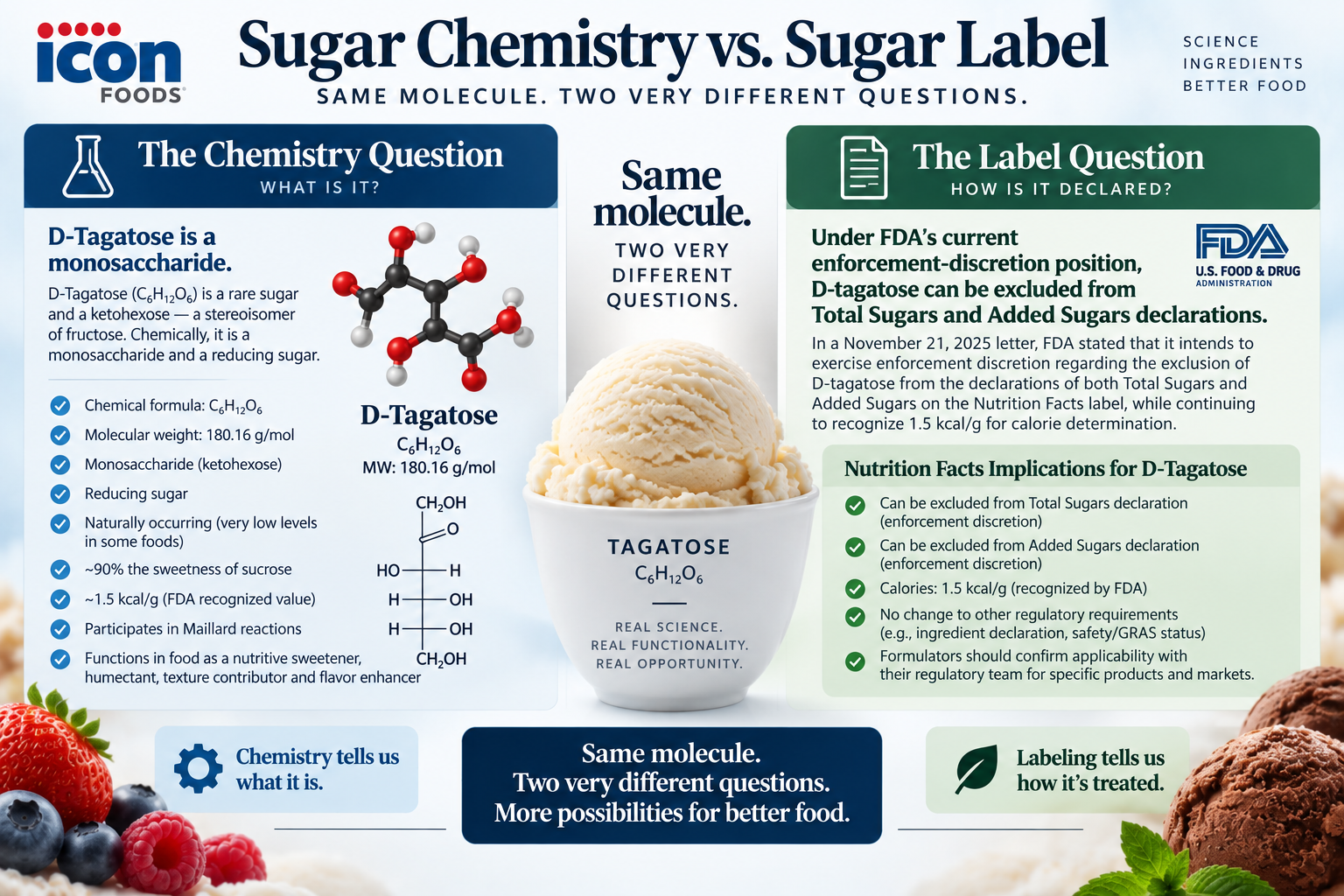
Let’s get the chemistry straight before marketing gets hold of the PowerPoint. D-tagatose is a ketohexose and stereoisomer of fructose with the molecular formula C₆H₁₂O₆ and molecular weight of approximately 180.16 g/mol. It is a reducing monosaccharide and is generally reported at roughly 90 to 92% of the sweetness of sucrose. Published literature places its caloric contribution around 1.5 kcal/g. That combination is unusual: Near-sucrose sweetness. Bulk. Low molecular weight.
Reducing-sugar chemistry. Substantially lower caloric contribution than sucrose.
For frozen-dessert formulators, however, the molecular weight deserves almost as much attention as sweetness. Sucrose has a molecular weight of about 342 g/mol. Tagatose is about 180.
That means, gram for gram, tagatose puts substantially more molecules into solution than sucrose. And freezing-point depression cares about the number of dissolved molecules, not whether consumers think the ingredient sounds natural, clean or vaguely terrifying. Physics remains stubbornly immune to marketing.
The Frozen Dessert Problem
A frozen dessert is not simply a frozen liquid. It is a multiphase system containing some combination of: ice crystals + air cells + fat droplets + proteins + dissolved sugars + minerals + hydrocolloids + an unfrozen concentrated serum phase. That last part is enormously important.
At normal ice cream serving temperatures, not all of the water is frozen. Some remains in an extremely concentrated liquid phase surrounding the ice crystals, fat network and air cells. The composition of that serum phase helps determine whether the product is: creamy, scoopable, chewy, hard, soft, icy, gummy, fast-melting, or structurally magnificent.
Sugar is one of the major controls governing that equilibrium. This is why replacing 12% sucrose with 12% of some random bulking system because a spreadsheet says the solids are equivalent is formulation malpractice.Equal solids do not mean equal frozen-dessert functionality.
Freezing Point Depression: Where Tagatose Gets Interesting
The classic relationship governing freezing-point depression is colligative. In simplified form: ΔTf ≈ iKf m where:
ΔTf = freezing-point depression
Kf = cryoscopic constant of the solvent
m = molality of dissolved material
i = van’t Hoff factor
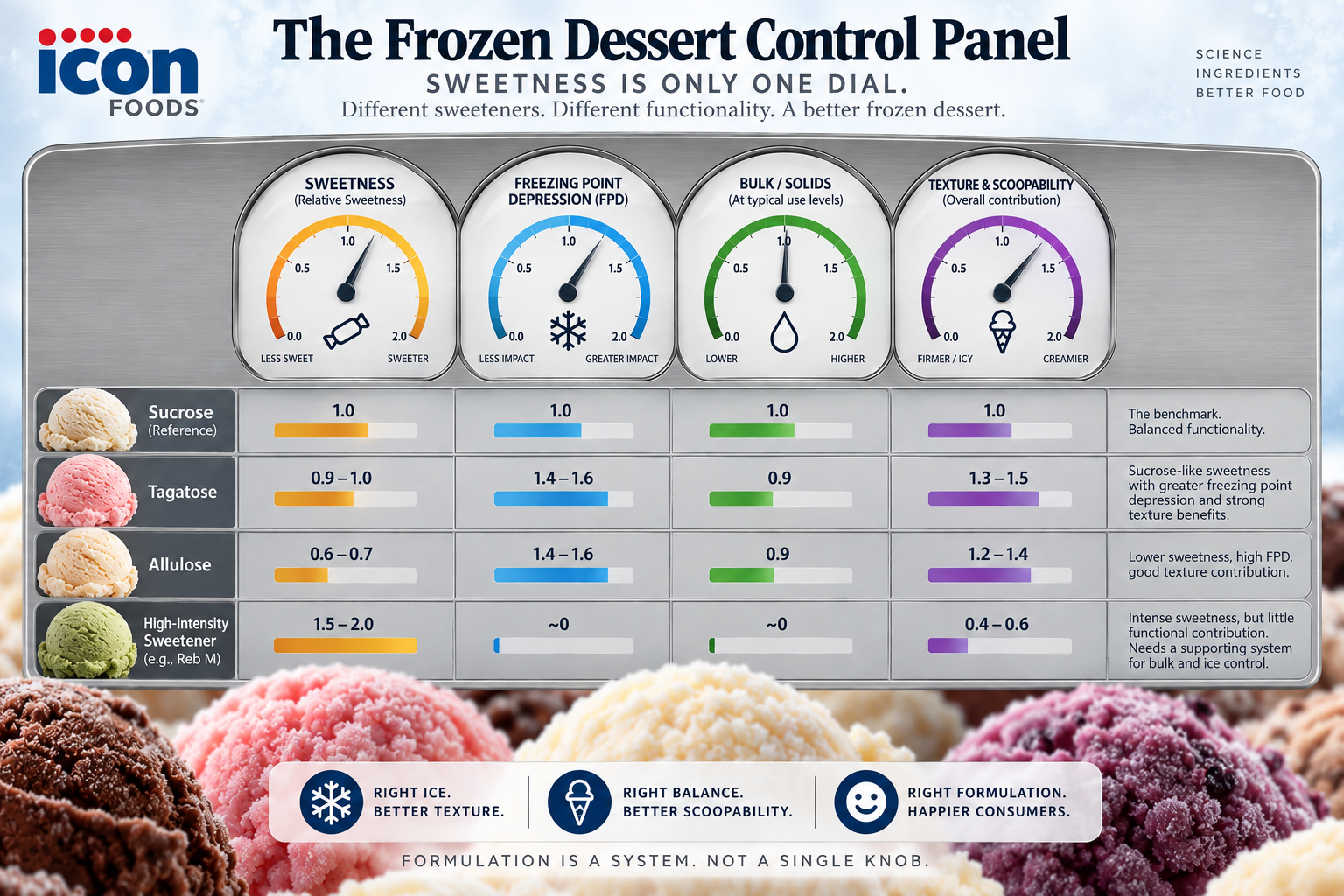
For our purposes, the important word is molality. Smaller molecules create more moles per gram. More dissolved particles mean greater freezing-point depression. That is why monosaccharides such as glucose and fructose generally depress freezing point considerably more strongly on an equal-weight basis than sucrose. And tagatose is a monosaccharide.
The recent experimental work is particularly useful because researchers didn’t merely assume tagatose would behave like one. They measured it. In the 2026 study, tagatose and dextrose solutions showed similar freezing curves across tested concentrations. The same general similarity persisted when the researchers moved into model ice cream systems containing 2.5% and 5% tagatose or dextrose. That gives formulators an extremely useful mental model: For initial formulation work, think of tagatose cryoscopically more like dextrose than sucrose. Not identically in every possible matrix, but that is a much better starting point than treating tagatose as a one-for-one sucrose replacement.
POD and PAC: Stop Formulating Sweeteners on Sweetness Alone
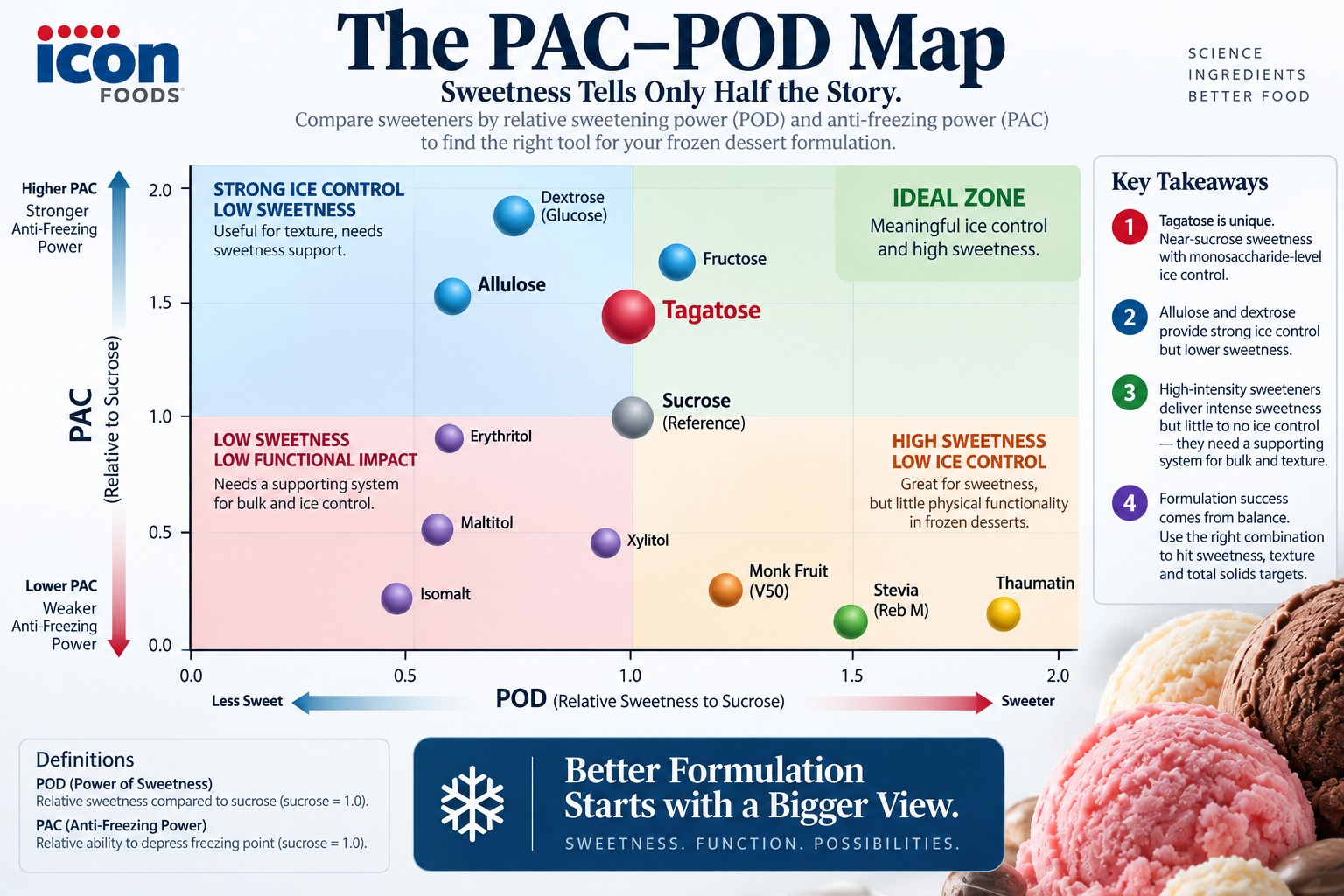
Frozen-dessert formulators frequently think in terms of two useful concepts: POD: relative sweetening power and PAC: anti-freezing power. These are not formal universal regulatory metrics. They are formulation tools.
Sucrose is typically treated as the reference. Tagatose has a sweetness relatively close to sucrose, roughly 0.9 to 0.92 relative sweetness under many conditions.But its freezing-point contribution per gram should be substantially greater than sucrose because of its lower molecular weight. This produces an important formulation asymmetry. Tagatose can deliver nearly sucrose-like sweetness while behaving cryoscopically more like a monosaccharide. That’s where the fun starts. Because if you replace sucrose aggressively with tagatose based exclusively on sweetness equivalence, the product can become softer than expected at the same storage temperature. You have increased the molar concentration of dissolved sugar. More molecules. Lower freezing point. Less frozen water at a given temperature. Softer product. Welcome to thermodynamics. Please keep your hands and feet inside the freezer at all times.
Why This Can Be a Feature Rather Than a Bug
Sugar-reduced frozen desserts routinely suffer from excessive hardness. Why? Because many sugar-reduction systems remove the very molecules responsible for controlling ice formation. Replace sucrose with a high-intensity sweetener at 100 or 200 ppm and you’ve solved sweetness while removing kilograms of dissolved solids. That creates a structural void. The formulation then gets patched with combinations of fibers, maltodextrins, proteins, gums, polyols and other bulking agents. Some work beautifully. Some produce frozen drywall. Tagatose approaches the problem differently.
It contributes both sweetness and meaningful freezing-point depression. That means a formulator can potentially use tagatose as part of the actual freezing architecture rather than using one ingredient for sweetness and another completely separate system to repair the physics that disappeared with sucrose. That is elegant formulation.
But Don’t Swing the Pendulum Too Far
Too little freezing-point depression creates a hard dessert. Too much creates something else entirely. At a given storage temperature, excessive freezing-point depression means too much water remains unfrozen. The result can become too soft, weak-bodied, slow to harden, sticky, prone to poor shape retention or unusually fast meltdown.
This is why I would rarely approach tagatose as: Sucrose out → Tagatose in → Done. That is ingredient substitution. Formulation is system engineering. That’s what we are getting paid for. A better approach is to decide how much freezing-point depression, sweetness and bulk you actually need, then construct the carbohydrate system accordingly.
Tagatose + Sucrose
This is the easiest place to begin. Partial replacement allows tagatose to lower conventional sugar and calories while retaining familiar sucrose functionality. As tagatose increases, however, expect freezing-point depression to increase relative to a sucrose-only system on an equal-weight basis. That means the formulator may need to compensate through higher-molecular-weight carbohydrate solids, protein, fiber, hydrocolloid adjustment, total solids, or simply a lower tagatose inclusion. Partial replacement is therefore not merely about replacing sweetness. You’re tuning the ice fraction curve.
Tagatose + Allulose
Now things get interesting. Both are rare monosaccharides. Both have molecular weights around 180 g/mol. Both can contribute significant freezing-point depression. But their sweetness profiles are different. Allulose is substantially less sweet than sucrose, while tagatose sits much closer to sucrose sweetness. From a frozen-dessert perspective, this gives the formulator two related but distinct levers. Allulose can provide strong cryoscopic activity without equivalent sweetness. Tagatose supplies strong cryoscopic activity with considerably more sweetness. Used together, they can create excellent sugar-reduction systems, but there is a trap monosaccharide stacking.
If you simply load both because each ingredient looks attractive individually, PAC can run away from you. The dessert may taste terrific coming out of the continuous freezer and then refuse to harden into the structure you designed. The formulation must therefore be balanced on a molar basis, not just grams of sugar replacement.
Tagatose + High-Intensity Sweeteners
This may ultimately be one of the most commercially useful architectures. Tagatose doesn’t have to carry the entire sweetness load. Consider using it for what it is particularly good at bulk + sucrose-like sweetness character + freezing-point control + solids + temporal sweetness foundation. Then finish the sweetness curve with small amounts of Reb M, optimized steviol glycosides, monk fruit or thaumatin-based modulation systems. This gives you something a pure high-intensity sweetener system cannot provide. Tagatose builds the runway. The high-intensity system gets the airplane airborne. And sensory modulation can clean up whatever is happening in the terminal.
Why Thaumatin Becomes Particularly Interesting
Frozen temperatures suppress sweetness perception. That’s basic sensory reality. The colder the food, the more difficult it becomes for many flavor and sweetness signals to present with the same intensity they show at warmer temperatures. Then the dessert warms in the mouth. Fat melts. Aromatics release. The serum phase dilutes. Sweetness perception changes over several seconds. So frozen desserts are inherently time-dependent sensory systems. That makes temporal modulation interesting.
Thaumatin has a slower sweetness onset and unusually persistent finish compared with sucrose. Used at modulation levels rather than attempting to make it carry the primary sweetness load, it can help extend and integrate sweetness perception. I wouldn’t formulate tagatose and thaumatin by saying we need X sucrose equivalents. I’d ask what should the sweetness curve look like from first frozen contact through complete melt? That’s a much smarter question.
Tagatose and Flavor Release
One of the overlooked advantages of having real carbohydrate mass in a reduced-sugar frozen dessert is flavor delivery. Frozen products suppress volatile release simply because they’re cold. As the matrix warms, compounds partition differently among fat, water and air. A well-designed carbohydrate system affects viscosity and water mobility, which in turn influence flavor perception.
Tagatose therefore should not be evaluated only through a sweetness triangle. Run full sensory work on sweetness onset, sweetness peak, sweetness decay, vanilla intensity, dairy character, cocoa perception, fruit acidity, flavor persistence, cooling perception and aftertaste.
The difference between an acceptable reduced-sugar frozen dessert and a great one is often hiding in the last three seconds of the sensory curve.
Tagatose and Chocolate: Now We Have Another Tool
Tagatose is a reducing sugar. That means it can participate in Maillard chemistry. That’s potentially useful in cooked dairy bases, chocolate systems, caramel systems and inclusions, but it also means process conditions matter. Maillard chemistry is influenced by temperature, time, pH, water activity and available amino groups. Tagatose therefore deserves attention during pasteurization, UHT treatment, retort exposure where relevant, heated flavor preparation, caramel development, and prolonged thermal holding.
You can use browning chemistry as a flavor-building tool. Or you can accidentally create it. Those are not the same thing. For vanilla ice cream, excessive cooked notes or color development may be undesirable. For chocolate, coffee, caramel, dulce de leche, brown butter or toasted dairy profiles, controlled reducing-sugar chemistry may actually work in your favor. Formulation doesn’t have good ingredients and bad ingredients. It has properties. Your job is to decide whether those properties are helping or hurting the product you’re building.
Solubility and Crystallization
Frozen desserts are brutally unforgiving when it comes to unwanted crystallization. Consumers will forgive a surprising amount of nutritional weirdness. They will not forgive sand. Tagatose is water soluble, with solubility increasing substantially with temperature. Published physicochemical literature reports moderate-to-high aqueous solubility and temperature dependence. That matters during mix preparation and storage.
As water freezes, dissolved solids become increasingly concentrated in the unfrozen phase. This phenomenon is called freeze concentration. A mix that looked comfortably unsaturated before freezing may become dramatically more concentrated as water converts to ice. So formulators should evaluate tagatose crystallization risk not merely in the liquid mix but across aging → dynamic freezing → hardening → storage → temperature cycling.
This becomes especially important when tagatose is combined with lactose from milk solids. Lactose already has its own infamous crystallization problem in frozen dairy desserts. One crystallization problem is enough. We don’t need to start a boy band.
Ice Crystal Size Matters More Than Consumers Know
Creaminess is partly a particle-size illusion. Ice crystals must remain sufficiently small that the tongue perceives the product as smooth. During dynamic freezing, large numbers of small crystals should nucleate. During hardening, crystal growth must be controlled.
During distribution, temperature abuse can allow small crystals to melt and larger ones to grow through recrystallization. Recent frozen-dessert research reinforces that ice-crystal size, freezing-point behavior and molecular characteristics of anti-freezing agents strongly affect hardness, rheology and meltdown.
This is another reason the carbohydrate system cannot be designed independently of processing. A beautiful formulation going through a lousy hardening tunnel is still a lousy frozen dessert. Ingredient architecture and process architecture are teammates. Neither wins the game alone.
Tagatose Does Not Replace Stabilizers
Let’s kill this idea before it escapes the lab. Tagatose contributes to water management and freezing behavior. It does not eliminate the need for intelligently designed hydrocolloid systems. Stabilizers such as guar, locust bean gum, cellulose gums, tara, carrageenan or other systems operate through different mechanisms.
They influence serum viscosity, water mobility, ice recrystallization and meltdown. Tagatose changes the colligative environment. Those are related functions. They are not interchangeable functions. The best system will use each ingredient for the job it actually performs rather than asking one molecule to play quarterback, linebacker and mascot.
What About Plant-Based Frozen Desserts?
This may be an even more interesting playground. Plant-based frozen desserts frequently struggle with body because dairy protein, milk fat and milk solids have been removed or replaced. The formulator may be dealing with oat, almond, coconut, cashew, pea protein, fava protein, soy, or combinations thereof.
Each changes the matrix. Tagatose can provide sweetness and cryoscopic functionality, but it will not magically recreate dairy structure. Plant-based systems often need deliberate reconstruction of protein network + fat crystallization + emulsification + solids + serum viscosity + freezing behavior. Tagatose can solve part of that equation extremely well. Just don’t confuse “part” with “all.”
For coconut-based systems in particular, fat crystallization behavior deserves careful consideration because coconut fats become structurally rigid at refrigerated temperatures. A strong freezing-point depressant can soften the aqueous phase while the fat phase remains relatively firm. That can produce strange sensory contradictions soft ice phase, hard fat perception, waxy melt, and delayed flavor release. Again, the matrix wins. Always.
A Practical Formulation Strategy
I would approach tagatose frozen-dessert development in stages.
Stage 1: Define the control
Characterize your full-sugar benchmark. Don’t just record Brix. Measure:
- total solids
- fat
- protein
- sweetener solids
- freezing point
- draw temperature
- overrun
- hardness at serving temperature
- meltdown
- ice crystal behavior
- sweetness intensity
- sweetness time-intensity
- flavor release.
Your control is your map. Without it, you’re just wandering around the freezer with a clipboard.
Stage 2: Establish the cryoscopic target
Calculate the approximate molar contribution of every meaningful dissolved carbohydrate. Do not simply calculate total sugar. Sucrose, lactose, glucose, fructose, tagatose and allulose do not contribute equally gram-for-gram to freezing-point depression. This is one of the most common mistakes in reduced-sugar frozen dessert formulation.
Stage 3: Decide what tagatose is supposed to do
Is it there primarily for:
- sugar reduction?
- calorie reduction?
- sweetness?
- freezing-point depression?
- bulk?
- label positioning?
- flavor development?
The answer can be several of those. But rank them.
Stage 4: Rebuild solids deliberately
If significant sucrose mass disappears, rebuild the missing structural solids intelligently. Possible partners include proteins, soluble fibers, resistant dextrins, hydrocolloids and other carbohydrates.
But remember high-molecular-weight bulking ingredients contribute much less freezing-point depression per gram than monosaccharides. That can be extremely useful. Tagatose pushes the system one direction. Fiber can pull it back. Now we’re formulating.
Stage 5: Finish sweetness separately
Once physical structure is close, finish the sweetness curve. This is where Reb M, monk fruit or thaumatin-based modulation may become useful. Do not use expensive high-intensity sweetness to fix a structural problem. And don’t use five additional grams of tagatose merely to fix a 5% sensory sweetness deficit if those five grams destroy your hardening characteristics. Use the right wrench.
Stage 6: Stress-test the product
Never approve a frozen dessert based solely on product coming directly out of the pilot freezer. Test it after hardening. Then temperature-cycle it. Evaluate it at realistic retail and consumer conditions. A formula that survives perfect -20°F storage isn’t necessarily a commercial formula. The grocery distribution system is not a cryogenic monastery.
A Starting Formulation Architecture
For a reduced-sugar premium frozen dairy dessert, I would investigate a system conceptually along these lines:
- Milk / cream base
- Milk protein or milk solids
- Tagatose
- Complementary bulking solids or soluble fiber
- Small sweetness correction with Reb M or monk fruit if necessary
- Thaumatin-based sensory modulation where appropriate
- Optimized stabilizer/emulsifier system
- Flavor system
The important point is not a magic tagatose percentage. There isn’t one. The appropriate concentration depends on the product’s fat, protein, lactose, total solids, other sweeteners, serving temperature, hardening conditions, desired overrun and target texture. Tagatose should therefore be titrated into the carbohydrate architecture, not dropped into the formulation as a sucrose impersonator.
A Better Experimental Design
Instead of making one prototype, I’d run a matrix. For example: Control: conventional sucrose system. Prototype A: low tagatose replacement. Prototype B: moderate tagatose replacement Prototype C: tagatose + fiber. Prototype D: tagatose + allulose + higher-MW bulking solid. Prototype E: tagatose + reduced bulk + high-intensity sweetness correction Then normalize sweetness as closely as practical and measure physical behavior. The key outputs should include:
- initial freezing temperature
- draw temperature
- hardness at -18°C
- hardness at serving temperature
- meltdown rate
- overrun
- ice crystal size
- serum viscosity
- sensory creaminess
- sweetness onset
- sweetness persistence
- aftertaste or decay rate
Now you can actually see what the molecules are doing. That’s infinitely more useful than asking five people in the lab which sample they “like.”
The Labeling Story Changed
This is where things became considerably more interesting. Historically, FDA’s treatment of D-tagatose required it to be declared as Total Sugars and Added Sugars, although FDA permitted use of 1.5 kcal/g for calorie calculation and later allowed an adjusted Added Sugars %DV reflecting that lower caloric contribution.
Then FDA moved again. In a November 21, 2025 letter, FDA stated that, while it considers broader regulation of sugars metabolized differently from traditional sugars, the agency intends to exercise enforcement discretion regarding excluding D-tagatose from the declarations of both Total Sugars and Added Sugars, while continuing to recognize 1.5 kcal/g for calorie determination.
That is a substantial development for product developers. It means tagatose can potentially do something extraordinarily useful in a U.S. frozen dessert behave physically like a real sugar without necessarily carrying the same Nutrition Facts treatment as conventional sugars under FDA’s current enforcement-discretion position. That is not marketing magic. That’s formulation leverage.
As always, regulatory teams should review the current FDA position, specific product formulation, ingredient source, claims and applicable standards before commercialization.
Regulatory Status and Use
FDA’s GRAS inventory includes multiple notices for D-tagatose. GRN 352 specifically identifies uses including ice cream and frozen yogurt, and FDA responded that it had no questions regarding the notifier’s GRAS conclusion.
A later notice, GRN 977, covers D-tagatose produced through a novel enzymatic cascade and describes intended functions including nutritive sweetener, flavor enhancer, humectant, texturizer and stabilizer across multiple food categories; FDA likewise responded that it had no questions regarding the GRAS conclusion.
This is also a reminder that formulators should review the specific tagatose source and corresponding regulatory basis, rather than assuming every commercial ingredient has an identical regulatory history. Details matter. Regulatory details have an especially irritating habit of mattering right before launch.
Digestive Tolerance: Don’t Ignore Dose
There is another reason I prefer blended architectures rather than trying to make tagatose do everything. Some tagatose escapes absorption in the small intestine and reaches the colon, where it can be fermented. That’s physiologically interesting. It’s also formulation-relevant.
Older controlled human studies found gastrointestinal symptoms, particularly flatulence and, at larger single doses, diarrhea and nausea. A study evaluating approximately 30 g consumed at once concluded that this level may exceed what should ordinarily be recommended as a single dose.
Another controlled chocolate study found 20 g of tagatose generally tolerated, although gastrointestinal symptoms including flatulence, bloating and nausea were increased compared with sucrose. So calculate grams per serving, not merely percentage in the mix. A 6% inclusion sounds modest. But serving size matters. So does consumer behavior. Nobody has ever stopped eating ice cream because the Nutrition Facts panel politely suggested the experience was over. Formulate accordingly.
The Metabolic Story Is Also Becoming Better Defined
A 2026 systematic review and meta-analysis evaluated controlled human intervention trials involving tagatose and allulose. Across the tagatose trials included in the analysis, tagatose intake was associated with lower postprandial glucose and insulin responses, although the strength of evidence differed among outcomes and some longer-term endpoints had considerably less certainty.
That doesn’t give marketers permission to turn a pint of frozen dessert into a metabolic superhero. It does mean the physiological behavior of tagatose is materially different from conventional sucrose. FDA itself now explicitly recognizes tagatose among sugars metabolized differently from traditional sugars. That’s the scientifically defensible story. No cape required.
Where I Think Tagatose Is Especially Strong
I see particularly interesting opportunities in premium reduced-sugar ice cream where texture cannot be sacrificed high-protein frozen desserts where protein already tends to increase body and hardness; GLP-1-oriented portion-controlled desserts where consumers may prioritize protein, lower conventional sugar and smaller servings; plant-based frozen desserts where carbohydrate architecture can help rebuild missing functionality; chocolate and caramel frozen desserts where reducing-sugar chemistry may become an additional flavor-development lever; frozen yogurt where sweetness, acidity and freezing behavior have to coexist; and better-for-you novelties where small serving sizes make tagatose dose management particularly attractive.
Where I Would Be More Cautious
I’d watch tagatose carefully in formulations with high existing monosaccharide concentrations, because freezing-point depression may become excessive; large allulose loads, for the same reason; high lactose concentrations, because overall crystallization behavior deserves close study; aggressive heat treatment, because tagatose is a reducing sugar; very high per-serving tagatose doses, because gastrointestinal tolerance becomes relevant; and extremely low-solids formulations, because tagatose cannot single-handedly replace all of the structural functions removed with sucrose.
The Bigger Lesson
The biggest mistake in sugar reduction is believing sweetness is the problem. Usually it isn’t. We have plenty of things that taste sweet. The hard part is replacing everything sugar was doing when nobody was paying attention. Frozen desserts make that brutally obvious.
Sucrose is sweet, but it is also controlling water, ice, viscosity, solids, body, flavor release and serving texture. Tagatose is exciting because it doesn’t merely address the receptor. It participates in the food system. And that is the distinction formulators should care about.
The 2026 research showing tagatose and dextrose behaving similarly in freezing experiments gives us something better than another marketing claim. It gives us a practical physical model for formulation. Think of tagatose as a near-sucrose-sweet monosaccharide with meaningful anti-freezing power. Then formulate around that reality. Don’t blindly replace sucrose gram-for-gram. Don’t formulate to Brix alone. Don’t solve sweetness before solving ice. And definitely don’t assume that because something tastes good coming out of the freezer barrel, you’ve invented great ice cream. That’s the trick. The consumer doesn’t need to understand the thermodynamics. But the formulator damn well does.
Formulator’s Cheat Sheet
Tagatose sweetness: approximately 90–92% of sucrose.
Molecular weight: approximately 180.16 g/mol versus approximately 342.3 g/mol for sucrose.
Energy value recognized by FDA: 1.5 kcal/g.
Frozen-system behavior: recent experimental work found freezing behavior similar to dextrose in both aqueous and model ice cream systems.
Primary formulation implication: greater freezing-point depression per unit mass than would be expected from sucrose, requiring deliberate balancing of the carbohydrate system.
Sweetness strategy: use tagatose to build bulk and the primary sweetness architecture; use high-intensity sweeteners or sensory modulators only where necessary to finish the curve.
Processing watch-out: reducing-sugar chemistry means thermal history and Maillard browning deserve attention.
Dose watch-out: calculate tagatose per serving and evaluate GI tolerance implications at meaningful consumption levels.
U.S. labeling: FDA’s November 2025 position states an intent to exercise enforcement discretion regarding exclusion of D-tagatose from Total Sugars and Added Sugars declarations and recognizes 1.5 kcal/g for calorie determination.