

by Thom King CFS – Founder, Chief Innovation Officer, Food Scientist, Icon Foods
We spend a lot of time talking about what sweeteners do inside humans. Glycemic response. Calories. Dental health. Digestive tolerance. Water activity. Freezing-point depression. Humectancy. Maillard chemistry. Sweetness curves. But there is another consumer wandering around the kitchen who cannot read your Nutrition Facts panel, has absolutely no respect for portion size, and considers an unattended protein bar on the coffee table an engraved invitation.
The dog.
And when we formulate with polyols, that matters. Because while erythritol, maltitol, sorbitol, mannitol, lactitol, isomalt and xylitol all live under the broad regulatory and formulation umbrella of sugar alcohols, they should absolutely not be treated as toxicological equivalents in canines. There is one polyol that deserves a giant red circle around it: Xylitol.
For humans, xylitol is a useful reduced-calorie sweetener with excellent dental credentials and roughly sucrose-like sweetness. For dogs? Completely different ballgame. And that distinction offers formulators an important lesson that extends well beyond xylitol, Ingredient safety is species-specific.
First Things First: A Polyol Is Not a Polyol Is Not a Polyol
The term sugar alcohol describes a chemical family, not a biological destiny. FDA recognizes sugar alcohols including sorbitol, xylitol, lactitol, mannitol, erythritol and maltitol as sugar substitutes used in human foods. They vary substantially in sweetness, caloric contribution, absorption and metabolism.
From the formulator’s bench, we already know this. Erythritol behaves nothing like maltitol. Maltitol doesn’t behave like sorbitol. Xylitol doesn’t behave like mannitol. Different molecular structures produce different solubilities, cooling effects, hygroscopicity, crystallization behavior, digestive tolerance and metabolic pathways. Yet somewhere along the way, “sugar alcohol” became a convenient mental bucket. That’s useful until it isn’t. Canine toxicology is where that bucket springs a very large leak.
Xylitol: The Outlier That Changes the Conversation
Xylitol is particularly dangerous to dogs because their metabolic response to it is dramatically different from ours. In humans, xylitol does not trigger the kind of rapid insulin response seen in dogs.
In dogs, absorbed xylitol can stimulate a rapid, dose-dependent release of insulin from pancreatic beta cells. The resulting plunge in circulating glucose can produce profound hypoglycemia.
Think of it as the dog’s pancreas seeing xylitol and slamming the insulin button like somebody leaning on the buzzer during Jeopardy!. Except this isn’t trivia. It can become a medical emergency.
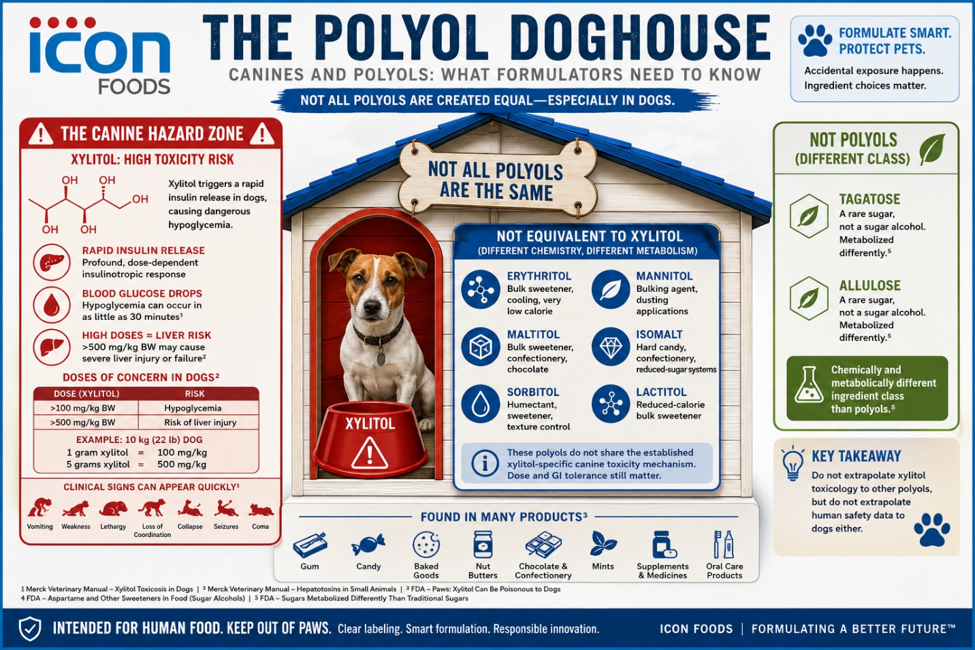
According to the Merck Veterinary Manual, doses above approximately 100 mg xylitol/kg body weight have been associated with hypoglycemia in dogs. At doses above approximately 500 mg/kg, some dogs may develop severe hepatic injury or liver failure.
Put that into formulation perspective. For a 10 kg dog, roughly 22 pounds:
- 1 gram of xylitol = 100 mg/kg
- 5 grams = 500 mg/kg
Those are not enormous ingredient quantities. A dog doesn’t need to knock over a 25-kilogram bag in the pilot plant. Depending on the formulation and animal, stealing one consumer product could potentially matter. That’s why FDA doesn’t mince words: xylitol can be poisonous to dogs.
What Actually Happens?
The sequence can move frighteningly fast.
Step 1: Xylitol is consumed.
Maybe the dog finds gum. Maybe it’s candy. Maybe it’s a baked product. Maybe it’s a supplement, nut butter or another reduced-sugar formulation. FDA specifically warns that xylitol occurs across a surprisingly broad range of foods, oral-care products, medicines and dietary supplements. It may even appear under terms such as birch sugar or wood sugar.
Step 2: Xylitol is rapidly absorbed.
Step 3: The canine pancreas releases insulin.
And not just a polite little squirt. Merck reports that xylitol can produce a profound dose-related insulinotropic response in dogs.
Step 4: Blood glucose falls.
Clinical signs can include: vomiting → weakness → lethargy → loss of coordination → collapse → seizures → coma. Signs may develop within roughly 30 minutes, although absorption from some food matrices can delay presentation for hours.
Step 5: At higher exposures, liver injury becomes another concern.
The mechanism isn’t completely resolved. Proposed mechanisms include ATP depletion and oxidative damage during xylitol metabolism. And here’s an important wrinkle: A dog developing hepatic injury doesn’t necessarily have to develop obvious hypoglycemia first. That makes xylitol more than a simple blood sugar problem.
Now Comes the Important Part: What About the Other Polyols?
This is where we need scientific discipline. The fact that xylitol is toxic to dogs does not mean every polyol should automatically be labeled toxic to dogs. Chemical cousins aren’t identical twins.
Erythritol, maltitol, sorbitol, mannitol, lactitol and isomalt have different absorption and metabolic characteristics, and the dramatic canine insulin response associated with xylitol should not simply be extrapolated across the entire polyol category. FDA’s current animal-health warnings specifically identify xylitol among potentially dangerous human-food ingredients for pets. That doesn’t mean formulators should interpret every other polyol as unlimited dog food. There is a giant difference between: “not known to cause xylitol-like canine toxicity” and “feed the Labradordoodle as much as he wants.”
Large quantities of poorly absorbed carbohydrates can still create gastrointestinal problems. Dose matters. Molecular structure matters. Absorption matters. The food matrix matters. Toxicology without dose is just chemistry wearing a scary Halloween costume.
The Formulator’s Polyol Cheat Sheet
| Polyol | Human formulation role | Canine perspective |
| Xylitol | Sweetener, bulking agent, dental applications | Major canine toxicity concern. Avoid exposure. |
| Erythritol | Bulk sweetener, cooling effect, very low calorie | Does not carry the established xylitol-specific canine toxicity mechanism |
| Maltitol | Bulk sweetener, confectionery, chocolate | Not equivalent to xylitol; excessive ingestion may still cause GI effects |
| Sorbitol | Humectant, sweetener, texture control | Not equivalent to xylitol; dose and GI tolerance still matter |
| Mannitol | Bulking agent, dusting applications, low hygroscopicity | Not equivalent to xylitol; excessive consumption isn’t desirable |
| Isomalt | Hard candy, confectionery, reduced-sugar systems | Not equivalent to xylitol; GI tolerance remains relevant |
| Lactitol | Reduced-calorie bulk sweetener | Not equivalent to xylitol; GI tolerance remains relevant |
And here’s the sentence I’d put a box around, do not extrapolate xylitol toxicology to other polyols, but do not extrapolate human safety data to dogs either. That’s the scientific sweet spot.
Human Food Formulators Should Still Care
“But Thom, we’re making protein bars, not dog treats.” Absolutely. And your customer has a Labrador doodle named Dignan who has never encountered a zipper bag he couldn’t defeat. This becomes particularly relevant in categories such as:
- protein and nutrition bars
- reduced-sugar baked goods
- peanut and nut butters
- chocolate and confectionery
- gummies
- chewing gum
- mints
- powdered supplements
- chewable supplements
- functional foods
These products frequently live in purses, gym bags, backpacks, kitchen counters and bedside tables. In other words, exactly where dogs conduct their independent clinical trials.
FDA specifically identifies sugar-free gum, candies, baked goods, nut butters, medicines, oral-care products and supplements among potential sources of xylitol exposure. So although your formulation may be completely appropriate for its intended human consumer, foreseeable accidental canine exposure is worth considering during product development and commercialization.
Ingredient Statements Matter More Than You Think
Consumers increasingly recognize the word xylitol. That’s good. But FDA notes that xylitol may also be referred to as wood sugar, birch sugar or birch bark extract on some products. That creates an interesting communication challenge. Formulators love ingredient technology. Consumers love understandable labels. Dogs love whatever fell behind the sofa. Those three realities eventually collide.
For products containing meaningful quantities of xylitol, manufacturers should think beyond regulatory compliance and consider how clearly consumers can identify the ingredient and understand the potential pet hazard. That’s not fear marketing. That’s useful communication.
And Please Don’t Confuse Tagatose With a Polyol
This deserves a sidebar because the alternative-sweetener world has become one enormous family reunion where everybody gets introduced as somebody’s cousin. Tagatose is not a sugar alcohol. Neither is allulose.
FDA specifically distinguishes sugars metabolized differently than traditional sugars, including D-allulose and D-tagatose, from sugar alcohols such as erythritol, xylitol, sorbitol and maltitol.
Chemically and metabolically, these are different ingredient classes. That distinction matters when discussing:
- metabolism
- labeling
- digestive tolerance
- functionality
- toxicology
- and animal exposure.
Calling every alternative bulk sweetener a “sugar alcohol” is the food-science equivalent of calling every four-legged animal a cow. Close enough for kindergarten. Not close enough for formulation.
What If You’re Formulating Food Specifically for Dogs?
Now the rulebook changes completely. Do not assume an ingredient appropriate for human food is appropriate for animal food.
FDA explicitly states that ingredients incorporated into animal foods must be approved food additives or otherwise considered GRAS for their intended animal-food use. FDA even uses xylitol as an example: although xylitol has permitted uses in human foods, its extreme toxicity to dogs makes it unacceptable for dog food.
That is a regulatory distinction worth remembering: Human-food status does not automatically travel across species. GRAS isn’t a magic passport. Intended use matters. Species matters. Dose matters.
What Should Formulators Actually Do?
I’m not suggesting that the entire food industry redesign itself around the possibility that somebody’s Australian Shepherd might burglarize the pantry. But good formulation is ultimately risk management applied to deliciousness. When developing reduced-sugar products, ask a few additional questions: Which polyol am I using? Not merely, “Are we using polyols?” How much is present per serving and per package?
A 40-gram serving and a 400-gram package represent very different accidental-exposure scenarios. Could this product realistically be attractive and accessible to a dog? Peanut butter? Protein bar? Brownie? Cookie? You already know the answer.
Is xylitol necessary to achieve the formulation objective?
Sometimes the answer may legitimately be yes. But sometimes erythritol, maltitol, soluble fibers, rare sugars or combinations of bulk sweeteners and high-intensity sweeteners can accomplish the desired sensory and functional objective. That’s formulation. We’re not replacing ingredients because they’re scary. We’re selecting ingredients because their entire performance profile makes sense for the application.
The Bigger Lesson: Stop Formulating by Ingredient Category
This is really the message. Polyol. Fiber. Rare sugar. High-intensity sweetener. Natural sweetener. Those categories are convenient for PowerPoint slides. Molecules couldn’t care less. Every ingredient has its own, structure → absorption → metabolism → functionality → tolerance → toxicology.
That’s why xylitol and erythritol can sit next to each other in the sugar-alcohol family while behaving dramatically differently in a canine. The molecule always gets the final vote.
The Take Home
Polyols remain extraordinarily useful formulation tools. They help us manage sugar reduction, bulk, texture, freezing point, moisture, crystallization, dental properties and sweetness. But xylitol carries a unique and well-established canine toxicity risk that food and beverage formulators should understand. In dogs, relatively small exposures can trigger profound insulin release and potentially dangerous hypoglycemia. Larger exposures have been associated with serious hepatic injury.
Other polyols should not automatically be painted with the same toxicological brush. And rare sugars such as tagatose and allulose aren’t polyols in the first place. So when someone says: “Sugar alcohols are dangerous to dogs.” The scientist’s answer is: Which sugar alcohol? Because chemistry rarely rewards lazy categories. And neither does the dog who just stole your prototype protein bar.
References & Further Reading
- Merck Veterinary Manual. “Xylitol Toxicosis in Dogs.”
This is the strongest technical source for the paper. It documents the rapid, dose-dependent insulin response in dogs, profound hypoglycemia, clinical signs, and hepatic injury. Merck reports that doses above approximately 100 mg/kg have been associated with hypoglycemia, while some dogs consuming more than 500 mg/kg may develop severe hepatic insufficiency or failure. Merck Veterinary Manual: Xylitol Toxicosis in Dogs - U.S. Food & Drug Administration. “Paws Off! Xylitol is Toxic to Dogs.”
Excellent consumer-facing FDA confirmation that xylitol can be poisonous to dogs. FDA identifies potential sources including sugar-free candy, gum, baked goods, nut butters, dietary supplements, medicines, mouthwash and toothpaste. It also notes alternative names including wood sugar, birch sugar and birch bark extract. FDA: Paws Off! Xylitol is Toxic to Dogs - U.S. Food & Drug Administration. “Paws Off Xylitol; It’s Dangerous for Dogs.”
This FDA resource explains the species-specific mechanism particularly well. In dogs, xylitol can be rapidly absorbed and stimulate potent pancreatic insulin release, producing a rapid and profound decline in blood glucose. FDA: Paws Off Xylitol; It’s Dangerous for Dogs - U.S. Food & Drug Administration. “Sugars That Are Metabolized Differently Than Traditional Sugars.”
This is the source I would use for the paper’s important tagatose/allulose clarification. FDA specifically distinguishes D-tagatose and allulose from sugar alcohols. FDA identifies sorbitol, xylitol, lactitol, mannitol, erythritol and maltitol as examples of sugar alcohols, while allulose and D-tagatose are sugars metabolized differently from traditional sugars.
FDA: Sugars That Are Metabolized Differently Than Traditional Sugars - U.S. Food & Drug Administration. “How Sweet It Is: All About Sweeteners.”
A useful general reference for defining the sugar-alcohol category. FDA lists sorbitol, xylitol, lactitol, mannitol, erythritol and maltitol as sugar alcohol examples and separately categorizes D-allulose and D-tagatose. FDA: How Sweet It Is: All About Sweeteners
U.S. Food & Drug Administration. “Potentially Dangerous Items for Your Pet.”
FDA specifically identifies xylitol among ingredients in human products that can be dangerous to pets, alongside chocolate, grapes, raisins, onions and other established hazards. FDA: Potentially Dangerous Items for Your Pet