
by Thom King – Founder, Chief Innovation Officer, Food Scientist, Icon Foods
Before we ask whether a dextrin is a fiber, a bulking agent, or the answer to our latest formulation problem, we should answer a more basic question: what the hell is a dextrin?
Dextrins are mixtures of glucose chains produced by partially breaking down starch. Depending on the manufacturing process, some of the bonds connecting those glucose units may also be rearranged. The result is a family of starch-derived carbohydrates with different molecular sizes, branching patterns, solubilities, and digestibilities.
“Dextrin” does not identify one uniform molecule. It also does not automatically mean dietary fiber. That distinction is where this entire conversation needs to begin.
Start with glucose, then build the starch
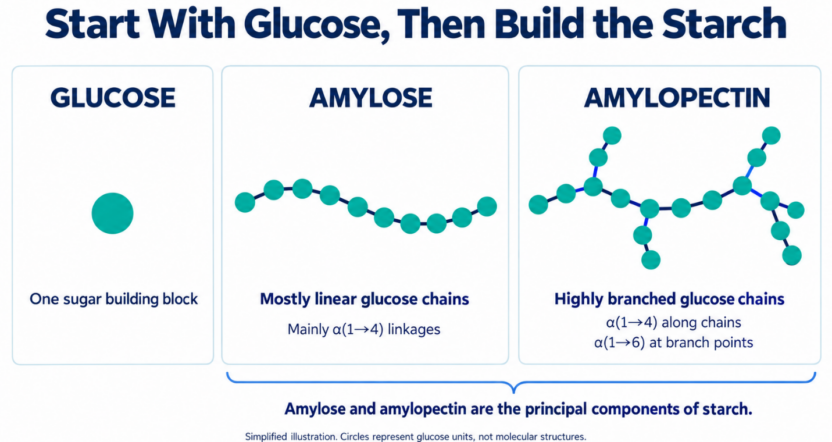
Glucose is a single sugar molecule. Plants connect large numbers of glucose units to build starch, an energy reserve found in ingredients such as corn, potatoes, rice, wheat, and tapioca.
Starch contains two principal molecular components: amylose and amylopectin. Amylose consists largely of relatively linear glucose chains. Amylopectin is extensively branched. Their chains contain predominantly alpha-1,4 linkages, with alpha-1,6 linkages forming branch points.
Those numbers describe how the glucose units connect. They matter because digestive enzymes recognize particular bonds and need access to them to do their work.
However, bonds are only part of the story. Starch molecules are organized within granules, and that physical organization influences hydration, cooking behavior, and enzyme accessibility. Processing can change that organization, which changes both functionality and digestibility. Research on gelatinization and retrogradation demonstrates why the same starting starch can behave differently after different treatments.
Think of starch as a large structure assembled from glucose building blocks. Dextrinization takes portions of that structure apart. Some processes also reconnect the blocks in different arrangements. Same building material. Different architecture. Different performance.
How starch becomes dextrin
Partial hydrolysis breaks some of the bonds in starch through reactions involving water, producing smaller carbohydrate chains. More extensive hydrolysis can produce smaller sugars, including glucose.
In broad biochemical usage, dextrins include intermediate products of starch breakdown. Commercial ingredient definitions are more specific. The U.S. regulation for dextrin describes incompletely hydrolyzed starch prepared by dry heating, with or without specified pretreatments. Heat-driven conversion can involve chain cleavage and, depending on the conditions, molecular rearrangement. That manufacturing history matters. A dextrin’s properties depend on the starting material and how it was processed. Some grades are useful for binding and coatings. Others contribute soluble solids or body. Still others are manufactured to contain substantial digestion-resistant fractions.
Buying dextrin without a meaningful specification is like hiring someone because their résumé says works in sports. You still need to know whether you hired a quarterback, a referee, or the person selling nachos.
Where maltodextrin fits
Conventional maltodextrin is a related starch hydrolysate. The U.S. definition describes a glucose polymer linked primarily through alpha-1,4 bonds, with a dextrose equivalent below 20.
Dextrose equivalent, or DE, measures reducing power relative to dextrose on a dry basis. Within comparable starch hydrolysates, it provides an indication of the extent of hydrolysis. It is not a dietary-fiber measurement.
Conventional maltodextrins are useful formulation ingredients. They can carry flavors, add solids, contribute body, and support drying applications without delivering sucrose-level sweetness. But modest sweetness does not establish low digestibility. A carbohydrate does not need to taste particularly sweet to provide digestible carbohydrate.
Likewise, low DE does not mean high fiber. DE cannot tell us everything about branching, molecular-weight distribution, or enzyme resistance.
What makes a dextrin resistant to digestion
The more precise terms are digestion-resistant maltodextrin and resistant dextrin. These ingredients contain molecular structures that human digestive enzymes do not readily hydrolyze. Their manufacture can involve controlled heat, acid, enzymatic treatment, and purification. The process produces mixtures containing both digestible and less readily digestible linkages.
FDA’s scientific review describes resistant maltodextrin/dextrin as containing non-digestible alpha-1,2 and alpha-1,3 linkages alongside digestible linkages. The exact composition depends on the material and manufacturing process.
That means resistance is not simply a consequence of making starch chains shorter. It depends on the resulting molecular structure. A long chain with accessible, digestible bonds can be broken down. A shorter chain containing resistant linkages can escape small-intestinal digestion.
Commercial names overlap, so “resistant maltodextrin” is not inherently superior to “resistant dextrin.” Neither establishes a universal fiber percentage. Ask for the actual grade’s identity, fiber content, moisture or solids, residual digestible carbohydrate, and analytical method.
Starch and fiber describe different things
Starch describes a carbohydrate family. Dietary fiber describes a nutritional and regulatory category. Those categories overlap. Resistant starch remains starch, while a portion resists digestion. Resistant dextrins are starch-derived ingredients that can provide eligible dietary fiber. Conversely, ordinary starch hydrolysates do not become fiber simply because they originate from a plant.
FDA identifies resistant maltodextrin/dextrin among the additional isolated or synthetic non-digestible carbohydrates covered by its dietary-fiber enforcement-discretion policy pending rulemaking. That policy does not extend automatically to every ingredient called dextrin. FDA
Botanical source also cannot settle the question. “Tapioca” tells us where an ingredient began. It does not independently establish how much of the finished ingredient is digestion-resistant. The same applies to corn, wheat, or potato.
Compare ingredients by the job they need to perform
The following table summarizes typical tendencies. Commercial grades and processing conditions can change the outcome.
| Ingredient | Primary formulation strengths | What needs verification |
| Native starch | Cooked thickness, gel structure, water management | Cooking requirements, texture stability, digestibility |
| Modified food starch | Texture and process stability tailored to an application | Modification type and performance; “modified” does not automatically mean resistant |
| Conventional maltodextrin | Soluble solids, carriers, body, drying support | DE, molecular distribution, residual sugars, digestible carbohydrate |
| Conventional dextrin | Binding, coatings, films, and solids | Solubility, viscosity, color, digestibility |
| Resistant dextrin or maltodextrin | Soluble fiber and bulk with relatively low viscosity | Eligible fiber fraction, residual carbohydrate, process stability |
| Resistant starch | Fiber enrichment, particularly in solid or opaque foods | Resistance after processing, particle behavior, texture |
| Inulin and FOS | Fiber; grade-dependent sweetness, bulk, or creaminess | Acid and thermal stability, chain-length distribution, tolerance |
| Viscous fibers such as guar and pectin | Thickening, stabilization, or gel formation | Hydration, interactions, appropriate dose, and fiber contribution |
The practical implication is straightforward: replacing a thickening starch with a low-viscosity resistant dextrin can preserve solids while radically changing texture. Conversely, using enough of a highly viscous fiber to reach a nutrition target can produce a beverage with the drinking characteristics of joint compound. A sauce may need starch for texture and resistant dextrin for fiber enrichment. A clear beverage may need resistant dextrin without a starch thickener. Give each ingredient a defined job.
Chain length matters, but it does not explain everything
Degree of polymerization, or DP, describes how many monomer units are connected in a chain. Chain length influences functionality, but it works alongside branching, molecular shape, concentration, and interactions with the surrounding food matrix. Shortening a polymer often reduces thickening power. That does not mean every short-chain carbohydrate has the same viscosity or digestibility.
For formulators, the useful distinction is between building texture and delivering fiber. Those objectives may overlap, but they are not interchangeable. A relatively thin beverage can contain meaningful fiber. A thick starch paste can contain substantial digestible carbohydrate.
Digestion resistance is not the same as processing resistance
Three separate questions deserve separate answers:
- Does the ingredient resist digestive enzymes?
- Does it resist chemical breakdown during processing and storage?
- Does it retain the physical performance the product requires?
An ingredient can perform well on one measure and poorly on another. Commercial resistant maltodextrin grades are available with supplier-supported acid and heat stability. These can be useful candidates for acidic beverages and thermally processed foods. However, supplier performance statements apply to specified grades and conditions. They should not be extended to every resistant dextrin on the market.
Inulin provides a useful comparison. Experimental work demonstrates that acidic conditions can hydrolyze inulin, with temperature and exposure time influencing the reaction. Chain cleavage can change the fructan distribution and generate free fructose. This does not mean every acidic beverage immediately loses its inulin. It means the complete processing and storage conditions matter.
Starches have another set of considerations. Gelatinization changes granule organization. Subsequent retrogradation changes chain associations. These changes can influence texture and enzyme susceptibility, but cooling does not universally guarantee reduced digestibility. Experimental work has shown more complicated outcomes in partially gelatinized systems.
The word “stable” needs a measurement attached to it. Stable viscosity? Stable fiber content? Stable clarity? Stable flavor? A clear bottle proves that the product is clear. It does not prove the fiber survived.
What this means in actual applications
In acidic beverages, evaluate final pH, titratable acidity, the actual time-temperature profile, and storage conditions. Measure fiber retention and relevant carbohydrate changes alongside clarity, viscosity, and flavor.
In carbonated systems, evaluate dispersion, foaming, haze, and sediment in the complete formula. A material that dissolves in plain water may behave differently alongside proteins, minerals, flavors, and acids.
In bars and baked products, watch water distribution and texture over time. A formulation that bends beautifully on day one can become a hockey puck later. Resistant starch and soluble resistant dextrin also contribute different physical behavior; equal fiber delivery does not guarantee equal texture.
In frozen desserts, assess bulk, ice formation, and scoopability separately. Equal ingredient weights do not necessarily produce equal freezing-point depression.
These are reasons to test the intended ingredient in the intended process, not reasons to avoid the ingredients.
Digestive benefits need their own evidence
Resistant dextrins can reach the colon and undergo fermentation. The response depends on the ingredient, dose, food matrix, and individual.
Human studies support specific outcomes for particular resistant maltodextrins. One randomized study in adults without a daily defecation habit reported improvements in colonic transit and stool characteristics. Another crossover trial tested 15 and 25 grams daily; significant changes in fecal bifidobacteria and stool wet weight occurred at the 25-gram dose. Those findings do not establish that every resistant dextrin delivers the same benefits at every dose.
Fiber content, fermentation, prebiotic effects, and gastrointestinal tolerance are related subjects, but each needs appropriate evidence. A consumer also experiences the combined formulation, and the combined diet. Your beverage may be consumed alongside a fiber bar and a snack containing sugar alcohols. The gut does not evaluate those products as separate purchase orders.
Calculate delivered fiber rather than ingredient weight
Suppose a powder contains 90% eligible fiber as supplied. To deliver 5 grams of fiber:
5 ÷ 0.90 = 5.56 grams of ingredient per serving.
In a 355 mL beverage, that equals approximately 15.65 grams of ingredient per liter.
Now suppose the specification reports 90% fiber on a dry basis, and the powder contains 5% moisture:
0.90 × 0.95 = 85.5% fiber as supplied.
The same target now requires:
5 ÷ 0.855 = 5.85 grams of ingredient.
For a syrup containing 70% solids and 90% fiber within those solids:
0.70 × 0.90 = 63% fiber as supplied.
Delivering 5 grams of fiber requires:
5 ÷ 0.63 = 7.94 grams of syrup.
These are illustrative calculations. Actual specifications, variability, and demonstrated processing losses must inform the finished formula.
The same logic applies to cost. Compare cost per kilogram of delivered eligible fiber, then include freight, handling, yield, and any additional ingredients needed to achieve acceptable texture.The cheapest kilogram is not always the cheapest finished serving.
Calculate Delivered Fiber Rather Than Ingredient Weight
Target: 5 grams of eligible dietary fiber per 355 mL beverage
| Ingredient scenario | Fiber calculation as supplied | Actual fiber content | Ingredient per serving | Ingredient per liter |
| Powder: 90% fiber as supplied | Already accounts for moisture | 90.0% | 5.56 g | 15.65 g/L |
| Powder: 90% fiber on a dry basis, 5% moisture | 90% fiber × 95% solids | 85.5% | 5.85 g | 16.47 g/L |
| Syrup: 70% solids, 90% fiber within those solids | 90% fiber × 70% solids | 63.0% | 7.94 g | 22.36 g/L |
The calculation
Same 5 grams of fiber. Different ingredient weights. Water comes along for the ride, but it does not get to count as fiber.
These calculations assume no fiber loss during processing or storage. Values are rounded from the full calculations.
Why compare this way? Converting every specification to an as-supplied basis puts powders and syrups on equal footing. Comparing ingredient weight alone would confuse the amount purchased with the amount of fiber delivered.
Make the label follow the evidence
Safety, fiber eligibility, and claim substantiation are separate questions. A safety determination does not automatically establish dietary-fiber eligibility. A laboratory fiber result also cannot independently establish whether every measured non-digestible fraction meets FDA’s definition. FDA explains that manufacturers must distinguish eligible dietary fiber from added non-digestible carbohydrates that do not qualify, including maintaining records when both occur in a product.
Analytical method selection matters, too. Traditional methods can miss low-molecular-weight soluble fractions. Discuss the exact ingredient and complete fiber mixture with the laboratory; integrated methods such as AOAC 2017.16 may be appropriate, depending on the application and regulatory requirements.
For U.S. calorie calculations, the general factor under 21 CFR 101.9(c)(1)(i)(C) is 2 kcal per gram of soluble non-digestible carbohydrate. Residual digestible carbohydrate must also be accounted for. Do not assign the entire mixed ingredient the calorie factor of its fiber fraction.
Before approving a supplier, obtain the ingredient identity, fiber method and reporting basis, moisture or solids, residual carbohydrate composition, safety basis, and relevant processing data. Then verify the finished product. A resistant dextrin can be an excellent choice when the goal is fiber enrichment with limited thickening. A starch can be the right choice when the goal is structure. Some formulations need both.
The successful formulation is the one where molecular structure, processing, sensory quality, nutrition, and cost agree with each other. Chemistry gets a vote. It usually casts the deciding one.
ProBiotica® and FibRefine® line of soluble fibers serves as a multifaceted ingredient in food formulation, offering various functional benefits that improve texture, moisture retention, and overall product stability. Its health benefits, including digestive support and low glycemic impact, make it the gold standard for manufacturers looking to create healthier food products.
Reach out to your Icon Foods representative for ProBiotica® and FibRefine® line of soluble fibers samples, documentation and usage guidance. Since 1999 Icon Foods has been your reliable supply chain partner for sweeteners, fibers, sweetening systems, inclusions and sweetness modulators. Taste the Icon difference!
References:
- U.S. Food and Drug Administration. Questions and Answers on Dietary Fiber.
Covers FDA’s fiber definition, eligible ingredients, and documentation requirements.
FDA reference - U.S. Food and Drug Administration. (2018). The Declaration of Certain Isolated or Synthetic Non-Digestible Carbohydrates as Dietary Fiber on Nutrition and Supplement Facts Labels: Guidance for Industry. Establishes the enforcement-discretion policy covering resistant maltodextrin/dextrin and other identified fibers. Guidance PDF
- U.S. Food and Drug Administration. (2018). Review of the Scientific Evidence on the Physiological Effects of Certain Non-Digestible Carbohydrates. Includes resistant maltodextrin/dextrin chemistry and the human evidence FDA evaluated. Scientific review PDF
- Electronic Code of Federal Regulations. 21 CFR § 184.1277—Dextrin. Regulatory definition, manufacturing description, and permitted uses. Regulation
- Electronic Code of Federal Regulations. 21 CFR § 184.1444—Maltodextrin. Defines conventional maltodextrin, including its predominant glucose linkages and DE below 20.
Regulation - Electronic Code of Federal Regulations. 21 CFR § 101.9—Nutrition Labeling of Food. Relevant sections include calorie calculations, dietary-fiber declarations, and supporting records. Regulation
- Starch gelatinization, retrogradation, and enzyme susceptibility of retrograded starch: Effect of amylopectin internal molecular structure. (2020). Supports the discussion of starch architecture and its relationship to processing and digestibility. PubMed record
- A mechanistic approach to studies of the possible digestion of retrograded starch by α-amylase revealed using a log of slope (LOS) plot. (2014). Experimental research on gelatinization, retrogradation, and enzyme susceptibility. Full article
- Partially gelatinized corn and potato starch show faster digestibility after retrogradation. (2025). Demonstrates why cooling and retrogradation should not automatically be equated with reduced digestibility. PubMed record
- Digestion-resistant maltodextrin effects on colonic transit time and stool weight: A randomized controlled clinical study. (2016). Human intervention research on bowel-function outcomes for the tested resistant maltodextrin. Full article
- Analysis of the hydrolysis of inulin using real time ¹H NMR spectroscopy. (2012).
Experimental evidence supporting the discussion of acid-mediated inulin hydrolysis.
Full article - Megazyme. Setting New Standards in Dietary Fiber Methodology. Method-developer technical resource explaining fiber measurement, including low-molecular-weight soluble fractions and integrated methods. Technical reference