
By Thom King, CFS — Founder, Chief Innovation Officer, Icon Foods
How Upcycling Dairy Streams is Helping Build a Smarter, More Sustainable Food System
For decades, the food industry has been searching for ingredients that check every box. Consumers want better nutrition. Manufacturers want reliable functionality. Retailers want compelling sustainability stories. Governments want lower environmental impact. Rarely does one ingredient satisfy all four.
Tagatose does.
What makes tagatose remarkable isn’t simply that it tastes and behaves like sugar while delivering significant metabolic advantages. Its origin tells an equally compelling story. Rather than requiring additional farmland, irrigation, fertilizer, or dedicated crops, bovine-derived tagatose begins with something the dairy industry has produced for generations:
Lactose.
Instead of allowing this naturally occurring milk sugar to become a low-value byproduct, modern food science transforms it into one of the world’s most exciting rare sugars. This is not simply ingredient innovation. It is resource innovation.
Seeing Opportunity Where Others See Waste
Every year the global dairy industry processes hundreds of millions of tons of milk into products such as cheese, butter, yogurt, and protein concentrates.
One of the largest remaining components is lactose.
Historically, lactose streams have represented a relatively low-value output. Depending on geography and processing infrastructure, lactose has been:
- dried into commodity lactose
- used in animal feed
- fermented
- or simply treated as part of waste management systems.
While lactose certainly has commercial applications, its economic value is relatively modest compared with many finished food ingredients. Tagatose changes that equation.
Instead of viewing lactose as the end of the manufacturing story, it becomes the beginning of an entirely new one.
Upcycling Instead of Starting Over
One of the greatest environmental costs of producing food ingredients comes from growing entirely new raw materials. Producing additional crops requires:
- Agricultural land
- Water
- Fertilizer
- Energy
- Harvesting
- Transportation
- Processing
Tagatose avoids much of this because its starting material already exists. No additional dairy cows are needed. No additional farmland is planted. No additional irrigation systems are installed. No new feed crops are required. Instead, manufacturers utilize an existing dairy-derived carbohydrate that is already part of the food production ecosystem.
This approach embodies one of the central principles of the circular economy: Create more value from resources that already exist.
Rather than extracting more from the planet, tagatose extracts more value from the same resource.
A Circular Economy Success Story
The circular economy is built on one simple idea: Waste should become feedstock. Rather than discarding materials after their first use, industries continually transform them into new products. Tagatose is an excellent example of this philosophy.
The process upgrades a low-value dairy carbohydrate into a premium functional ingredient capable of replacing sugar across hundreds of food and beverage applications. That means:
- more value from existing resources
- less dependence on new agricultural production
- greater overall resource efficiency
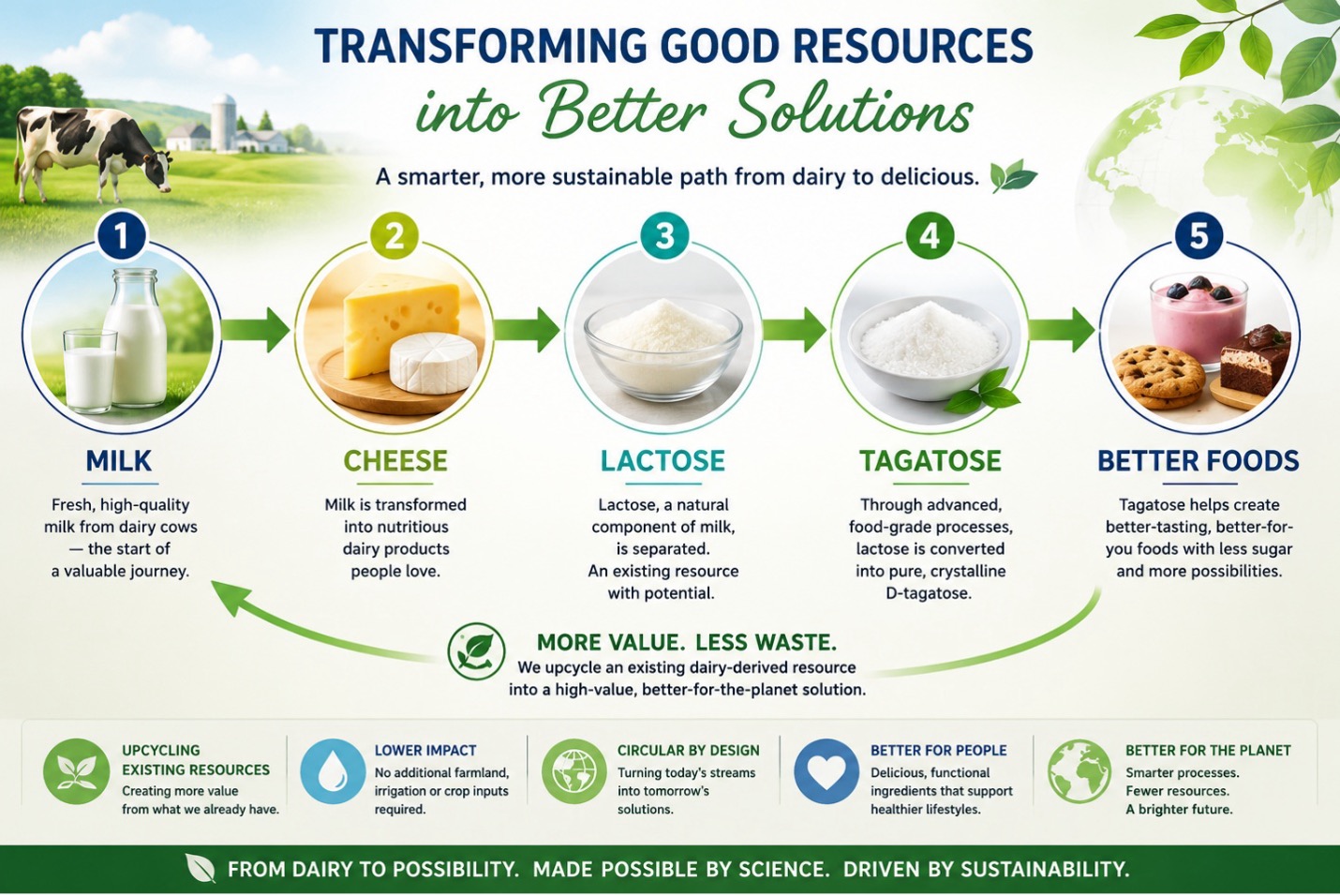
Instead of linear production… Milk → Cheese → Waste
The model becomes: Milk → Cheese → Lactose → Tagatose → Better Foods
Every step creates additional value.
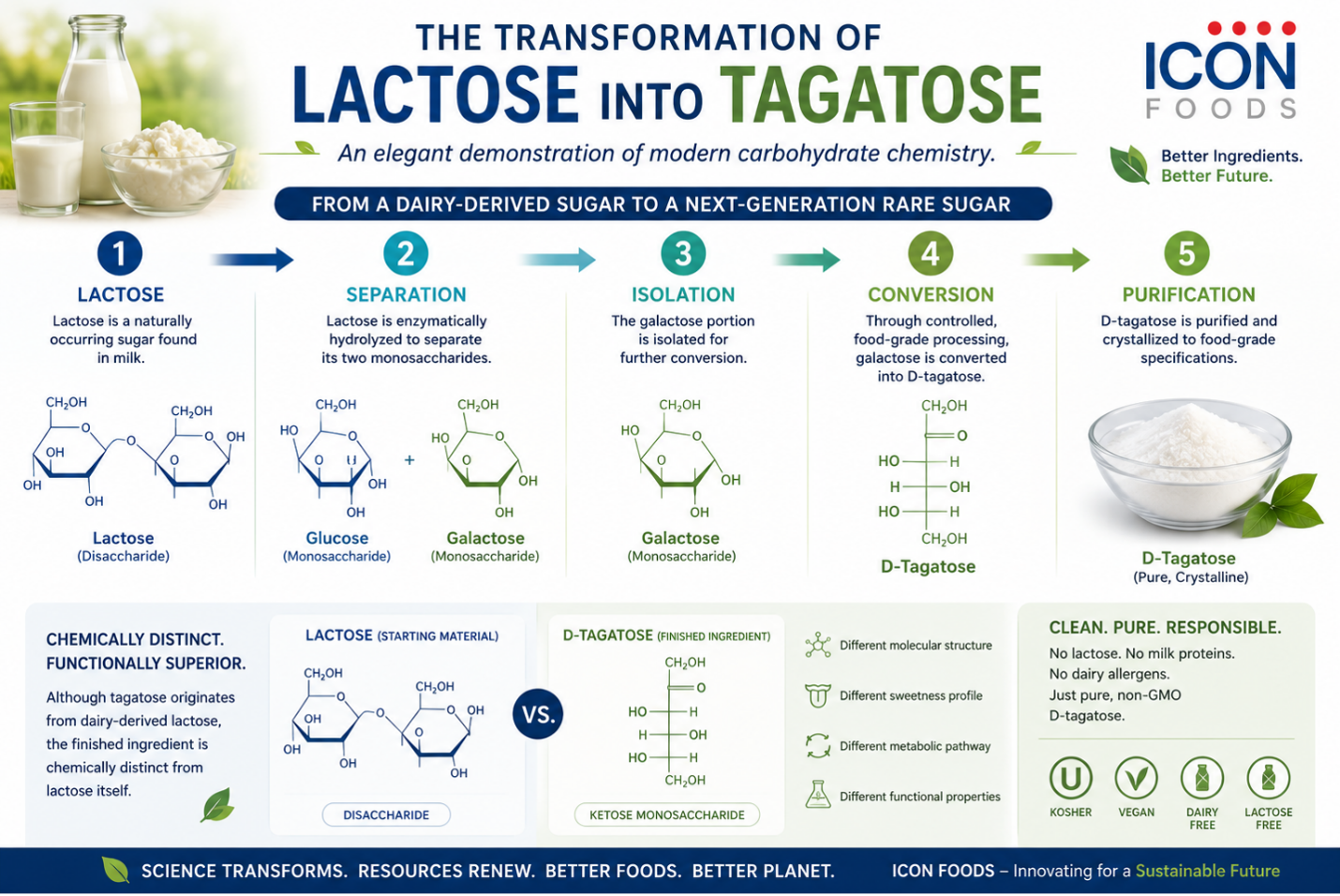
Food Science at Its Best
The transformation of lactose into tagatose is an elegant demonstration of modern carbohydrate chemistry.
Lactose is first separated into its naturally occurring monosaccharides:
- glucose
- galactose
The galactose portion is then converted into D-tagatose through controlled food-grade processing. Although tagatose originates from dairy-derived lactose, the finished ingredient is chemically distinct from lactose itself. The original milk proteins are removed during purification.
Milk fats are absent. Casein is absent. Whey proteins are absent. Lactose is absent. The finished ingredient is simply pure crystalline D-tagatose.
How Can Something From Milk Be Dairy-Free?
This is one of the most common questions formulators receive. The answer lies in purification. Think about pharmaceutical-grade vitamin C. Although it may begin from fermentation of agricultural sugars, the finished molecule is no longer recognizable as its original starting material. The same principle applies to tagatose. The production process removes:
- proteins
- fats
- allergens
- lactose
leaving only purified D-tagatose.
The final ingredient contains no detectable dairy proteins or lactose and therefore does not function as a dairy ingredient.
Kosher. Vegan. Dairy-Free.
Despite its dairy origin, highly purified tagatose can satisfy a surprising range of dietary preferences because the manufacturing process removes all animal-derived components from the finished ingredient. As a result, commercially produced bovine-derived tagatose may be certified:
- Kosher
- Vegan
- Dairy-Free
- Lactose-Free
These certifications are based on both the purification process and compliance with the standards of the certifying organizations. Manufacturers should always verify the specific certifications of the supplier they choose, as certifications apply to individual production facilities and products. This creates a rare combination, a dairy-origin ingredient, that contains no dairy and is suitable for products marketed to vegan consumers when appropriately certified. It is an excellent example of how modern food science can separate origin from composition.
Less Extraction. More Innovation.
Many alternative sweeteners require:
- new crops
- extensive refining
- intensive purification
- dedicated agricultural production
Tagatose begins with an ingredient already present in an established food system. Instead of increasing agricultural demand, it improves the utilization of existing resources. That’s sustainability through efficiency rather than expansion.
Functional Benefits Meet Environmental Benefits
The sustainability story would be interesting on its own. But tagatose also happens to be one of the most functional rare sugars available. It delivers approximately 90% of the sweetness of sucrose while providing:
- Excellent bulking properties
- Sugar-like freezing point depression
- Authentic browning through Maillard reactions
- Superior mouthfeel
- Reduced calories
- Low glycemic response
- Certified prebiotic potential
- Tooth-friendly characteristics
Unlike many high-intensity sweeteners, tagatose contributes both sweetness and structure, allowing formulators to replace more than sweetness alone. That means fewer formulation compromises and, in many applications, fewer additional ingredients.
Sustainability That Consumers Can Understand
Consumers increasingly recognize buzzwords such as:
- Upcycled
- Circular economy
- Reduced waste
- Resource efficiency
Tagatose provides a story that is both scientifically credible and easy to explain. Instead of saying: “We manufacture another sweetener.” We can say: “We transform an existing dairy-derived resource into a next-generation rare sugar, reducing waste while creating healthier foods.”
That is a narrative consumers increasingly appreciate.
Why This Matters to Food Manufacturers
Sustainability is rapidly becoming a competitive advantage rather than simply a corporate responsibility initiative. Major food companies are establishing goals around:
- Carbon reduction
- Resource efficiency
- Waste minimization
- Circular sourcing
- Sustainable ingredient portfolios
Ingredients that naturally support these objectives help brands tell authentic sustainability stories backed by real manufacturing practices. Tagatose fits comfortably into that future.
The Icon Foods Perspective
At Icon Foods, sustainability is not a marketing slogan. It is a design principle that influences how we evaluate every ingredient we bring to market. Our philosophy is simple: The most sustainable ingredient is often the one that delivers more value from resources already available. Tagatose embodies that philosophy beautifully.
By transforming a dairy-derived lactose stream into a premium rare sugar, tagatose demonstrates how modern food science can create better ingredients without demanding additional agricultural resources. It is a practical example of circular thinking, where existing food system outputs become the starting point for the next generation of healthier, more functional products.
When paired with thoughtful formulation, tagatose enables brands to reduce sugar while supporting broader sustainability goals through smarter ingredient sourcing and resource utilization.
For Icon Foods, innovation is measured not only by what an ingredient does inside the formulation, but also by how intelligently it fits into the future of food.
Reach out to your Icon Foods representative for TagaLite Tagatose samples, documentation formulation and usage guidance.
Since 1999 Icon Foods has been your reliable supply chain partner for sweeteners, fibers, sweetening systems, inclusions and sweetness modulators.
Taste the Icon difference.