
by Thom King, CFS, Founder, Chairman, Chief Innovation Officer Icon Foods
There are moments in food science where you stop and just appreciate the absurd beauty of chemistry. Tagatose is one of those moments.
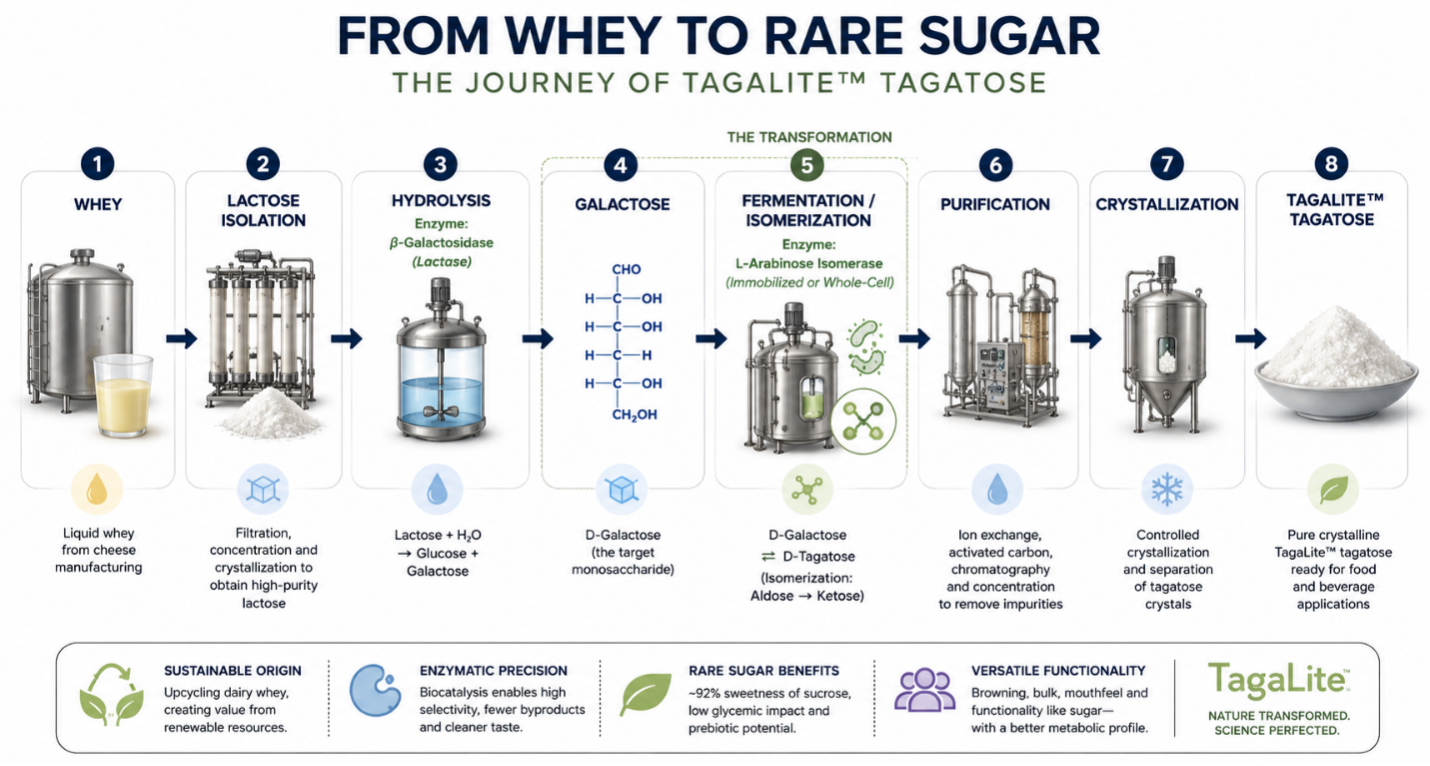
We take lactose, a byproduct of cheese manufacturing that historically created disposal headaches for the dairy industry, and through enzymatic conversion and precision fermentation, transform it into one of the most exciting rare sugars in modern formulation. Same atoms. Different architecture. Completely different metabolic behavior.
That’s not just ingredient manufacturing. That’s molecular engineering wearing a lab coat and cleats.
As formulators, we spend a lot of time chasing sweetness systems that behave like sugar without carrying sugar’s metabolic baggage. Most high-intensity sweeteners can hit sweetness potency, but they struggle with functionality. Tagatose occupies a very different lane. It behaves like a carbohydrate because it is a carbohydrate. It simply happens to be one the body handles differently. That distinction matters.
The Starting Point: Lactose
Commercial tagatose production begins with lactose, typically recovered from whey streams generated during cheese manufacturing. Whey permeate and dairy side streams are purified using membrane filtration, crystallization, and drying technologies to isolate high-purity lactose. This process simultaneously creates value from a former waste stream while supplying the substrate needed for rare sugar production.¹
Lactose itself is a disaccharide composed of glucose and galactose:
Lactose=Glucose+Galactose
Before conversion to tagatose can occur, lactose must first undergo hydrolysis.
Step One: Hydrolysis
Using the enzyme β-galactosidase, commonly known as lactase, lactose is cleaved into its two monosaccharide components:
Lactose+H2O→Glucose+Galactose
The glucose fraction is generally removed or metabolized separately within the process stream. The real target is D-galactose, because this is where the transformation begins. And this is where food science starts throwing 98 mph fastballs.
The Conversion: Galactose to Tagatose
Tagatose production relies on an isomerization reaction in which D-galactose is rearranged into D-tagatose:
D-Galactose⇌D-Tagatose
Industrially, this is typically achieved using the enzyme L-arabinose isomerase, often derived from thermophilic or engineered microbial strains including Geobacillus stearothermophilus, Thermotoga maritima, and selected Lactobacillus species.²˒³
This conversion changes the sugar from an aldose to a ketose without altering the molecular formula. Same molecular composition. Different carbonyl placement. Entirely different physiological behavior.
That tiny rearrangement changes everything. Modern tagatose manufacturing increasingly relies on:
- Immobilized enzyme systems
- Precision fermentation
- Whole-cell biocatalysis
- Continuous bioreactor processing
Compared to older alkaline chemical conversion methods, fermentation-driven enzymatic systems provide:
- Higher selectivity
- Lower degradation product formation
- Improved sensory quality
- Reduced color generation
- Better sustainability metrics
- Improved purity profiles⁴
In practical terms, this means cleaner flavor, better formulation performance, and reduced off-notes. For formulators, that matters more than most marketing decks ever will.
Purification and Crystallization
Following bioconversion, the reaction broth contains a mixture of:
- Tagatose
- Residual galactose
- Minerals
- Salts
- Organic impurities
- Enzyme residues
Purification commonly involves:
- Ion exchange
- Activated carbon treatment
- Simulated moving bed chromatography
- Vacuum concentration
- Controlled crystallization⁵
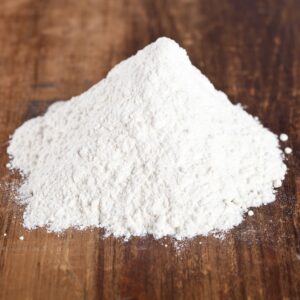
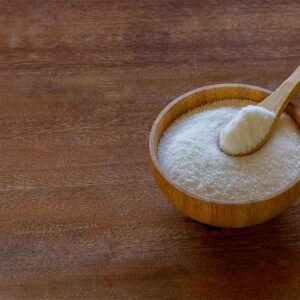
The resulting crystalline tagatose delivers:
- Approximately 92% the sweetness of sucrose
- Excellent solubility
- Minimal cooling effect
- Participatory Maillard browning
- Sugar-like bulking properties
This last point is critically important. Unlike most high-intensity sweeteners, tagatose behaves functionally like a true carbohydrate system.
Why Tagatose Is So Valuable in Formulation
This is where the ingredient separates itself from the pack. Most high-intensity sweeteners are sweetness delivery systems. They provide sweetness potency, but they do not provide the structural, thermal, or sensory contributions of sugar. Tagatose does. It contributes:
- Bulk
- Mouthfeel
- Water activity control
- Freezing point depression
- Humectancy
- Browning reactions
- Flavor development
That opens doors across:
- Dairy applications
- Chocolate systems
- Frozen desserts
- Baked goods
- Gummies
- Nutritional products
- RTD beverages
In many systems, formulators are not simply replacing sweetness. They are rebuilding architecture. Sugar is a structural ingredient masquerading as a sweetener. Tagatose understands the assignment.
Metabolic and Microbiome Considerations
Tagatose also possesses unique physiological properties that continue attracting scientific interest. Due to incomplete absorption in the small intestine, a portion of ingested tagatose reaches the colon where it undergoes microbial fermentation. Studies have demonstrated that tagatose fermentation can increase short-chain fatty acid production including butyrate, acetate, and propionate.⁶˒⁷ Research has additionally shown:
- Low glycemic impact
- Reduced insulin response
- Favorable caloric reduction compared to sucrose
- Potential prebiotic effects⁶˒⁸
For formulators working in:
- Better-for-you beverages
- Functional foods
- Metabolic health
- Gut health
- GLP-1 aligned products
…this becomes extremely relevant.
We are watching the market evolve from simple sugar reduction into metabolic optimization. That is a very different ballgame.
The Manufacturing Challenge
Tagatose is not a commodity ingredient. Thus, the high price. This should come down as manufacturing becomes more efficient and massive scale is achievable because the substrate is almost free. Until then manufacturing remains technically demanding due to:
- Isomerization equilibrium limitations
- Yield constraints
- Energy-intensive purification
- Crystallization complexity
Fermentation optimization requirements. Historically, conversion yields remained relatively low because the galactose-to-tagatose reaction naturally reaches equilibrium before full conversion. Advanced systems now improve efficiencies using:
- Thermophilic enzymes
- Immobilized biocatalysts
- Continuous reactor systems
- Product removal technologies
- Metabolic engineering strategies⁹
This is one reason tagatose has traditionally carried a higher cost structure than conventional sweeteners. You are not refining corn syrup.You are orchestrating molecular rearrangement at industrial scale.
At Icon Foods we have spent decades formulating with virtually every sweetener system on the market. Very few ingredients genuinely change how formulators think about sugar reduction. Tagatose is one of them. Not because it is trendy. Not because it photographs well on LinkedIn. Not because somebody slapped “clean label” on a sales sheet.
It matters because it behaves like food. It browns. It builds body. It supports flavor development. It contributes texture. It works with proteins. It works in frozen systems.It works in baked goods. It works where formulators actually live: in the brutal physics of finished product performance. And perhaps most fascinating of all, it begins with lactose from dairy waste streams and ends as a rare sugar with dramatically different metabolic behavior. That’s a mind blower.
Food science at its best is not subtraction. It is transformation and tagatose is one of the best examples of that.
References
- Levin GV. Tagatose, the new GRAS sweetener and health product. J Med Food. 2002;5(1):23-36.
- Oh DK. Tagatose: properties, applications, and biotechnological processes. Appl Microbiol Biotechnol. 2007;76:1-8.
- Kim P. Current studies on biological tagatose production using L-arabinose isomerase: a review and future perspective. Appl Microbiol Biotechnol. 2004;65:243-249.
- Beerens K, Desmet T, Soetaert W. Production of tagatose by biotechnological methods. Appl Microbiol Biotechnol. 2012;93:603-613.
- Granström TB, Takata G, Tokuda M, Izumori K. Izumoring: a novel and complete strategy for bioproduction of rare sugars. J Biosci Bioeng. 2004;97(2):89-94.
- Bertelsen H, Jensen BB, Buemann B. D-Tagatose: a novel low-calorie bulk sweetener with prebiotic properties. World Rev Nutr Diet. 1999;85:98-109.
- Laerke HN, Jensen BB, Højsgaard S. In vitro fermentation pattern of D-tagatose is affected by adaptation of the microbiota from the gastrointestinal tract of pigs. J Nutr. 2000;130:1772-1779.
- Donner TW, Wilber JF, Ostrowski D. D-Tagatose, a novel hexose: acute effects on carbohydrate tolerance in subjects with and without type 2 diabetes. Diabetes Obes Metab. 1999;1:285-291.
- Caspeta L, Castillo T, Nielsen J. Modifying biocatalytic processes for rare sugar production: advances and opportunities. Biotechnol Adv. 2015;33:1484-1493.