
Tagatose in Beverages: A Formulator’s Guide to Building Better Drinks
By Thom King CFS – Food Scientist, Founder & Chief Innovation Officer, Icon Foods
The beverage industry has spent the last decade chasing the holy grail of sugar reduction. We’ve tried high-intensity sweeteners alone. We’ve tried fibers. We’ve tried modulators. We’ve tried flavor systems designed to convince consumers that less sugar somehow tastes like more sugar. Some work. Most involve tradeoffs. Tagatose is different.
Tagatose behaves more like sugar than most alternative sweeteners because, chemically speaking, it is a sugar. It delivers approximately 92% of the sweetness of sucrose, contributes bulk, provides a clean temporal profile, and supports mouthfeel in ways that many high-intensity sweeteners simply cannot.
For beverage formulators looking to reduce sugar while maintaining consumer acceptance, tagatose deserves a place in the toolbox.
Why Tagatose Works So Well in Beverages
Unlike stevia, monk fruit, or thaumatin, tagatose contributes sweetness through mass. This matters because sweetness is only part of what sugar contributes to a beverage. Sugar also provides:
- Body
- Mouthfeel
- Flavor delivery
- Sweetness onset
- Sweetness duration
- Flavor balance
Tagatose helps restore many of these functions while reducing calories and eliminating added sugar declaration concerns under current FDA guidance. The result is often a beverage that tastes more complete, more rounded, and more sugar-like than formulations relying solely on high-intensity sweeteners.
Beverage Categories Where Tagatose Excels
Ready-to-Drink Teas
Tea is notoriously unforgiving. Bitter polyphenols, tannins, and botanical notes often become more noticeable when sugar is removed. Tagatose helps soften these rough edges while contributing a sucrose-like sweetness profile. Typical Applications:
- Sweet tea
- Green tea
- Yerba mate
- Functional teas
- Botanical beverages
Recommended Starting Level: 1.5-4.0%
Energy Drinks
Energy drinks often contain acids, caffeine, amino acids, vitamins, and botanical extracts. These ingredients can create bitterness and metallic off-notes. Tagatose helps round the flavor profile while working synergistically with stevia, monk fruit, and thaumatin.
Recommended Starting Level: 1.0-3.0%
Best paired with:
- Reb M
- Monk fruit
- Thaumatin
- Natural flavor modulators
Functional Beverages
The more functionality you add, the more flavor challenges you create. Adaptogens, nootropics, mushrooms, electrolytes, amino acids, and nutraceuticals can all introduce bitterness. Tagatose provides a valuable sweetness foundation that helps mask these challenges while contributing body.
Recommended Starting Level: 2.0-5.0%
Sports Drinks and Electrolyte Beverages
Sports drinks benefit from sweetness, but they also need refreshment. Tagatose delivers sweetness without becoming heavy or syrupy.
Recommended Starting Level: 1.0-3.0%
Particularly effective when paired with:
- Allulose
- Reb M
- Monk fruit
Protein Beverages
Protein beverages often suffer from:
- Barnyard off-notes
- Chalkiness
- Astringency
- Lingering bitterness
Tagatose helps smooth texture and soften off-notes.
Recommended Starting Level: 2.0-6.0%
Particularly effective when paired with:
- MonkSweet LS4
- Thaumatiq L10
- SteviaSweet RM95D
Especially effective in:
- Dairy-based RTDs
- Plant-based protein beverages
- Meal replacement beverages
Carbonated Soft Drinks
Tagatose performs exceptionally well in carbonated systems because carbonation enhances sweetness perception while helping maintain refreshment.
Recommended Starting Level: 1.5-4.0%
Applications Where Tagatose May Not Be the Best Fit
No ingredient is perfect. Tagatose has a few situations where formulators should proceed carefully. Ultra-Low-Cost Beverages. If the formulation target is a highly cost-sensitive product where every fraction of a cent matters, tagatose may not be the most economical sweetening option. In these situations, blends of:
- Allulose
- High-intensity sweeteners
- Fibers
may provide a lower cost-in-use solution.
Shelf-Stable High-Protein Systems
Tagatose is a reducing sugar. In certain high-protein systems subjected to severe thermal processing, Maillard browning can occur over time. This isn’t necessarily a problem, but it should be evaluated during shelf-life testing. Pay particular attention to:
- UHT beverages
- High-protein RTDs
- Extended ambient storage products
Extremely Acidic Beverages
Tagatose is generally stable in beverage systems, but highly acidic products should always undergo accelerated shelf-life testing to confirm flavor stability. Examples include:
- Energy shots
- Acidified wellness shots
- Highly acidified juice concentrates
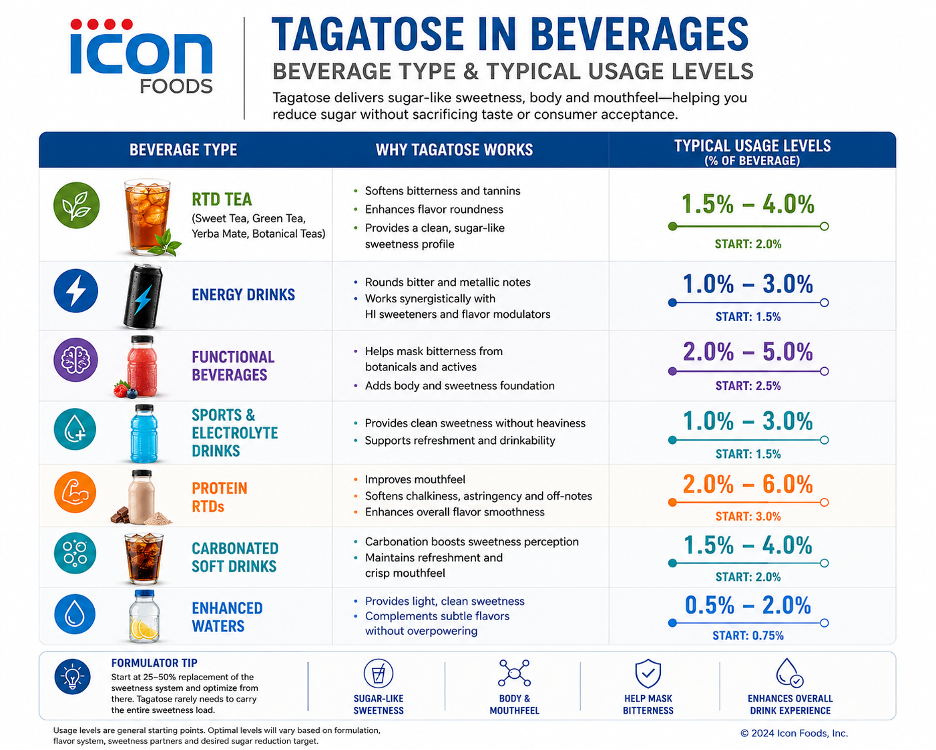
Recommended Starting Usage Levels
|
Beverage Type |
Typical Usage |
|
RTD Tea |
1.5-4.0% |
|
Energy Drinks |
1.0-3.0% |
|
Functional Beverages |
2.0-5.0% |
|
Sports Drinks |
1.0-3.0% |
|
Protein RTDs |
2.0-6.0% |
|
Carbonated Soft Drinks |
1.5-4.0% |
|
Enhanced Waters |
0.5-2.0% |
A good rule of thumb: Start at 25-50% replacement of the sweetness system and optimize from there. Rarely does tagatose need to carry the entire sweetness load. Its real magic happens when it serves as the foundation of a sweetener stack.
Best Practices for Formulators
Think in Systems, Not Ingredients
The strongest beverage formulations often combine:
- Tagatose
- Reb M
- Monk Fruit
- Thaumatin
- Fibers for viscosity
Each ingredient contributes something different. Tagatose supplies sugar-like sweetness and body. Reb M delivers sweetening power. Monk fruit broadens the sweetness curve. Thaumatin extends sweetness duration and enhances flavor. Fibers improve mouthfeel and support nutritional positioning. Together they often outperform any single sweetener.
Use Tagatose to Reduce Sweetener Stress
One of the biggest mistakes formulators make is asking a high-intensity sweetener to do all the work. When stevia or monk fruit must provide 100% sweetness replacement, off-notes become more noticeable. When tagatose supplies part of the sweetness foundation, high-intensity sweeteners can operate in their sweet spot. The result is often cleaner, more consumer-friendly flavor.
Evaluate During Shelf-Life Testing
Always evaluate:
- Color development
- Flavor stability
- Sweetness stability
- Protein interactions/Maillard
- Packaging interactions
Particularly in shelf-stable beverages.
Tagatose is not trying to be stevia. It is not trying to be allulose. It is not trying to be monk fruit. Its value comes from behaving more like sugar than almost any alternative sweetener available today. For beverage formulators, that creates an opportunity.
The future of sugar reduction will not be built around a single ingredient. It will be built around intelligently designed sweetener systems. Tagatose is increasingly becoming one of the most useful players on that team. And in beverages, it often punches well above its weight class.
This piece pairs particularly well with a follow-on section showcasing Icon Foods TagaLite™ Tagatose, including synergy data with SteviaSweet™ RM95D, Thaumatiq™ L10, and FibRefine™ beverage fiber systems, which is where the formulation story gets really interesting.
At Icon Foods, we’ve spent more than two decades helping formulators solve one of the industry’s toughest challenges: delivering sugar-like taste and functionality without the sugar.
What makes our approach different is that we don’t view tagatose as a standalone ingredient. We view it as part of a complete sweetness architecture.
Our TagaLite™ Tagatose works seamlessly with our portfolio of sweeteners, fibers, and modulators, allowing formulators to build systems that are cleaner, more sugar-like, and often more cost-effective than relying on any single ingredient.
For beverage developers, that means access to:
- TagaLite™ Tagatose for sugar-like sweetness and mouthfeel
- SteviaSweet™ RM95D for clean, high-potency sweetness
- SteviaSweet™ SG95e for exceptional sensory performance at a highly competitive cost-in-use
- MonkSweet™ LS4 for sweetness curve enhancement
- Thaumatiq™ L10 for sweetness amplification and flavor enhancement
- FibRefine™ beverage fibers for mouthfeel, fiber claims, sugar replacement solids, and digestive wellness positioning
The result is a toolbox that allows formulators to target virtually any beverage category, from zero-sugar energy drinks and functional beverages to protein RTDs, sparkling refreshers, coffee drinks, teas, and nutritional beverages. Perhaps most importantly, we formulate these systems every day.
We don’t simply sell ingredients. We help customers solve sweetness challenges, reduce sugar, improve margins, achieve label claims, and get products to market faster. Because at the end of the day, consumers don’t buy sweeteners. They buy beverages that taste great. Our job is helping you create them.