

By Thom King, CFS, Founder and Chief Innovation Officer, Icon Foods
Let’s talk dairy. Milk, yogurt, ice cream, and cultured dairy products are some of the most interesting formulation systems in the food industry. They are also some of the least forgiving when we start tinkering with sugar.
Consumers want less sugar. They want more protein. They want clean labels, fewer calories, better nutrition, and, naturally, they want everything to taste exactly as good as the full-sugar version. Of course they do. And apparently, we’re supposed to accomplish all of this without changing the flavor, texture, mouthfeel, stability, or price. No pressure.
The problem is that sucrose is doing considerably more work in dairy than simply making things sweet. It contributes solids, influences water activity, modifies freezing behavior, balances acidity, and helps create the rich, rounded sensory experience consumers associate with indulgence. Take it out, and things start getting interesting.
That’s where rebaudioside M, or Reb M, enters the conversation. Not because it magically replaces everything sugar does. It doesn’t. But because it gives formulators a remarkably useful tool for rebuilding sweetness without dragging along the bitterness, licorice character, and lingering aftertaste historically associated with some stevia extracts. And in dairy, where subtle flavor defects have nowhere to hide, that is a very big deal.
Meet Reb M: Stevia’s More Sophisticated Cousin
Reb M is one of the naturally occurring steviol glycosides found in the leaves of Stevia rebaudiana. It belongs to the same family as rebaudioside A, or Reb A, but its molecular structure contains additional glucose units attached to the steviol backbone. Those seemingly minor structural differences have substantial sensory consequences.
Reb M generally exhibits a more sucrose-like sweetness profile than Reb A, with less perceived bitterness, astringency, and lingering off-notes. Published research places its sweetness potency at approximately 200 to 350 times that of sucrose, depending on the concentration and evaluation conditions. Here’s where the chemistry gets interesting.
Our perception of sweetness begins when sweet compounds interact with the T1R2/T1R3 sweet taste receptor complex. Different sweeteners interact with this receptor system differently, influencing perceived sweetness intensity and temporal characteristics.
Reb M’s glycosylation pattern contributes to a sensory profile that, in comparative studies, tends to be closer to sucrose than traditional Reb A. That doesn’t mean Reb M tastes identical to sugar. It means we have a better starting point for building a convincing sweetness profile. And in formulation, a better starting point can save an enormous amount of time, money, and colorful language in the laboratory.
Why Dairy Is Such an Interesting Sweetness Environment
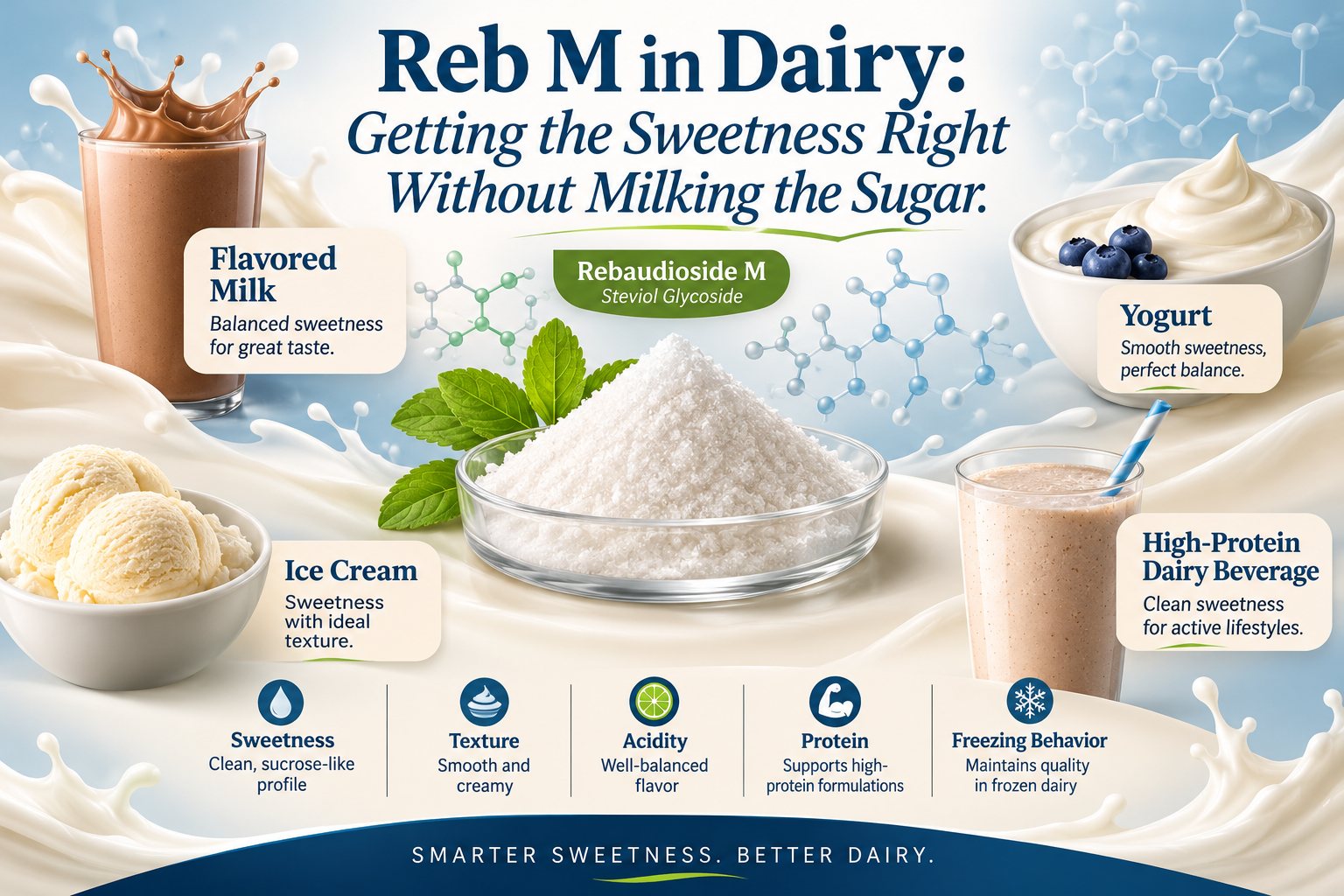
Dairy isn’t water with a little milk flavor sprinkled in. It’s a complex colloidal system containing proteins, fats, minerals, lactose, and, depending on the product, hydrocolloids, cultures, and flavor compounds. Every one of those components can influence how sweetness is experienced. Consider the major players.
Milk proteins: Casein micelles and whey proteins contribute body and influence flavor perception. High-protein systems can introduce bitterness, astringency, and drying sensations that complicate sweetness optimization.
Milk fat: Fat contributes richness, lubrication, and flavor delivery. Removing fat and sugar simultaneously can make a product seem thin, acidic, or less indulgent.
Lactose: Milk’s naturally occurring sugar provides modest sweetness compared with sucrose. Its contribution becomes especially important when formulating reduced-added-sugar products.
Acidity: In yogurt, kefir, and cultured dairy, lactic acid introduces sourness that must be balanced by sweetness.
Hydrocolloids and fibers: These ingredients influence viscosity, water retention, texture, and oral processing. They can change how quickly flavor and sweetness are perceived, even when the sweetener concentration remains constant.
The result? The same concentration of Reb M can produce a different sensory experience in skim milk, whole milk, Greek yogurt, and ice cream. This is why I continually remind formulators that sweetness equivalency measured in water is a starting point, not a finished formulation. The matrix matters. It always matters.
The Sweetness Curve: Where Reb M Earns Its Keep
When we evaluate sweeteners, we tend to focus on sweetness intensity. How sweet is it? How many times sweeter than sugar? How much do we need? Those are useful questions, but they don’t tell the whole story. Sweetness has a beginning, a middle, and an end. I like to think of it as a three-act movie.
Act One: Onset. How quickly does sweetness appear after the product enters the mouth?
Act Two: Peak. How intense is the sweetness, and how well does it integrate with the product’s flavor?
Act Three: Decay. How quickly does sweetness disappear, and what flavors or off-notes remain after swallowing?
Sucrose provides a familiar temporal reference. Its sweetness develops relatively quickly, reaches a rounded peak, and then declines without an unusually persistent sweet tail. Traditional Reb A can present a slower onset, a different sweetness trajectory, and a lingering bitter or licorice-like finish. Reb M generally improves that experience. Comparative sensory studies have reported faster sweetness onset and reduced lingering bitterness for Reb M relative to Reb A. In dairy, this is key.
Imagine a vanilla yogurt with a beautiful, creamy opening, followed by an oddly persistent sweetness that outlasts the vanilla. The consumer may not identify the problem as stevia. They just know something tastes off. Reb M can help bring the sweetness curve into better alignment with the dairy flavor profile. But here’s the important distinction, Reb M improves the sweetness architecture. It does not automatically fix the entire building. If you’ve removed 8% sucrose from a yogurt, you still have to account for the lost solids, body, and sensory balance.
Reb M in Fluid Milk and Flavored Dairy Beverages
Flavored milk is one of the most promising applications for Reb M. Chocolate milk, strawberry milk, vanilla milk, and ready-to-drink dairy beverages all present opportunities for meaningful added-sugar reduction. The challenge is maintaining a balanced flavor profile.
In chocolate milk, sweetness has to work against cocoa bitterness and astringency. In strawberry milk, it has to complement fruit acidity and aroma. In vanilla milk, there is virtually nowhere for off-notes to hide. Reb M’s relatively clean sweetness profile makes it an attractive candidate across all three.
Chocolate milk: The cocoa conundrum
Cocoa contains polyphenols and other compounds that contribute bitterness and astringency. Sucrose helps balance those characteristics. When sucrose is reduced, cocoa bitterness can become more pronounced. Reb M can restore sweetness intensity without adding significant calories, but it does not necessarily reproduce all of sucrose’s bitterness-suppression effects.
In many formulations, the best approach is to retain a portion of the sugar and replace the remaining sweetness with Reb M. For example, a chocolate milk containing 8% added sucrose might initially be reformulated to 4% sucrose, with Reb M supplying much of the sweetness difference. That is a starting hypothesis, not a guaranteed sensory equivalence. The final concentration should be determined through bench trials, considering cocoa type, milk fat, protein concentration, and the target sweetness profile.
Vanilla milk: The honesty test
Vanilla is a particularly revealing application. A high-quality vanilla dairy beverage should taste creamy, rounded, and aromatic, without a medicinal finish or sweetness that hangs around after the vanilla has left the building. Reb M’s reduced bitterness compared with Reb A can be a meaningful advantage here. But the vanilla flavor system must be evaluated alongside the sweetener.
Sweetness and aroma interact perceptually. A formulation that delivers sufficient sweetness analytically may still seem less flavorful if the overall sensory balance has shifted. My advice? Don’t just match sweetness. Match the entire flavor experience.
Reb M in Yogurt: Balancing Sweetness and Acidity
Yogurt is where things get particularly interesting. Cultured dairy introduces lactic acid, which contributes the characteristic tartness consumers expect. Sugar traditionally balances that acidity while also contributing body and solids. Remove the sugar, and the yogurt can become noticeably more tart, even if the actual pH hasn’t changed. This is a sensory interaction, not necessarily a change in acid concentration. Reb M can help restore sweetness and improve the sweetness-to-acidity balance.
Published application research has also demonstrated that Reb M can remain functional through yogurt processing and refrigerated storage. One study reported no significant loss of sweetness during pasteurization and fermentation, with stability maintained over six weeks of refrigerated storage.
Sweetness-to-acid ratio
The appropriate Reb M concentration depends on the yogurt’s titratable acidity, pH, fruit preparation, and intended sweetness. A mild vanilla yogurt may require a very different sweetness system than a tart raspberry Greek yogurt.
Protein concentration
Greek and high-protein yogurts introduce additional challenges. Concentrated protein systems may increase perceived astringency or chalkiness, depending on the protein composition and processing conditions. Reb M can improve sweetness balance, but it cannot independently eliminate those texture defects.
Lost solids and mouthfeel
If sucrose is removed, the yogurt may lose body and perceived creaminess. This is where ingredients such as Icon Foods’ FibRefine™ soluble tapioca fiber or suitable soluble dietary fibers may play a supporting role. They can contribute solids and, depending on the specific fiber and usage level, modify viscosity and mouthfeel. However, they are not interchangeable.
Soluble tapioca fiber, acacia, partially hydrolyzed guar gum, and inulin can behave very differently in cultured dairy systems. Their effects on viscosity, fermentation, syneresis, and gastrointestinal tolerance must be evaluated individually. The objective isn’t simply to make the yogurt thicker. It’s to restore the texture and sensory balance that sugar helped create.
Ice Cream: Where Sweetness Meets Thermodynamics
Now we’re getting into some wonderfully nerdy territory. Ice cream is a multiphase system involving ice crystals, air cells, fat globules, and a concentrated unfrozen serum phase. Sugar plays a critical role in controlling freezing behavior. Sucrose depresses the freezing point, helping determine how much water remains unfrozen at a given temperature. That influences hardness, scoopability, ice crystal formation, and the overall eating experience. Reb M provides sweetness but contributes negligible bulk at its normal use levels.
Consequently, replacing sucrose with Reb M alone can produce an ice cream that is harder, icier, and less pleasant to eat. The sweetness may be beautiful. The texture may resemble a frozen hockey puck. Not exactly the consumer experience we’re after.
The solution: Separate sweetness from freezing functionality
In reduced-sugar ice cream, we need to address several functions independently:
- Sweetness: Reb M can deliver sweetness intensity.
- Freezing-point depression: Appropriate carbohydrates, rare sugars or polyols can help restore freezing behavior.
- Total solids: Fibers, dairy solids, and other bulking ingredients can help replace lost mass.
- Body and texture: Stabilizers, proteins, and the overall formulation must be optimized to manage ice crystals and melting behavior.
Icon Foods’ allulose and particularly tagatose can be especially interesting in certain frozen dairy systems because it contributes bulk and freezing-point depression while providing less sweetness than sucrose. But allulose and tagatose is not a drop-in replacement on a gram-for-gram basis.
Its freezing-point-depression contribution per unit mass differs from sucrose, and excessive substitution can produce an overly soft product. This is where Reb M becomes particularly valuable.
We can use allulose or tagatose to address part of the physical functionality while using Reb M to fine-tune sweetness without substantially changing the solids concentration. In other words, let each ingredient do what it does best. That’s a much better strategy than asking one ingredient to play every position on the field.
High-Protein Dairy: Reb M Has Another Job to Do
High-protein dairy beverages are enjoying tremendous consumer interest, and for good reason. Protein provides nutritional value, satiety, and functionality. Unfortunately, protein ingredients don’t always come with a complimentary flavor profile.
Whey protein concentrates, whey protein isolates, milk protein concentrates, and hydrolyzed proteins can introduce varying degrees of bitterness, astringency, sulfurous notes, and mouth-drying sensations. The higher the protein loading, the more challenging the sensory system can become. Reb M offers an opportunity to improve sweetness quality, but let’s be clear about something. Sweetness enhancement is not the same thing as flavor masking.
Reb M can help balance certain unpleasant taste attributes through sweetness interactions, but it does not chemically remove bitter compounds or guarantee suppression of protein-derived off-notes. This distinction becomes especially important in protein beverages.
A 30-gram protein shake with an unpleasant bitter finish may require a combination of sweetness optimization, protein selection, flavor development, and texture management. Simply increasing Reb M until the bitterness disappears is usually a poor strategy. At some point, you’re likely to create an excessively sweet beverage with an unusually persistent finish. Congratulations. You’ve traded one problem for another.
The Reb M and thaumatin opportunity
This is where blending sweeteners becomes particularly interesting. At Icon Foods, we work with sweetening systems incorporating Reb M, monk fruit mogrosides, and thaumatin. Thaumatin is a sweet-tasting protein with a distinctive temporal sweetness profile, including a relatively long-lasting sweet finish.
In carefully optimized blends, it may help shape sweetness perception and support flavor continuity. For example, a Reb M and thaumatin system could be evaluated for its ability to extend the perception of sweetness and complement vanilla, chocolate, or caramel flavor notes. But the operative word is optimized. Too much thaumatin can produce an overly persistent sweetness tail. The objective is not to make sweetness last forever. It’s to make the sweetness last exactly as long as the flavor experience requires. That’s the difference between formulation and ingredient dumping.
Processing Stability: Can Reb M Take the Heat?
Dairy products encounter a wide range of processing conditions, from conventional pasteurization to ultra-high-temperature processing, fermentation, homogenization, and frozen storage. Reb M is generally compatible with many of these conditions. Published research indicates that Reb M exhibits useful stability across approximately pH 4–8, with degradation dependent on temperature, pH, and exposure time. That’s particularly encouraging for dairy applications. However, a few distinctions deserve attention.
Pasteurized milk: Reb M is a reasonable candidate for conventional pasteurized dairy beverages, subject to validation under the actual processing conditions.
Cultured dairy: Reb M has demonstrated stability in yogurt applications, including during fermentation and refrigerated storage.
UHT beverages: Short-duration high-temperature exposure may be compatible, but commercial UHT processing, extended ambient storage, and the complete formulation should be evaluated together.
Frozen dairy: Reb M can provide sweetness in frozen systems, but freeze-thaw behavior, recrystallization, and sweetness perception at serving temperature require attention.
One additional consideration is solubility. Reb M is not infinitely soluble in water. Its crystalline and amorphous forms exhibit different dissolution characteristics, and published equilibrium solubility data indicate limitations that formulators should understand. At typical dairy usage concentrations, this is often manageable. Still, proper ingredient dispersion, hydration, and incorporation are essential.
My preference is to prepare a properly dissolved sweetener premix before incorporating it into the larger dairy system, provided the selected ingredient grade and process support that approach. To really suspend these molecules, I would recommend vegetable glycerin.
And remember, a product that tastes perfect immediately after processing may behave differently after six months of storage. Shelf-life testing is not optional.
Formulation Starting Points: Putting Reb M to Work
The following concentrations are proposed screening ranges for purified Reb M, not finished commercial formulations or validated Icon Foods product specifications. Published application research identifies a broad range of approximately 150–1,000 ppm for dairy products when Reb M is used as a single sweetener. For reduced-sugar formulations that retain some sucrose or other sweeteners, lower concentrations may be appropriate.
| Dairy application | Initial Reb M screening range |
|---|---|
| Reduced-sugar flavored milk | 75–200 ppm |
| Chocolate milk | 100–250 ppm |
| Vanilla yogurt | 100–250 ppm |
| Fruit yogurt | 125–300 ppm |
| High-protein RTD beverage | 100–300 ppm |
| Reduced-sugar ice cream | 100–250 ppm |
These are illustrative bench-trial ranges for formulation development, not experimentally established optimum concentrations. Actual requirements depend on Reb M purity, remaining sugars, product composition, desired sweetness, and sensory performance. One ppm is approximately 1 mg/kg in a product measured by mass.
I would recommend evaluating at least three Reb M concentrations within a suitable range, alongside a full-sugar control and a reduced-sugar control without Reb M. And don’t just ask panelists whether the product is sweet enough. Ask what happens to the sweetness over time. Does it arrive too slowly? Does it complement the dairy flavor? Does it linger? Does it amplify or expose bitterness? Does the product still taste creamy? Those answers tell us far more than a simple sweetness intensity score.
The Icon Foods Approach: Build a Sweetening System, Not a Sweetener Dependency
One of the most common formulation mistakes I see is the assumption that a single sweetener should solve every problem. Sometimes it can. Often, it can’t.
At Icon Foods, we approach sugar reduction by separating the functions that sucrose originally provided.
SteviaSweet™ RM95
Provide high-intensity sweetness with a relatively clean sensory profile. These are useful starting points for reducing sugar in milk, yogurt, and high-protein dairy products.
FibRefine™ soluble fibers
Help restore solids and modify texture where appropriate. Fiber selection must account for the desired viscosity, stability, and sensory properties.
TagaLite™ Tagatose
Offers bulk, sweetness, and freezing-point functionality, making it particularly useful to investigate in frozen dairy applications.
KetoseSweet™ Allulose
Provides bulk, sweetness, and freezing-point depression, making it a particularly promising ingredient for frozen dairy formulations where texture, scoopability, and sweetness balance are critical.
Thaumatiq™ and thaumatin sweetness modulation systems
Provide additional opportunities to modify sweetness timing and flavor perception in selected dairy applications.
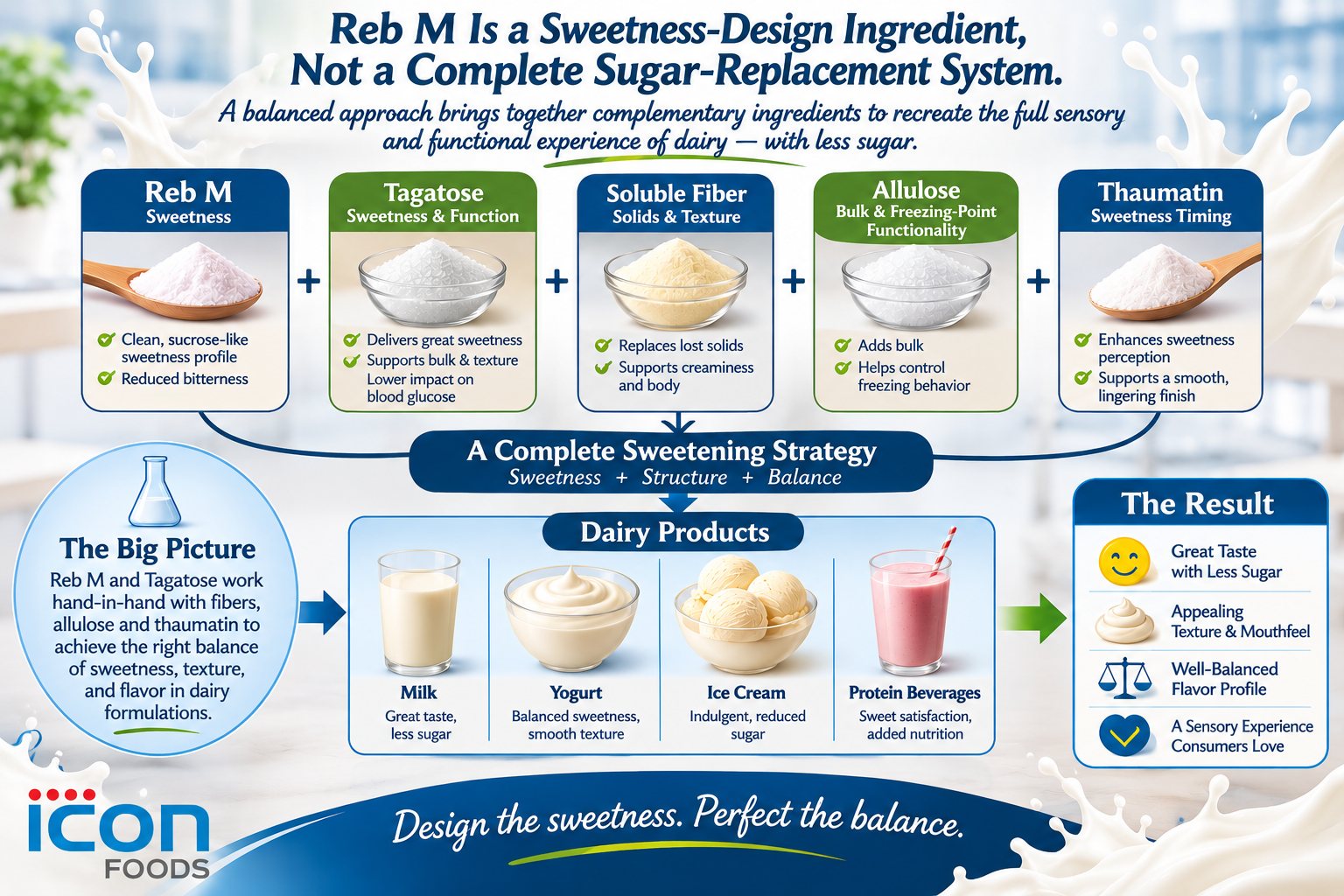
The key is understanding that these ingredients perform different jobs. Reb M supplies sweetness. Fibers may contribute solids and texture. Tagatose and Allulose contributes bulk and freezing behavior. Thaumatin can influence the temporal sweetness profile. The magic, if you’ll forgive a scientist for using that word, comes from understanding how those functions interact.
One caution: ingredient origin, manufacturing process, and regulatory status must be verified for the specific grade and target market. Reb M made through leaf extraction, enzymatic bioconversion, or fermentation may have different specifications and labeling considerations. Regulatory permissions and claims also need to be checked for the intended dairy product.
A Practical Dairy Formulation Protocol
If I were developing a reduced-sugar dairy product tomorrow, here’s how I’d approach it.
Step 1: Establish the full-sugar control
Measure pH, titratable acidity where relevant, viscosity, total solids, and sweetness intensity. For frozen products, establish hardness, overrun, and melting behavior.
Step 2: Reduce sucrose in controlled increments
Evaluate 25%, 50%, and 75% added-sugar reduction, where feasible. This helps identify the point where sensory and physical defects become significant.
Step 3: Introduce Reb M using a concentration series
Evaluate sweetness onset, peak, decay, bitterness, and overall acceptability. Do not assume a fixed sweetness equivalency across matrices.
Step 4: Restore missing functionality
Add appropriate bulking ingredients, fibers, or freezing-point modifiers only where the formulation requires them.
Step 5: Optimize flavor and mouthfeel
Evaluate dairy flavor release, creaminess, acidity, protein astringency, and aftertaste. Use descriptive sensory analysis rather than sweetness intensity alone.
Step 6: Validate the commercial process
Run the selected formula through the intended heat treatment, homogenization, fermentation, or freezing process.
Step 7: Conduct shelf-life and consumer testing
Track chemical stability, sensory performance, physical changes, and consumer acceptance through the intended shelf life.
For a serious development program, I would also recommend time-intensity sensory testing. Measure sweetness and bitterness at defined intervals after tasting. This helps distinguish formulations that have similar peak sweetness but very different temporal profiles. That information is particularly valuable when comparing Reb A, Reb M, monk fruit, and Reb M/thaumatin blends. Because the finish is key. It always has.
The Bigger Picture: Better Dairy Through Better Sweetness Design
Sugar reduction in dairy isn’t about finding the strongest sweetener. It’s about finding the right combination of ingredients to recreate the sensory and functional experience consumers expect.
Reb M represents a meaningful advancement in stevia technology because its sweetness profile is generally cleaner and more sucrose-like than traditional Reb A. That makes it particularly attractive for applications where dairy flavor, creaminess, and delicate aromatic notes must remain front and center.
But the best formulations recognize that sweetness is only one part of the equation. Texture matters. Acidity matters. Protein matters. Fat matters. Processing matters. And the way sweetness arrives, develops, and disappears matters. The real opportunity isn’t simply reducing sugar. It’s designing better dairy products with less sugar, without asking consumers to compromise on the experience.
Because at the end of the day, nobody buys a chocolate milk because it has a beautiful ingredient statement. They buy it because it tastes like chocolate milk.
And if we can deliver that experience with substantially less added sugar, now we’re doing some pretty good food science.
Related reading: Formulation Guide: Practical Selection and Use of RebD, 95 RebM and RM95D, Designing Reduced-Sugar Ice Cream Systems and Thaumatiq™ R10: The Formulator’s Field Guide to Sweetness Modulation Without the Sugar Circus.
Scientific References and Further Reading
- Prakash, I., et al. (2014). Development of Next Generation Stevia Sweetener: Rebaudioside M. Foods, 3(1), 162–175. PubMed Central (PMC)
- Sugar Reduction in Dairy Food: An Overview with Flavoured Milk as an Example. (2020). Review of sugar reduction, sweetness, and dairy matrix considerations. PubMed Central (PMC)
- A Review on Rebaudioside M: The Next Generation Steviol Glycoside and Noncaloric Sweetener. (2024). Journal of Food Science, 89(11), 6946–6965. Institute of Food Technologists
- FDA GRAS Notice 000882. Rebaudioside M. Stability and technical assessment. U.S. Food and Drug Administration