

By Thom King, CFS, Founder and Chief Innovation Officer, Icon Foods
Let’s get something straight, viscosity and rheology are not the same thing.
If you’ve spent any time in a food formulation lab, you’ve probably heard someone say, “We need to improve the viscosity.” Fair enough. But viscosity is only one player on a much bigger team.
Rheology is the entire starting lineup, coaching staff, playbook, and occasionally the referee making questionable calls. Here’s the distinction. Viscosity describes a material’s resistance to flow. Rheology describes how that material deforms and flows when forces are applied.
Viscosity tells us how resistant a syrup is to pouring. Rheology tells us what happens when we pump it, shake it, spread it, squeeze it, chew it, or let it sit on a shelf for six months.
And for food and beverage formulators, that distinction can mean the difference between a product that performs beautifully and one that looks terrific in the beaker but falls apart when it meets the real world.
Viscosity: The Resistance Movement
Viscosity is fundamentally a measure of a fluid’s resistance to flow. Water has relatively low viscosity. Honey has considerably more. Molasses? Now we’re approaching rush-hour traffic. For a Newtonian fluid, viscosity can be expressed as:
η = τ / γ̇
Where:
- η = dynamic viscosity, typically expressed in Pa·s or mPa·s
- τ = shear stress
- γ̇ = shear rate
In simple human terms, viscosity describes how much stress is required to make a fluid flow at a particular rate. But here’s where things get interesting. Not every food behaves like water. Many formulated foods are non-Newtonian, meaning their apparent viscosity changes depending on how much force is applied, how quickly that force is applied, and sometimes how long the force continues.
Newtonian vs. shear-thinning behavior
Below is a conceptual illustration, not measured ingredient data. A Newtonian fluid maintains constant viscosity at a fixed temperature; a shear-thinning fluid becomes less viscous as shear rate increases.
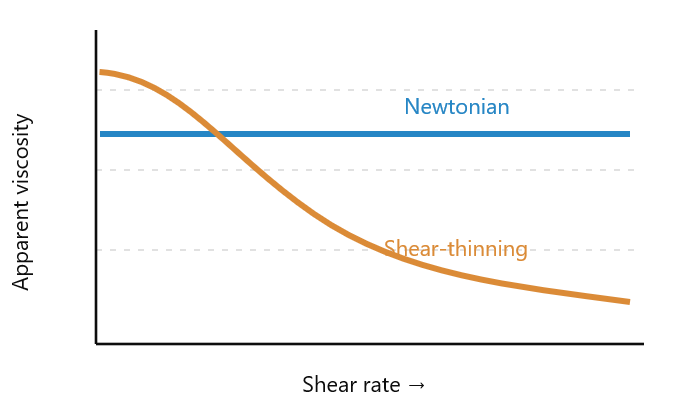
Consider ketchup. It sits stubbornly in the bottle until you shake or squeeze it. Suddenly, it flows. Stop applying force, and its structure can begin rebuilding. That is rheological behavior at work, including shear thinning and, in many formulations, time-dependent structural recovery. It’s also why simply measuring viscosity at one spindle speed doesn’t tell the whole story. A single viscosity measurement is a snapshot. Rheology is the movie. And anyone who’s watched a movie knows the plot matters.
Rheology: Where Physics Meets Mouthfeel
Rheology encompasses several behaviors that matter enormously in food formulation.
| Property | What it means | Why formulators care |
|---|---|---|
| Viscosity | Resistance to flow | Pourability, pumping, filling |
| Shear thinning | Viscosity decreases as shear increases | Sauces, dressings, drinkable products |
| Yield stress | Minimum stress required to initiate sustained flow | Suspensions, spreads, sauces |
| Elasticity | Ability to recover deformation | Dough structure, gels, chewiness |
| Viscoelasticity | Combination of viscous and elastic behavior | Gummies, bakery, dairy systems |
| Thixotropy | Time-dependent reduction in structure under shear, with recovery at rest | Processing and dispensing |
Why does this matter? Because consumers don’t experience a viscosity reading. They experience creaminess, body, slipperiness, coating, chewiness, and the way a product breaks down in their mouths.
A beverage can have a perfectly acceptable measured viscosity and still feel thin, sticky, slimy, or unpleasantly heavy. Likewise, two products with similar viscosity readings can deliver dramatically different sensory experiences. The difference often lies in their rheological behavior under the changing shear conditions of oral processing, together with lubrication, saliva interactions, particle characteristics, and flavor release. That’s where ingredient selection becomes fascinating. And where Icon Foods enters the picture.
Sweeteners: More Than Just Sweetness
Let’s start with a fundamental formulation truth. Sugar is not simply a sweetener. It’s a functional ingredient. Sucrose contributes soluble solids, bulk, water activity reduction, freezing point depression, crystallization behavior, and viscosity. Depending on the application, it also influences glass transition, browning, and structural development. Remove sugar and you’re not simply removing sweetness. You’re pulling a structural component out of the formulation and hoping the building doesn’t notice.
This is why replacing 15% sucrose with 150 ppm of a high-intensity sweetener may solve the sweetness problem while leaving the texture problem standing in the corner looking thoroughly unimpressed. Let’s examine the alternatives.
Allulose: The Functional Sugar Alternative
Allulose is particularly interesting because it can replace some of sucrose’s bulk and functionality while providing approximately 70% of its sweetness. As a low-molecular-weight monosaccharide, allulose contributes dissolved solids and can influence viscosity, water activity, freezing behavior, and crystallization. However, it is not a perfect one-for-one functional substitute.
At equivalent concentrations, allulose and sucrose solutions need not have identical viscosities, and their behavior changes with temperature and solids content.
In frozen desserts, allulose’s freezing point depression can improve softness and scoopability, but excessive inclusion can produce an overly soft product.
In syrups and sauces, allulose contributes body, although additional hydrocolloid or fiber structure may be required to reproduce the desired texture.
In bakery applications, its reducing-sugar chemistry promotes Maillard browning, often more rapidly than sucrose under comparable conditions. The formulation takeaway?
Allulose provides more than sweetness, but its functionality must be engineered around the specific application.
TagaLite™ Tagatose: Sweetness With Structural Substance
Tagatose deserves a seat at the grown-ups’ table. With approximately 90% of sucrose’s sweetness, depending on the system and evaluation conditions, tagatose offers substantial sweetness alongside the functional contributions of a bulk sugar. It can influence soluble solids, viscosity, crystallization, moisture relationships, and browning.
In bakery systems, tagatose can contribute to crust color and flavor development through Maillard reactions.
In confectionery, it offers opportunities for building sugar-reduced structures, although crystallization, moisture sensitivity, and glass transition behavior require careful evaluation.
Tagatose is not a hydrocolloid. It doesn’t create the entangled polymer networks associated with many gums and soluble fibers. Its influence on rheology primarily comes from its concentration, solution properties, interactions with water, and effects on the surrounding matrix. Different molecular tools. Different mechanisms. Same goal,make the product behave.
Erysweet™ Erythritol: Crystals, Cooling, and Structure
Erythritol is another valuable ingredient, particularly in confectionery, coatings, and bakery systems. But erythritol comes with a few personality traits. It crystallizes readily, has more limited water solubility than sucrose at typical processing temperatures, and produces a pronounced cooling sensation because of its endothermic heat of dissolution.
In a confectionery coating, erythritol particle size and crystal distribution can influence flow, texture, and perceived grittiness.
In aqueous systems, crystallization during storage can alter the product’s physical behavior and sensory quality. This is an important rheological consideration.
A coating might flow beautifully during processing and become unpleasantly gritty after temperature cycling. The initial viscosity reading wasn’t necessarily wrong. It simply wasn’t the entire story. Rheology doesn’t end when the product leaves the production line.
High-Intensity Sweeteners: Big Sweetness, Tiny Structural Footprint
Now let’s talk about stevia, monk fruit, and thaumatin. Icon Foods’ SteviaSweet™ portfolio, MonkSweet™ extracts, and Thaumatiq™ thaumatin systems can deliver substantial sweetness at extremely low use levels.
But from a rheological standpoint, their direct contribution is generally negligible at typical dosing concentrations. Consider a beverage formulated with 100 ppm of Reb M. That’s 0.01% by weight. You can achieve meaningful sweetness at that concentration, but you’re not going to build the body of a traditional sugar-sweetened beverage with it. The molecular math simply doesn’t support it. And this is where formulators sometimes make a costly mistake.
They replace sugar with a high-intensity sweetener, discover the product feels thin, and start increasing flavors to compensate. Flavor isn’t a substitute for structure. You can paint the house a beautiful color, but if the framing is missing, you’ve got a very attractive pile of lumber.
The smarter approach is to separate sweetness design from texture design. Use SteviaSweet™ Reb M, MonkSweet™ MV50, or carefully designed blends to establish the sweetness profile. Then use functional bulking agents and soluble fibers to build the physical characteristics that sugar previously supplied.
Thaumatiq™ thaumatin can also help modify sweetness perception and the temporal sensory profile, although it should not be confused with a rheological structurant at normal use levels. This gives formulators more independent control over sweetness, flavor perception, and texture. And that’s a powerful advantage.
Soluble Fibers: Where Rheology Gets Really Interesting
Now we’re talking about some of my favorite ingredients. Soluble fibers can do things that high-intensity sweeteners simply cannot.
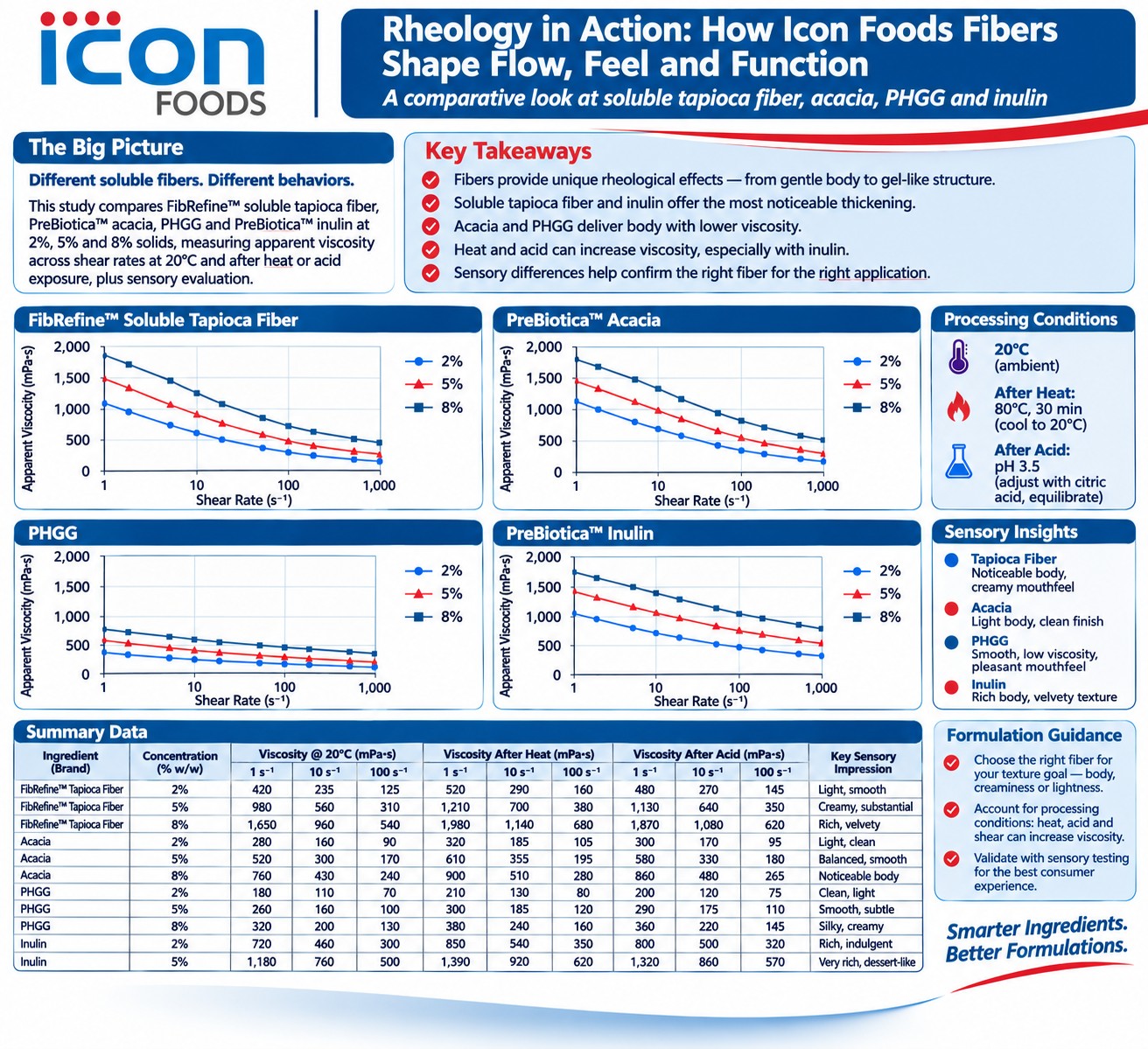
Depending on their molecular weight, chain architecture, concentration, hydration, and interactions with other ingredients, they can influence viscosity, flow behavior, water retention, and mouthfeel. But here’s the important catch. Not all soluble fibers behave alike. Some provide significant viscosity at relatively low concentrations. Others deliver substantial fiber content while contributing comparatively little viscosity. And that difference can be a tremendous advantage.
FibRefine™ Soluble Tapioca Fiber: Body Without Excessive Thickness
Icon Foods’ FibRefine™ soluble tapioca fiber portfolio provides opportunities to add dietary fiber and soluble solids without necessarily creating the heavy, gum-like viscosity associated with some hydrocolloids.
Depending on grade, molecular weight distribution, and concentration, soluble tapioca fiber can contribute to body and mouthfeel while maintaining relatively manageable processing viscosity. This is particularly useful in beverages.
Imagine developing a prebiotic soda. You want meaningful fiber delivery, a satisfying mouthfeel, and a clean drinking experience. You don’t want something that pours like pancake syrup. Soluble tapioca fiber can be a useful tool for delivering solids and improving body without making excessive viscosity the price of admission. However, fiber content, viscosity, acid stability, and gastrointestinal tolerance should be evaluated for the specific grade and dosage.
PreBiotica™ Acacia Fiber: A Quietly Effective Performer
Gum acacia is one of those ingredients that rarely gets the applause it deserves. It’s highly water soluble and can be used at meaningful concentrations while maintaining relatively low viscosity compared with many thickening gums. Its highly branched molecular structure contributes to this behavior. That makes acacia particularly attractive for beverages requiring fiber enrichment without dramatic thickening.
It can also provide emulsification and stabilization functionality in appropriate systems, depending on the acacia grade and its composition. The result? An ingredient that can help support fiber delivery and selected physical properties without turning a refreshing beverage into something requiring a spoon.
Partially Hydrolyzed Guar Gum: The Art of Controlled Viscosity
Conventional guar gum is a powerful thickener. Its high molecular weight and hydrated polymer chains produce substantial viscosity, even at relatively modest concentrations. Partially hydrolyzed guar gum, or PHGG, is a different creature. Through controlled enzymatic hydrolysis, the molecular weight of guar is reduced, dramatically lowering its viscosity-building potential. This allows formulators to incorporate meaningful amounts of soluble fiber while maintaining a relatively fluid product.
PHGG is especially interesting for beverages, nutritional products, and other applications where fiber delivery matters but excessive thickening is undesirable. It can contribute dissolved solids and subtle mouthfeel effects without behaving like conventional guar gum. But don’t mistake low viscosity for universal compatibility. PHGG still requires evaluation for solubility, pH, thermal processing, ingredient interactions, and long-term stability. The important lesson is that molecular weight matters enormously. Two ingredients can originate from the same botanical source and behave completely differently because their polymer chains have been modified. That’s not marketing. That’s polymer physics.
PreBiotica™ Inulin and FOS: Concentration Changes the Game
Inulin and fructooligosaccharides offer another interesting rheological contrast. Short-chain FOS generally contributes relatively little viscosity at typical beverage use levels. Longer-chain inulin, particularly at sufficiently high concentrations, can create particulate or gel-like structures that contribute creaminess and fat-mimetic mouthfeel. The distinction depends on degree of polymerization, solubility, concentration, temperature, and processing history.
This makes inulin especially useful in certain dairy alternatives, frozen desserts, and reduced-fat applications. However, long-chain inulin can also present solubility challenges and may recrystallize or form particles under certain conditions. And gastrointestinal tolerance deserves attention, especially when stacking multiple fermentable fibers. A product can be technically brilliant and still deliver an unfortunate gastrointestinal encore. Nobody ordered that sequel.
The Icon Foods Ingredient Rheology Playbook
Here’s how I think about these ingredients from a practical formulation standpoint.
| Ingredient system | Typical rheological contribution | Best formulation opportunities |
|---|---|---|
| Allulose | Soluble solids, bulk, modest concentration-dependent viscosity | Bakery, sauces, frozen desserts, syrups |
| TagaLite™ tagatose | Bulk, dissolved solids, crystallization and thermal functionality | Bakery, confectionery, fillings |
| Erysweet™ erythritol | Solids and crystalline structure; particle effects | Coatings, confectionery, dry mixes |
| SteviaSweet™ Reb M | Negligible direct viscosity at typical use levels | Sweetness design |
| MonkSweet™ MV50 | Negligible direct viscosity at typical use levels | Sweetness design |
| Thaumatiq™ thaumatin | Primarily sensory functionality at typical use levels | Sweetness and flavor-profile optimization |
| FibRefine™ soluble tapioca fiber | Soluble solids, body, generally modest viscosity depending on grade | Beverages, bars, syrups |
| PreBiotica™ acacia | Low-viscosity fiber delivery; selected stabilization functions | Beverages, emulsions |
| PHGG | Low viscosity relative to native guar | Nutritional beverages, fiber fortification |
| PreBiotica™ inulin | Chain-length-dependent thickening and possible gel formation | Dairy alternatives, frozen desserts |
| PreBiotica™ FOS | Relatively low viscosity at typical use levels | Beverages, nutritional formulations |
These are formulation tendencies, not universal performance specifications. Actual behavior depends on ingredient grade, concentration, temperature, pH, and the complete product matrix.
Application Spotlight: The Prebiotic Beverage Problem
Let’s put this into practice. Suppose we’re developing a reduced-sugar, prebiotic carbonated beverage. Our objectives are straightforward. We want a clean sweetness profile, meaningful fiber delivery, refreshing mouthfeel, acceptable carbonation performance, and stability throughout shelf life.
The temptation might be to choose a sweetener and add enough fiber to hit the nutritional target. But that approach overlooks the physical behavior of the finished beverage. A better strategy is to formulate the system in layers. A layered approach to beverage formulation
Layer 1: Sweetness architecture
SteviaSweet™ Reb M, MonkSweet™ MV50, or complementary blends establish sweetness intensity and temporal profile.
Layer 2: Solids and mouthfeel
FibRefine™ soluble tapioca fiber, acacia, or PHGG contribute soluble solids and help tune body without necessarily creating excessive viscosity.
Layer 3: System stability
Evaluate acidity, hydration, haze, sedimentation, carbonation behavior, and physical stability under real processing and storage conditions.
Layer 4: Sensory validation
Confirm that sweetness, body, flavor release, and finish work together in the finished beverage.
The objective isn’t simply to make the beverage thicker. It’s to create the right sensory and physical experience. Sometimes the best rheological decision is to avoid adding viscosity altogether.
Bakery: Where Rheology Becomes Structural Engineering
Beverages are relatively forgiving compared with baked goods. In bakery, rheology can determine whether a product rises, spreads, holds gas, develops the desired crumb, or collapses into a very expensive disappointment. Sugar contributes to batter and dough behavior through water competition, solids concentration, and interactions with proteins and starches. Replacing it changes the system.
Allulose and tagatose can restore some bulk and soluble-solids functionality, but they also change browning kinetics, moisture behavior, and thermal properties. FibRefine™ soluble tapioca fiber may help restore solids and influence moisture management. Inulin can contribute texture, although its functionality depends heavily on chain length and hydration.
Meanwhile, the gluten network, starch gelatinization, fat phase, leavening system, and processing conditions continue to control much of the finished structure. This is why bakery formulation should never be reduced to a sweetness-equivalency calculation.
A sweetener replacement that tastes perfect in water can behave very differently in cookie dough. And here’s a particularly important point. The same ingredient can improve one rheological property while making another worse. A formulation may achieve desirable batter viscosity but produce excessive spread during baking. Or it may improve moisture retention while compromising crispness. The goal is not to maximize viscosity. The goal is to optimize the complete rheological and structural profile for the intended product.
Measuring What Actually Matters
If we’re serious about understanding rheology, we need to move beyond a single Brookfield viscosity number. A Brookfield measurement can be useful for routine quality control, but it does not necessarily provide a complete flow curve or characterize elastic behavior.
For more sophisticated formulation work, I recommend considering the following measurements.
| Measurement | What it reveals | Practical application |
|---|---|---|
| Flow curve | Apparent viscosity across shear rates | Pumping, filling, pouring |
| Yield stress | Stress needed to initiate flow | Sauces, spreads, suspensions |
| Oscillatory testing | Storage modulus G′ and loss modulus G″ | Gels, doughs, structured foods |
| Thixotropic recovery | Breakdown and rebuilding of structure | Dressings, fillings, dispensing |
| Temperature sweep | Changes in material behavior with temperature | Processing, heating, cooling |
| Texture profile analysis | Mechanical texture characteristics | Gels, baked goods, confectionery |
A rotational rheometer can characterize flow and viscoelastic behavior under controlled conditions. But don’t forget that rheology and sensory perception are related, not interchangeable. A rheometer doesn’t have taste buds. It doesn’t experience flavor release, trigeminal sensations, or oral lubrication the way a consumer does. That’s why rheological measurements should be paired with sensory evaluation. The instrument tells us what the material does. The consumer tells us whether it matters.
A Practical Formulation Protocol
When replacing sugar or introducing soluble fibers, here’s the process I’d recommend. First, characterize the original product. Establish baseline viscosity at relevant shear rates, total solids, water activity, pH, texture, and sensory properties.
Second, separate sweetness from structure. Determine the sweetener system independently from the bulking and fiber system wherever practical.
Third, select fibers based on molecular functionality. Don’t assume that equal fiber concentrations produce equal viscosity, hydration, or mouthfeel.
Fourth, test under realistic processing conditions. Include temperature, shear, hydration time, acidification, and relevant thermal treatment.
Fifth, evaluate storage stability. Look for crystallization, phase separation, sedimentation, viscosity drift, and changes in texture.
Finally, validate with sensory testing. Because a beautiful rheology curve is not particularly useful if the finished product tastes like disappointment.
For a meaningful comparison, control temperature, solids content, measurement geometry, shear history, and hydration time. Report viscosity with the shear rate and temperature whenever possible. Without those details, comparing two viscosity values can be about as useful as comparing two baseball batting averages without knowing which season they came from.
The Future of Sugar Reduction Is About More Than Sweetness
For years, sugar reduction focused primarily on replacing sweetness. Find a sweetener that tastes like sugar. Reduce calories. Clean up the label. Mission accomplished. Except the mission wasn’t accomplished. Because sugar does much more than taste sweet. It affects water, structure, flow, crystallization, freezing, and the entire sensory experience. And that’s why the next generation of formulation needs a more integrated approach. We need to think about sweetness kinetics, rheology, water management, thermal behavior, and sensory performance as interconnected systems.
At Icon Foods, our portfolio of rare sugars, high-intensity sweeteners, sweet proteins, and soluble fibers gives formulators multiple tools for addressing those challenges.
SteviaSweet™ and MonkSweet™ can help design sweetness.
TagaLite™ tagatose and allulose can restore selected bulk-sugar functions.
FibRefine™ and PreBiotica™ fibers can help manage solids, mouthfeel, and, depending on the ingredient, viscosity and structure.
Thaumatiq™ can help refine sweetness perception and the sensory finish.
No single ingredient does everything. And frankly, that’s a good thing. It allows us to build more precise formulations rather than asking one ingredient to perform six different jobs and then acting surprised when it files a complaint.
The Bottom Line: Don’t Just Formulate for Thickness. Formulate for Behavior.
Viscosity tells us how strongly a fluid resists flow. Rheology tells us how a food or beverage behaves under the forces it experiences during manufacturing, storage, dispensing, and consumption. Understanding that distinction changes the way we formulate. It helps us choose ingredients more intelligently, avoid unnecessary processing problems, improve sensory performance, and create better sugar-reduced products. The real opportunity isn’t simply replacing sugar. It’s designing food systems that perform better because we understand the molecular interactions behind them. And that’s where food science gets super duper fun.
Related reading: Soluble Fibers Under Fire, Beyond the Fiber Claim and The Sweet Science of Getting Golden, Delicious, and Seriously Reducing Sugar.